Chapter 5
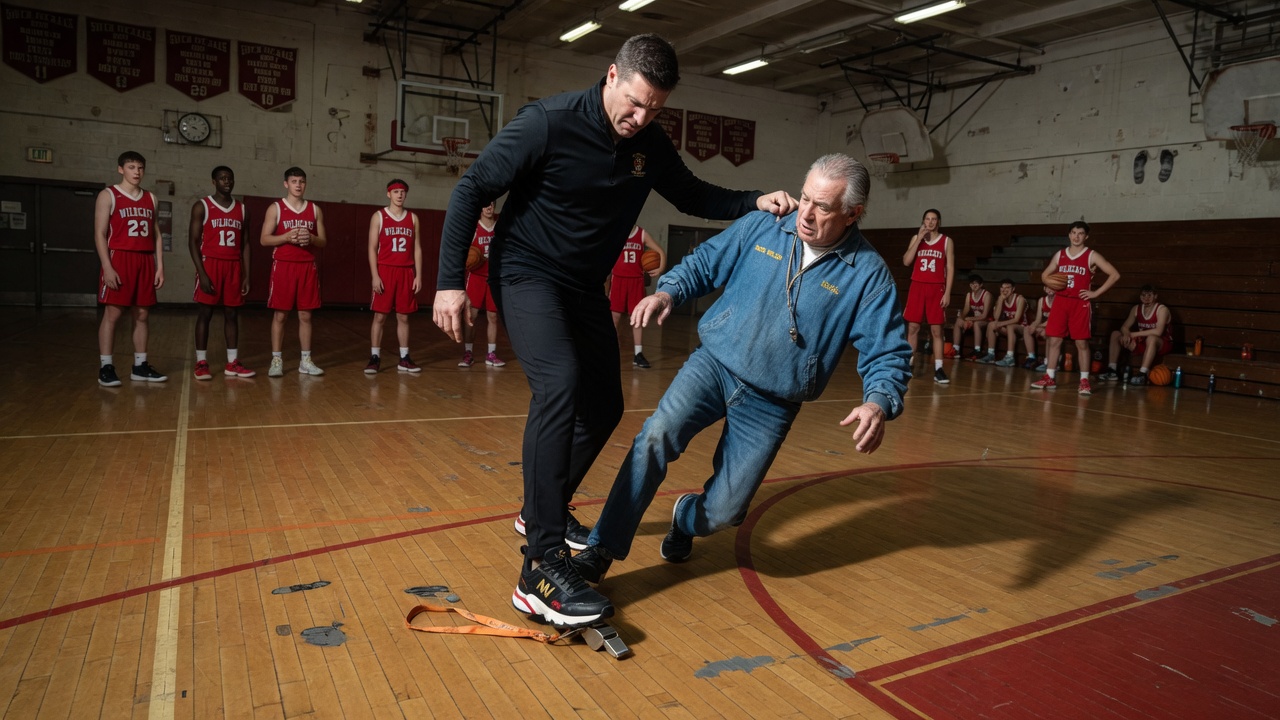
The sound of Marcus Vane hitting the floor stayed in the rafters long after the physical noise had faded. It was the sound of a certain kind of order collapsing. Buck stood in the center circle, his lungs working with a mechanical, heavy precision. He felt the silver whistle in his pocket, a cold, hard lump against his thigh. He didn’t look at the parents. He didn’t look at Gary, who was standing near the bench with his mouth open, looking like a man who had just seen his career go up in a cloud of dust.
He looked at Javi. The boy was white-faced, his eyes darting between the gasping man on the floor and the coach who had just broken the world. Javi didn’t look inspired; he looked terrified. That was the residue Buck hadn’t accounted for—the realization that for these kids, violence wasn’t a heroic reversal. It was a weather pattern they spent their lives trying to outrun.
“Coach?” Leo’s voice was the first to break the vacuum. He had stepped forward, leaving the loose semicircle of players. He looked at Vane, then at Buck. There was a grim kind of recognition in the boy’s face, a shadow of the temper Buck knew Leo’s father struggled to keep under lock and key.
“Leo, take the boys to the locker room,” Buck said. His voice was steady, but it sounded like it was coming from a long way off. “Javi, go with them. Now.”
“He’s not going anywhere!” Henderson screamed. The developer had finally found his voice, and it was shrill with a mixture of outrage and the sudden, frantic need to be the hero of the aftermath. He scrambled onto the court, his expensive loafers clicking frantically. “You saw that! You all saw that! That’s assault! That’s a felony!”
Vane was finally getting air back into his lungs, a series of wet, hitching gasps. He rolled onto his side, clutching his chest where Buck’s palm had landed. He looked up at Buck, and for a second, the mask of the tech-bro administrator was gone. There was only raw, unadulterated hatred, the kind that survives long after the physical pain fades.
“You’re dead, Miller,” Vane wheezed, a thin line of saliva trailing from his lip. “I’ll take everything. Your house, your name… everything.”
The gym doors groaned open again. Sheriff Grady walked in, his tan uniform a sharp contrast to the chaotic colors of the gym. He didn’t rush. He moved with the slow, deliberate pace of a man who had seen enough scenes like this to know that the energy was already spent. Behind him, two deputies stood by the doors, their thumbs hooked into their belts.
Grady looked at Vane on the floor. He looked at the box of office supplies scattered near the logo. Finally, he looked at Buck. There was no judgment in the Sheriff’s eyes, only a deep, weary sadness.
“Buck,” Grady said.
“Grady.”
“Anyone want to tell me what happened, or should I just look at the forty phones currently pointed at the center of the court?” Grady asked, his gaze sweeping over the parents.
“He attacked him!” Mrs. Sterling cried out, pointing a manicured finger at Buck. “Coach Miller just… he snapped. He attacked Marcus for no reason. It was unprovoked.”
Grady didn’t look at her. He walked over to where the silver whistle lay near Buck’s foot. He picked it up, turned it over in his hand, and saw the deep, jagged indentation from Vane’s sneaker. He looked at Vane.
“Marcus, you want to press charges?” Grady asked.
“Damn right I do,” Vane spat, his voice getting stronger. He let Henderson help him to his feet, though he winced as he straightened his back. “I want him in cuffs. Right now. In front of his precious team.”
Grady sighed. He walked over to Buck. “Turn around, Coach.”
“Dad, no!” Leo shouted from the edge of the court.
“Leo, locker room. Now,” Grady snapped, the father-voice overriding the Sheriff-voice for a split second. He turned back to Buck, his voice dropping to a low murmur. “I’m sorry, Buck. But there’s too many witnesses. I can’t walk you out the back.”
Buck nodded. He felt the cold steel of the handcuffs click around his wrists. The metal was biting, a physical reminder that the “safe” world he had built for himself was gone. As Grady led him toward the doors, the gym erupted. Parents were shouting, some in anger, some in a strange, hushed excitement. But the players—the boys in the red jerseys—remained silent. They watched their coach go, their faces unreadable, a line of young men caught between the man they knew and the act they had just witnessed.
The ride to the station was quiet. The cruiser smelled of stale coffee and the pine-scented air freshener hanging from the rearview mirror. Grady didn’t say anything until they were two blocks away from the school.
“He stepped on Danny’s whistle, didn’t he?” Grady asked, his eyes on the road.
“He didn’t just step on it, Grady. He ground it into the wood. Like it was a cigarette butt.”
Grady tightened his grip on the wheel. “I know. I saw the mark on the floor. Look, Vane’s already calling the district lawyers. They’re going to go for the throat, Buck. They’ll use the Parkinson’s. They’ll say you’re a liability, that you have ‘diminished capacity’ and ‘uncontrollable outbursts.’ They’ll make you out to be a monster so they don’t have to admit they fired a legend for paying a kid’s tuition.”
“Let them,” Buck said. He looked out the window at the familiar streets of Oakhaven. The town looked the same, but it felt smaller. “I’m tired of hiding the hand, Grady. I’m tired of being afraid of the end.”
“Well, the end is here,” Grady said. “And it’s going to be loud.”
After the processing, which was done with a somber, apologetic efficiency by the deputies Buck had known since they were in Little League, he was allowed one phone call. He didn’t call a lawyer. He called his daughter, Elena.
She was at the station in twenty minutes. Elena was a nurse at the county hospital, a woman who carried her father’s stoicism like a shield. She didn’t cry. She didn’t yell. She sat across from him in the sterile interview room, her scrub-clad shoulders tight.
“You’re sixty-eight years old, Dad,” she said, her voice trembling slightly despite her efforts. “You have a progressive neurological disorder. And you just beat up the Athletic Director in a room full of people.”
“I didn’t beat him up, El. I defended myself.”
“The video is already on Facebook, Dad. Henderson’s wife posted it ten minutes ago. It has three thousand shares. The comments… they’re calling you a thug. They’re saying you’ve finally lost it.” She leaned forward, her eyes searched his. “Why didn’t you just walk away? We talked about this. You could have just retired. We could have fought the tuition thing quietly.”
“It wasn’t about the tuition. It was about the whistle. It was about the fact that they think they can own everything—the gym, the kids, even the memories.” Buck looked down at his hands, which were resting on the metal table. The left one was shaking again, a frantic, rhythmic tapping. He didn’t try to hide it. “If I walked away, Javi would be on the street by Monday. Leo would have Gary as a coach, and Gary would teach him that the only thing that matters is the scoreboard. I couldn’t let that be the last thing I did.”
“And now?” Elena asked. “The board is meeting tonight in an emergency session. Vane is demanding your immediate termination for cause. They’re going to strip your pension, Dad. Everything you worked forty years for… it’s gone.”
“They can have the money,” Buck said. “They can’t have the forty years. That’s already in the boys.”
Elena looked at him for a long time. She saw the tremor, the age in his face, but she also saw something else—a clarity that had been missing for years. The “safe” Coach Miller was gone, replaced by the man who had nothing left to lose.
“The Sheriff is going to release you on your own recognizance,” she said, standing up. “But you can’t go near the school. There’s a restraining order being filed as we speak.”
“I don’t need to go to the school,” Buck said. “The gym isn’t the building. It’s the people in it.”
That night, Buck sat in his darkened living room, the only light coming from the streetlamp outside. The house felt too big, the silence too heavy. He kept expecting to hear Danny’s footsteps on the stairs, or the sound of his wife humming in the kitchen. But there was only the hum of the refrigerator and the distant sound of a siren.
There was a knock at the door. It wasn’t the tentative knock of a neighbor or the sharp rap of a reporter. It was heavy, rhythmic.
Buck opened the door to find Leo standing on the porch. Beside him was Javi, looking small and uncertain, and behind them, three other players from the varsity team. They weren’t wearing their jerseys. They were in hoodies and jeans, their faces somber.
“Coach,” Leo said.
“You shouldn’t be here, Leo. The board… if they find out you’re here, they’ll bench you for the season.”
“They already benched us,” Javi said, his voice cracking. “Vane called our parents. He said the ‘at-risk’ kids are suspended indefinitely pending a ‘re-evaluation of program standards.’ He told my mom I wasn’t allowed back on school grounds until the hearing.”
Buck felt a cold, sharp anger twist in his gut. Vane wasn’t just going after him; he was purging the team, making good on his threat to turn the program into a scout’s paradise.
“We aren’t here to talk about the season,” Leo said. He stepped inside, the others following him without being asked. They sat in the small living room, the space suddenly crowded with the energy of young men. “My dad told me what happened with the whistle. I told the guys.”
“It’s just a piece of metal, boys,” Buck said, though he knew it was a lie.
“No, it’s not,” Javi said. He reached into his pocket and pulled out a small, crumpled envelope. “We took a collection. It’s not much, but… we wanted to help with the lawyer. Or the tuition. Whatever you need.”
Buck looked at the envelope. He could see the jagged scrawl of names on the front. These were kids who counted their change for lunch, who wore the same shoes until the soles flapped.
“Keep your money, Javi. You’re going to need it.”
“We don’t need the money, Coach,” Leo said, his voice hard. “We need you. The board thinks they can just delete forty years because some guy in a quarter-zip got his feelings hurt. But they forgot one thing.”
“What’s that?” Buck asked.
“They forgot who you coached before us,” Leo said.
He pulled out his phone and showed Buck a screen. It was a private Facebook group, created less than two hours ago. The title was The Final Whistle. It already had six hundred members. Buck scrolled through the names. He saw the Sheriff. He saw the local mechanic. He saw the high school principal from ten years ago. He saw the man who ran the grocery store, the woman who worked the town’s only law firm, and the doctor who had treated Danny after the accident.
They were all there. Forty years of alumni, of “boys” who were now men with their own lives, their own power. And they were all saying the same thing.
He didn’t just teach us ball. He kept us alive.
“The hearing is Thursday night,” Leo said. “Vane thinks it’s going to be a quiet execution in a sterile room. He wants to show the video and sign the papers.”
“He’s wrong,” Javi said, a small, fierce smile touching his lips. “He’s never seen a fourth quarter in Oakhaven. Not really.”
Buck looked at the boys, and for the first time since the whistle had shattered, the tremor in his hand stopped. He wasn’t a ghost. He wasn’t a relic. He was the center of a web that stretched across the entire valley, and Marcus Vane had just stepped into the middle of it.
“All right,” Buck said, his voice gravelly but certain. “If we’re going to do this, we do it the right way. No more fighting. No more anger. We show them what a team looks like.”
As the boys left, Buck sat back down in the dark. He looked at the shattered whistle on the coffee table. It was broken beyond repair, but as he held it, he realized it didn’t matter. The sound was already out there, echoing in the hearts of the men he had made. The final whistle hadn’t blown yet. It was just the end of the third.
And the fourth quarter belonged to the Coach.
Chapter 6
The night of the hearing, the Oakhaven District Office looked more like a fortress than a school building. Two police cruisers were parked out front, their light bars dark but their presence unmistakable. Marcus Vane had requested “heightened security,” citing concerns for his personal safety after the “violent incident” in the gym.
Inside the boardroom, the air was clinical and cold. Vane sat at the front, wearing a soft cervical collar that looked suspiciously new. He had a lawyer on one side and Mrs. Sterling on the other. He didn’t look like a tech-bro anymore; he looked like a professional victim, his eyes downcast, his movements slow and exaggerated.
The board members were all present, their faces set in the grim, practiced neutrality of people who had already made up their minds. They had the video. They had the bursar’s report. They had the “assault” charges. On paper, it was the easiest decision they would ever make.
Buck sat at the small table reserved for the respondent. He was alone. Elena had wanted to come, but he had asked her to stay in the hallway. He wanted to do this as the man he was, not as a father or a patient. He wore his best suit—an old, charcoal-gray wool that smelled faintly of mothballs—and his white shirt was starched so stiff it scratched his neck. His left hand was under the table, gripped tight around his right wrist.
“This meeting of the Oakhaven School Board is now in session,” the Board President said, a man named Henderson who was currently leaning into his role as the arbiter of justice. “The matter before us is the immediate termination for cause of head basketball coach Buck Miller. Marcus, you have the floor.”
Vane didn’t stand. He spoke in a low, pained voice. “I don’t want to be here. I took this job because I love Oakhaven. I wanted to bring this program into the future. But what happened last Tuesday… it wasn’t just a disagreement. It was a breakdown of the very standards we expect from our educators. Coach Miller attacked me. He used professional-grade combat techniques on a colleague in front of students. He showed a complete lack of control, a total disregard for the safety of the environment.”
He paused, letting a small, shaky breath escape. “And then there’s the financial matter. The personal payments to students to bypass eligibility. It’s a pattern of deception, of a man who believes he is above the rules because of his tenure. I’m asking the board to terminate his contract immediately and strip his pension to offset the legal and medical costs he has incurred upon the district.”
The Board President nodded. “Coach Miller? Do you have a statement?”
Buck stood up. He didn’t look at Vane. He looked at the board members. He saw the way they avoided his eyes, the way they looked at their tablets.
“I’m not here to deny what I did,” Buck said. “I hit Mr. Vane. I hit him because he was degrading a memory and a person. I hit him because I’ve spent forty years teaching boys that there are things worth protecting, and in that moment, I realized I had to lead by example.”
“So you admit to the assault?” Henderson snapped.
“I admit to defending the soul of my program,” Buck said. “As for the tuition… yes, I paid it. I paid it because the ‘metrics’ you’re so fond of don’t account for hunger. They don’t account for a kid whose father is in jail and whose mother is working three shifts at the mill. I didn’t bypass standards; I gave those boys the stability they needed to meet them. Javi’s GPA went from a 1.2 to a 2.8 in six months. That’s not a ‘conflict of interest.’ That’s coaching.”
“It’s a violation of the code, Buck,” Mrs. Sterling said, her voice dripping with artificial regret. “And the violence… it just proves what Marcus was saying. You’re not fit for the physical or emotional demands of the job. Your health—”
“My health is my business,” Buck interrupted, his voice rising for the first time. “But since you’re so concerned, let’s talk about it. I have Parkinson’s. I’ve had it for three years. And in those three years, I haven’t missed a practice. I haven’t missed a game. My ‘stability’ isn’t about my hand. it’s about my heart. And my heart is still in that gym.”
“The video speaks for itself,” Vane said, his voice regaining its edge. “The board has the evidence. We don’t need a melodrama.”
The Board President reached for his gavel. “I think we’ve heard enough. If there are no further comments—”
“There are further comments.”
The voice came from the back of the room. Sheriff Grady stood in the doorway, his hat in his hand. He wasn’t alone. He stepped aside, and the heavy doors swung open wide.
One by one, they filed in.
They weren’t wearing suits. They were wearing flannel shirts, mechanic’s overalls, hospital scrubs, and police uniforms. There was the man who ran the pharmacy. There was the high school’s first All-State point guard from 1982, his hair now white but his shoulders still broad. There was the lawyer who had handled Buck’s wife’s estate, and the man who fixed the town’s water mains.
There were forty of them. They didn’t shout. They didn’t protest. They simply walked into the room and stood along the walls, a silent, living wall of history.
“What is the meaning of this?” Henderson demanded, his face reddening. “This is a closed hearing!”
“Actually,” the lawyer from the back said, “the district bylaws state that any hearing regarding the termination of a contract for a tenured employee must be open to the public if the employee requests it. And Coach Miller requested it twenty minutes ago.”
Grady walked to the front of the room. He didn’t look at the board; he looked at the alumni.
“I’m not here as the Sheriff,” Grady said. “I’m here as a player. Class of ’94. I was the kid Coach Miller wouldn’t let play because I’d gotten into a fight at the arcade. He sat me for the championship game. I hated him for it. I thought he was a relic. But ten years later, when I was sitting in a patrol car and a guy pulled a knife on me, I didn’t think about my shooting percentage. I thought about the man who told me that my temper was my cage, and that the only way out was discipline. I’m the Sheriff today because Buck Miller wouldn’t let me be a winner until I was a man.”
The room was silent. One by one, the others began to speak.
“He paid for my shoes in ’88,” the mechanic said. “I didn’t know it until ten years later. He told me the school had a ‘grant.’ There was no grant. It was him.”
“He sat with me in the hospital for three days after my son died,” the doctor said. “He didn’t say a word. He just sat there. Because he knew. He’s the only person in this town who really knew.”
The board members looked at the crowd. They weren’t looking at a ‘has-been’ anymore. They were looking at the men who built the town, the men whose votes and taxes and loyalty kept the district running.
Vane was squirming in his seat, the cervical collar looking more and more like a noose. He looked at Henderson, but the Board President was looking at the ground.
Finally, Javi and Leo walked to the front. They were holding something—a large, framed photograph. It was a picture of the 1996 team, the year Buck’s son would have been a senior. Danny was in the center, his arm around a young, grinning Grady.
“We found this in the equipment room,” Leo said. “Vane threw it in the trash. He said it was ‘clutter.’”
Leo turned the frame around. Taped to the back was a single, hand-written note from Danny to his father. “Keep them safe, Dad. They’re the only team we’ve got.”
Buck felt a lump in his throat that threatened to choke him. He looked at the boys, at the men, at the history he had spent forty years building.
The Board President looked at Vane, then at Mrs. Sterling. He saw the writing on the wall. This wasn’t a termination hearing anymore; it was a political suicide. If they fired Buck Miller now, they wouldn’t just be losing a coach; they’d be losing the town.
“We’ll take a ten-minute recess,” Henderson said, his voice barely a whisper.
The “ten minutes” turned into an hour. When they returned, the atmosphere had shifted. Vane was no longer at the front table; he was sitting in the back row, his lawyer whispering frantically in his ear. Mrs. Sterling looked like she wanted to be anywhere else.
“The board has reached a decision,” Henderson said. “In light of the… extensive testimony regarding Coach Miller’s contributions to the community, we are prepared to offer a settlement. The termination for cause is withdrawn. Coach Miller will be allowed to finish the season and retire at the end of the year with his full pension intact. The tuition payments will be reclassified as a private scholarship fund, which the district will match through a new community-led initiative.”
The room erupted. It wasn’t a cheer; it was a roar, a deep, resonant sound of victory that shook the glass partitions. Buck felt Elena’s arms around his neck, and for the first time, he let his hand shake. He let the tremor come, and he didn’t care.
But as the crowd began to thin, and the alumni came forward to shake his hand, Buck felt a hand on his shoulder. It was Gary, the assistant coach. He looked pale, but there was a flicker of something new in his eyes—not hunger, but shame.
“Coach,” Gary said. “I… I’m sorry. I should have spoken up. I was afraid.”
Buck looked at the younger man. He saw the version of himself from forty years ago—the man who wanted to be liked, who wanted the title, who thought the game was about the rules.
“Fear is a bad coach, Gary,” Buck said. “But it’s a good teacher. You’ve got three months to learn the difference. After that, the whistle is yours. Don’t waste it.”
Three months later, the final game of the season was held in the Oakhaven gym. It wasn’t the state championship—they had lost in the semifinals—but the gym was packed to the rafters. Every seat was taken, and people were standing three-deep along the walls.
Marcus Vane was gone, having “resigned for personal reasons” weeks earlier. Henderson and Mrs. Sterling were still on the board, but they sat in the back, quiet and watchful.
The game was over. Oakhaven had won by two points on a last-second layup by Javi. The players were celebrating on the court, but the crowd wasn’t looking at the scoreboard. They were looking at the man in the blue coaching jacket.
Buck walked to the center circle. He looked at the rafters, at the banners, at the logo he had defended with his own two hands. He felt the tremor in his leg, the heaviness in his limbs, but he also felt a deep, abiding peace. He had finished the game. He hadn’t just coached them to a win; he had coached them to a life.
Leo walked over and handed him a small box. Buck opened it. Inside was a silver whistle. It wasn’t Danny’s—that one was still in his pocket, flattened and silent—but it was new, polished to a mirror finish. On the side, engraved in tiny letters, were the words: The Soul of the Valley.
Buck put the whistle to his lips. He looked at the boys, at the men they were becoming, and at the ghosts that finally felt at rest.
He blew the whistle.
The sound was sharp, clear, and final. It cut through the cheering, through the years of grief, through the fear of being forgotten. It was the sound of a legacy, and it echoed in the gym long after Buck Miller turned and walked toward the locker room for the very last time.
He didn’t look back. He didn’t have to. The team was safe. The boys were men. And the whistle was in good hands.