Chapter 5
The walk home felt longer than the bus ride ever had. Malik didn’t look at his phone, but he could feel it vibrating in his pocket—a frantic, rhythmic buzzing that signaled the death of his anonymity. Every car that passed him on the shoulder of the county road seemed to slow down just a fraction of a second more than usual. He didn’t look up. He kept his eyes on the white line of the asphalt, his right hand still throbbing inside the white wraps. He could feel the phantom heat of the impact where his palm had met Brock’s chest. It was a familiar, sickening sensation—the feeling of a man’s structure failing under his weight.
He had broken his promise. Not because he had been afraid, but because he hadn’t been afraid enough.
When he reached the small, sagging porch of their apartment, he saw the white envelope tucked into the doorframe. He didn’t need to open it to know what it was. The property was owned by Sterling Management, a subsidiary of the same construction empire that had built half of Oakhaven and put the Sterling name on the high school’s wrestling pavilion.
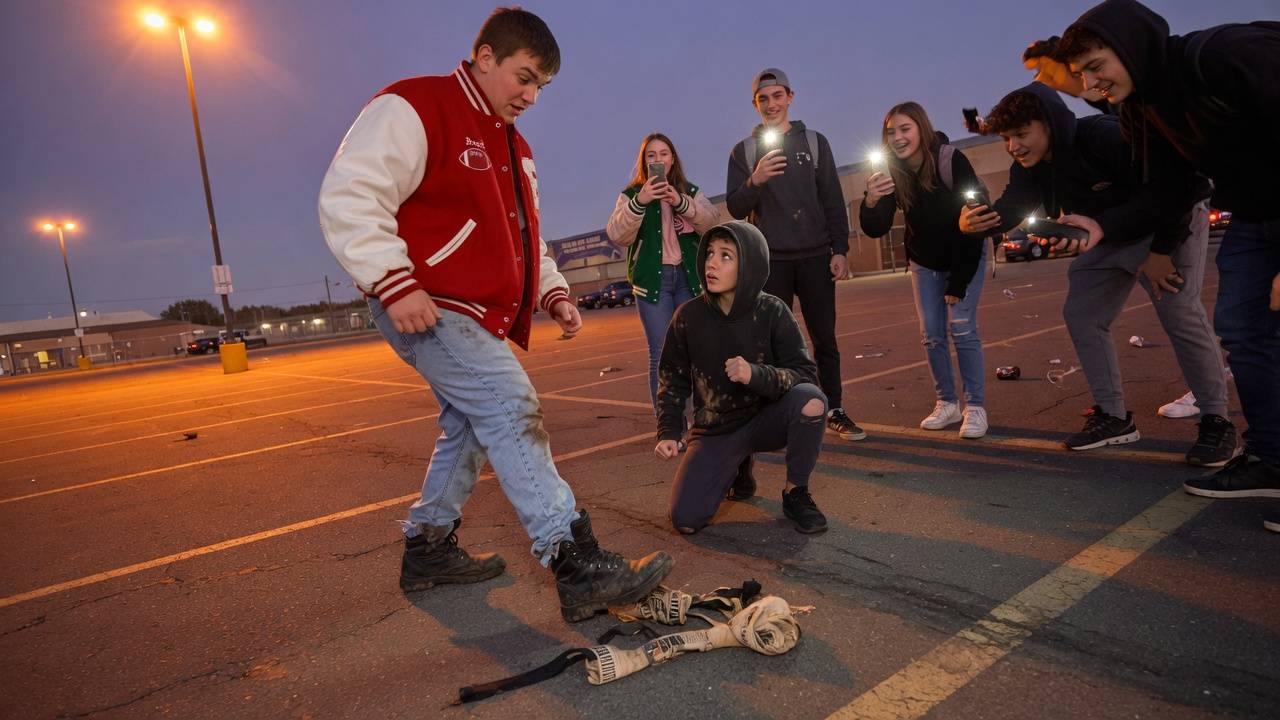
He went inside. The apartment was quiet, the only sound the hum of the refrigerator and the distant whistle of the wind through the poorly sealed windows. He sat at the small kitchen table and unwrapped his hands. The fabric was stained with dirt and a few drops of grease from the parking lot. He folded the wraps carefully, smoothing out the wrinkles, as if by fixing the cloth he could undo the afternoon.
The door opened twenty minutes later. His mother didn’t say anything. She didn’t drop her keys or scream. She just walked into the kitchen and stood there, still wearing her Blue Bonnet Diner uniform, the smell of fried onions and coffee clinging to her hair. She looked at the wraps on the table, then at Malik.
“It’s on the internet, Malik,” she said. Her voice was terrifyingly calm. “Mr. Henderson showed me on his phone during his break. He thought I’d be proud.”
“Ma, he was—”
“I know what he was,” she snapped, her composure fracturing. “I saw him at the diner. I saw him at the school. I knew he was a bully. But I also knew who you were. I thought you knew, too.”
“He was going to go to the diner, Ma. He was talking about coming after you. He stepped on the wraps. He wouldn’t stop.”
Elena Moore sat down across from him, her shoulders slumped. She looked at the white envelope he’d placed on the table. “I saw the notice on the door. We have seventy-two hours. Mr. Sterling called the owner of the diner, too. He didn’t fire me, but he told me it might be better if I ‘took some time off’ until the dust settles. Which is a nice way of saying I don’t have a job as long as your face is on every screen in this town.”
Malik felt a surge of the old, dark heat in his chest—the Ground and Pound instinct that told him to find the source of the pressure and neutralize it. But there was no sternum to strike here. There was no leg to sweep. This was a different kind of violence, the kind that happened in offices and over phone lines.
“I’ll fix it,” Malik said.
“How? You going to fight the sheriff? You going to fight the school board?” She reached across the table and grabbed his hand, her grip surprisingly strong. “This is why your father left, Malik. Not because he was a coward. But because he realized that the more he fought, the more he lost. He thought if he disappeared, the target on our backs would go with him.”
“Is he dead, Ma?”
The question had been sitting in the back of Malik’s throat for years. Elena looked away, her eyes fixing on a water stain on the wall. “I don’t know. The last time I saw him, he told me he was going to end it. Not the life, but the fight. He said the only way to win was to make sure no one ever wanted to step into the ring with him again.”
The next morning, the school was a gauntlet. Malik walked through the front doors and the world went silent. It wasn’t the silence of respect; it was the silence of a crowd waiting for a car crash. The “lapdog” had turned out to be a wolf, and the town didn’t know whether to shoot him or throw him a bone.
He was intercepted before he reached his locker by two deputies and the principal, Mr. Vargas. They didn’t use handcuffs, but they walked him to the office with a grim formality that felt like a funeral procession.
Inside the office, the air was thick with the scent of expensive cigars and cold fury. Brock’s father, Richard Sterling, was sitting in one of the leather chairs. He was a man who looked like he’d been carved out of a block of Texas limestone—weathered, grey, and immovable. Brock was sitting next to him, a large bandage visible under his shirt where the push-kick had landed. He wouldn’t look at Malik. His eyes were fixed on his own knees.
“Mr. Moore,” Principal Vargas said, looking at a folder on his desk. “We’ve reviewed the footage. Several versions of it, in fact.”
“Then you saw he hit me first,” Malik said.
“I saw a student being harassed,” Vargas conceded, “and then I saw a professional-grade assault. We have a zero-tolerance policy, Malik. But more importantly, we have a liability issue. The techniques you used… they aren’t ‘self-defense’ taught in any high school gym. Those are lethal-force maneuvers.”
“He’s a thug,” Richard Sterling said, his voice a low, gravelly vibration. “My son is a State-ranked athlete. He has a scholarship to UT on the line. And this… this transplant comes in here and tries to ruin a boy’s future because he’s got a chip on his shoulder about his ‘dignity’.”
“Your son shoved him and stepped on his property,” Maya’s voice came from the doorway. She was standing there with her camera, her jaw set. “I have the unedited footage, Mr. Vargas. I have the audio of Brock threatening Malik’s mother. That’s harassment. That’s a hate crime in some jurisdictions.”
“Get out of here, girl,” Sterling growled.
“I’m the editor of the school paper, Mr. Sterling. And I’ve already sent the raw files to the Dallas Morning News. If you want to talk about ‘ruined futures,’ let’s talk about yours when the world sees how Oakhaven handles a bully whose dad owns the town.”
Sterling stood up, his face flushing a deep, dangerous purple. “You think you’re smart? You think you know how this world works? I can have your father’s dealership audited by noon. I can have this school’s funding questioned before the next board meeting.”
The room went cold. It was the naked display of power that Malik had been running from his whole life. It was the reason “Iron” Mike had stayed in the shadows.
“Malik Moore is expelled,” Vargas said, his voice trembling slightly. “Effective immediately. The police are considering charges of aggravated assault.”
Malik looked at Brock. He expected to see triumph. Instead, he saw something else. Brock looked sick. He looked like a kid who had realized that the pedestal he stood on was made of glass, and it was currently shattering.
Malik stood up. He didn’t look at Sterling. He didn’t look at Vargas. He looked at Maya. “Don’t send the video,” he said.
“What? Malik, they’re destroying you!”
“I know,” Malik said. “But I’m not going to be the reason another family loses everything. I’m not my father.”
He walked out of the office, the weight of the expulsion feeling like a physical burden. He walked past the trophies, past the banners, and out into the blinding Texas sun. He didn’t go home. He went to the Blue Bonnet Diner.
He found his mother sitting in the back booth, her head in her hands. She wasn’t crying; she was just… empty.
“They expelled me, Ma,” he said, sitting across from her.
“I know,” she said. “The school called. The sheriff’s department called, too. They want you to come in for questioning.”
“We’re leaving, aren’t we?”
“We don’t have anywhere to go, Malik. We spent everything we had to get here. The car needs a new transmission. My last paycheck is being withheld for ‘damages’ to the diner’s reputation.”
The door to the diner jingled. Malik didn’t look up. He assumed it was more of Brock’s friends, or perhaps the deputies coming to take him in.
But the footsteps were different. They were heavy, measured, and carried a rhythmic scrape that Malik recognized in his marrow. The air in the diner seemed to change, the molecules vibrating with a sudden, intense pressure.
A man sat down in the booth next to them. He didn’t look like a legend. He looked like a construction worker who had spent too much time in the sun. He was wearing a faded grey t-shirt and work pants, his hands scarred and thick with calluses. His face was a map of old wars—a slight tilt to the nose, a scar above the left eye, and a jaw that looked like it could take a sledgehammer and ask for more.
“Iron” Mike Moore didn’t look at Malik. He looked at Elena.
“You look tired, El,” he said. His voice was like grinding stones.
Elena didn’t scream. She didn’t faint. She just closed her eyes and took a long, shaky breath. “You’re late, Mike.”
“I had to make sure the trail was cold,” he said. He finally turned his head and looked at Malik. His eyes were the same shade of grey as the sky before a tornado. “You got a decent lead leg, kid. But your hip rotation on that strike was sloppy. You left yourself open for a counter-takedown.”
Malik stared at him. “You were there?”
“I’ve been in Oakhaven for two weeks,” Mike said. “I’ve been watching you take it. I wanted to see if you had the stomach for the silence. Most men don’t. They want the roar of the crowd. They want the ‘win’.”
“I lost everything,” Malik said. “Ma lost her job. We’re being evicted. I’m being charged.”
Mike Moore stood up. He reached into his pocket and pulled out a small, digital recorder. He set it on the table. “You didn’t lose anything you can’t get back with the right word. Fists are for people who don’t know how to speak. I spent twenty years ending fights with my hands, and all it got me was a life where I couldn’t look my son in the eye.”
He looked at the door. “Sterling is on his way. He saw my truck outside. He knows who I am.”
“What are you going to do?” Malik asked, his heart hammering against his ribs.
Mike Moore looked at his scarred knuckles, then at Malik. “I’m going to teach you the final lesson of the Moore family. It’s not how to hit. It’s how to end a fight so completely that it never happens again.”
Chapter 6
Richard Sterling didn’t enter the Blue Bonnet Diner; he invaded it. He came through the door with two of his foremen behind him, men who looked like they were used to enforcing his will on job sites. He saw Mike Moore sitting in the booth, and for the first time, Malik saw the limestone mask of the billionaire crack.
“Moore,” Sterling said, stopping five feet from the table. “I thought you were buried in a hole in Vegas.”
“I was,” Mike said, not looking up from his water. “But the thing about holes, Richard, is that they’re only permanent if you stay dead. I decided I wasn’t done being a father.”
“You think your name carries weight here?” Sterling sneered, though he didn’t move any closer. “This isn’t an MMA cage. This is Oakhaven. I own the ground you’re standing on. Your son is a criminal. Your wife is a liability. And you’re a ghost.”
Mike Moore stood up. He was shorter than Sterling, but the space around him felt twice as large. He leaned against the counter, his movements casual, almost lazy. “I did some work for you back in the day, Richard. Remember? Before the Santos fight. Before you had all this. You were just a guy with a few trucks and a very large gambling debt to some people in Chicago.”
Sterling’s face went white. The two foremen looked at each other, confused.
“I don’t know what you’re talking about,” Sterling said, his voice dropping an octave.
“I think you do. I think you remember the night I had to go into a basement on 47th Street to pay off that debt for you. Not with money, but with blood. My blood. Because you’d bet against the house and lost.” Mike reached into his pocket and pulled out the digital recorder. “I kept the ledgers, Richard. The ones you thought were burned in that office fire ten years ago. I kept the recordings of the phone calls where you begged me to take that dive so the ‘investors’ wouldn’t take your legs.”
“You’re bluffing,” Sterling whispered.
“Try me. I’ve already sent a copy to the District Attorney’s office in Austin. They’re very interested in the way Sterling Management got its start. And I’m sure the IRS would love to hear about the ‘consulting fees’ you’ve been paying to shell companies for a decade.”
Mike stepped forward, and Sterling actually flinched. But Mike didn’t raise a hand. He just leaned in, his voice a low, terrifying rumble.
“Here is what is going to happen, Richard. You’re going to go to the school board. You’re going to tell them that you’ve reviewed the situation and that your son, Brock, was the primary instigator. You’re going to tell them that Malik Moore showed ‘exemplary restraint’ until he was physically provoked. The expulsion will be wiped. The police charges will vanish.”
Sterling opened his mouth to protest, but Mike cut him off.
“And then,” Mike continued, “you’re going to sell that apartment complex to a buyer I’ve already contacted. At a loss. Elena is going to be the new manager. She’ll have a permanent contract and a salary that reflects the hell you’ve put her through. And Brock… Brock is going to sit down with my son and apologize. Not a PR apology. A real one. Man to man.”
“I’ll ruin you,” Sterling hissed.
“You already tried. It didn’t stick.” Mike looked at the door. “Now get out of here. My son and I have some catching up to do.”
Sterling stared at him for a long, agonizing minute. The power in the room had shifted so violently that the air felt thin. Finally, the billionaire turned and walked out, his foremen following him like beaten dogs.
The diner was silent. Elena was looking at Mike like he was a stranger, or a miracle, or both. Malik felt a strange, hollow sensation in his chest. The fight was over. There had been no blood. No one had been pinned to the mat. And yet, the victory felt more absolute than anything he’d ever experienced in a ring.
“Is it true?” Malik asked. “The recordings?”
Mike sat back down. He looked tired—not the exhaustion of work, but the weariness of a man who had been carrying a secret for too long. “Most of it. The rest… well, Richard is a man who builds his life on fear. When you show a man like that a mirror, he sees his own ghosts.”
“Why did you leave, Dad?”
Mike Moore looked at his son. He didn’t offer a hug or a platitude. He just reached out and put a heavy hand on Malik’s shoulder. “Because I was a monster, Malik. I loved the violence too much. I looked at you when you were five years old, and I saw that you had the same thing in your eyes. I thought if I stayed, I’d turn you into me. I thought if I left, Elena could make you into someone better.”
“She did,” Malik said, looking at his mother.
“She did,” Mike agreed. “But Oakhaven isn’t a place for people like us to hide. You can’t hide a storm, kid. You can only learn how to steer it.”
The following Monday, Malik walked back into Oakhaven High. The lockers were the same. The banners were the same. But the world was different.
Brock was waiting for him by the front doors. He didn’t have his entourage. He looked smaller, his varsity jacket appearing a size too big for his frame. His father had been “detained” for questioning over the weekend, and the Sterling name was already beginning to peel off the school’s foundations like old paint.
“Moore,” Brock said.
Malik stopped. He didn’t get into a stance. He didn’t wrap his hands. He just waited.
“My dad… he’s a piece of work,” Brock said, looking at the floor. “I didn’t know about the Chicago stuff. I didn’t know about any of it.”
“It doesn’t matter,” Malik said.
“It does. I wanted to be the best so bad that I forgot how to be a person. I saw you, and I saw someone who wasn’t afraid of the things I was afraid of. I hated you for it.” Brock looked up, his eyes red. “I’m sorry. About your mom. About the wraps. About everything.”
Malik looked at him for a long time. He saw the bully, yes. But he also saw the boy who had been built by a father who only valued winning. He saw a mirror of what he might have become if his own father hadn’t had the courage to walk away.
“Don’t do it again, Brock,” Malik said. It wasn’t a threat. It was a command.
“I won’t.”
Malik walked past him and into the hallway. The silence was still there, but it was different now. It wasn’t the silence of a victim, and it wasn’t the silence of a champion. It was the silence of a man who knew exactly who he was, and who no longer needed to prove it to anyone.
He found Maya in the library. She was packing her camera bag, a small smile on her face.
“So,” she said. “The son of a legend returns. What’s the next headline?”
Malik sat down across from her. He felt a lightness in his limbs, a freedom he hadn’t known since he was a child. He looked out the window at the Texas sky, vast and indifferent.
“No headlines, Maya,” Malik said. “Just a student. Just a guy whose mom manages an apartment complex. Just… Malik.”
“You’re not going to fight anymore?”
“I’ll fight,” Malik said, thinking of his father’s scarred hands and his mother’s tired eyes. “But only when the silence isn’t enough.”
That evening, Malik sat on the porch of their new apartment. The sun was setting, casting long, purple shadows over the town of Oakhaven. His father was sitting on the steps below him, cleaning a pair of old leather boots. They didn’t talk much. They didn’t need to.
Malik pulled the white hand wraps from his pocket. They were clean now, washed by his mother and dried in the Texas sun. He didn’t wrap his hands. He just held the fabric, feeling the weight of the history it carried.
He realized then that the “Unspoken Power” wasn’t the ability to break a man’s ribs or snap an arm. It was the power to hold the world at bay with a single, steady gaze. It was the strength to be gentle in a world that demanded cruelty.
“You coming in, Malik?” his mother called from the kitchen.
“In a minute, Ma,” he replied.
He looked at his father, then at the wraps, and then at the quiet street ahead of him. He stood up, tucked the wraps into his pocket, and walked inside. The fight was over. The silence was finally his own.