Chapter 5
The drive home was a blur of gray asphalt and the rhythmic, frantic clicking of the turn signal. Marcus gripped the steering wheel so hard his knuckles turned the color of bone. He could still feel the phantom vibration in his palm from the strike to Tyler’s chest—the way the energy had traveled through his arm, anchored by his hip, rooted in the ground. It was the “last legacy” his father had whispered about, and now it was out in the world, uncontained and bleeding across the internet.
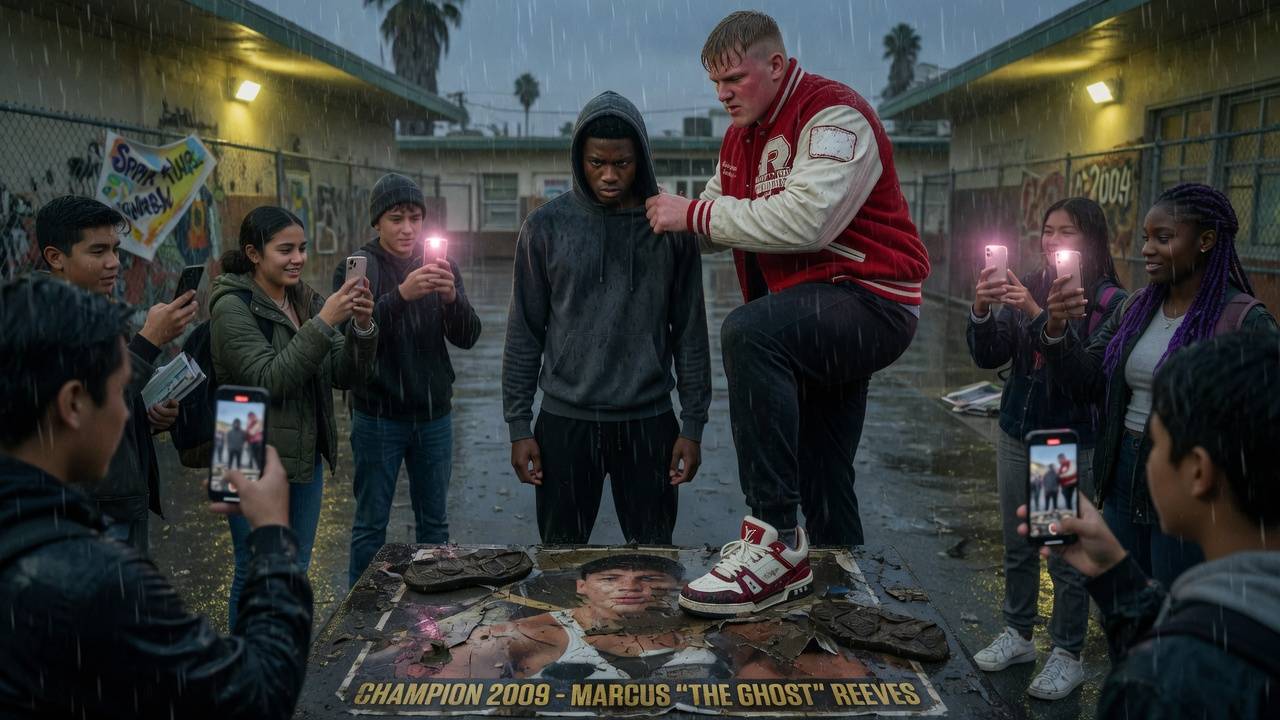
He pulled the old Dodge into the gravel driveway. The engine ticked as it cooled, a metallic sound that felt like a countdown. In the passenger seat, the ruined poster lay like a dead thing. The mud from Tyler’s shoe had dried into a crusty gray smear across his father’s face. Marcus didn’t pick it up yet. He just sat there, breathing in the scent of old upholstery and stale coffee, waiting for the adrenaline to finish its slow, poisonous retreat from his nervous system.
His “reading” hadn’t shut off. Even now, staring at the front door of the small, weathered house, he was analyzing the cues. The way the curtains in the kitchen were pulled slightly to the left meant Elias was sitting at the table. The absence of the lawnmower in the bed of the truck meant his father had finished the day’s work early. The silence of the neighborhood felt heavy, expectant, as if the suburban air itself was waiting for the shockwave of the video to hit.
Marcus grabbed the poster and stepped out of the truck. His legs felt heavy, like he was walking through knee-deep water. He entered the house through the kitchen door.
Elias was there, as expected. He wasn’t drinking coffee. He was sitting with his large, scarred hands flat on the laminate table, staring at a small, flickering smartphone screen propped up against a sugar jar. The sound was low, but Marcus recognized the wet thud of the push-kick and the collective gasp of the crowd.
Elias didn’t look up when Marcus entered. He just watched the loop again.
“Sam called me,” Elias said. His voice was a rasp, dryer than usual. “He said you broke the seal.”
Marcus didn’t answer. He walked over and laid the muddy poster on the table, covering the phone. The image of the young, triumphant Elias was now a stark contrast to the man sitting in the dim kitchen light.
“He was stepping on it, Pop,” Marcus said. He hated how young his voice sounded, how much it trembled despite the violence he had just dispensed. “He was stepping on your face. He told me to pick it up with my teeth.”
Elias finally looked up. His eyes weren’t full of the pride Marcus had secretly hoped for, nor the rage he had feared. They were full of a profound, weary sadness. It was the look of a man who had tried to build a dam against a flood, only to watch the first crack appear.
“I didn’t teach you that combo so you could win a fight at school, Marcus,” Elias said softly. “I taught it to you so you’d never have to fight at all. So you’d know you could, and that would be enough to keep you calm.”
“I was calm,” Marcus snapped, the frustration finally boiling over. “I gave him a warning. I told him his center was too high. He didn’t listen. He swung first. I did exactly what you told me to do—I handled it so it wouldn’t happen again.”
Elias stood up, his massive frame casting a shadow that seemed to swallow the kitchen. He took a step toward Marcus, and for a second, the “reading” kicked in—Marcus saw the shift in his father’s weight, the way his right shoulder dropped. It was a reflexive, defensive cue. Marcus flinched, a tiny movement of the chin, and he saw the moment his father realized it.
Elias stopped. The sadness in his eyes deepened into something sharper. Shame.
“You’re reading me,” Elias whispered. “Your own father.”
“I can’t turn it off!” Marcus shouted. “I see everything! I see the way Tyler’s dad is going to come after us because his kid is a coward who got exposed. I see the way the school is going to look at me like I’m a monster. I see the way you look at me!”
The silence that followed was suffocating. Then, the phone under the poster began to buzz. It vibrated against the table, a frantic, electronic hum. Marcus reached for it, but Elias was faster. He picked up the phone.
“It’s the school,” Elias said, looking at the caller ID. “Principal Miller.”
He answered it, putting it on speaker.
“Mr. Vance?” the Principal’s voice was strained, the professional veneer stripped away by panic. “We have a situation. There has been a physical altercation on campus involving Marcus and Tyler Vance. The police have been notified by the Vance family, and the school board is calling an emergency hearing for Monday morning. Marcus is suspended indefinitely, effective immediately. Do not bring him to campus.”
“Was the other boy injured?” Elias asked. He sounded like a man giving a deposition.
“Tyler has a suspected cracked sternum and a concussion. But Mr. Vance… the video. It’s not just the fight. It’s the… the efficiency of it. People are scared. The Vances are talking about ‘lethal intent.’ They’re bringing in their lawyers.”
“I understand,” Elias said. He hung up without saying goodbye.
He looked at Marcus, and for the first time in years, he reached out and touched his son’s shoulder. His hand was heavy, the grip firm but not aggressive.
“They’re going to try to turn you into a story, Marcus. A ‘thug’ with specialized training. They’re going to use my name to bury yours.”
“What do we do?”
Elias looked at the ruined poster, then back at Marcus. “We do what we should have done ten years ago. We stop hiding in the garden.”
The rest of the evening was a blur of digital noise. Marcus’s phone was a war zone of notifications. Leo called seventeen times. When Marcus finally answered, Leo was nearly hyperventilating.
“Marcus, dude, you’re trending on Twitter. Not just the school’s feed, like, the whole valley. People are calling you the ‘Ghost of the Octagon.’ But Tyler’s mom… she posted a photo of him in the ER. He looks pathetic, Marcus. Tubes and monitors. She’s calling for your arrest. She’s saying you’re a ‘predator’ who targeted her son.”
“He started it, Leo. You saw it. Everyone saw it.”
“It doesn’t matter what they saw,” Leo said, his voice dropping. “They’re rich, Marcus. They own the narrative. Tyler’s dad is on the board of the country club where the District Attorney plays golf. You didn’t just hit a kid; you hit an investment.”
Marcus hung up and went to his room. He stripped off the long-sleeved hoodie. In the mirror, his own body looked foreign to him. The muscles were lean, corded like steel cables, but all he saw was a target. He realized then that the “Cage of Silence” wasn’t just about not speaking. It was about the isolation of being the only person who saw the world for what it was—a series of collisions waiting to happen.
He spent the night sitting on the edge of his bed, watching the headlights of passing cars sweep across his walls. Every time a car slowed down, he expected the flash of police lights. He expected the front door to be kicked in.
Around 3:00 AM, he heard a sound from the backyard. He crept to the window and looked out.
His father was out there, illuminated by the floodlight. Elias wasn’t gardening. He was standing in front of the old heavy bag that had been buried under a tarp for a decade. He was moving—slowly, rhythmically. He wasn’t hitting it hard. He was just touching it, finding the range, his feet dancing in the dirt with a grace that Marcus had only seen in the old videos.
Elias was preparing. Not for a fight in a ring, but for the defense of his son.
Marcus watched him for an hour. He saw the way his father’s back muscles rippled under his work shirt. He saw the ghost of the champion return, not in a burst of violence, but in a quiet, steady resolve.
When Marcus finally fell asleep, he dreamed of the courtyard. But in the dream, he didn’t hit Tyler. He just stood there, and the crowd’s phones turned into mirrors, reflecting back a thousand versions of himself, all of them wearing long sleeves, all of them silent, all of them waiting for a signal that never came.
He woke up to the smell of bacon and the sound of the morning news. The lead story wasn’t the weather. It was a “disturbing incident of violence at a local high school.” They showed a blurred still of Marcus standing over Tyler.
The battle lines were drawn. The silence was over. And Marcus knew that the next few days would determine if he’d spend the rest of his life in a different kind of cage—one made of steel bars and orange jumpsuits.
He walked into the kitchen. Elias was dressed in a suit. It was old, the lapels too wide for current fashion, and it strained across his chest, but he looked like a man of substance.
“Eat,” Elias said, pointing to a plate. “We have a lot of work to do before Monday. We’re going to see Sam. He’s got the unedited footage from the school security cameras. The stuff the kids didn’t catch because they were too busy trying to get a good angle on your face.”
“Will it be enough?” Marcus asked.
Elias looked him square in the eye. “It has to be. Because if it’s not, I’m going to have to tell the world why I really quit. And that’s a story the Vances aren’t going to like.”
Marcus sat down and ate. For the first time in his life, the “reading” felt like it was working for him, not against him. He could see the path ahead. It was narrow, dangerous, and full of obstacles. But for the first time, he wasn’t walking it alone.
Chapter 6
The Monday morning air outside the school district headquarters was sharp and carried the scent of exhaust and damp concrete. Marcus sat in the back of the Dodge, watching a fleet of black SUVs pull into the reserved parking spots. Men in crisp navy suits and women with ironed hair stepped out, carrying leather briefcases like shields. These were the Vances’ people—lawyers, publicists, and “consultants” hired to turn a schoolyard scrap into a character assassination.
Elias sat in the driver’s seat, his hands resting on the wheel. He hadn’t spoken since they left the house. He was in his “pre-fight” state—a vacuum of emotion, a total focus on the immediate environment. Marcus could feel the pressure coming off him, a steady, low-frequency hum of intent.
“Remember,” Elias said as he cut the engine. “Don’t look at the cameras. Don’t look at Tyler. Look at the people behind the desk. They’re the ones who decide if you’re a student or a statistic.”
They walked toward the entrance. A small huddle of reporters was gathered near the steps, tipped off by a “concerned parent.” Flashbulbs popped, the light jagged and intrusive.
“Marcus! Did your father train you to attack students?”
“Mr. Vance, is it true you were banned from the MMA for life?”
Marcus kept his head down, but his “reading” was hyper-active. He saw the way the reporters angled their microphones, trying to provoke a flinch. He saw the security guards at the door shifting their weight, their hands hovering near their belts. Everyone was braced for impact.
Inside the hearing room, the atmosphere was clinical and cold. A long oak table sat at the front, occupied by five board members who looked like they’d rather be anywhere else. To the right sat the Vance family.
Tyler was there, wearing a neck brace that looked three sizes too big for him. He sat between his parents, his face pale and eyes downcast. His father, Richard Vance, was a man who looked like he’d been built out of mahogany and spite. He didn’t look at Marcus. He looked at Elias with a sneer that suggested he was smelling something rotten.
Sam, the security guard, was sitting in the back row, his old trainer’s jacket replaced by a clean uniform. He gave Marcus a curt, barely visible nod.
The hearing began with a dry recitation of the school’s “Zero Tolerance” policy. Then, the Vances’ lead attorney, a man named Halloway with a voice like polished marble, stood up.
“What we saw on that video,” Halloway began, gesturing toward a large monitor, “was not a fight. It was a demonstration of professional-grade violence. Marcus Vance didn’t defend himself; he dismantled a classmate. He used techniques designed to incapacitate, to cause maximum internal damage. This is a young man who has been raised as a weapon, living among us under the guise of a quiet student. The ‘Cage of Silence’ wasn’t a choice, members of the board. It was a concealment of a lethal threat.”
He played the video. On the big screen, Marcus looked terrifying. The efficiency of the 3-beat combo was undeniable. Without the context of the humiliation, it looked like a predator striking a confused victim.
Tyler’s mother began to sob, a loud, performative sound that echoed through the room.
“Mr. Vance,” the board chair said, looking at Elias. “Do you have a response? Your son has declined legal counsel. He says he wants to speak for himself.”
Elias stood up. He didn’t look at the board. He looked at Richard Vance.
“I spent ten years trying to make sure my son never had to stand in a room like this,” Elias said. His voice was quiet, but it filled every corner of the oak-paneled chamber. “I became a gardener because the world of professional fighting is a world of noise and ego. I wanted Marcus to know the value of silence. But silence isn’t a cage. It’s a boundary. And Mr. Vance’s son crossed it.”
“He’s a child!” Richard Vance shouted, slamming his hand on the table. “Your ‘boundary’ nearly killed him!”
“He’s a bully,” Elias countered, his voice dropping an octave. “And he’s a bully who was taught that money could buy him the right to degrade others. Sam, if you would.”
Sam stood up and walked to the tech station. He plugged in a thumb drive.
“This is the security footage from the twenty minutes leading up to the incident,” Sam said. “It hasn’t been edited for TikTok. It hasn’t been filtered for ‘likes.'”
The screen changed. It showed the courtyard from a high angle. It showed Tyler and his group cornering Leo. It showed Tyler ripping the poster out of Marcus’s bag earlier that morning—a detail the viral video missed. It showed the systematic, thirty-minute escalation of psychological torture.
Then, it showed the humiliation. In high-definition, without the shaky handheld movement, you could see Marcus’s face. You could see the fear. You could see him pleading with Tyler to stop. You could see the moment Tyler’s boot hit the poster, and you could hear—thanks to the courtyard’s high-gain mics—Tyler’s final threat.
“Pick it up with your teeth, or I’ll break your friend’s other leg.”
The board members shifted in their seats. The crying from the Vance side of the table stopped abruptly.
“My son reacted to a threat against a disabled peer,” Elias said. “He used the minimum amount of force required to neutralize a larger, aggressive attacker who had already initiated physical contact. If he were ‘professional-grade,’ as Mr. Halloway suggests, Tyler wouldn’t be sitting here with a neck brace. He’d be in a long-term care facility. Marcus held back. He read the cues, and he chose the path of least damage.”
Marcus looked at Tyler. For the first time, Tyler looked up. Their eyes met. In that second, the “reading” was effortless. Marcus saw the truth: Tyler wasn’t a monster. He was a boy who had been told he was a lion his whole life, and he was terrified that everyone now knew he was just a cub. He saw the crushing weight of Richard Vance’s expectations sitting on Tyler’s shoulders, heavier than any neck brace.
Marcus stood up.
“I don’t want Tyler to be expelled,” Marcus said.
The room went dead silent. Richard Vance’s mouth dropped open. Elias turned to look at his son, his expression unreadable.
“What I want,” Marcus continued, his voice gaining strength, “is for the silence to stop. I spent three years pretending I wasn’t my father’s son because I was ashamed of the violence. And Tyler spent three years pretending he was a warrior because he thought it made him important. We were both lying.”
He walked toward the center of the room, stopping halfway between the two tables.
“The video is out there. You can’t take it back. People are going to call me names, and they’re going to laugh at Tyler. That’s the consequence. But the school shouldn’t be a place where we have to hide who we are just to survive the hallway. I’m not a weapon. I’m a kid who knows how to protect himself. And Tyler… Tyler is just a kid who needs to learn how to lose without trying to destroy people.”
The board chair cleared her throat. “Marcus, the policy is very strict regarding physical—”
“The policy is about safety,” one of the younger board members interrupted. “And looking at this footage, Marcus Vance is the only reason that courtyard didn’t turn into a riot. He contained the situation.”
After another hour of deliberation, the verdict was delivered. Marcus’s suspension was reduced to three days, already served. He was required to attend five sessions of conflict resolution. Tyler was suspended for two weeks and stripped of his captaincy of the boxing club.
It wasn’t a clean victory. It wasn’t a movie ending.
When they walked out of the building, the reporters were still there. Richard Vance tried to shove past them, pulling Tyler by the arm. Tyler looked broken, his head low, the weight of his father’s disappointment visible in the hunch of his back.
Marcus watched them go. He didn’t feel the urge to gloat. He just felt a strange, quiet empathy.
“You did good, kid,” Sam said, catching up to them at the truck. He shook Elias’s hand, then Marcus’s. “The Hammer would be proud. But Marcus? The gardener’s son… he’s the one who won today.”
The drive home was different. The silence in the truck wasn’t the “Cage” anymore. It was just… quiet.
Elias pulled into the driveway. He didn’t get out right away. He reached into the glove box and pulled out a roll of heavy-duty clear tape. He took the ruined poster from the dashboard.
“It’s going to have scars,” Elias said, looking at the muddy, torn paper. “The tape will show. The mud will leave a stain.”
“I know,” Marcus said.
“But it’s still the truth,” Elias said.
They went inside. Together, they cleared the space on the kitchen wall where the old photos used to be. They taped the poster back up. It looked messy. It looked battle-worn. It looked exactly like their lives.
Elias sat down at the table and started the coffee maker.
“Marcus,” he said.
“Yeah, Pop?”
“Tomorrow, after school… we’re going to the garage. We’re going to take the tarp off the bags.”
Marcus felt a surge of panic. “Why? I thought you didn’t want me to be a weapon.”
Elias looked at him, and for the first time in ten years, he smiled. It was a small, tired smile, but it reached his eyes.
“You’re not a weapon, Marcus. You’re a man who knows how to carry one. And if you’re going to carry it, you might as well learn how to put it down properly. No more hiding. No more long sleeves in the heat.”
Marcus sat down across from him. He looked at his father’s hands—the scars, the dirt under the nails, the strength. He looked at his own hands, which were finally still.
The “reading” didn’t stop, but the data changed. He didn’t see the vectors of a strike. He saw the tilt of his father’s head, indicating an invitation to talk. He saw the relaxation in the shoulders, signaling peace.
The Cage of Silence hadn’t just been broken; it had been dismantled, piece by piece, until there was nothing left but the two of them, sitting in the morning light, finally able to hear each other.
“So,” Marcus said, leaning back in the plastic chair. “Tell me about the championship in ’08. Sam said you fought the last three rounds with a broken rib.”
Elias took a long sip of his coffee, the steam rising around his face. “Four rounds,” he corrected. “And it wasn’t just the rib. But that’s a long story.”
“I’ve got time,” Marcus said.
Outside, the California sun began to burn through the valley haze, promising a day that would be eighty-five degrees. Marcus stood up, walked to the door, and took off his grey hoodie, revealing the corded muscle of his arms to the morning air. He threw the sweater over the back of the chair and sat back down, ready, for the first time, to just be seen.