Chapter 5
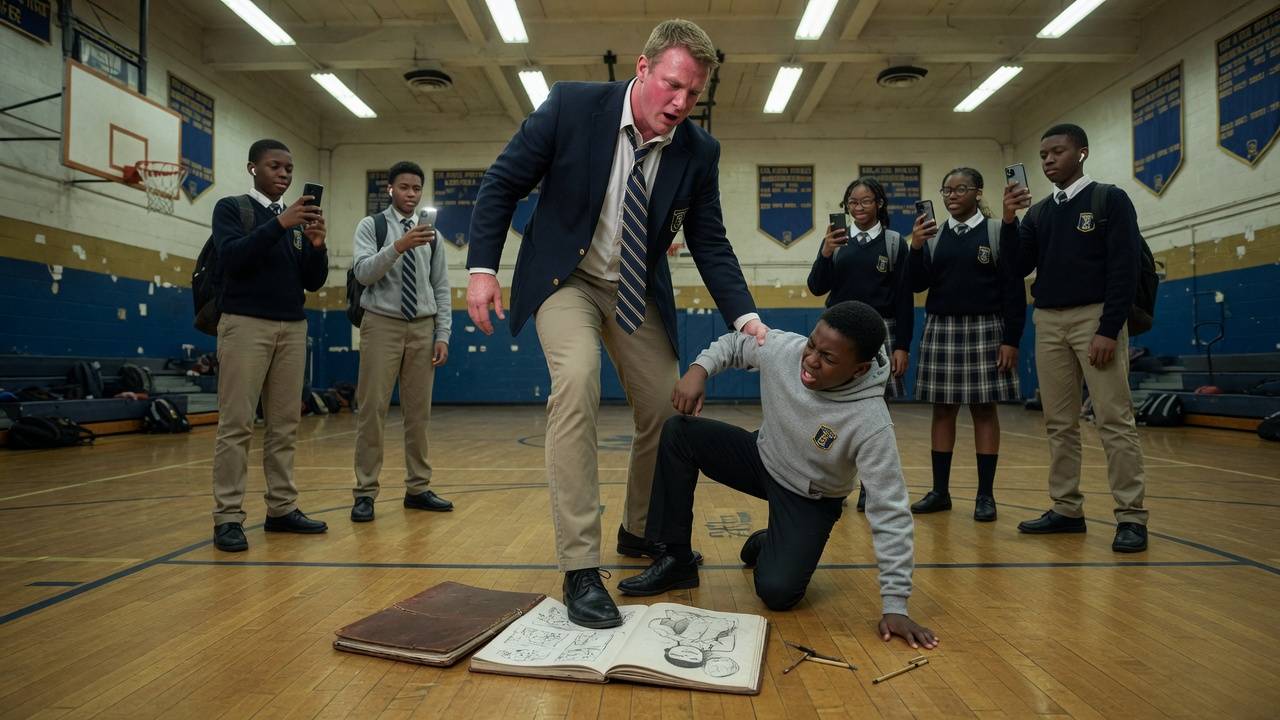
The blue light of the smartphone was the only thing illuminating the cramped kitchen of their apartment. Kaleb sat at the laminate table, the edges peeling like sunburnt skin, watching his own hands on the screen. In the video, he looked different—clinical, cold, almost mechanical. He watched himself snap Brody’s arm off-axis. He watched the body-weight strike land. The sound of the front push kick hitting Brody’s chest was a dull, wet thud that seemed to vibrate through the table and into Kaleb’s bones.
The video already had twelve thousand views on the “St. Jude’s Unfiltered” page. The comments were a toxic sludge of shock, racial slurs, and a terrifying kind of awe.
Across from him, his mother, Sarah, sat perfectly still. She wasn’t looking at the phone. She was looking at the stack of bills she’d been sorting, her finger still resting on a red-circled line item for the electric company. She looked smaller than she had that morning, the fluorescent light above them humming with a headache-inducing persistence.
“I did what I had to do, Ma,” Kaleb said, his voice sounding thin even to his own ears.
Sarah finally looked up. Her eyes weren’t angry. They were hollowed out by a exhaustion that went deeper than a long shift. “No, Kaleb. You did what you wanted to do. There’s a difference.”
“He stepped on the book. He touched me first. He was going to—”
“I know what he was going to do!” Sarah’s voice didn’t rise, but it sharpened, cutting through the hum of the kitchen. “I spend ten hours a day in a basement office seeing exactly who those people are. I see the checks Marcus Vance writes to make problems go away. I see the way they talk about people like us when they think the help isn’t listening. I didn’t send you to that school to be a hero, Kaleb. I sent you there to be a ghost. To get the degree and get the hell out.”
She stood up, her knees popping. She walked to the window, looking out at the Chicago skyline, where the Sears Tower stood like a middle finger to the neighborhoods below. “Marcus called me twenty minutes ago. On my personal cell. He didn’t yell. He didn’t even mention the fight. He just told me that there was a ‘discrepancy’ in the Q3 filings I handled and that I shouldn’t bother coming in on Monday while they conduct an internal audit.”
Kaleb felt a cold stone drop into his stomach. “Audit? You didn’t do anything wrong.”
“It doesn’t matter,” she whispered, her forehead leaning against the glass. “An audit means a freeze on my record. It means no references. It means they can tie me up in legal fees until we’re living out of a suitcase. He’s going to ruin me to get to you, and he’s going to use you to get to your father.”
Kaleb stood up, the chair scraping harshly against the floor. “Dad was there today. At the school.”
Sarah turned around slowly, her face going pale. “What?”
“He was dressed as an electrician. He saw it. He saw the whole thing.”
Sarah sank back into her chair, her hands shaking as she covered her mouth. “That fool. That arrogant, stubborn fool. He’s going to get himself killed, and he’s taking you with him.”
“He’s trying to clear his name, Ma. Elias told me—”
“Elias is a bottom-feeder who smells blood,” Sarah snapped. “Your father didn’t ‘disappear’ to protect us, Kaleb. He disappeared because he couldn’t handle being a loser. He couldn’t handle that Marcus Vance owned him, so he ran. And now he’s back, playing spy, while you’re throwing kicks in a gym like it’s a movie.”
The silence that followed was heavy with four years of resentment. Kaleb wanted to defend his father, to talk about the “Zone of Silence” and the technical perfection of the strikes, but looking at his mother’s trembling hands, it all felt like a lie. The MMA tapes, the anatomy drawings, the secret training—it was all a preparation for a world that didn’t exist. In the real world, Marcus Vance didn’t need to know how to throw a punch. He just needed to know how to sign a termination letter.
A soft knock at the door made them both jump. Kaleb reached for the steak knife on the table without thinking, his grip tightening.
“It’s me,” a voice whispered from the hallway. Gravelly. Tired.
Kaleb opened the door. Elias stood there, his grey suit looking even more wrinkled in the hallway light. He slipped inside before Kaleb could say a word, his eyes darting back to the stairs.
“We don’t have much time,” Elias said, nodding toward Sarah. “Sarah, I’m sorry. I tried to keep him back, but your husband is… focused.”
“He’s a ghost, Elias,” Sarah said, her voice dead. “That’s what ghosts do. They haunt people until there’s nothing left.”
“Marcus Vance is moving the ledger tonight,” Elias said, ignoring the jab. “The video of the fight? It did more than humiliate Brody. It spooked Marcus. He thinks the ‘Ghost’ is making a move through the kid. He’s panicked. He’s hosting the Founders’ Gala at the school tonight, but it’s a front. He’s using the noise and the crowd to clear out his private safe in the Athletic Director’s office and move the evidence to a secure facility in the Caymans.”
Kaleb stepped forward. “Where’s my dad?”
“He’s already in the building. But the security is tighter than we thought. Vance brought in his private detail—the ‘Blackwood’ guys. They aren’t school guards, Kaleb. They’re hitters. If your dad goes in there alone, he’s not coming out.”
“So what are we supposed to do?” Kaleb asked.
Elias looked at Kaleb, his eyes scanning the boy’s lean frame, the way he stood with his weight perfectly centered. “The security is focused on the perimeter and the basement. But the Athletic Director’s office is on the third floor, adjacent to the student theater. There’s a ventilation shaft that runs from the prop room directly into the office ceiling. A man your father’s size can’t fit. But a kid…”
“No,” Sarah said, standing up. “Absolutely not.”
“Sarah, if Marcus moves that ledger, you’re going to jail for ’embezzlement’ by Tuesday,” Elias said, his voice sharp. “He’s already set the paper trail. This is the only way out. Kaleb knows the building. He knows the anatomy of that school better than the architects.”
Kaleb looked at his mother. He saw the terror in her eyes, the way she was looking at him like he was already gone. He thought about Brody’s boot on his sketchbook. He thought about his father, a man who had been reduced to a shadow, lurking in the rafters of a school that treated his son like a parasite.
“I can do it, Ma,” Kaleb said softly. “I’m the only one who can.”
“You’re seventeen,” she whispered.
“I’ve been ‘The Ghost’s’ son for seventeen years,” Kaleb countered. “It’s time I started acting like it.”
Sarah didn’t give her blessing. she just sat back down and stared at the red-circled bills, her silence a heavy, suffocating shroud. Kaleb grabbed his hoodie—the grey one, the one that made him invisible—and followed Elias out into the rain.
The drive to St. Jude’s was a blur of neon lights and windshield wipers. Elias drove an old Crown Vic that smelled of stale coffee and cigarettes. Neither of them spoke. Kaleb watched the city go by, feeling the “Zone of Silence” settle over him. It wasn’t the adrenaline-fueled rage of the gym; it was something colder. It was the realization that everything he had learned—every nerve ending, every joint lock, every silent step—had been leading to this.
They pulled up two blocks away from the school. The St. Jude’s campus was lit up like a Christmas tree, the gothic spires draped in white lights. Limousines and black SUVs lined the driveway, depositing the city’s elite into the grand entrance.
“Your dad is by the service entrance near the kitchens,” Elias said, handing Kaleb a small, encrypted earpiece. “He’s got the frequency for the Blackwood radios. He’ll guide you through the halls. Once you get the ledger, you meet him at the old wrestling room in the basement. There’s a tunnel that leads to the street.”
Kaleb took the earpiece. “And if I get caught?”
Elias looked at him, and for the first time, the man looked genuinely sorry. “If you get caught, Kaleb, you tell them everything was your idea. You tell them you were looking for your sketchbook. You don’t mention your father. You don’t mention me. You stay a kid.”
Kaleb opened the door and stepped into the rain. He didn’t look back. He moved toward the shadows of the campus, his footsteps silent on the wet pavement. He was no longer a student. He was no longer a victim. He was a ghost, moving through a world of light and noise, looking for the truth that had been stolen from him before he was old enough to know what it was worth.
As he reached the perimeter fence, his earpiece crackled to life. A voice he hadn’t heard in four years, a voice that sounded like gravel and memory, whispered into his ear.
“Left side, Kaleb. The sensor on the gate is tripped. You have ten seconds before the guard rotates. Move.”
Kaleb breathed out, his heart slowing to a steady, rhythmic thrum. “I’m in, Dad.”
“I know you are,” his father said. “Now, let’s show them what a ghost can do.”
Chapter 6
The St. Jude’s Founders’ Gala was a symphony of staged perfection. From the vents above the student theater, Kaleb could smell the cloying scent of expensive lilies and the metallic tang of chilled champagne. Below him, women in silk gowns and men in tuxedoes moved like pieces on a chessboard, their laughter a brittle, hollow sound that barely reached the rafters.
“Two guards at the east door of the theater,” his father’s voice whispered in the earpiece. “They’re distracted by a caterer with a broken tray. You have a window. Thirty seconds. Go.”
Kaleb moved with a fluidity that felt like shedding a skin. He slid out of the vent and onto the catwalks above the stage, his sneakers finding purchase on the cold steel without a sound. He remembered the diagram he’d drawn in the library—the one Brody had mocked. It wasn’t just a map; it was an anatomical drawing of the building’s nervous system. He knew where the wires ran, where the weight-bearing beams met, where the shadows were thickest.
He reached the access panel for the Athletic Director’s office. It was a heavy oak door with a keypad lock.
“The code is 0-4-2-2,” his father said. “The date of his first million-dollar laundered kickback. Men like Vance never forget their first time.”
Kaleb punched in the numbers. The lock clicked—a small, sharp sound that felt like a gunshot in the quiet hallway. He slipped inside and closed the door behind him.
The office was a monument to Marcus Vance’s ego. Trophies lined the walls, most of them for sports he’d donated the equipment for. A massive mahogany desk sat in the center of the room, and behind it, a painting of Marcus and a young Brody, both of them smiling with a warmth that Kaleb knew was a lie.
“The safe is behind the portrait of the school’s founder,” his father directed. “It’s a biometric override, but I’ve bypassed the relay from the basement. Just put your thumb on the pad. It won’t recognize the print, but it’ll accept the signal I’m sending.”
Kaleb moved the painting. The safe was a sleek, black box recessed into the wall. He pressed his thumb to the glowing pad. For a second, nothing happened. Then, a low hum vibrated through the wall, and the heavy door swung open.
Inside was a single, leather-bound ledger. It looked unremarkable, just a book of numbers and names. But as Kaleb pulled it out, he felt the weight of it. This was his mother’s freedom. This was his father’s name. This was the reason he had spent four years being a punching bag for the North Shore elite.
“I have it,” Kaleb whispered.
“Good. Now get out of there. The guards are—”
The earpiece cut out into a burst of static.
Kaleb froze. The silence of the office suddenly felt heavy, predatory. He stuffed the ledger into the waistband of his trousers and moved toward the door.
He didn’t even hear the lock turn.
The door swung open, and Marcus Vance stepped into the room. He wasn’t wearing a tuxedo. He was in a dark suit, his face a mask of controlled, aristocratic fury. Behind him stood two men in tactical gear—the Blackwood hitters. And between them, looking pale and shaken with a dark bruise blossoming across his chest, was Brody.
“I told you he was a freak, Dad,” Brody said, his voice trembling. He wouldn’t look Kaleb in the eye. He looked at the floor, at the open safe, at anything but the boy who had broken him.
Marcus Vance stepped into the room, the door clicking shut behind him. He looked at Kaleb with a clinical curiosity, the way a scientist might look at a specimen that had suddenly started speaking.
“Your father was always a talented man, Kaleb,” Marcus said, his voice smooth and resonant. “A bit short-sighted, a bit too attached to his ‘honor,’ but talented. I see he’s passed that on to you. That little display in the gym? Quite impressive. Brody tells me he didn’t even see the move coming.”
Kaleb didn’t move. He stood in the center of the room, his hands at his sides, his breath slow and shallow. He was calculating the distance. Six feet to Marcus. Eight feet to the guards. The guards had holstered sidearms. Marcus was unarmed.
“Give me the book, Kaleb,” Marcus said, holding out a hand. “You think that ledger is your salvation? It’s just paper. Even if you walk out of here with it, who’s going to believe you? A kid who just assaulted the board president’s son? A mother who’s already being investigated for fraud? You’re not saving your family. You’re burying them.”
“You framed him,” Kaleb said, his voice flat.
“I made a business decision,” Marcus countered. “Your father found himself in a position where he was no longer an asset. So, I liquidated him. It’s how the world works. Some people are the ones who write the checks, and some people are the ones who get written off. You’ve had a taste of what happens when you try to change that. Look at your mother. Look at your life. Is this book worth her spending the next ten years in a state facility?”
Kaleb looked at the guards. They were moving, flanking him, their hands near their belts. He looked at Brody, who was watching with a sick kind of fascination.
“You’re right, Marcus,” Kaleb said. “I’m just a kid. And this is just a book.”
He reached into his waistband and pulled out the ledger. Marcus smiled, a thin, triumphant curve of his lips.
“Smart boy. Bring it here.”
Kaleb stepped forward, the ledger held out. But as he reached the edge of the desk, he didn’t stop. He pivoted on his lead foot, the movement a blur of grey fabric and shadow.
He didn’t hit Marcus. He threw the ledger.
The heavy book caught the lead guard square in the face, the edge of the leather binding slicing into his nose. As the guard recoiled, Kaleb dropped low. He didn’t use the 3-beat combo from the gym. This wasn’t a sparring match.
He drove his shoulder into Marcus Vance’s midsection, the air leaving the older man in a sharp woof. Using Marcus’s momentum, Kaleb swung around, grabbing the man’s lapels and spinning him into the second guard who was trying to draw his weapon. The three of them went down in a tangle of limbs and mahogany.
Kaleb didn’t stay to finish the fight. He scrambled over the desk, his hand catching the edge of a heavy bronze trophy—a rowing award. He didn’t swing it at a person; he swung it at the floor-to-ceiling window behind the desk.
The glass shattered with a roar, the cold Chicago wind screaming into the office.
“Kaleb!” Brody yelled, finally finding his voice.
Kaleb looked back once. Brody was standing there, paralyzed by a world that had suddenly stopped following the rules of privilege.
“Tell your dad the audit is over,” Kaleb said.
He stepped out onto the ledge. Three stories up. Below him was the decorative fountain of the quad, filled with three feet of water and lilies. It was a move his father had taught him—not a fight move, but a survival move. The fall is just another joint to manage. Relax. Aim for the center. Don’t fight the impact.
He jumped.
The world went silent as he fell, the lights of the gala blurring into a white streak. He hit the water hard, the coldness a physical shock that knocked the breath from his lungs. He scrambled out of the fountain, his clothes heavy and dripping, and ran for the gate.
He didn’t go to the wrestling room. He didn’t go to the street. He went to the accounting office in the basement.
He burst through the door, his lungs burning. Elias was there, standing over a copier, his face illuminated by the green light of the scanner.
“You have it?” Elias asked, his voice urgent.
Kaleb pulled the ledger from his wet shirt. It was damp, but the ink hadn’t run. He handed it to the PI. “Scan it. Send it to the Tribune. Send it to the D.A. Now.”
“Where’s your father?”
“He’s clearing the path,” a voice said from the doorway.
“The Ghost” Miller stepped into the room. He was covered in soot from the ventilation shafts, and there was a cut above his eye, but he was standing tall. He looked at Kaleb, and for the first time, the boy saw the man behind the tapes. Not a hero. Not a ghost. Just a father who had been hiding for too long.
“We have to move,” his father said. “The Blackwood detail is regrouping.”
“I’m not leaving without my mom,” Kaleb said.
“She’s already safe,” Elias said, hitting the ‘Send’ button on the scanner. “I had a deputy friend pick her up an hour ago. She’s at the precinct. Once this data hits the server, Marcus Vance couldn’t touch her if he owned the whole city.”
The sounds of sirens began to wail in the distance—not the school security, but the real Chicago PD. The gala was ending, but not with a toast.
They moved through the maintenance tunnels, emerging into the biting wind of an alley three blocks away. Kaleb stood there, shivering, his wet clothes clinging to his skin. He looked at his father. The man reached out and put a hand on Kaleb’s shoulder. His grip was firm, warm, and real.
“You shouldn’t have been there, Kaleb,” his father said softly. “I wanted you to have a different life. A life where you didn’t have to know where the pressure points were.”
“I know,” Kaleb said. “But the world isn’t built for ghosts, Dad. We have to live in it.”
The fallout lasted for months. The “St. Jude’s Scandal” dominated the headlines. Marcus Vance was indicted on thirty-four counts of money laundering and racketeering. Brody was expelled, his family’s name stripped from the library wing.
Sarah Miller didn’t go back to accounting. She used the settlement from her wrongful termination suit to open a small firm of her own, one that specialized in helping people who didn’t have Marcus Vance’s phone number.
Kaleb didn’t go back to St. Jude’s. He finished his diploma at a public school on the South Side. He didn’t wear the grey hoodie as much anymore. He didn’t need to be invisible.
On a cold Tuesday in November, Kaleb sat on his fire escape, his new sketchbook in his lap. He wasn’t drawing anatomy. He was drawing the skyline—the jagged, beautiful, broken teeth of the city.
The window behind him opened, and his father stepped out, carrying two cups of hot chocolate. The man had a job now, working security for a shipping firm. He wasn’t “The Ghost” anymore. He was just Miller.
“You still drawing those weak spots?” Miller asked, nodding at the book.
Kaleb looked down at the sketch of the Sears Tower, the way the light hit the steel. “No,” Kaleb said, a small smile touching his lips. “I’m drawing the things that stay standing.”
He closed the book. The leather was new, but inside the front cover, he’d taped a single page from his old, ruined sketchbook—the drawing of the brachial plexus. A reminder of the boy who had been pushed into a corner and the ghost who had fought his way out.
The wind off the lake blew hard, but Kaleb didn’t flinch. He sat there in the cold, a young man who finally knew his own weight, watching the city breathe, no longer afraid of the shadows, because he knew exactly what they were made of.