They call me “Government-funded trash.”
I spend twelve hours a day in a shop that smells like old oil and broken dreams, just trying to keep my head down and my record clean.
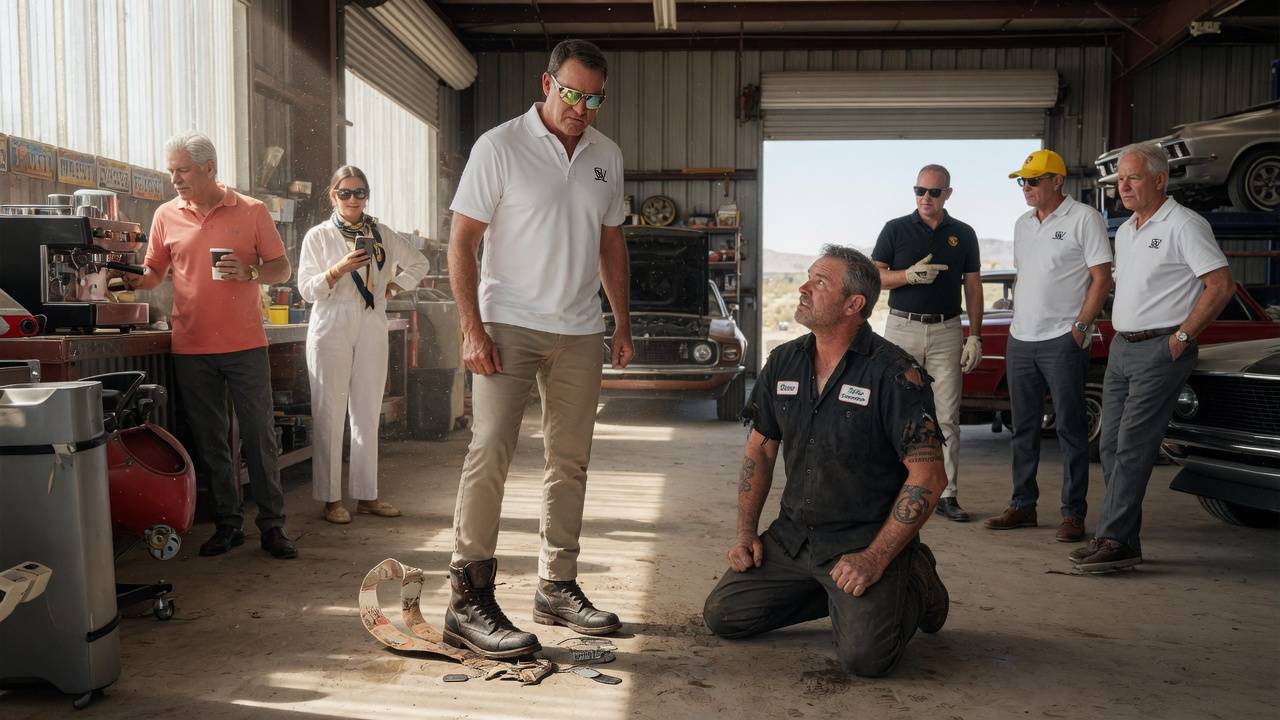
Sterling Vance walked in like he owned the air we breathe, with two assistants recording every word and a group of wealthy vultures watching for the kill.
He didn’t just want his Porsche restored; he wanted to see me crawl.
He saw the Silver Star on my workbench—the one that came home in a box when my brother Benny didn’t.
Sterling laughed, called it a “participation trophy for losers,” and swept it onto the grease-slicked floor.
Then he put his $2,000 boot right on top of it, grinding the medal into the dirt while he told me to clean his shoes.
I’m on probation. One “outburst” and I go back to a cell.
He knew that. He counted on it.
But he didn’t count on what happens when a man who has lost everything finally finds the one thing he’s willing to lose his freedom for.
He thought I was a ghost. He forgot that ghosts can still haunt you.
The room went dead silent when I finally moved.
The full story is in the comments.
Chapter 1
The air in the Silver Star Garage didn’t just smell like grease; it felt like it. It was a heavy, microscopic mist of 10W-30 and oxidized iron that clung to the back of Miller’s throat, a taste he hadn’t been able to wash away in three years. He liked it. It was honest. It was a hell of a lot more honest than the lemon-scented disinfectant in the parole office where he spent his Tuesday mornings.
Miller adjusted the shop light, the metal casing hot against his calloused palms. He was deep in the guts of a ’69 Chevy C10, the same model his brother Benny used to drive through the Nevada wash when they were kids. This one wasn’t Benny’s, though. This one belonged to a guy in Vegas who had more money than memories and wanted the truck to look like it had never seen a day of work in its life. Miller hated that. A truck without a scratch was a truck without a soul, but he didn’t say that to the customers. He didn’t say much of anything to anyone anymore.
“You’re late with the manifold, Marcus,” Miller said, his voice a low gravelly rasp. He didn’t look up from the engine block.
Marcus, a twenty-two-year-old kid who thought a backwards baseball cap and a TikTok account made him a mechanic, jumped. He’d been leaning against a tool chest, scrolling through his phone. “I was just checking the specs, Miller. Chill.”
“Specs are in the manual on the bench. Not on Instagram,” Miller said. He straightened up, his back popping with the sound of a dry branch snapping. He was forty-two, but his joints felt sixty. The shrapnel in his left thigh always ached more when the desert heat started to climb past ninety, a dull, rhythmic throbbing that reminded him he was alive while better men were dust.
“Whatever, man. Hey, you hear the buzz? Sterling Vance is coming by today. Like, the Sterling Vance. The tech guy.” Marcus sounded breathless, his eyes wide with the kind of celebrity worship that made Miller’s stomach turn.
“I don’t care if it’s the Pope. If he brought a car, it goes in the queue. If he didn’t, he’s blocking the bay.”
Miller wiped his hands on a rag that was more black than red. He walked over to his private workbench at the back of the shop. It was the only area Marcus wasn’t allowed to touch. On the scarred wood sat a small, velvet-lined box, open to the air. Inside was a Silver Star and a pair of dog tags. They weren’t polished. They were dull, scratched, and carried a faint dent in the edge of one tag where a piece of lead had tried to find a home.
He didn’t look at them for long. He couldn’t. Every time he did, he saw the smoke over the Kunar Province. He heard the screaming that wasn’t Benny’s, because Benny had gone quiet almost instantly. Miller had survived that ambush, but sometimes, standing in the silence of the Nevada desert, he felt like he’d just been on a very long delay.
The shop’s front door buzzed, and the heavy atmosphere of the garage shifted. It wasn’t the usual arrival of a local with a busted radiator. This was the sound of money—the kind of money that felt entitled to the air it occupied.
Three men walked in. The one in the middle was Sterling Vance. He looked exactly like his photos: porcelain teeth, a white designer polo that had never seen a drop of sweat, and a pair of sunglasses that probably cost more than Miller’s truck. Behind him were two younger guys, clones of the Marcus variety but with more expensive haircuts, holding stabilized camera rigs.
“Is this it?” Sterling asked, his voice echoing off the corrugated metal walls. He didn’t look at Miller. He looked at the shop with the kind of amused pity a tourist might give a Third World ruin. “I thought you said this was the place, Marcus? It looks like a scrap yard with a roof.”
Marcus was already scrambling forward, his face flushed. “Mr. Vance! Yes, sir. Best restoration in the state. Miller here is a genius with vintage blocks.”
Sterling finally turned his gaze toward Miller. He didn’t offer a hand. He just looked at Miller’s grease-stained work shirt, lingering on the “Miller” patch over the pocket and the faded Marine Corps “EGA” on his forearm. A thin, mocking smile touched Sterling’s lips.
“A genius, huh?” Sterling stepped closer, his Italian leather boots clicking on the concrete. “You look more like the help, Miller. I have a 911 Targa that needs a frame-up. I don’t want ‘good enough.’ I want perfection. Can you handle that, or are you too busy reminiscing about the good old days in the mud?”
Miller felt the familiar heat rising in his chest, the old “outburst” threat that the court-ordered therapist called Intermittent Explosive Disorder. Miller called it common sense. He forced his hands to stay flat on the workbench. He thought about his probation officer, Miller’s monthly drug tests, and the fact that Sarah—Benny’s widow—needed the checks from this shop to keep the house.
“The queue is six months long,” Miller said, his voice flat. “Leave your details with the kid. We’ll call you.”
Sterling’s smile didn’t falter, but his eyes hardened. He wasn’t used to “no.” He wasn’t even used to “wait.” He leaned over Miller’s workbench, his shadow falling across the Silver Star. “I don’t wait six months. I don’t wait six minutes. I’m going to buy this entire block, Miller. I’m putting in a private track and a showroom. You’re either the guy who works for me, or you’re the guy who gets bulldozed. Which is it?”
Miller didn’t blink. “Get out of my shop.”
Sterling chuckled, a cold, dry sound. He reached out a manicured finger and flicked the dog tags in the box. They chimed against the wood. “Sensitive, aren’t we? Maybe that’s why you’re on the state’s leash. I did my homework, Miller. Assault. Battery. A real hero.”
Sterling leaned in closer, his breath smelling of expensive mints. “Keep the shop clean. I’ll be back with some friends. I want them to see what a ‘decorated hero’ looks like when he’s taking orders.”
As Sterling turned to leave, his assistants stayed behind for a second, filming the “Miller” patch and the old, flickering shop light. Miller stood perfectly still, his heart hammering against his ribs like a trapped bird. The taste of grease in his mouth had turned to copper.
Chapter 2
The next three days were a slow-motion car crash. Miller knew guys like Sterling Vance. They didn’t just want what you had; they wanted to prove you didn’t deserve to have it in the first place.
On Thursday, the “friends” arrived. It wasn’t just Sterling. It was a caravan of six high-end sports cars—Lamborghinis, McLarens, and a vintage Ferrari that made Marcus nearly faint. They pulled into the dusty lot of the Silver Star Garage like a swarm of brightly colored hornets.
Miller was under a Jeep Grand Wagoneer, his arms aching as he fought a rusted exhaust bolt. He heard the engines cut out, the synchronized “thwack” of expensive car doors closing, and the high-pitched laughter of people who didn’t know what it was like to worry about a utility bill.
He rolled out from under the Jeep on his creeper, wiping a smear of black sludge from his forehead. Sterling stood in the center of the bay, flanked by his two cameramen and a group of five other men—wealthy collectors, local investors, the kind of people who bought “authenticity” because they had none of their own.
“There he is!” Sterling announced, spreading his arms wide. “The Last of the Mohicans. Tell them, Miller. Tell them about the Silver Star. My friends here think I’m exaggerating about the decor.”
The collectors shuffled forward, looking at Miller with a mixture of curiosity and condescension. One of them, a man in a linen suit holding a gold-plated phone, peered at the workbench. “Is that real? The medal?”
“It’s real,” Miller said, standing up. He felt the sweat slicking his spine. He was outnumbered, not just by people, but by status. These men had lawyers on speed dial and the Sheriff on their Christmas card lists. Miller had a public defender he couldn’t remember the name of and a record that made him a permanent villain in any police report.
“Miller is a bit of a traditionalist,” Sterling said, walking over to the workbench. He picked up a wrench and turned it over in his hands like it was a primitive stone tool. “He thinks because he bled in a hole somewhere, the world owes him a living. He doesn’t realize that in the real world, the only thing that matters is who owns the dirt.”
“I own the dirt, Sterling,” Miller said quietly.
The room went quiet. Marcus, standing in the corner, looked like he wanted to vanish into the floorboards.
Sterling narrowed his eyes. “Excuse me?”
“This shop. The acre it sits on. It’s mine. It was my father’s, then it was Benny’s, and now it’s mine. You can bring your friends and your cameras, but you’re still a guest. And you’re overstaying.”
Sterling’s face flushed a deep, ugly red. The mocking mask slipped for a fraction of a second, revealing the petulant child underneath. He tossed the wrench back onto the bench with a loud clang.
“Marcus,” Sterling snapped.
Marcus jumped. “Yes, Mr. Vance?”
“This ‘hero’ tell you he’s a landlord? Or did he forget to mention he’s one bad day away from a jail cell? I’ve seen the reports, Marcus. He’s unstable. Dangerous. Probably shouldn’t be around heavy machinery, let alone ‘mentoring’ youth.”
Sterling turned back to Miller, his voice dropping to a theatrical whisper that the cameras were sure to catch. “You think owning a patch of sand makes you a king? It makes you a target. I’ve already talked to the zoning board. Environmental impact of all this leaked oil, Miller. The noise. The ‘visual blight.’ You won’t own this dirt by Christmas.”
One of the collectors chuckled. “He’s right, you know. This place is an eyesore. Why not just take the buyout and go play soldier in the woods?”
Miller’s hand tightened around the rag in his pocket. He could feel the pulse in his neck. He looked at the dog tags on the bench, the way the sunlight hit the tarnished silver. He thought about Benny’s face the day they’d enlisted—the pride, the terrifying innocence.
“Get out,” Miller said. It wasn’t a shout. It was a command, the kind he used to give to privates who were about to do something stupid.
Sterling laughed, but it was forced. He stepped into Miller’s space, the scent of his cologne clashing with the smell of the shop. “Or what? You’ll hit me? In front of ten witnesses and three cameras? Go ahead, Miller. I’ve got the best dental plan in the country. You’ve got a one-way ticket back to the state pen. Do it.”
Sterling waited, his chin tilted up, a smug, untouchable grin on his face. He was counting on Miller’s fear. He was counting on the system.
Miller didn’t hit him. He just stared into Sterling’s eyes until the tech mogul blinked and stepped back.
“That’s what I thought,” Sterling muttered, adjusting his polo. “Come on, boys. The air in here is starting to smell like failure. We’ll let the lawyers handle the eviction.”
As they filed out, Sterling paused at the door, looking back at the Silver Star. “Nice participation trophy, Miller. Hope it’s worth the house.”
Chapter 3
The garage felt smaller after they left. The silence was heavier, filled with the ghosts of a dozen conversations Miller had never had with his brother.
Later that evening, Sarah showed up. She was thirty-four, but she carried the weight of a woman who had seen the end of the world. She had Benny’s eyes—wide, restless, and perpetually searching for something that wasn’t there anymore. She was holding a stack of envelopes, the red “Overdue” stamps visible even in the dim light of the shop.
“They’re calling the house, Miller,” she said, her voice trembling. “Some company called Vance Horizons. They say they’re buying the debt on the property. They say we have thirty days.”
Miller took the envelopes, his fingers trembling slightly. “He’s bluffing, Sarah. He can’t just buy debt like that.”
“He can if the bank wants to sell it. And they do. They don’t want to deal with us. We’re a ‘high-risk asset,’ Miller. That’s what they called us.” She sat on a stool, her head in her hands. “I can’t lose that house. It’s all the girls have left of him. The height marks on the doorframe… the smell of his old jackets…”
“You aren’t losing anything,” Miller said, his voice cracking. He walked over to her, hesitant, and placed a hand on her shoulder. He felt like a fraud. He was the one who was supposed to protect them, yet his presence was the very thing Sterling was using to ruin them.
“I have the deed, Sarah. I checked the floorboards. It’s all clear. He’s trying to scare us into quitting.”
“He’s succeeding,” she whispered. She looked up at him, her eyes red-rimmed. “Why is he doing this? We don’t even know him.”
“Because he can,” Miller said. “And because I told him no. Men like that… they don’t see people. They see obstacles.”
After Sarah left, Miller sat in the dark shop for hours. He didn’t turn on the lights. He just sat on his workbench, the Silver Star in his lap. He thought about the secret he’d kept since the day he got back. He didn’t just own the shop. He owned the mineral rights to the entire three-hundred-acre ridge behind it. His father had bought them for a song in the seventies, thinking there was copper. There wasn’t. But there was something else now: the exact path Sterling needed for his private “mountain-ascent” track.
Sterling didn’t know yet. He thought he was fighting a mechanic. He didn’t realize he was fighting the man who held the keys to his kingdom.
The next morning, Sterling returned. But he wasn’t alone. He had brought a local news crew this time, a young woman with a microphone and a cameraman who looked like he’d rather be anywhere else.
“We’re doing a piece on ‘Modernizing the Desert,'” Sterling told the reporter, loud enough for Miller to hear. “Showing how we can take these stagnant, decaying properties and turn them into something that actually contributes to the tax base. Look at this place. It’s a liability waiting to happen.”
Miller walked out of the bay, a wrench in his hand. Marcus was behind him, looking terrified.
“Sterling,” Miller said.
“Ah, the hero returns!” Sterling beamed at the camera. “Miller, I was just telling Sarah—oh, wait, did I mention I spoke to your sister-in-law? Lovely woman. Very concerned about her future. I told her I’d take care of everything once you moved on.”
The wrench in Miller’s hand felt like it weighed a hundred pounds. “You stay away from her.”
“Is that a threat, Miller? On camera?” Sterling stepped closer, his entourage closing in. The collectors from the day before were there too, like a gallery at a hanging. “You see this, folks? This is the ‘veteran volatility’ we hear so much about. A man who can’t handle the progress of the world, so he resorts to intimidation.”
Sterling walked over to Miller’s workbench. He saw the Silver Star. He saw the dog tags. He saw the small, framed photo of Benny that Miller had put out.
“This is the problem,” Sterling said, picking up the photo. “Living in the past. Your brother is dead, Miller. He died for a hill that doesn’t exist anymore. And you’re going to lose this shop for a memory that no one cares about but you.”
“Put the photo down,” Miller said, his voice a low, vibrating hum.
Sterling didn’t put it down. He looked at the camera, then back at Miller. “Make me.”
He dropped the photo. The glass shattered on the concrete. Then, with a slow, deliberate movement, Sterling swept his hand across the workbench. The Silver Star and the dog tags tumbled into the oil-stained dirt.
The crowd gasped. Marcus let out a small, strangled sound.
Sterling looked down at the medal, then stepped forward. He placed his boot directly on the Silver Star, grinding the delicate silver points into the grit.
“Clean my boots with that rag, trash,” Sterling sneered. “Maybe then I’ll give you an extra week to pack your brother’s junk.”
Miller looked at the boot. He looked at the medal. He felt the world go white at the edges. The shrapnel in his leg stopped throbbing. The air in the shop went perfectly still.
“Take your foot off the medal,” Miller said. It was the last warning he would ever give.
Chapter 4
The silence in the Silver Star Garage was physical, a pressurized weight that made the air feel thick as oil. The news camera was rolling, a red light blinking like a heartbeat in the shadows. The collectors stood frozen, their expensive phones held up like shields.
Sterling Vance didn’t move his foot. He pressed down harder, the heel of his Italian leather boot grinding the Silver Star into the Nevada dust. He leaned in, his face inches from Miller’s, his eyes dancing with a cruel, manic triumph.
“Or what, Miller?” Sterling whispered, loud enough for the microphone to catch. “You going to have another ‘episode’? You going to prove me right in front of the whole world? Come on. Show them the monster you are.”
Sterling reached out and grabbed Miller by the collar of his grey work shirt. He bunched the fabric in his fist, pulling Miller forward and forcing him to look down at the boot-covered medal. “You’re nothing. You’re a footnote in a war that everyone forgot. Now, clean the boot.”
Miller felt the familiar roar in his ears, the sound of the ambush, the heat of the fire. But for the first time in years, the roar wasn’t chaotic. It was focused. It was a cold, sharp blade of clarity. He looked at Sterling’s hand on his collar. He looked at the mockery in Sterling’s eyes.
“Take your foot off the medal,” Miller said again. His voice wasn’t a growl anymore. It was a statement of fact.
Sterling laughed, a sharp, ugly sound. “I don’t think so.” He shoved Miller back, then grabbed him again, tighter this time, his knuckles white. He jerked Miller closer, trying to humiliate him, trying to make him break. “You’re a dog, Miller. And I’m the—”
Sterling never finished the sentence.
Miller’s left foot planted into the concrete, his weight shifting with the practiced grace of a man who had spent a lifetime learning how to survive. He didn’t swing a wild punch. He didn’t roar.
Miller’s right hand snapped up, his palm hitting the crook of Sterling’s grabbing arm. With a sharp, explosive jerk, Miller snapped Sterling’s arm off-line. The movement was so fast Sterling’s shoulder turned off-axis, his chest opening up, his balance disappearing like smoke in a high wind.
The crowd flinches. The cameraman stumbled back.
Before Sterling could even gasp, Miller stepped inside his space. Miller’s rear foot drove into the ground, his hip rotating with the force of a hydraulic ram. He drove a compact, body-weight palm-heel strike directly into Sterling’s sternum.
There was a wet thud as the strike landed. Sterling’s designer polo compressed under the impact. His breath left him in a ragged wheeze, his shoulders snapping backward as his torso followed the force. His feet scrambled, his expensive boots sliding uselessly on the dusty floor.
Sterling was still trying to find his footing when Miller finished it.
Miller planted his standing foot and drove a front push kick into the center of Sterling’s chest. It wasn’t a tap. It was a full-extension, hip-driven strike that used every ounce of Miller’s 190-pound frame.
The sole of Miller’s work boot slammed into Sterling’s chest. Sterling’s upper body snapped back, his hips lagging behind as he was launched off his feet. He flew backward three feet, his arms flailing, before hitting the ground with a heavy, jarring thud that sent a cloud of Nevada dust into the air.
Sterling scrambled, his face pale, his sunglasses skewed across his forehead. He tried to get up, but his lungs refused to work. He looked up at Miller, his eyes wide with a terror that no amount of money could buy.
“Please!” Sterling wheezed, raising a trembling hand defensively as he slid backward on the floor. “Please, stop! I’m sorry! Don’t hit me again!”
The great Sterling Vance was begging in the dirt, his white polo stained with oil, his dignity shattered in front of his own cameras.
Miller didn’t move toward him. He didn’t raise his fists. He just stood over him, his shadow long and dark across the garage floor. He reached down and picked up the Silver Star, blowing the dust off the tarnished metal before tucking it into his pocket.
“Don’t ever touch my brother’s things again,” Miller said.
He turned his gaze to the news crew, then to the collectors, who were all staring in stunned, terrified silence.
“Get out of my shop,” Miller said.
This time, nobody waited to be asked twice. The hornet’s nest emptied in seconds, the roar of expensive engines fading into the desert heat as they scrambled to get away from the man they’d thought was a footnote.
Miller stood alone in the center of the bay. He looked at Marcus, who was still standing in the corner, his phone shaking in his hand.
“Did you get it, Marcus?” Miller asked quietly.
Marcus swallowed hard, nodding. “Every second of it, Miller. The whole thing. He… he stepped on it. Everyone saw.”
Miller nodded. He felt the shrapnel in his leg start to throb again, but the weight in his chest was gone. He knew what was coming. The police. The probation violation. The lawyers.
He walked over to the phone on the wall and dialed a number he knew by heart.
“Sarah?” he said when she picked up. “It’s Miller. I need you to call the Sheriff. And Sarah… tell the girls they don’t have to worry about the house anymore.”
He hung up the phone and walked back to the ’69 Chevy. He picked up his wrench and went back to work. He had a manifold to finish, and the clock was ticking.