Chapter 5
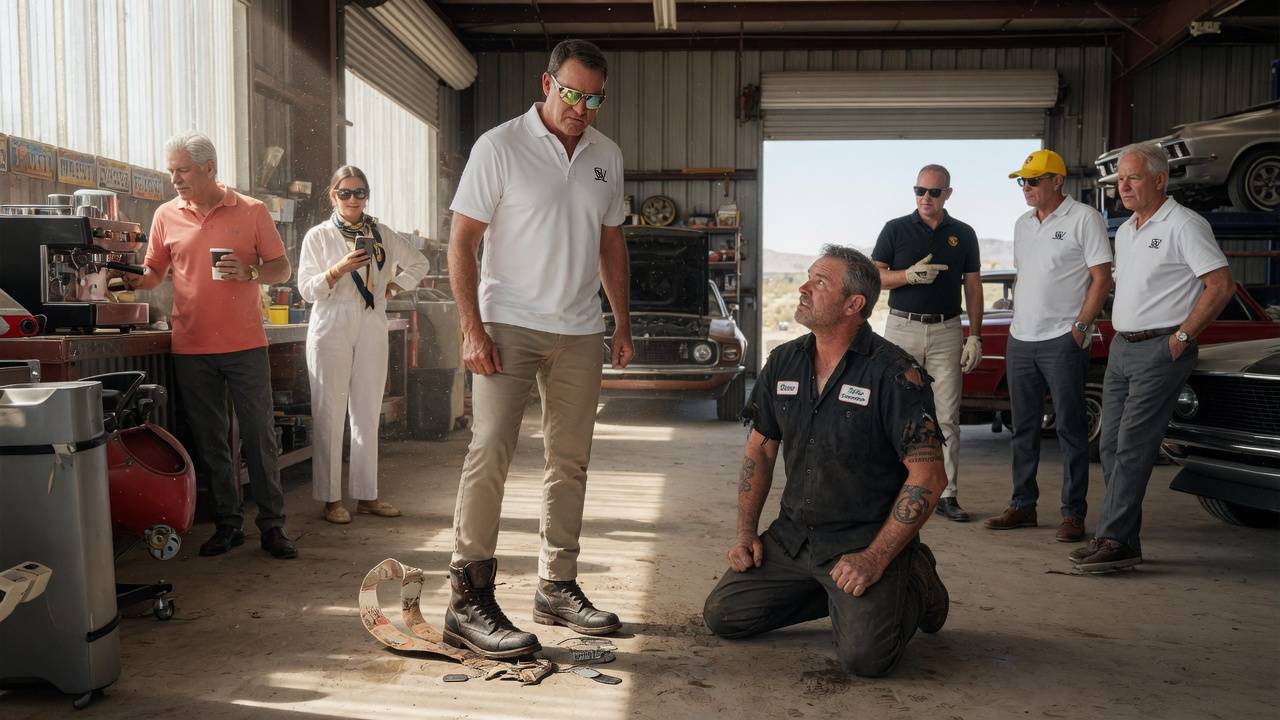
The sirens didn’t scream across the desert; they wailed with a weary, rhythmic inevitability. Miller sat on his rolling stool, the grease-stained rag still clutched in his right hand. He didn’t try to wash the oil from his skin, and he didn’t try to hide the Silver Star that now sat prominently on the corner of his workbench, its ribbon slightly frayed but its weight feeling like an anchor for the first time in years. Sterling Vance had been hurried out by his assistants, his white polo shirt ruined by a perfect, dusty imprint of Miller’s boot, but the silence he left behind was louder than the engines of his fleeing fleet.
Sheriff Wyatt arrived first. He was a man built like a sourdough loaf—heavy, crusty, and seasoned by thirty years of Nevada sun. He didn’t come in with his gun drawn. He walked into the bay, looked at the shattered glass of Benny’s photo on the floor, and then looked at Miller.
“I saw the video, Miller,” Wyatt said. He didn’t sound angry. He sounded like a man watching a storm he’d predicted finally make landfall. “One of the kids in the back had it on the cloud before Vance even hit his brakes in the parking lot. You know I have to take you in.”
“I know,” Miller said. He stood up slowly, his knees popping. The adrenaline was gone, replaced by a cold, hollow clarity. “He stepped on the medal, Wyatt. He broke the photo. He put his hands on me first.”
Wyatt sighed, the sound heavy with the dust of the shop. “I saw that too. Doesn’t change the fact that you’re on paper for an ‘outburst’ and you just put a billionaire in the dirt on camera. His lawyers are already calling the DA. They aren’t talking about a scuffle; they’re talking about aggravated assault, hate crimes against the ‘successful,’ whatever bullshit they can stitch together.”
Miller held out his wrists. It was a practiced motion, one that carried the weight of every mistake he’d made since the Kunar Province. “The truck’s manifold is done. Tell Marcus to torque the bolts to sixty-five. Don’t let him use the air-ratchet.”
Wyatt shook his head, the metal of the handcuffs clicking with a sound that felt final. “You’re a hell of a mechanic, Miller. A lousy politician, but a hell of a mechanic.”
The ride to the county jail was quiet. The desert looked different from the back of a cruiser—caged, distant, and indifferent to the struggles of the men moving across it. Miller didn’t look at the mountains. He looked at his own hands. They were trembling, just a little. It wasn’t fear. It was the residue of the force he’d used. He’d spent years trying to bury the man who knew how to break another human being, convinced that that version of himself was a curse. But as he sat in the back of Wyatt’s car, he realized that for the first time, he hadn’t used that force out of panic or blind rage. He’d used it as a shield.
Processing was a blur of fluorescent lights and the smell of industrial floor wax. The guards knew him. They didn’t mock him; they just moved him through the system with a quiet, somber efficiency. By the time he was sitting in a holding cell, the sun was beginning to dip toward the horizon, casting long, orange bars across the concrete floor.
Sarah arrived an hour later. She was pale, her hands shaking as she pressed them against the plexiglass in the visiting room.
“Miller, what were we thinking?” she whispered, her voice cracking. “The news… it’s everywhere. They’re calling you the ‘Vigilante Mechanic.’ And Sterling… his lawyers just served me with an emergency injunction. They’re locking the shop gates tomorrow morning. They’re claiming the property is a crime scene and a public hazard.”
Miller looked at her, really looked at her. He saw the exhaustion in the lines around her mouth and the way she was holding herself together for the sake of Benny’s girls. He felt a surge of something that wasn’t anger—it was a cold, quiet resolve.
“The shop isn’t a crime scene, Sarah. It’s an asset,” Miller said. His voice was steady, the gravelly rasp deeper than usual. “Go back to the shop. Under the floorboards in the office, under the old filing cabinet with the broken drawer. There’s a metal box. Not the one with the medals. A smaller one. It’s wrapped in plastic.”
Sarah frowned, her brow furrowing. “Benny’s box? I thought that was just old tax returns.”
“It’s the deed, Sarah. And the mineral rights. My father didn’t just leave us the land. He left us the rights to everything beneath it, all the way up to the ridge. Sterling wants that ridge for his track. He thinks he can bully us off the surface, but he doesn’t realize we own the heart of the mountain.”
“What does that mean, Miller?”
“It means he can’t move a single shovelful of dirt without our permission. It means his ‘mountain-ascent’ dream is built on land he’ll never touch. Get that box to Joe Halloway. He’s the only lawyer in this town who isn’t on Sterling’s payroll.”
Sarah stared at him, a flicker of hope warring with the terror in her eyes. “Miller, he’s going to come for you. He’s going to try to keep you in here.”
“Let him try,” Miller said. “He’s fighting for a showroom. I’m fighting for my brother. He’s already lost; he just hasn’t realized it yet.”
The night in the cell was the longest of his life. He didn’t sleep. He listened to the distant hum of the ventilation and the occasional shout from down the hall. He thought about the ambush. He thought about Benny’s hand reaching for him in the smoke. For years, he’d felt like he’d failed that moment because he’d lived. He’d carried the guilt like a backpack full of lead, thinking that his only job now was to disappear, to be a ghost in a grease-stained shirt.
But as the moon moved across the small, high window of his cell, he realized that Benny hadn’t died so Miller could hide. He’d died so Miller could live. And living meant protecting what was left.
The next morning, the “Vigilante Mechanic” video had ten million views. The image of the billionaire begging in the dirt while a scarred veteran stood over him had touched a nerve in a country tired of being stepped on. But Sterling Vance wasn’t going down without a fight. He appeared on a morning news circuit from his hospital bed—despite having nothing more than a bruised sternum—claiming he was the victim of a “radicalized, violent individual” and calling for the maximum sentence.
At 10:00 AM, Sheriff Wyatt walked up to Miller’s cell. He didn’t have his keys out. He had a tablet in his hand.
“The DA just dropped the aggravated assault charge,” Wyatt said, a ghost of a smile tugging at his mouth.
Miller stood up. “Why?”
“Because Joe Halloway just walked into the county clerk’s office with a stack of papers that turned the zoning board upside down. And because that ‘young apprentice’ of yours, Marcus? He didn’t just film the fight. He’d been filming for an hour. He caught Vance talking about ‘buying the debt’ to force a widow out of her home. He caught him admitting to planning the ‘environmental impact’ fraud to tank your property value.”
Wyatt unlocked the cell door. “Self-defense is a lot easier to prove when the other guy is on tape admitting to a conspiracy to commit racketeering. You’re still looking at a misdemeanor for the ‘outburst,’ but the judge gave you time served and a stern look. Get out of here, Miller.”
Miller walked out of the jail and into the blinding Nevada sun. Joe Halloway was waiting in a dusty Buick, Sarah sitting in the passenger seat. They didn’t say much. They didn’t have to. The air felt different now—lighter, as if the desert had finally exhaled.
But Miller wasn’t done. He didn’t go to Sarah’s house, and he didn’t go to a diner. He told Joe to drive him straight to the Silver Star Garage.
The parking lot was a circus. There were news vans, protesters, and two black SUVs that Miller recognized as Sterling’s security detail. The gates were locked with a heavy, industrial chain, and a “NOTICE OF SEIZURE” sign was plastered over the garage door.
Sterling Vance was there, standing by his lead SUV, talking to a man in an expensive suit. He saw Joe’s Buick pull in and his face twisted into a mask of pure, unadulterated loathing. He marched toward the car before Miller could even get out.
“You think a few mineral rights are going to save you?” Sterling shouted, his voice cracking with rage. “I’ll tie you up in court for a decade! I’ll spend fifty million dollars just to make sure you never turn another wrench! I own the banks, Miller! I own the—”
Miller opened the car door and stepped out. He didn’t move fast. He didn’t raise his hands. He just stood there, his presence domesticating the chaos of the lot. He looked at the chain on his gate, then he looked at Sterling.
“You don’t own anything here, Sterling,” Miller said. His voice was quiet, but it carried through the crowd, silencing the reporters and the security guards alike. “Joe, give him the paper.”
Halloway stepped out, handing a single, notarized sheet to Sterling.
“That’s a cease-and-desist regarding the ridge access,” Halloway said. “But more importantly, it’s a notice of a private easement violation. You built your temporary staging area on land that belongs to the Miller estate. That’s trespassing, Sterling. And since you used corporate funds to do it, it’s a breach of your own bylaws.”
Sterling looked at the paper, his hands trembling. “This is a joke. This is—”
“It’s not a joke,” Miller said. He stepped closer, entering that 1-meter space that Sterling had once used to humiliate him. “You wanted to buy this dirt, Sterling. You wanted to level it. But you forgot that dirt has memory. It remembers who bled on it, and it remembers who took care of it.”
Miller leaned in, his voice a whisper that only Sterling could hear. “I’m not a hero, and I’m not a vigilante. I’m a mechanic. And right now, I’m looking at a very broken machine. You can walk away, drop the lawsuits, and clear the debt on Sarah’s house. Or I can spend the rest of my life making sure you never build so much as a sandbox in this state. Which is it?”
Sterling looked at the cameras. He looked at the scarred man in front of him who wasn’t afraid of his money or his power. He saw the “Vigilante Mechanic” who had the world watching, and he saw a fight he couldn’t win with a checkbook.
For the first time, Sterling Vance looked small. He looked like a boy who had broken a toy he didn’t know how to fix. He turned without a word, climbed into his SUV, and signaled his driver. The black vehicles peeled out of the lot, kicking up a cloud of dust that coated the “Notice of Seizure” sign.
Miller watched them go. He didn’t cheer. He didn’t pump his fist. He just walked over to the gate, pulled a bolt cutter from Joe’s trunk, and snapped the chain. The sound of the metal hitting the concrete was the most satisfying thing he’d ever heard.
“Marcus!” Miller called out.
The kid poked his head out from behind a news van, looking like he’d just won the lottery. “Yeah, Miller?”
“The manifold. Did you torque it?”
“Sixty-five pounds, man! I swear!”
Miller nodded, a small, barely perceptible smile touching the corners of his mouth. “Good. Get the shop open. We’ve got work to do.”
Chapter 6
The desert had a way of reclaiming things if you didn’t pay attention. If you stopped watering the scrub, it turned to tinder. If you stopped driving a truck, the seals dried out and the engine seized. Miller had spent three years letting himself seize up, becoming a relic of a war that wouldn’t end in his head. But as he stood in the bay of the Silver Star Garage a week after the “incident,” he felt the parts of himself finally beginning to move in sync.
The shop was quiet, the way he liked it. The news vans were gone, chased away by a bigger scandal in Vegas. Sterling Vance’s lawyers had signed the settlement papers three days ago. The debt on Benny’s house was gone, paid in full as part of a “confidential agreement” that Joe Halloway had negotiated with the kind of shark-like glee Miller hadn’t known the old man possessed. Sterling had officially “delayed” his mountain-ascent project, citing “environmental complexities,” which was billionaire-speak for “the mechanic beat me.”
Miller was under Benny’s old C10. This wasn’t a customer’s car. It was the truck that had sat in the back of the shop under a tarp for three years, a hunk of rusting steel that Miller hadn’t been able to bring himself to touch. It was the last thing Benny had been working on before they deployed.
He was scraping a layer of carbon off the valves, his movements methodical and slow. The shrapnel in his leg ached, a dull reminder of the Kunar Province, but it didn’t feel like a shackle anymore. It felt like a scar. And scars, as Miller was starting to learn, were just proof that you’d survived the break.
“You’re doing it wrong,” a voice said from the bay door.
Miller didn’t have to roll out to know who it was. Sarah was standing there, holding two cups of lukewarm coffee from the diner down the road. She was wearing one of Benny’s old flannel shirts, the sleeves rolled up past her elbows. She looked better. The hollow look in her eyes had been replaced by a quiet, steady light.
Miller rolled out on his creeper, wiping his hands on a rag. “He always said the valves were the heart of the machine. If the heart is dirty, the rest of the body is just dragging weight.”
Sarah handed him a coffee, her fingers brushing his. “He also said you were the only person he trusted to finish it. He knew he was a better driver than a mechanic. He used to say you had the ‘feel’ for the iron.”
Miller took a sip of the coffee. It tasted like burnt beans and sugar. It tasted like home. “I’m almost there. The block is clean. I just need to seat the gaskets and prime the pump. She’ll roar by sunset.”
They stood in silence for a moment, the only sound the ticking of the shop’s tin roof as it cooled in the afternoon shadows. The Silver Star medal was back in its box on the workbench, but the box was closed now. Miller didn’t need to look at it to remember what it stood for. He didn’t need the tarnished silver to tell him he was a man of worth.
“The girls want to know if you’re coming for Sunday dinner,” Sarah said, looking at the truck. “They missed their Uncle Miller. And Marcus has been telling them you’re a ninja. I think they’re expecting a demonstration.”
Miller let out a short, dry chuckle. “Tell them I’m just a guy who knows where the grease goes. No ninjas in this shop.”
“I think the internet disagrees,” Sarah said softly. She stepped closer, looking at the shattered photo of Benny that Miller had taped back together and placed in a new, sturdy wooden frame. “Thank you, Miller. For everything. For staying.”
“I didn’t stay, Sarah,” Miller said, looking her in the eye. “I just finally arrived.”
After Sarah left, Miller went back to work. He didn’t rush. He felt the weight of the wrench, the resistance of the bolts, the way the metal responded to his touch. It was a conversation he was having with the machine, a way of putting things back together that had been broken for a long, long time.
As the sun began to dip behind the ridge—the ridge that Sterling Vance would never touch—Miller climbed into the cab of the C10. The interior smelled like old vinyl and his brother’s favorite tobacco. He reached for the ignition, his hand steady.
“For you, Benny,” he whispered.
He turned the key.
The engine didn’t just start; it exploded into life. The dual exhaust roared, a deep, rhythmic thrum that vibrated through the concrete floor and up into Miller’s bones. It was a loud, defiant sound, a middle finger to the silence of the desert. He sat there for a long time, listening to the idle, feeling the heat of the engine through the firewall. It was perfect.
He climbed out and walked to the front of the shop, looking out at the lot. Marcus was there, sweeping the pavement with a vigor that suggested he’d finally found a purpose beyond his phone. The kid looked up and grinned, the roar of the truck echoing off the canyon walls.
“Sounds like a beast, Miller!” Marcus shouted.
“Sounds like a truck,” Miller called back.
The Sheriff’s cruiser pulled into the lot, Wyatt stepping out with a slow, deliberate gait. He leaned against the hood of his car, listening to the C10.
“Nice sound,” Wyatt said. “Almost drowns out the sound of Vance’s lawyers whining in my ear.”
“They still calling?” Miller asked.
“Every day. They want to know if you’ll sell the mineral rights. They’ve tripled the offer.”
Miller looked up at the ridge, the jagged spine of Nevada gold and red. He thought about the billionaire in the white polo, the cameras, and the feeling of the boot on the medal. He thought about the debt that was gone and the house that was safe.
“Tell them no,” Miller said.
Wyatt grinned. “I already did. Just wanted to hear you say it. You know, people are still talking about that video. They’re calling it the ‘Justice Combo.’ There’s a guy in Reno who wants to put it on a t-shirt.”
“Tell him if he does, I’ll sue him for every dime he’s got,” Miller said, though there was no heat in it.
He walked back into the shop and picked up a broom. He started at the back, near his workbench, sweeping the dust and the metal shavings toward the door. He swept past the place where Sterling had stood. He swept over the spot where the Silver Star had been ground into the dirt.
The justice hadn’t been in the fight. The fight was just the catalyst. The justice was in the quiet that followed. It was in the grease on his hands and the roar of his brother’s truck. It was in the fact that he could look at a photo of Benny and see a brother instead of a ghost.
Miller reached the front of the bay and swept the last of the Nevada grit out into the wind. He leaned on the broom, watching the sky turn a deep, bruised purple.
He wasn’t a hero. He wasn’t a legend. He was just a mechanic who had fixed the one thing that mattered.
He turned off the shop lights, one by one. The C10 continued to rumble in the dark, a steady, pulsing heart in the center of the garage. Miller walked to the door, pulled the heavy sliding frame shut, and locked it.
He didn’t look back. He walked to his own truck, climbed in, and drove toward the house where Benny’s girls were waiting for dinner. Behind him, the Silver Star Garage stood silent and strong, a fortress of grease and iron, holding its ground in a world that had tried to level it.
The desert was quiet again, the way it was meant to be. And for the first time in three years, Miller didn’t feel like he was waiting for the next ambush. He was just going home.