Chapter 5
The blue lights weren’t directly behind them yet, but they were pulsing against the low-hanging clouds over the tree line, a rhythmic, bruised violet that made Jax’s pulse thrum in his ears. He kept the Econoline’s speed steady at forty-five. Fast enough to make distance, slow enough not to invite a reckless high-speed pursuit he couldn’t win in a vehicle that sounded like it was coughing up its own iron lungs.
“Jax,” Toby whispered. The kid was huddled in the passenger seat, the brass-bound urn clutched to his chest like a holy relic. His knuckles were white, the skin stretched thin over small, dirty hands. “The sirens. I hear them.”
“Don’t listen to the sirens, Toby. Listen to me.” Jax’s voice was flat, the tactical ‘cold’ settling into his bones. It was a familiar numbness, a ghost from the valley in Kunar. When the world became a series of threats and vectors, the person named Jax went into a box, and the operator took the wheel. “In the glove box. There’s a map of the timber roads. Pull it out.”
Toby scrambled to obey, the paper crinkling loudly in the cramped, dark cabin. The van smelled of old rain and the metallic tang of adrenaline. Jax reached over and flicked the overhead light off, relying on the dim glow of the dashboard and the occasional flash of lightning.
“They’re going to put us in jail,” Toby said, his voice hitching. “They’re going to send me back, and they’re going to take Miller. That man said he’d turn the van into a soda can. He meant it.”
“He’s on the ground in the mud right now,” Jax said, his eyes scanning the side of the road for the unmarked turn-off he’d scouted on the way in. “He’s not thinking about soda cans. He’s thinking about how to get his pride back. That makes him dangerous, but it also makes him predictable.”
Jax saw it—a break in the dense wall of Douglas firs, a gravel track overgrown with blackberry brambles. He swung the heavy steering wheel hard to the right. The van groaned, the tires spitting loose stone as they plunged into the darkness of the old logging route. He cut the headlights. The world vanished into a void of wet needles and deep shadows.
He drove by instinct and memory, feeling the tilt of the road, the way the suspension buckled over washouts. He pushed the van three miles deep into the timber claim, finally coming to a stop in a clearing where the remains of a rusted loading crane stood like a skeletal sentinel.
He killed the engine. The silence that followed was heavy, broken only by the rain drumming on the roof and Toby’s shaky breathing.
“We stay here for two hours,” Jax said, leaning back. His hands were still vibrating. He gripped the steering wheel until the sensation subsided. “They’ll keep the patrols on the main highway. They won’t think I’d take a dead-end logging road in a van this heavy. Not until morning.”
“Is the Mayor okay?” Toby asked.
Jax looked at the kid. Toby’s lip was still split, a reminder of the life he was running from. “He’s breathing. He’s got a bruised sternum and a broken ego. But he’s the kind of man who uses the law like a club. He’s going to call every favor he’s ever bought.”
Jax reached back and pulled a small, black nylon bag from under the bench seat. He unzipped it with a clinical precision. Inside, the matte-black components of the Remington 700 shimmered. He didn’t assemble it. He just touched the bolt, the cold steel grounding him. This was the ‘psychological instability’ the Army had been so worried about—the fact that he felt more at home with a precision weapon than a dinner fork.
“Why do you have that?” Toby asked, staring at the rifle parts.
“Because sometimes the world doesn’t care about promises,” Jax said. “I promised Miller I’d get him to the coast. I’m not breaking that promise because of a man in a tan trench coat.”
Back in Oakhaven, the diner was a swarm of activity. Mayor Tom Thorne wasn’t in an ambulance; he was sitting in the back of a deputy’s cruiser, a bag of frozen peas pressed to his chest and his face a mask of purple fury. His son, Leo, stood ten feet away, watching as the deputies interviewed the witnesses.
The viral video was already live. One of the high school kids had uploaded it before Jax had even cleared the town limits. The comments were a battlefield. ‘Veteran snaps.’ ‘Bully gets what he deserves.’ ‘Who is this guy?’
“Leo,” Thorne barked, beckoning his son over. His voice was strained, each breath a struggle. “Did you get his plate? Tell me you got the plate.”
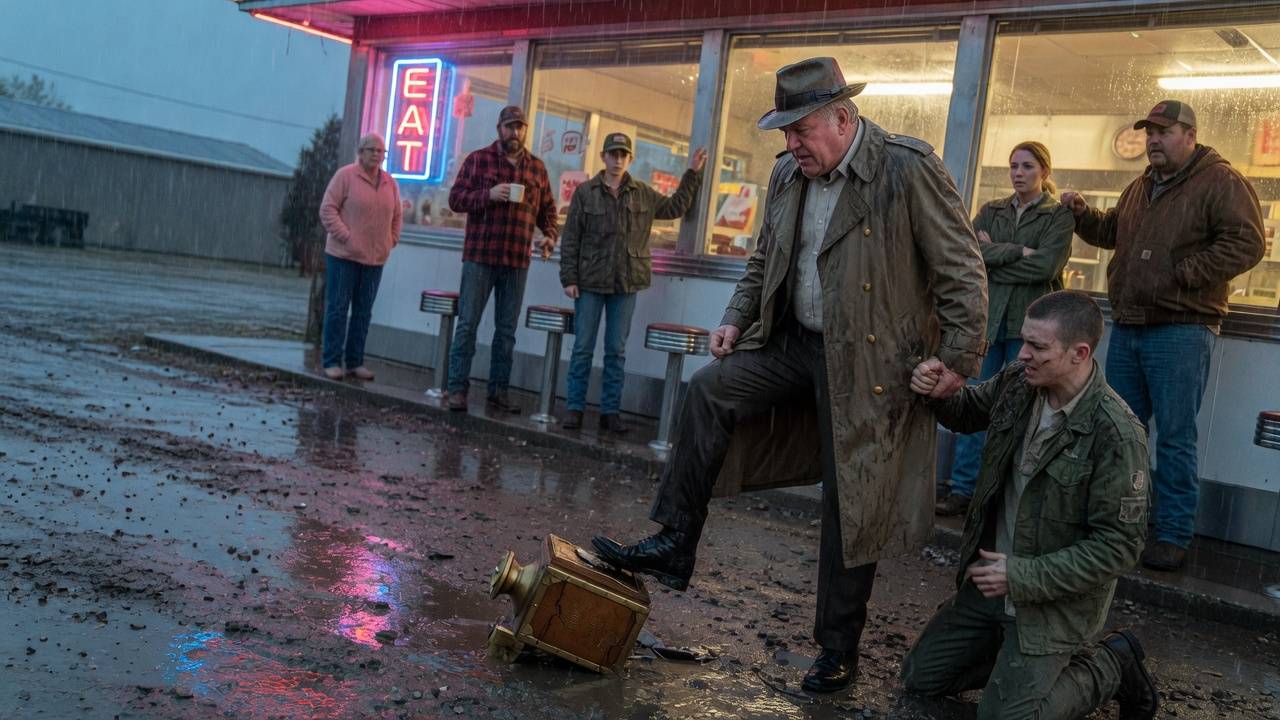
Leo looked at his father. He saw the way the rain had ruined the expensive coat, the way the mud was caked into his father’s gray hair. He also saw the look in his father’s eyes—the same look Leo had seen right before his father had authorized the clearing of the tent city on the river last winter. It wasn’t about the law. It was about erasure.
“I didn’t see it, Dad,” Leo lied. He’d seen the plate. He’d even written it down in his head. W-A-V-E-6-7.
“You were standing right there!” Thorne coughed, clutching his chest. “Useless. Just like your mother. Get the Sheriff on the phone. Tell him I want a state-wide alert. I want that ‘psych’ case found. He’s got a kid in there. Use that. Kidnapping. Endangerment. I want him in a cage by sunrise.”
Leo looked back at the diner window. Marge, the cook, was staring out at them. She looked disgusted. Leo felt a cold knot of shame tighten in his gut. He remembered the way the veteran had looked at the wooden box. It wasn’t loot. It wasn’t a prop. It was a person.
“He asked you to move your foot, Dad,” Leo said quietly.
Thorne froze. He slowly lowered the bag of peas. “What did you say?”
“He asked you. Twice. You didn’t have to kick it.”
Thorne’s hand shot out, grabbing Leo’s varsity jacket, pulling him down to the window of the cruiser. “He’s a vagrant. A drifter. He’s a threat to everything we’re building here. You think those investors are going to sign the deal if the front page shows a hobo beating the Mayor in his own parking lot? You choose a side right now, Leo. You’re either with this family, or you’re out in the mud with him.”
Leo didn’t pull away. He didn’t have the strength. He just looked at the mud on his father’s boots—the same mud that was now smeared on the urn that held a soldier’s remains.
Out in the timber camp, Jax was moving. He had Toby help him prop the van up on a stump. He had to crawl into the cold, gray muck to reach the starter motor. His fingers were numb, his field jacket soaked through, but he worked with the practiced speed of a man who had fixed Humvees in the middle of a sandstorm.
“Miller was a mechanic,” Jax said, his voice muffled by the van’s undercarriage. “Back in Ohio. He used to say a machine was like a person. If you didn’t listen to it, it’d eventually stop talking to you.”
“Was he your best friend?” Toby asked. He was holding a flashlight, the beam shaking as he tried to keep it steady for Jax.
“He was the guy who stayed,” Jax said. He grunted as he hammered a screwdriver against the starter solenoid. “When the unit got hit… when everyone else was scrambling for cover… Miller stayed on the gun. He kept them off us long enough for the medevac to get in. He took three rounds to the chest doing it. He died looking at me, Toby. Asking me if we were clear.”
Jax crawled out from under the van, his face streaked with grease and mud. He looked at the urn sitting on the passenger seat. “He never saw the ocean. He grew up in a landlocked town and spent his whole life dreaming of the Pacific. He used to keep a picture of the Oregon coast pinned to his locker. Said the air there smelled like life, not dust.”
Jax climbed back into the driver’s seat. He took a deep breath and turned the key.
The engine hesitated. It groaned. And then, with a violent shudder, it roared into life.
“We have to go,” Jax said, his eyes hardening. “The sun’s going to be up in three hours. We have a hundred miles to cover, and half of it is patrolled.”
“Jax,” Toby said, looking at the road ahead. “What happens when we get there? When you scatter him? Do we just… keep driving?”
Jax looked at the kid. He saw the reflection of himself—the runaway, the ghost, the person with no place to land. He thought about the sniper rifle in the back. He thought about the “psychological instability” tag on his file. He realized that for the first time in three years, he wasn’t just moving away from something. He was moving toward something.
“We get him to the water first,” Jax said. “The rest… we’ll figure that out when the sun comes up.”
He shifted the van into gear. They didn’t head back to the highway. Jax knew these roads—the old logging veins that crisscrossed the coastal range. They were dangerous, prone to slides, and unmapped by GPS, but they led west.
As they drove, the radio in the van crackled. Jax tuned it to the local emergency band.
“…all units be advised, suspect is considered armed and extremely dangerous. Accompanying a juvenile, possible kidnapping victim. Vehicle is a white 1994 Ford Econoline. Mayor Thorne has authorized a reward for information leading to the arrest…”
Jax turned the volume down. He looked at Toby. The kid wasn’t scared anymore. He was watching the trees go by, his hand resting on the brass hinges of the urn.
“They’re calling you a kidnapper,” Toby said.
“They call you what they need to call you to make the hunt easier,” Jax replied. “In Afghanistan, they called us ‘stabilization forces.’ The guys shooting at us called us ‘invaders.’ The labels don’t change the dirt under your fingernails.”
They hit the mountain pass as the first hint of gray began to bleed into the eastern sky. The rain had turned to a fine, misty spray that coated the windshield. The van was overheating, the temp gauge needle hovering in the red, but Jax pushed it. He could smell the salt in the air. It was faint, buried under the scent of pine and wet earth, but it was there.
Suddenly, a pair of headlights appeared in the rearview mirror. They weren’t the flashing blues of a cruiser. They were the high-intensity LEDs of a private vehicle. A black Escalade.
“Thorne’s security,” Jax hissed. “They found the track.”
The Escalade was closing fast, the heavy SUV ignoring the potholes and washouts that Jax had to navigate carefully. The tall guard, Miller—the man whose name was an insult to the box in Toby’s lap—was driving.
“Toby, get on the floor!” Jax yelled.
The Escalade surged forward, ramming the back of the van. The impact sent a jolt through Jax’s spine, the sound of rending metal echoing in the narrow canyon. The van fishtailed, the rear tires sliding toward the edge of a hundred-foot drop-off.
Jax wrestled the wheel, his muscles screaming. He didn’t brake. He floor-boarded the accelerator, the old V8 engine screaming in agony.
“You want to play?” Jax whispered, his eyes narrowing. “Let’s play.”
He saw the bridge ahead—a narrow, one-lane timber span over a rushing creek. It was old, the wood gray and weathered. Jax knew the weight limits. He knew the structural integrity of a van vs. a five-ton armored SUV.
He timed it perfectly. He slammed on the brakes just before the bridge, letting the Escalade’s momentum carry it alongside him. Then, he veered left, his heavy steel bumper catching the Escalade’s rear quarter panel.
It wasn’t a violent hit, but it was a tactical one. The Escalade’s traction control system fought the slip, but the mud was too deep. The SUV spun, its nose catching the heavy timber railing of the bridge. The wood splintered with a roar, and the Escalade slid halfway off the side, the front wheels spinning uselessly over the ravine.
Jax didn’t stop to look. He didn’t check to see if they were alive. He knew the frame of the SUV was wedged; they weren’t going anywhere for hours.
He drove across the bridge, the van’s engine rattling like a tin can full of nails. They cleared the pass and began the long descent toward the sea.
The sky was turning a pale, bruised blue. The clouds were breaking. And there, at the end of the long, winding road, was the horizon.
“We’re here,” Toby whispered, standing up to look through the windshield.
Jax didn’t say anything. He couldn’t. His throat was tight, the ‘cold’ finally starting to melt. He looked at the urn. The wood was scarred, the mud dried into the grain, but it was whole.
“Sunrise, Miller,” Jax said, his voice a ghost of a sound. “Just like we said.”
But as they hit the coastal highway, the blue lights were waiting. Not one or two, but a wall of them. The Sheriff had blocked the entrance to the state park.
Jax pulled the van to the shoulder. He didn’t try to run. The van was dead anyway, steam pouring from under the hood. He looked at the police, the rifles leveled over the tops of car doors, the megaphones calling his name.
He looked at Toby. “Take the back door. Go into the dunes. Don’t look back.”
“No,” Toby said, his voice firm. “I’m staying with you. And Miller.”
Jax looked at the urn. He looked at the sea. He realized that the promise wasn’t about the water. It was about the dignity of the finish.
He reached for the black bag with the rifle. He didn’t put it together. He just took the heavy, brass-bound box and stepped out into the wind.
Chapter 6
The wind off the Pacific was a physical force, a wall of brine and cold that tore at Jax’s field jacket. It carried the roar of the surf, a deep, rhythmic thrumming that drowned out the idling engines of the six patrol cars lined up across the highway. The morning light was a sliver of gold on the edge of the world, bleeding into the gray-blue expanse of the water.
“Drop the package and put your hands behind your head!” The megaphone’s voice was distorted by the wind, thin and tinny against the vastness of the coast.
Jax didn’t drop it. He cradled the urn against his chest, feeling the weight of it, the solid reality of the oak. He took a step forward, his boots sinking into the soft, white sand of the dunes.
“I said drop it!” A deputy moved forward, his Remington 870 leveled at Jax’s chest.
Jax stopped. He didn’t look at the deputy. He looked at the man standing behind the line of cars—Mayor Tom Thorne. Thorne was wrapped in a new coat, a dark wool one this time, his face still bruised and swollen. Next to him stood the Sheriff, a man named Miller—ironically—who looked like he’d rather be anywhere else.
And then there was Leo. The son. He was leaning against his father’s car, his eyes fixed on the ground.
“He’s got a weapon!” Thorne yelled, pointing a shaking finger at Jax. “Search the van! He’s a sniper! He’s got a high-powered rifle in there!”
The Sheriff signaled, and two deputies rushed the Econoline. They dragged Toby out, the kid screaming and kicking, before they dove into the back of the van. Moments later, one of them emerged, holding the black nylon bag. He unzipped it, revealing the disassembled bolt and the heavy barrel.
“Confirmed, Sheriff,” the deputy called out. “M24 configuration. Disassembled.”
“See?” Thorne’s voice was a triumphant screech. “He’s a killer! He was planning an assassination! Arrest him! Shoot him if you have to!”
The Sheriff looked at the rifle parts, then at Jax. He saw the way the veteran was standing—not in a combat stance, but with the weary, slumped shoulders of a man who had reached the end of a very long road.
“Jax!” Toby’s voice broke through the wind. They had him pinned against the hood of a cruiser, his face pressed to the cold metal. “Jax, don’t let them!”
Jax turned his head slightly, his eyes finding Toby. “It’s okay, kid. It’s done.”
Jax looked back at the Sheriff. “I’m not an assassin. I’m a delivery man. I have a permit for the rifle. It’s legal. And I’m not ‘unstable.’ I’m just tired of people like him stepping on things they don’t understand.”
Jax turned his back on the police. He began walking toward the water.
“Halt! Or we will open fire!” The Sheriff’s voice was firm now, the professional mask sliding into place.
Jax didn’t halt. He walked through the tall beach grass, the sand filling his boots. He could hear the clicks of safeties being disengaged, the sharp, metallic sounds of a dozen men preparing to kill.
“Wait!”
The shout didn’t come from a deputy. It came from Leo Thorne.
The Mayor’s son pushed past his father, stumbling into the sand. “Wait! Stop!”
“Leo, get back here!” Thorne grabbed for his son’s arm, but Leo wrenched away.
Leo ran toward the Sheriff, his face flushed, his breath coming in ragged gasps. “He didn’t do anything! He didn’t kidnap the kid! The kid was hiding in the van because he was scared of his stepdad! I saw the messages on the town board! And the vet… he didn’t attack Dad first!”
The Sheriff frowned. “Leo, your father said—”
“My father lied!” Leo yelled, his voice cracking, the sound carrying over the dunes. “I have the video! The whole thing! Not just the part the kids put online. I have the security feed from the diner’s back lot. My dad kicked the box. He stepped on it. He told the guy to move his ‘trash.’ The vet gave him a warning. He tried to walk away!”
Thorne’s face went from purple to a ghostly, sickly white. “Leo, shut your mouth. You’re talking out of turn.”
“No, Dad. I’m talking for the first time,” Leo said. He pulled a small thumb drive from his pocket and held it up. “It’s all here. The whole ten minutes. My dad used the town’s tow truck to illegally impound a vehicle on public property. He provoked a combat veteran. He assaulted him first.”
The Sheriff looked at the thumb drive, then at the Mayor. The silence among the deputies was deafening. They all knew Thorne was a bully, but they’d always looked the other way because Thorne signed the checks. But this… a viral video, a veteran, a dead soldier’s remains… this was a PR nightmare they couldn’t bury.
Jax didn’t stop to listen to the argument. He reached the edge of the water. The tide was coming in, the cold spray soaking his jeans. The sun was fully above the horizon now, a blinding, brilliant eye that turned the spray into diamonds.
He knelt in the wet sand. He placed the urn in front of him.
“We’re here, Miller,” Jax whispered. “Smell that? That’s the Pacific. No dust. No heat. Just the big blue.”
He reached for the brass latches. His hands were steady now. The ‘cold’ was gone, replaced by a hollow, aching warmth. He opened the lid.
Inside, the ashes were fine and gray, mixed with a few small pieces of bone—all that was left of a man who loved classic cars and could fix a transmission with a paperclip.
Jax stood up. He took a handful of the ashes. He felt the grit against his skin, the physical connection to a history that was finally ending. He threw the ashes into the wind.
They didn’t fall. They took flight, caught by the gale, swirling into the gold light before being pulled down into the white foam of the breakers.
Handful by handful, Jax gave his friend to the sea. He didn’t say a prayer. He didn’t give a speech. He just watched as the gray dust vanished into the infinite blue.
When the urn was empty, Jax closed the lid. He stood there for a long time, the wind whipping his jacket, his eyes fixed on the horizon. He felt light. He felt like the ‘psychological instability’ wasn’t a weight anymore, but a shield. He was different, yes. He was broken in places that would never fully knit. But he was here. And Miller was home.
He turned back toward the highway.
The police were still there, but the rifles were lowered. The Sheriff was standing with Leo, looking at the thumb drive. Mayor Thorne was sitting on the bumper of a cruiser, his head in his hands, the image of a man whose empire had just developed a fatal crack.
Toby was standing by the van, the deputies having let him go. He was watching Jax with a look of pure, unblinking awe.
Jax walked back through the sand. He didn’t run. He didn’t hide. He walked right up to the Sheriff and held out his hands, wrists together.
“The warrant’s still active,” Jax said. “And I’m sure the Mayor wants to press charges for the assault.”
The Sheriff looked at Jax’s wrists, then at the empty urn. He looked at Leo, who was standing tall for the first time in his life. Then he looked at the row of deputies, many of whom were veterans themselves.
“The warrant is for a wellness check,” the Sheriff said slowly. “Not an arrest. As for the assault… the video I just saw shows a man defending his property and his dignity against an aggressor. In this county, we call that self-defense.”
The Sheriff reached out and patted the urn. “Is he gone?”
“He’s in the water,” Jax said.
“Good,” the Sheriff nodded. “Then my job here is done. Deputy, get the kid some hot cocoa. And get the vet’s van a jump-start. We’re clearing the road.”
“Wait!” Thorne stood up, his face contorted. “You can’t just let him go! He’s a menace! He ruined the project! He—”
“Shut up, Tom,” the Sheriff said, not even turning around. “Go home. Before I decide to look into those development permits Leo mentioned.”
Jax stood by the Econoline as the police cars began to pull away. The sun was warm on his back now, the mist burned off by the morning heat. Toby was sitting on the back bumper, drinking from a foam cup, looking out at the ocean.
Leo Thorne walked over. He looked at the van, then at Jax.
“I’m sorry,” Leo said. “About the box. About everything.”
Jax looked at the young man. He saw the cost of the choice Leo had made. He’d lost his father’s favor, his inheritance, and the only life he’d ever known.
“You did the right thing,” Jax said. “That’s harder than the tactical thing.”
“Where will you go?” Leo asked.
Jax looked at the van. The engine was idling smoothly now, the sound of the Pacific drowning out the rattle. He looked at Toby. The kid was looking at him, waiting for the command.
“North,” Jax said. “I heard there’s work in the fisheries. They don’t care much about labels up there. Just if you can pull your weight.”
“Can I come?” Toby asked, his voice small.
Jax looked at the empty passenger seat where the urn had sat for three thousand miles. He thought about the ghost of Miller. He thought about the promise. The promise was kept. The mission was over. It was time for a new one.
“Get in the van, kid,” Jax said. “We have a long drive ahead of us.”
Jax climbed into the driver’s seat. He placed the empty urn on the passenger seat, a reminder of the weight he no longer had to carry. He shifted into gear and pulled onto the coastal highway, the white foam of the Pacific visible in the rearview mirror until the road turned back into the trees.
The sunrise was behind them now, casting long, golden shadows across the asphalt. Jax didn’t look back. He kept his eyes on the road, his hands steady on the wheel, driving toward a horizon that finally felt like it belonged to him.