Chapter 5
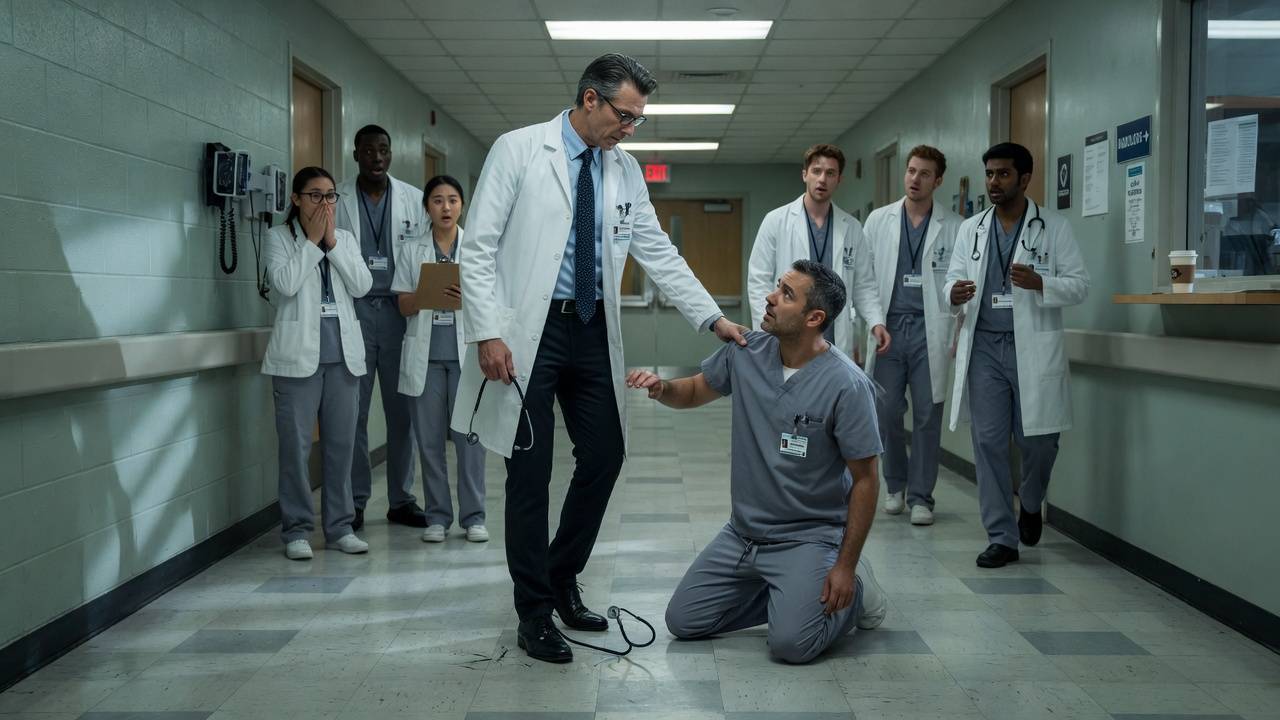
The elevator didn’t move fast enough. Henry stood in the corner of the small, mirrored box, his reflection a stranger in grey scrubs. His hands were tucked into his pockets, but he could feel the vibration in his bones—the same post-action hum that used to settle into his marrow after a long night in a triage tent. It was the adrenaline receding, leaving behind a cold, hollow clarity. He could still feel the phantom impact in his palm, the way Crane’s sternum had jolted under the strike. It wasn’t satisfaction he felt. It was a heavy, leaden dread.
He didn’t go to the locker room. Instead, he took the service stairs to the sub-basement, a labyrinth of pipes and humming generators where the hospital’s mechanical heart lived. He found a dark corner behind a stack of industrial air filters and sat on a plastic crate.
He stayed there for twenty minutes, staring at the floor, listening to his own breathing. He thought about the boy in Kandahar. Private Miller—no relation, though the name had always felt like a jagged piece of glass in Henry’s throat. Miller had been nineteen, with a tattoo of a compass on his forearm that he’d gotten because he was afraid of getting lost. Henry had been the one who’d lost him. He’d hesitated for one heartbeat, trying to decide between two equally grim surgical paths, and in that heartbeat, the choice had been made for him.
He’d spent three years trying to be a ghost to atone for that heartbeat. Now, because of a surgeon’s ego and a dying man in 402, the ghost was gone.
“You can’t hide down here forever, Henry.”
The voice was soft, but it echoed in the concrete space. Sarah was standing at the entrance to the utility corridor, her shadow long and thin. She looked small against the massive machinery.
“How did you find me?” Henry asked, not moving.
“I know where people go when they’re trying to disappear,” she said, walking toward him. She stopped a few feet away, her arms crossed tightly over her chest. “The police are in the lobby. Security has been searching every floor. Dr. Sterling called an emergency board meeting. They’re calling it an ‘unprovoked assault by a staff member with a falsified history.’”
Henry gave a short, mirthless laugh. “Unprovoked. That’s a good word for it.”
“The video is everywhere, Henry,” she whispered, her voice trembling. “Someone—one of the students—uploaded it. It’s got two million views. People are calling you the ‘Ninja Janitor.’ But Sterling is furious. He cares about the hospital’s endowment, and Crane is the golden goose. He’s already talking about pressing criminal charges.”
Henry looked up at her. “How’s Henderson?”
Sarah’s expression softened. “He’s stable. They moved him to the cardiac ICU. The resident on duty confirmed it was tamponade. You saved him, Henry. If you hadn’t walked in there, he’d be in the morgue right now, and Crane would be signing a death certificate for a ‘massive pulmonary embolism.’”
“It doesn’t matter,” Henry said, standing up. His joints felt stiff, as if he’d aged twenty years in the last hour. “I broke the rules. I touched a patient without a license. I struck a superior officer—a doctor. In this building, that’s a sin you don’t recover from.”
“You weren’t just a medic, were you?” Sarah asked.
Henry reached into his pocket and pulled out the shattered pieces of his stethoscope. He’d picked them up before he left the hallway, a reflex he couldn’t explain. “I was a surgeon. I had a fellowship in trauma at Mass General before I went over. I was supposed to be the guy who fixed everything.”
“Why did you stop?”
“Because I learned that some things can’t be fixed. And sometimes, the person trying to fix them is the one doing the most damage.”
Before Sarah could respond, the heavy steel door at the end of the corridor groaned open. Two security guards stepped through, followed by Mrs. Gable. She looked pained, her usual stern composure fractured.
“Henry,” she said, her voice echoing. “I’m sorry. You need to come with us. Dr. Sterling is waiting.”
Henry didn’t resist. He walked toward them, his head down. As they led him through the hospital, the atmosphere was different. The nurses didn’t look away. They stopped and watched. Some of them looked terrified, but others—the ones who had spent years being barked at by Julian Crane—looked at him with something that felt dangerously like gratitude.
They took him to the executive wing, a place of plush carpets and mahogany doors that felt like a different world from the ammonia-scented hallways of the fourth floor. Inside Dr. Aris Sterling’s office, the air was thick with the scent of expensive cigars and panic.
Sterling sat behind a desk that looked like it had been carved from a single, ancient oak tree. He was a man of seventy, with skin like parchment and eyes that saw everything as a balance sheet. To his right, Julian Crane sat in a leather armchair. He had a bandage on his chest and a bruise beginning to bloom on his jaw. He looked like a man who had been violated by the very universe he thought he controlled.
“Sit down, Mr. Miller,” Sterling said, his voice a dry rasp.
Henry sat. He felt the security guards take up positions behind him.
“We’ve spent the last hour reviewing your file,” Sterling continued, tapping a thin folder on his desk. “Or rather, the file you provided when you were hired. It’s remarkably thin. No previous hospital experience. A discharge from the Army with no specific details. And a name that seems to be quite common.”
“I didn’t lie on the application,” Henry said. “I just didn’t include the parts you didn’t ask for.”
“You assaulted a world-renowned surgeon!” Crane exploded, his voice cracking. “You nearly killed me! You’re a violent, unstable man who has been lurking in our hallways, waiting for a chance to strike!”
“I was waiting for a chance to mop,” Henry said quietly. “You’re the one who decided to use my chest as a napkin and my past as a footstool.”
“Enough,” Sterling snapped. He turned his gaze to Henry. “Mr. Miller—or should I call you Dr. Miller? We did a more thorough search. We found your record at the Board of Medicine. You surrendered your license voluntarily three years ago. No malpractice suits. No disciplinary actions. You just… quit.”
“I lost my fitness to practice,” Henry said.
“That’s not what the military record says,” Sterling countered. “It says you were recommended for a Silver Star. It says you saved fourteen men in a single night during a breach in the wire. It also says you requested a psychological discharge after the death of a single private.”
The mention of Miller’s death made Henry’s vision blur for a second. He could feel the heat again. The smell of burning rubber.
“You’re a hero with a death wish, it seems,” Sterling said, leaning back. “But here is the problem. You are currently an unlicensed individual who performed a high-risk surgical procedure in my hospital. You also committed a felony assault on a senior staff member. The video of this is currently the top trending topic on three different social media platforms. The public sees a hero. My board of directors sees a liability that could bankrupt this institution.”
“So fire me,” Henry said. “I’ve already packed my bag.”
“It’s not that simple,” Sterling said. “Dr. Crane wants you arrested. He wants a public trial. He wants to crush you.”
“I do!” Crane shouted. “I want him in a cage!”
Sterling looked at Crane with a flicker of annoyance. “Julian, be quiet. The problem, Henry, is that the patient you saved is the CEO of a major logistics firm. His family is currently in the ICU, and they are demanding to know why a janitor was the only person in the room who knew how to save their father. They are also asking why Dr. Crane was treating him for an embolism when the symptoms were clearly cardiac.”
Crane went pale. The theatrical indignation vanished, replaced by a sudden, cold realization.
“The narrative is shifting,” Sterling said. “If we prosecute you, we admit that our head of cardiothoracic surgery is incompetent and that a janitor had to step in to prevent a wrongful death. Our insurance premiums would triple. Our reputation would be in the dirt.”
“So what do you want?” Henry asked.
“I want a compromise,” Sterling said. “You sign a non-disclosure agreement. You disappear. You leave Boston tonight. In exchange, we won’t press charges, and we will provide you with a quiet, off-the-books settlement for your ‘injury’ sustained during your employment.”
Henry looked at the old man. He looked at the greed and the fear masked as pragmatism. Then he looked at Crane, who was staring at his own hands, his pride a shattered thing.
“No,” Henry said.
The room went still.
“Excuse me?” Sterling asked.
“I’m not signing anything,” Henry said, his voice growing stronger. “And I’m not disappearing. You want to protect the hospital? Fine. But you don’t do it by lying. You do it by fixing the problem.”
He pointed at Crane. “He’s a danger to his patients. He’s been a danger for a long time, but everyone was too afraid of his ego to say anything. If I leave, he stays. And the next time, there won’t be a janitor in the room to catch the mistake.”
“You have no leverage here, Henry!” Crane spat. “You’re a disgraced doctor who lost his mind in a desert!”
“I have the video,” Henry said. “And I have the medical students who saw what you did. And I have the patient’s family, who I’m sure would love to hear my version of the events.”
Sterling’s eyes narrowed. He looked at Henry as if he were a new species of predator he hadn’t accounted for. “What are you asking for, Henry?”
“I want Crane out. Today. No golden parachute. No quiet resignation. A full review of his surgical outcomes for the last five years.”
“And what about you?” Sterling asked.
Henry looked at the shattered stethoscope in his hand. The weight in his chest was still there, but it felt different. It felt like a foundation rather than a burden.
“I’m going to find a way to get my license back,” Henry said. “But not here. And not as a surgeon. I think I’ve spent enough time in the silence. I want to be somewhere where the ammonia doesn’t smell like penance.”
He stood up and walked toward the door. The security guards didn’t stop him.
As he stepped out into the hallway, the hospital felt different. The tension was still there, the high-pressure hum of a thousand lives in the balance, but for the first time, he didn’t feel like a ghost. He felt like a man walking through a doorway he had spent three years trying to lock.
He found Gus waiting by the elevators. The old man looked at him and nodded once, a sharp, military gesture of respect.
“You did it, Doc,” Gus said.
“I just finished the spill, Gus,” Henry said, pressing the button for the lobby. “Now I have to go see someone about a compass.”
Chapter 6
The grey dawn over the Charles River was cold and indifferent, much like the city of Boston itself. Henry stood on the bridge, his hands deep in the pockets of a worn canvas jacket. He wasn’t wearing scrubs anymore. He was wearing the clothes he’d arrived in three years ago—a flannel shirt, heavy jeans, and boots that had seen too much of the world.
In his pocket, his phone buzzed. It had been buzzing for twelve hours. News outlets, lawyers, old colleagues from the Army—the world was clawing at him, trying to turn his three-minute takedown of Julian Crane into a fable. But Henry wasn’t a fable. He was a man who had finally stopped running, only to find himself at the edge of a very long road.
He took the bus to a quiet suburb on the edge of the city. The houses here were small, with neat lawns and American flags that flapped in the morning breeze. He walked to a house at the end of a cul-de-sac. It was a white Cape Cod with blue shutters and a pot of fading marigolds on the porch.
He hesitated at the gate. This was the one thing he hadn’t been able to face. Not the board of medicine, not the police, not the ghost of his own failure.
He walked up the path and knocked.
A woman answered after a long moment. She was in her fifties, with silver-streaked hair and eyes that held a quiet, permanent sadness. She looked at Henry, and for a second, her breath hitched.
“Henry,” she whispered.
“Hello, Mrs. Miller,” Henry said.
She opened the door wider, her hand trembling as she beckoned him in. The house smelled of cinnamon and old books. On the mantle in the living room, there was a framed photograph of a young man with a compass tattoo on his arm.
“I saw the news,” she said, sitting on the edge of a floral armchair. “I saw the video of you in the hospital. My sister sent it to me. She said, ‘Isn’t that the doctor who was with our Jacob?’”
Henry sat on the sofa opposite her. He felt the weight of the room, the years of unspoken grief that lived in the corners. “I’m sorry it took me so long to come here, Martha. I was… I was trying to find a way to be worth the visit.”
“You were a good doctor, Henry. Jacob’s letters always said that. He said you were the only one who didn’t look through them. You looked * at* them.”
“I let him die,” Henry said, the words finally out in the open. “I made a choice. I thought I could save the sergeant first, and Jacob would hold on. I was wrong. I was arrogant enough to think I could play God in a ditch, and I lost him.”
Martha looked at the photograph of her son. She didn’t cry. She had done her crying years ago. “Jacob didn’t die because of your choice, Henry. He died because of a war. You’re the one who’s been punishing yourself for a choice you weren’t supposed to have to make.”
She reached out and took his hand. Her skin was dry and warm. “I used to be angry. I used to think if you’d just been a second faster, or a second smarter, he’d be sitting here having breakfast. But then I realized that if you’d been that perfect, you wouldn’t be human. And Jacob loved you because you were human.”
Henry felt a crack in the armor he’d worn for three years. A deep, jagged fracture that let the light in.
“I’m trying to go back,” Henry said, his voice thick. “To medicine. But not the way I was. I think I’m done with the prestige. I want to go to the clinics. The places where people are invisible. Like I was.”
“Then you’re already back,” Martha said.
When Henry left the house an hour later, the sun was fully up. The world looked sharper, the colors more vivid. He took the bus back to the hospital, not to work, but to close the final chapter.
The lobby of Saint Jude’s was crowded. A group of protesters had gathered outside, holding signs that said SUPPORT THE HERO JANITOR and PATIENTS OVER PROFITS. Inside, the tension was palpable.
Henry walked past the security desk. The guard, a man named Mike who had usually ignored him, gave him a solemn nod.
“He’s in the ICU, Henry,” Mike said. “Room 4.”
Henry didn’t ask how he knew who he was looking for. He went up to the fourth floor.
He found Sarah standing outside Room 4. She looked exhausted, but her eyes were bright.
“He’s awake,” she said. “Mr. Henderson. He’s been asking for the man who saved his life. He told the Board he won’t sign the waiver for the hospital unless they reinstate you.”
“I don’t want to be reinstated,” Henry said.
He walked into the room. Mr. Henderson was propped up on pillows, a series of tubes running from his chest. He was pale, but his breathing was clear. When he saw Henry, a small smile touched his lips.
“The ghost,” Henderson rasped. “My wife told me what you did. She said you hit that doctor so hard he started praying.”
“I’m sorry about the mess in the hallway, Mr. Henderson,” Henry said, standing by the bed.
“Don’t be. That man was a parasite. He looked at me and saw a chart. You looked at me and saw a person.” Henderson reached out a weak hand. “They told me you were a doctor once. They told me you quit.”
“I did,” Henry said, taking the man’s hand. “But I think I’m starting a new residency.”
“Where?”
“Wherever they need someone who knows how to use a mop and a stethoscope.”
Henry stayed with him for a few minutes, checking his vitals out of habit, feeling the steady, rhythmic beat of a heart he had fought for.
As he walked out of the room, he saw Dr. Sterling standing at the nurse’s station. The Chief of Staff looked like a man who had spent the night in a storm. He held a manila envelope in his hand.
“Henry,” Sterling said.
Henry stopped. “Dr. Sterling.”
“Crane is gone,” Sterling said, his voice flat. “The board met this morning. We’ve opened a full audit of his department. His contract has been terminated for cause.”
“And the lawsuit?” Henry asked.
“We’re settling with the Hendersons. They’ve made it clear that their cooperation is contingent on our treatment of you.” Sterling handed him the envelope. “This is your file. The official record will state that you were an attending physician on a temporary consulting basis. Your license restoration is being fast-tracked through the state board. I’ve made some calls.”
Henry took the envelope. He didn’t thank him. He knew this wasn’t an act of kindness; it was a desperate attempt at damage control.
“There’s a position,” Sterling said, hesitating. “Head of Trauma. We need someone who can… stabilize the department.”
“No,” Henry said. “But thank you.”
He turned to Sarah, who was watching from the desk.
“I’m going to the free clinic on Harrison,” Henry said. “They need a night doctor. Someone who doesn’t mind cleaning up after the shift is over.”
Sarah smiled, a slow, beautiful expression that lit up her face. “I think they’d be lucky to have you, Henry.”
“And Sarah?” Henry added. “Keep an eye on the floors. Some of the orderlies get lazy with the figure-eights.”
He walked toward the service elevator. He didn’t take the fancy mirrored one this time. He took the one with the scratched steel walls and the smell of industrial cleaner.
He went down to the basement one last time. He opened his locker. He took out the tattered green duffel bag. He looked at the empty space where his mop bucket used to be.
He felt a hand on his shoulder. It was Gus.
“Leaving us, Doc?”
“Moving on, Gus. There’s a war on the streets. I think I’m better suited for that one.”
“You got your hands back,” Gus said, his eyes crinkling. “That’s all that matters.”
Henry walked out of the hospital through the loading dock. He stepped into the bright, noisy reality of the city. He could hear the sirens, the honking of horns, the chaotic music of a million lives in motion.
He reached into his bag and pulled out a small, black box. Inside was a new stethoscope. It wasn’t vintage. It didn’t have an engraving. It was just a tool.
He slung the bag over his shoulder and started walking. He wasn’t a ghost anymore. He wasn’t a janitor. He wasn’t even the man he had been in the desert.
He was a man who knew the value of a heartbeat because he knew the weight of its absence.
As he turned the corner onto Harrison Avenue, the wind caught his jacket, and for the first time in three years, the air didn’t smell like ammonia.
It smelled like the future.
He didn’t look back at the sterile white tower of Saint Jude’s. He looked ahead at the row of crumbling brick buildings, at the people huddled in doorways, at the world that usually went unseen.
He had work to do. And this time, he wasn’t going to miss a single heartbeat.