Chapter 5
The morning after the Oak Ridge gala didn’t bring the clarity of a clean break; it brought the heavy, gray weight of a Virginia winter sky and the persistent, throbbing ache of a hip joint that had been pushed too far. Sam sat on the edge of his bed in the cramped apartment he rented in a forgotten corner of Arlington, the kind of place where the walls smelled faintly of other people’s cooking and the radiator hissed like a dying animal. He didn’t turn on the lights. He just sat there, his hands resting on the cool carbon fiber of his prosthetic, watching the dust motes dance in the sliver of streetlamp glow that managed to squeeze through the blinds.
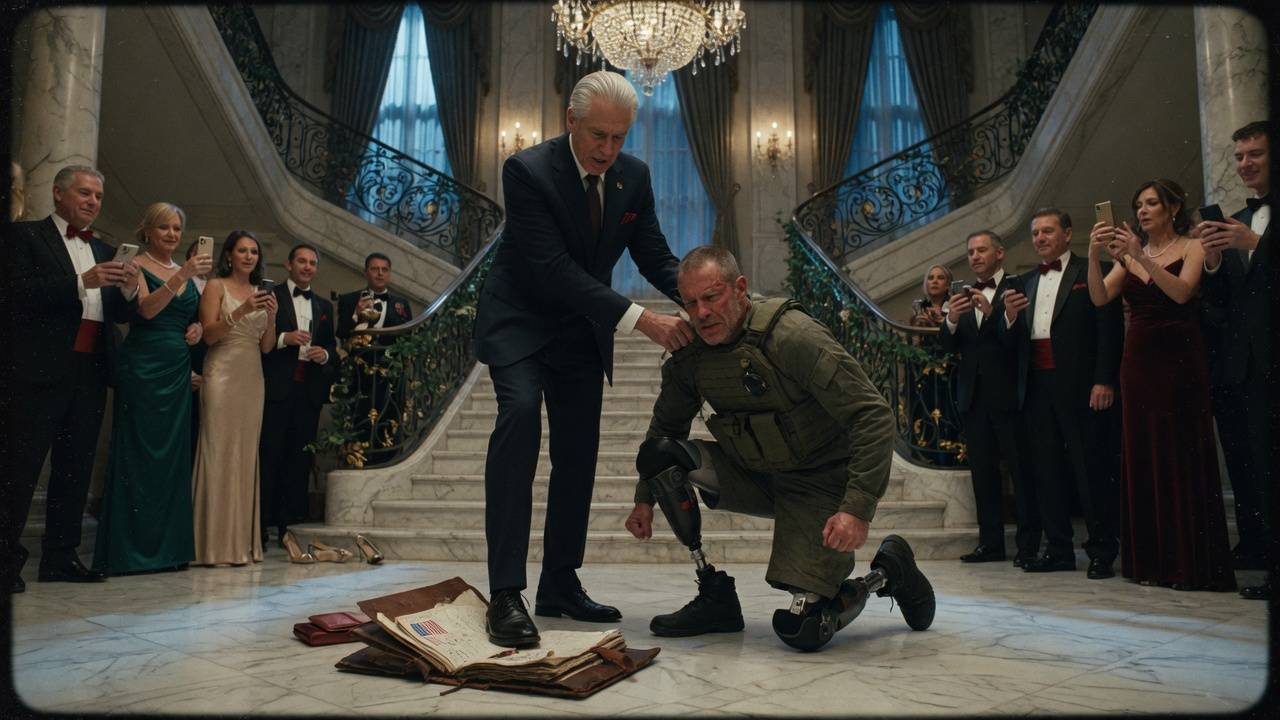
His phone was a vibrating brick on the nightstand. It had been pulsing since midnight—calls from unknown numbers, frantic texts from Diane, and a dozen notifications from social media platforms he barely knew how to navigate. He didn’t touch it. He knew what was on there. He knew how the video looked: a decorated Senator, a “war hero,” being struck down by a man he was supposedly trying to help. In the grainy, handheld footage that was already tearing through the news cycle, the nuance was lost. The whisper—the “one-legged beggar” line—wasn’t picked up by the microphones. All the world saw was Sam’s violence.
A heavy knock at the door made him flinch. It wasn’t the polite tap of a neighbor. It was purposeful.
Sam grabbed his cane, his movements stiff and mechanical, and navigated the three steps to the door. He peered through the peephole. It was Ben, the reporter, looking even more disheveled than he had at the estate, his tie loosened and his eyes bloodshot.
Sam unlocked the deadbolt. “It’s six in the morning, Ben.”
“It’s a revolution, Sam,” Ben said, pushing past him into the small living room. He didn’t wait for an invite. He set a laptop down on the cluttered kitchen table, shoving aside a stack of overdue utility bills. “You haven’t looked, have you? You haven’t seen what’s happening.”
“I know what happened,” Sam said, closing the door and leaning heavily on his cane. “I broke a Senator’s ribs in front of his biggest donors. I’m pretty sure that’s a felony in this zip code.”
“Hall isn’t pressing charges,” Ben said, his fingers flying across the trackpad. “Not yet. His PR team is trying to figure out if they can spin you as ‘mentally unstable’ first. Diane is already whispering to the networks about PTSD-induced outbursts. They’re trying to bury the ‘why’ under the ‘what.’ But they didn’t count on the girl.”
Ben turned the laptop toward Sam. It was a video, but not the one of the fight. It was Maya. She was standing in the gravel driveway of the estate, the gold light of the ballroom still visible behind her. Her eyes were red, but her voice was steady. She was holding the journal Sam had given her.
“This is my father’s handwriting,” Maya said to a group of reporters in the clip. “The stories in Senator Hall’s book… they didn’t happen to him. They happened to my dad. And Sam was the one who brought them home.”
Sam felt a knot tighten in his stomach. “She shouldn’t have done that. She’s a kid. They’ll chew her up.”
“She’s a Miller, Sam. She’s tougher than you give her credit for,” Ben said. He leaned back, the blue light of the screen making him look ghostly. “But here’s the kicker. Hall’s foundation just officially ‘postponed’ the endowment for the Falls Church VA clinic. They cited ‘unforeseen security concerns’ and the need to ‘re-evaluate the partnership.’ They’re strangling the clinic to punish you.”
Sam went cold. This was the residue. The cost of the truth wasn’t his own freedom—it was the health of the men who actually needed the help. He thought of Dr. Aris and the crowded waiting room full of guys who couldn’t sleep, couldn’t walk, couldn’t find a reason to keep going.
“I need to go there,” Sam whispered.
The Falls Church VA clinic was a squat, brick building that always seemed to be under-lit. When Sam arrived two hours later, the atmosphere was different. Usually, there was a low-level hum of bureaucracy and weary patience. Today, the air was brittle. Two news vans were parked across the street, their satellite dishes aimed at the entrance like predatory birds.
Sam ignored the cameras, his prosthetic clicking rhythmically on the linoleum as he made his way to the administrative wing. Dr. Aris was standing in the hallway, clutching a stack of files. She was a woman who had spent twenty years fighting for every cent of the clinic’s budget, her face a map of institutional exhaustion.
When she saw Sam, she didn’t smile. She didn’t scold him, either. She just looked at him with a profound, quiet sadness.
“Sam,” she said, gesturing toward her office. “Come in. Close the door.”
The office was cramped, filled with the smell of antiseptic and stale coffee. Dr. Aris sat behind her desk and rubbed her temples. “I just got off the phone with the Senator’s Chief of Staff. They aren’t just pulling the endowment, Sam. They’re launching an inquiry into our ‘vetting process’ for patient-advocates. They want your records. They want to prove you’re a liability.”
“He lied, Doctor,” Sam said, his voice flat. “He’s been stealing Miller’s life for a decade. He stepped on the journals. He called me a beggar.”
“I believe you,” she said, looking up. “I’ve seen men like Hall my whole career. They use the uniform as a costume. But the reality is that without that money, our prosthetic lab closes in thirty days. We have twelve guys on the list for new sockets. Three of them are bilateral amputees. What do I tell them, Sam? That the truth is worth their ability to walk?”
Sam looked down at his own leg. The socket was starting to pinch again, a raw, angry heat. He felt the crushing weight of the moral choice. He could go to Ben, give him the rest of the journals, and finish Hall—but the clinic would die in the crossfire. Or he could take the “hush money,” issue a public apology, claim a “medical episode,” and save the clinic.
“He offered a way out?” Sam asked.
“Diane called,” Aris said, her voice dropping. “A ‘restorative justice’ grant. Double the original endowment. All you have to do is sign a statement saying you were confused, that the book is accurate, and that the Senator showed ‘unparalleled restraint’ during your episode. You sign it, and the money is wired this afternoon.”
Sam felt a surge of nausea. It was a buyout. A clean, corporate execution of his friend’s memory.
“I can’t,” Sam said.
“Then you need to find another way to win, Sam. Because if you just stay in the middle, everyone loses.”
As Sam left the clinic, he was intercepted in the parking lot. It wasn’t the press. It was Leo, the young Sergeant from the gala. He was leaning against a gray sedan, his Dress Blue jacket replaced by a worn Army hoodie. He looked different—smaller, somehow. The worshipful light in his eyes had been replaced by a hollow, flickering uncertainty.
“Sir,” Leo said, not saluting this time. “I saw the video. I saw what Maya Miller said.”
Sam stopped, leaning on his cane. “What do you want, Sergeant?”
“I wanted to know if it’s true,” Leo said, his voice cracking. “I re-enlisted because of that man. I told my mother that if a guy like Gregory Hall could make it back and do something good, then maybe it was worth the risk. Tell me he didn’t lie about the ridge.”
Sam looked at the kid and saw the fracture. If he told the truth, he broke the kid’s world. If he lied, he protected a fraud.
“He wasn’t there, Leo,” Sam said. “He was at the TOC. He never touched the sand.”
Leo looked away, his jaw tightening as he struggled with the information. “He’s my CO. He’s… he was everything.”
“He’s a man with a good tailor and a better PR team,” Sam said. “The heroes don’t usually have those things.”
Leo stayed silent for a long time, watching the news vans across the street. Finally, he looked back at Sam. “They’re planning a press conference for tonight. At the Capitol. Hall is going to announce his run for the Governorship. He’s going to use the ‘attack’ at the gala as his platform for ‘mental health awareness’ for veterans. He’s going to make you the face of the ‘broken soldier’ he promises to fix.”
The residue of the night before was turning into a tide. Sam realized that Hall wasn’t just surviving; he was thriving on the conflict. He was turning Sam’s righteous anger into a political asset.
“Thank you, Leo,” Sam said.
“Don’t thank me,” Leo said, turning toward his car. “I just hate being a fool.”
Sam watched him drive away, the physical pain in his leg now secondary to the cold, hard realization that the time for being quiet was over. He called Ben.
“Where are the journals, Ben?”
“I have the scans at the office. Why?”
“I don’t want the scans. I want the originals. And I need you to find me a way into that press conference. Not as a guest. As the evidence.”
Chapter 6
The Capitol was a fortress of white marble and high-wattage anxiety. The air was thick with the humidity of a Washington evening, the kind that made the suit jackets feel like lead weights. Sam stood in the shadows of a side corridor, the hum of the crowd in the main briefing room muffled by heavy oak doors.
He felt the journals in his hand—not the leather-bound ones, but the loose, yellowed pages he’d kept hidden for years. He’d spent the last four hours with Ben and a forensic handwriting expert Ben knew from his days in New York. They had the proof now: a match between Miller’s service records and the handwritten entries that Hall had lifted, word for word, for his “memoir.”
But proof on a laptop wasn’t enough. Not for a man like Hall. You had to peel the skin off the lie in front of the world.
“You sure about this?” Ben asked, standing beside him. The reporter looked terrified, his hands trembling as he checked his recorder. “If this doesn’t land perfectly, Hall will sue us into the stone age. He’ll bury you, Sam. Legally, financially, every way there is.”
“He already tried that,” Sam said. He adjusted his tie, his fingers steady. “He thinks I’m afraid of being broken. He forgot that I already am. You can’t break something that’s already been through the fire.”
The doors opened, and the sound of the press conference surged forward. Gregory Hall was on the podium, framed by a dozen American flags. He looked magnificent. He was wearing a dark charcoal suit, his silver hair catching the light, his expression one of somber, statesman-like resolve.
“And that is why,” Hall was saying, his voice resonating through the room, “we must look at the tragedy of the Oak Ridge gala not as an act of malice, but as a cry for help. The man who struck me is a brother. He is a hero. But he is a hero who has lost his way in the darkness of trauma. My foundation will not only continue to support him, but we are doubling our commitment to veteran mental health. We will not leave them behind, even when they turn on us.”
The room was filled with the soft clicking of shutters. The donors in the front row—the same people who had watched Hall trip Sam—were nodding, their faces full of performative empathy.
Sam stepped out of the shadows.
He didn’t rush. He walked with the deliberate, uneven cadence of his prosthetic, the click-whine cutting through the silence as he approached the center aisle. The reporters turned, their lenses swiveling like turrets.
Hall saw him. For a split second, the Senator’s composure cracked—a flicker of pure, unadulterated panic in those glacier-blue eyes—before the mask slammed back into place.
“Sam,” Hall said, his voice dripping with forced warmth. “I’m so glad you’re here. We were just talking about the path to healing.”
Sam didn’t stop until he was ten feet from the podium. He didn’t look at the cameras. He looked only at Hall.
“I’m not here for healing, Gregory,” Sam said. His voice was quiet, but in the acoustically perfect room, it carried to the back wall. “I’m here for the truth. You told these people you crawled through the fire to save Miller. You wrote it on page 142 of your book. You said you heard his last words.”
“Sam, this isn’t the place,” Hall said, his smile tightening. He signaled to his security team, the charcoal-suited men moving in from the wings.
“The last words Miller ever said weren’t about the mission,” Sam continued, ignoring the guards. He held up a single, tattered page. “They were about a radiator in Ohio. They were about his daughter’s shoes. And I know that because I’m the one who wrote them down while he was dying in my lap. I wrote them in a journal you stole from my locker at the VA three years ago.”
The room went tomb-quiet. The reporters stopped typing.
“That’s a serious accusation, Sam,” Hall said, his voice turning hard. “A desperate one. Trauma does strange things to the memory. We’ve discussed this.”
“It’s not my memory we’re talking about,” Sam said. He turned the page around. “It’s your handwriting. Or lack of it. Ben?”
Ben stepped forward, holding a tablet high. He tapped a button, and the overhead monitors—usually reserved for campaign logos—flashed with a side-by-side comparison. On the left, the original journal page. On the right, Hall’s handwritten draft of the book, provided by a whistleblower in the PR firm.
The text was identical. But the ink on the left was ten years old, stained with the red dust of Afghanistan. The ink on the right was fresh.
“You didn’t even change the adjectives, Gregory,” Sam said. “You were so arrogant you thought a ‘one-legged beggar’ wouldn’t have the spine to call you on it.”
Hall looked at the screen. He looked at the press. He saw the tide turning in real-time. The “war hero” facade was melting under the heat of the stage lights.
“This is a fabrication,” Hall hissed, leaning into the mic, his voice losing its polished resonance. “A coordinated attack by a bitter man—”
“I’m not bitter,” Sam interrupted. “I’m just finished carrying you. You want to talk about mental health? Talk about the sociopathy it takes to stand over a man’s grave and claim his life as your own.”
The security guards hesitated. They looked at each other, then at the Senator. The moral authority in the room had shifted, physical and heavy, toward the man with the limp.
Suddenly, a voice came from the back of the room. “He’s telling the truth.”
It was Leo. The young Sergeant stood up, his face pale but determined. “I checked the logs, Senator. Your Humvee never left the wire that night. I have the digital signatures. I was going to bury them for you. But I can’t.”
The collapse was total. Hall didn’t beg this time; he just went silent, his mouth working but no sound coming out. He looked smaller, the expensive suit suddenly appearing too large for his frame. He was a man who had built a skyscraper on a foundation of sand, and the wind had finally arrived.
Sam didn’t stay for the questions. He didn’t stay to watch the police or the PR team scramble. He turned and walked out of the briefing room, through the marble halls, and into the night.
The aftermath wasn’t a celebration. It was a long, slow exhale.
A week later, the Falls Church VA clinic received a new endowment. It didn’t come from Hall’s foundation—that had been dissolved amid a flurry of federal investigations. It came from a private donor, a woman who had read Ben’s story and wanted to ensure that the “Lost Boys” had a place to find themselves.
Sam sat in a quiet park near the Potomac, the sun warming his face. He wasn’t wearing a tuxedo. He was back in his worn olive vest and jeans. Beside him sat Maya.
She was holding the original journals. She had spent the last few days reading them, learning about the man her father really was—not the cardboard cutout from a bestseller, but the man who worried about her shoes and loved the smell of rain in Ohio.
“He loved you so much, Maya,” Sam said.
“I know,” she whispered. She looked at Sam, her eyes clear. “Thank you for bringing him back.”
“I just held onto him for a while,” Sam said. “He was always yours.”
Sam stood up, his prosthetic giving its familiar, rhythmic click. It still hurt. It still whined. But the weight on his hip felt different now. It didn’t feel like a betrayal. It felt like a part of him—a reminder of what had been lost, and what had been saved.
He walked toward the parking lot, his pace steady, his head held high. He wasn’t a hero, and he wasn’t a beggar. He was just a man who had told the truth, and for the first time in a very long time, that was enough.
The wind off the river was cold, but as Sam reached his truck, he didn’t shiver. He just took a deep breath, the air filling his lungs, clean and sharp and real. He started the engine, the vibration humming through his leg, and drove away from the monuments and the lies, heading toward a future that was finally, undeniably, his own.