Chapter 5
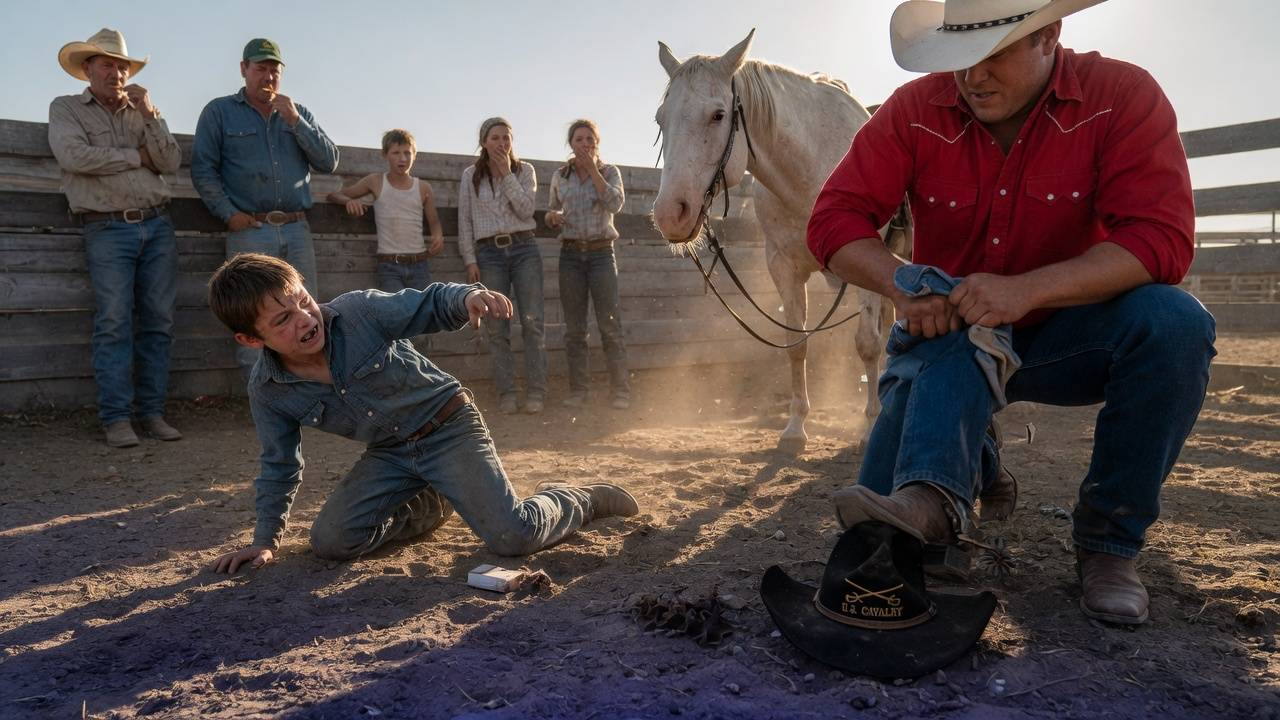
The sound of the Sheriff’s cruiser idling in the paddock was a low, rhythmic thrum that seemed to vibrate right through the soles of Wyatt’s boots. It was the only sound for a long time after the dust from Cody’s fall had settled. The crowd—the neighbors, the investors, the ranch hands who had laughed only minutes before—had drawn back into a jagged semicircle, their faces a blurred gallery of shock and redirected judgment. Nobody was filming anymore. The raw, ugly reality of Cody West gasping for air in the dirt had sucked the digital oxygen out of the room.
Sheriff Miller didn’t rush. He was a man built like a sack of grain, heavy-set and weathered, with a mustache that had seen thirty years of Wyoming winters. He stepped out of the SUV, his boots crunching on the gravel, and looked first at Cody, then at the silver whip lying in the manure, and finally at Wyatt. Wyatt was still holding his cavalry hat, his fingers tracing the crushed gold of the insignia. His knuckles were white, the adrenaline still a cold, humming wire in his chest.
“Wyatt,” Miller said, his voice as dry as the landscape. “You want to tell me why young Mr. West is looking like he just tried to tackle a freight train?”
“He lashed the mare, Sheriff,” Wyatt said. His voice was steady, but there was a rasp to it he couldn’t quite smooth out. “And then he came for me. I warned him.”
“He broke the order!” Cody screamed, his voice cracking as he finally found enough breath to be loud. He was clutching his chest, his expensive red shirt stained with the grey-brown filth of the paddock. “You saw it! He attacked me! I’m the victim here! Arrest him! Get those cuffs on him now!”
Miller looked at Cody, a flicker of something that might have been exhaustion or maybe just plain distaste crossing his eyes. He turned back to Wyatt. “You know the rules, Wyatt. Judge didn’t leave much room for interpretation. You lay hands on him, you go in the back of the car.”
“I know,” Wyatt said. He stepped forward, crossing his wrists. He didn’t look at Cody. He looked at Elias, who was standing by Bluebell’s head. The old cowboy’s face was unreadable, a map of deep-set lines and ancient patience, but his hand was firm on the mare’s bridle.
The handcuffs were cold and bit into the old scars on Wyatt’s wrists—scars from a different kind of restraint in a different kind of desert. As Miller led him toward the cruiser, the crowd parted like a receding tide. Wyatt felt the weight of their eyes—the social shame Cody had tried so hard to build was finally landing, but it wasn’t sticking to Wyatt. It was settling on the man still sitting in the dirt, clutching his ribs and crying about the law.
They were halfway to the car when the black Cadillac Escalade belonging to Arthur West pulled up. The “Old Man” stepped out, and the atmosphere shifted instantly. Arthur was seventy, with shoulders that refused to slouch and eyes that seemed to see right through the surface of things to the rot underneath. He looked at his son in the dirt, then at Wyatt in handcuffs, and then at the ruined cavalry hat sitting on the hood of the Sheriff’s car.
“Arthur,” Miller nodded.
“Jim,” Arthur replied. He walked over to Cody, standing over him not with concern, but with a terrifying, silent gravity. “Get up, Cody.”
“Dad, he hit me! He almost killed me!”
“I said get up,” Arthur repeated. His voice wasn’t loud, but it had the weight of fifty years of ownership behind it. “You’re embarrassing the name. Again.”
Cody scrambled to his feet, wincing, his face a mottled purple. “He’s going to jail! I’m pressing charges!”
Arthur didn’t look at his son. He looked at Wyatt. “Wyatt, Elias tells me you have some business in your tack room. Some business that involves my father.”
Wyatt met the old man’s gaze. There was no hostility there, only a weary, mutual recognition of a debt that had been ignored for too long. “I do, Mr. West. The safe box under the cot.”
“Jim,” Arthur said to the Sheriff. “Let him go get what he needs. I’ll vouch for him. We’ll do this in the office, not out here like a common street brawl.”
Miller hesitated, then reached into his belt for the key. The cuffs clicked open, and Wyatt rubbed his wrists, the blood rushing back into his hands with a dull ache. He walked toward the barn, his shadow long and thin against the weathered wood. He could hear Cody’s voice rising in a frantic, high-pitched protest behind him, but it sounded small now—like the buzzing of a fly against a windowpane.
Inside the tack room, the air was still and smelled of oil and history. Wyatt knelt by his cot and pulled out the heavy metal box. He didn’t need to open it to know what was inside; he’d memorized the language of the documents years ago. He took out the yellowed envelope, the paper brittle and smelling of cedar.
When he walked into the ranch office, the room was crowded. Arthur sat behind the massive oak desk that had belonged to his father. Cody was slumped in a leather chair in the corner, his chest still heaving, a bag of ice pressed to his ribs. Sheriff Miller stood by the door, his hat in his hands.
Wyatt laid the envelope on the desk. “My grandfather was David Thorne. He was a medic with the 10th Mountain. In 1944, he pulled your father, Samuel West, out of a burning scout car near Bastogne. He carried him through three miles of forest with a shrapnel wound in his own thigh.”
Arthur nodded slowly. “I know the story. My father spoke of it every Christmas until the day he died. He said David Thorne was the only man he ever met who didn’t know how to quit.”
“Your father didn’t have any money back then,” Wyatt continued, his voice quiet in the wood-paneled room. “But he had land. He gave my grandfather the mineral rights to the north and west sections of this ranch. He said it was a stake in the future. He had a lawyer in Cheyenne draw it up, and it was recorded in the county books in 1946. My grandfather never used them. He didn’t want the gold or the oil. He just wanted to know that if his family ever needed a place to stand, they’d own the ground beneath them.”
Wyatt pulled out the deed, the ink faded but the seal of the state of Wyoming still sharp and undeniable. He slid it across the desk toward Arthur.
Cody surged out of his chair, ignoring the pain in his ribs. “That’s a lie! It’s a fake! He’s a squatter! Dad, tell him it’s a fake!”
Arthur picked up the document, his spectacles perched on the end of his nose. He read it in silence for a long time. The only sound in the room was the ticking of the regulator clock on the wall and Cody’s ragged, panicked breathing.
“It’s not a fake, Cody,” Arthur said finally. He looked up, and his eyes were cold—colder than Wyatt had ever seen them. “I remember the lawyer coming to the house when I was a boy. I remember my father saying he was giving away the ‘dark’ of the land to the man who gave him the ‘light.’ I thought it was just an old man’s poetry. I didn’t realize he’d actually signed it over.”
“But that’s the development!” Cody shouted, his voice cracking. “The Denver group… the water rights… the fracking leases… that’s millions! That’s my inheritance!”
“It was never yours to sell,” Arthur said. He turned to the Sheriff. “Jim, I think the no-contact order needs to be reviewed. My son provoked this man on his own property. He trespassed on land he didn’t own and assaulted a horse that is, by extension of these rights, part of a protected estate.”
Sheriff Miller cleared his throat, looking from the document to Cody’s pale, sweat-streaked face. “If the deed is recorded, Arthur… then Wyatt owns the subsurface. And in Wyoming, the subsurface owner has a lot of leverage over what happens on the top.”
“Leverage?” Cody screamed. “He’s a stable boy! He shovels manure! You’re going to let a high-school dropout and a shell-shocked soldier take my future?”
Wyatt looked at Cody. He didn’t feel the rage anymore. He just felt a profound, hollow pity. Cody was a man who had been built out of paper and ink, and the wind was finally starting to blow. “I don’t want your future, Cody. I just want you to leave mine alone. I want you off this ranch. I want you away from the horses. And I want you to pick up my hat.”
Cody stared at him, his mouth hanging open. The silence in the room became a physical weight, pressing down on him. He looked at his father, looking for a lifeline, for the family name to wrap around him like armor. But Arthur West just sat there, his hands folded over the deed, his face a mask of disappointment that had been forty years in the making.
“Pick up the hat, Cody,” Arthur said.
Cody’s knees seemed to buckle. He looked at the Sheriff, who was watching him with a flat, professional indifference. He looked at Wyatt, whose eyes were as steady as the mountains.
He turned and walked out of the office, his ostrich-skin boots leaden on the floorboards. Wyatt followed him out, the rest of the room trailing behind like a funeral procession. They walked back to the paddock, where the ruined cavalry hat still lay in the dirt, a black smudge against the grey Wyoming earth.
The crowd was still there, watching. They saw Cody West, the rodeo star, the heir apparent, the man who had mocked the town for years, sink slowly to his knees. His red shirt was damp with sweat, and his hands were shaking. He reached out and picked up the hat. He used the sleeve of his expensive shirt to wipe away the manure and the dust. He straightened the gold insignia, his fingers trembling.
He stood up and held the hat out to Wyatt. His eyes were wet, not with remorse, but with the sheer, blinding agony of public ruin.
Wyatt took the hat. He didn’t say thank you. He didn’t need to. He placed it on his head, the brim shielding his eyes from the setting sun.
“Get your things, Cody,” Arthur West said from the porch of the office. “I’ll have your truck sent to your apartment in town. You’re not welcome on this land until you learn how to walk on it without trying to crush everything under your feet.”
Cody didn’t argue. He couldn’t. He walked toward the gate, his head down, his shoulders slumped. The ranch hands—the thugs he’d hired to be his shadow—didn’t follow him. They stayed by the fence, looking at Wyatt with a new, uncertain respect.
As the Raptor’s engine roared to life and the truck sped away, leaving a trail of bitter dust in the air, Wyatt felt the pressure in his chest finally begin to ease. The old wound—the scream of his service horse in the mountains—was still there, but it didn’t feel like a jagged piece of shrapnel anymore. It felt like a scar. Something that had healed, even if the mark would never go away.
He walked over to Elias and Bluebell. The mare nudged his chest, her breath warm and smelling of alfalfa.
“Is it over, Wyatt?” Elias asked softly.
“No,” Wyatt said, looking out over the sprawling, beautiful, struggling ranch. “But the wind is changing. And for the first time in a long time, I think I can breathe.”
Chapter 6
The legal fallout of the ownership reveal didn’t happen overnight, but the momentum was irreversible. Within forty-eight hours, the Denver development group had pulled their letters of intent. They weren’t interested in a protracted legal battle with a veteran who held the mineral rights and the sympathy of the local VFW. The fracking leases, the luxury condos, the planned golf course that would have sucked the valley’s water table dry—it all evaporated like mist on the mountains.
Wyatt spent most of the following week in the law offices in Cheyenne, a place of hushed voices and expensive carpet that made him feel more out of place than the desert ever had. He wore a borrowed suit that was too tight in the shoulders, and he sat through hours of depositions and document verifications. But every time the lawyers looked at him with that mixture of condescension and curiosity, he thought of the black cavalry hat sitting on the passenger seat of his truck. He thought of the mare.
Arthur West had been true to his word. He hadn’t fought the deed. In fact, he’d fired the family’s longtime attorney for “failing to conduct proper due diligence” and hired a firm that specialized in land conservation. The message was clear: the West family was done trying to pave over their history.
On Friday afternoon, Wyatt drove back to the ranch. The air was turning cooler, a hint of the early Wyoming autumn beginning to bite. He parked his truck near the barn and saw Mia, the vet’s daughter, sitting on the top rail of the paddock. She was holding a bag of carrots, and Bluebell was standing right in front of her, her head resting on the girl’s shoulder.
Wyatt walked over, his boots sounding rhythmic and solid on the earth. He’d shed the suit at a gas station ten miles back, and he felt like himself again in his worn denim and the crushed hat.
“She missed you,” Mia said, not looking away from the mare. “She wouldn’t eat for Elias this morning. She kept looking toward the road.”
“She’s a stubborn one,” Wyatt said, leaning against the fence next to her. “Takes after the people she hangs around with, I guess.”
Mia looked at him then, her eyes serious. “My dad says you’re the boss now. He says you own the ranch.”
“Not exactly, Mia,” Wyatt smiled, and it felt real this time. “I just own the part that matters. The part that keeps the grass growing and the water flowing. Mr. West still owns the buildings and the fences. We’re… partners, I suppose you could say.”
“Does that mean Cody is gone for good?”
Wyatt looked toward the main house, where the silence was a vast, peaceful improvement over the noise of the previous months. “He’s gone, Mia. He’s in Casper, I hear. Trying to figure out who he is when he isn’t the King of Wyoming. It might take him a while.”
He climbed over the rail and took a carrot from the bag. Bluebell nudged him, her blind eye milky and still, but her ears were forward, alert to every sound of the ranch. Wyatt fed her the carrot, feeling the strength in her jaw, the life that refused to be broken.
“Wyatt?” Mia asked softly.
“Yeah?”
“Why did you keep it a secret? The papers, I mean. You could have stopped him a long time ago.”
Wyatt looked out toward the horizon, where the mountains were turning deep purple in the fading light. “Because once you use a weapon like that, everything changes. You can’t go back to just being a hand. People look at you differently. They expect things. And I wasn’t sure I was ready to own anything again, Mia. Not after what I lost.”
He thought of Sampson, his service horse. He thought of the day he’d had to walk away from that smoking crater in the mountains, his hands stained with the blood of the only friend he’d had in a world that had gone mad. He’d spent six years trying to be invisible, trying to pay a debt to a ghost by taking care of horses that nobody else wanted. He’d thought that if he could just save enough of them, the weight in his chest would eventually go away.
But the fight with Cody had taught him something else. You couldn’t save anything by hiding. You had to stand your ground, even if that ground was covered in manure and the people watching were waiting for you to fail.
Later that evening, Elias found him in the tack room. The old man was carrying a bottle of bourbon and two mismatched glasses. He sat down on the stool and poured a generous measure into each.
“To the ground,” Elias said, raising his glass.
“To the ground,” Wyatt echoed.
They drank in silence for a while, the warmth of the whiskey settling in Wyatt’s stomach. The ranch felt different tonight. The tension that had been a permanent fixture of the place for years had dissolved. The hands were laughing in the bunkhouse, the sound of a harmonica drifting on the breeze.
“Arthur’s stepping down,” Elias said after a second glass. “He’s handing the management over to a board. He told me he’s going to spend his remaining years sitting on that porch and watching the wind blow. He wants you to run the horse program, Wyatt. Not just the rescues. The whole thing. He wants to turn this place into a sanctuary and a training center for veterans.”
Wyatt looked at his hands. They were steady. “I’m not a manager, Elias. I’m a scout.”
“You were a scout,” Elias corrected him. “Now you’re a man with a legacy. And those boys coming back… they need more than a paycheck. They need what you found here. They need a place where the noise stops.”
Wyatt thought about it. He thought about the hundreds of acres of Wyoming wilderness that were now protected because of a yellowed deed and a 3-beat combo in a muddy paddock. He thought about the horses that would never have to feel the lash of a man like Cody West.
“I’ll think about it,” Wyatt said.
“Don’t think too long,” Elias grinned, standing up. “The first trailer arrives on Monday. Three Mustangs from the BLM. They’re wild, they’re mean, and they don’t trust a soul. I told Arthur you were the only man for the job.”
Elias walked out, leaving Wyatt alone with the quiet and the bourbon. He walked over to the wooden peg and took down his cavalry hat. He looked at the crushed gold insignia, the mark of a history he’d tried to bury and a dignity he’d fought to reclaim. He didn’t try to fix it further. The damage was part of the story now.
He walked out of the tack room and headed toward the paddock. The moon was high and silver, casting a ghostly light over the valley. He found Bluebell standing by the gate, her head over the rail, waiting for him.
He climbed over and stood next to her, his hand resting on her neck. He closed his eyes and for the first time in six years, he didn’t hear the blast. He didn’t hear the screaming. He just heard the wind in the grass and the steady, rhythmic heartbeat of the horse beneath his hand.
He leaned his forehead against hers. “We’re home, Sampson,” he whispered into the night. “We’re finally home.”
The mare shifted, her weight solid and grounding. She didn’t know the names of the dead or the value of the minerals beneath her hooves. She only knew the man who stood beside her, the man who had warned the world to stay back and then made sure it did.
Wyatt looked up at the stars, the same stars he’d watched from a foxhole ten thousand miles away. They looked different now. They looked like they belonged to him. He took a deep breath, the cold Wyoming air filling his lungs, and he didn’t exhale until the last of the ghosts had drifted away into the dark.
The ranch was quiet. The war was over. And for Wyatt Thorne, the story was finally, truly beginning.