The rain in Manhattan doesn’t wash away the smell of ego and expensive cologne.
I’ve spent three months standing under the golden awning of the Beaumont, parkng cars for men who don’t see me.
They see the uniform, the grey hair, and the slight tremor in my right hand.
To them, I’m just a broken machine waiting to be replaced.
Julian Vane is the worst of them—a trust-fund predator who thinks money buys the right to humiliate.
He didn’t know I was counting the days until the federal trial where my testimony would end his father’s empire.
He didn’t know that every time he mocked my “shaky hands,” I was reciting the names of the men I lost in the Korengal Valley.
But then he saw the Bible.
It’s a worn leather book with a jagged shrapnel hole through the center—the only reason I’m still breathing.
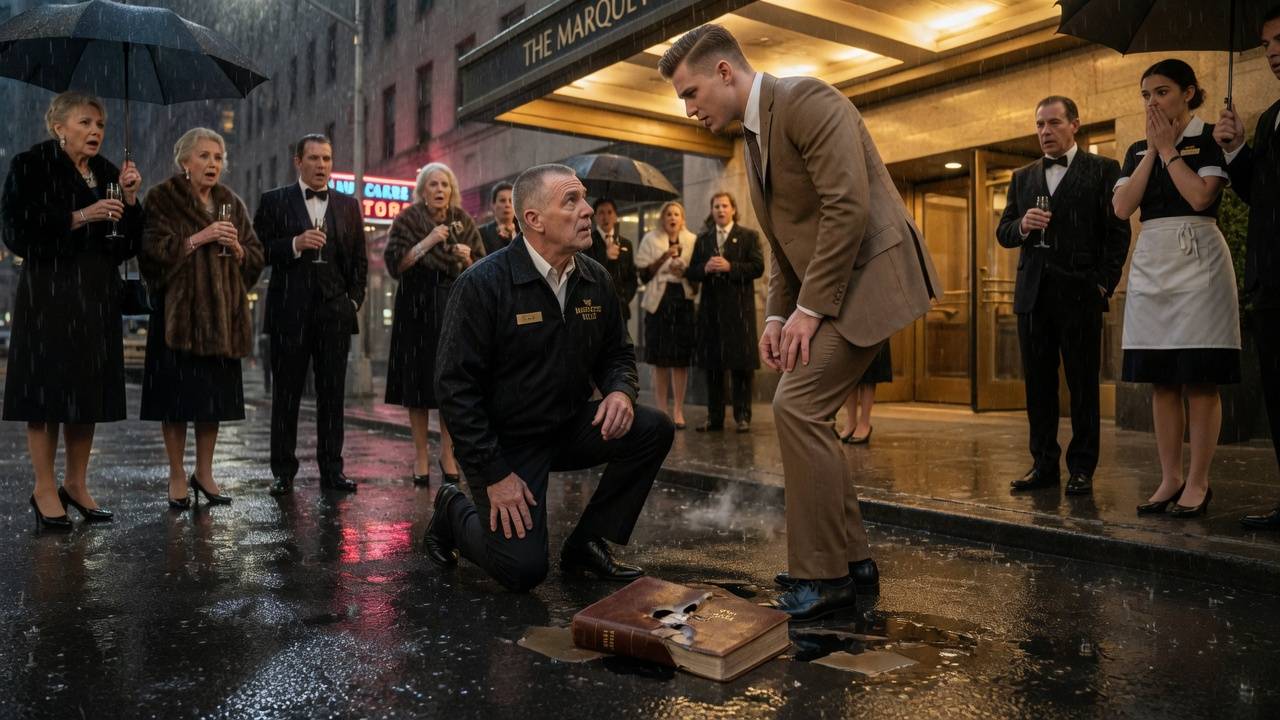
Julian knocked it into the mud and ground his leather boot into the word of God just to see me flinch.
The wealthy crowd stopped to watch, their phones recording what they thought was my final defeat.
My daughter was there, too, serving champagne and looking at me with the shame she’s carried for years.
Julian leaned in and told me to lick the mud off his boots if I wanted my “scrapbook” back.
I gave him one warning. He should have listened.
In five seconds, the “shaky old man” disappeared and the Ranger came back.
The look on his face when he hit the pavement was worth more than any settlement.
The full story is in the comments.
Chapter 1
The rain in Manhattan during a November gala isn’t the romantic drizzle they show in the movies. It’s a cold, vertical needles-and-pins assault that turns the black asphalt of 5th Avenue into a mirror for the city’s indifferent neon. I stood under the heavy gold-leaf awning of the Beaumont Hotel, my hands tucked into the pockets of a black valet jacket that was two sizes too big.
The tremor was back. It started in the tip of my right thumb and worked its way down into the meat of my palm, a rhythmic, insistent thrumming that felt like a trapped bird trying to beat its way out of my skin. I squeezed my fist tight, feeling the familiar ache in my forearm. It wasn’t Parkinson’s, and it wasn’t age, though at fifty-two, the city made me feel like an antique. It was a souvenir from a valley in Afghanistan that didn’t exist on most maps—a neurological echo of a blast that had taken everyone else in my humvee.
“Elias, silver Mercedes. Move it,” the valet manager barked. His name was Greg, a man whose entire personality was built on the foundation of a clip-on tie and a desperate need to please people who wouldn’t remember his face ten minutes after they checked out.
“Got it,” I said. My voice was raspy, a low-volume growl I’d never quite been able to smooth out.
I took the keys from a man who didn’t look at me, his eyes already fixed on the revolving glass doors. As I slid into the driver’s seat, the smell of expensive leather and vanilla hit me. It was the scent of a life I’d never understood—one where the biggest tragedy was a delayed flight or a lukewarm espresso.
I looked toward the service entrance, where the catering staff was unloading crates of crystal flutes. That’s where I saw her. Sarah. My daughter. She was wearing a crisp white server’s vest, her dark hair pulled back in a tight, professional bun. She was carrying a tray of hors d’oeuvres, her face set in a mask of grim concentration.
She caught my eye for a split second. There was no wave. No smile. Just a quick, sharp look of disappointment before she turned away. To her, I was the man who had disappeared for her childhood and returned as a ghost—a “cowardly” valet who took orders from men half his age and couldn’t even keep his hands still. She didn’t know about the federal handlers. She didn’t know about the safe house in Queens. She just saw a father who had given up.
“Hey! Shaky!”
The voice cut through the rain like a blunt knife. I didn’t have to look to know who it was. Julian Vane. Twenty-five years of unearned confidence wrapped in a tan silk suit that probably cost more than my first house. He was standing by the podium, his two buddies flanking him like hyenas. They were holding their phones up, the little red recording dots glowing in the gloom.
Julian’s father was the reason I was here. Marcus Vane was currently under federal indictment for a multi-billion dollar racketeering scheme, and I was the “Last Watchman”—the lead witness who had seen where the bodies, both literal and financial, were buried. The Feds had tucked me away at the Beaumont, telling me to be “invisible” until the trial started in two weeks.
“You’re late with my car, Elias,” Julian sneered. He stepped into my space, smelling of bourbon and a gym he clearly used for vanity rather than utility. “Is the steering wheel too heavy for those vibrating hands of yours?”
His friends chuckled, the sound muffled by the rain. I kept my eyes on his chest. Never the eyes. If you look a predator in the eye before you’re ready to strike, you give away the game.
“The car is coming around, Mr. Vane,” I said. My hand was shaking harder now. Not from fear. From the effort of keeping the Ranger buried under the valet.
“I don’t like waiting,” Julian said, his voice dropping to a low, mocking hum. He reached out and flicked the brass button on my jacket. “And I don’t like looking at trash that’s broken. You’re a glitch, Elias. A dirty little glitch in a beautiful hotel.”
I felt the heat rising in my neck, the old pressure behind my ears that usually preceded a tactical shift. I forced a breath out, slow and controlled. Two more weeks, I told myself. Two weeks, and then you can disappear for real.
“Sir, please step back from the podium,” I said quietly.
“Or what?” Julian laughed, looking back at his friends. “You’ll shake at me? You’ll vibrate me to death?”
He reached out and deliberately swiped a small, leather-bound book off the valet podium. It hit the wet asphalt with a dull thud. It was my Bible. The shrapnel hole in the center was visible, the edges of the leather charred and curled.
I froze. That book had been in my chest pocket when the IED went off. It was the only thing that had stopped a piece of jagged steel from tearing through my heart. It was more than a book; it was the weight of the men I’d left behind.
“Oops,” Julian said, his eyes gleaming. He didn’t move to pick it up. Instead, he shifted his weight, his leather boot hovering just inches above the cover. “Looks like your scrapbook got dirty.”
Across the driveway, I saw Sarah stop. She was watching us. Her eyes were wide, her tray trembling in her hands. She was waiting to see if her father would finally stand up for something, or if he would just bow his head and take it like he always did.
“Pick it up, Julian,” I said. The rasp in my voice was gone. It was just cold now.
“Make me, valet,” he replied, and I felt the world begin to narrow into a single, high-tension point.
Chapter 2
The silence between us was punctuated only by the rhythmic thwack-thwack of windshield wipers from a nearby town car. Julian didn’t move his foot. He was enjoying the moment, the theater of power. He knew I was a valet, a service worker, a man whose livelihood depended on the whims of people like him. He also knew his father’s lawyers were looking for any reason to discredit me, any sign of instability or violence that could be used to paint me as a “unhinged veteran” on the witness stand.
“Greg!” Julian shouted without taking his eyes off me.
The valet manager scurried over, his shoes squeaking on the wet pavement. “Yes, Mr. Vane? Is there a problem?”
“Your man here is being threatening,” Julian said, his voice dripping with faux concern. “I accidentally dropped his little book, and he’s looking at me like he wants to commit a felony. Is that how we treat guests at the Beaumont?”
Greg turned to me, his face turning a mottled shade of purple. “Elias! What the hell is wrong with you? Pick up the gentleman’s car and apologize! Now!”
I looked at Greg, then back at the Bible on the ground. The rain was soaking into the pages, blurring the verses I’d memorized in the dark of a hundred different foxholes. I could feel Sarah’s gaze like a physical weight on the side of my head. She hadn’t moved. She was watching her father be dismantled in public by a boy who had never seen a day of real hardship in his life.
“I’m waiting, shaky,” Julian said. He leaned in closer, his breath hot against my ear. “Apologize. Say it nice and clear for the camera.”
His friend moved the phone closer, the lens inches from my face. I could see my own reflection in the black glass—a man with tired eyes and a tremor that wouldn’t quit.
“I’m sorry you feel that way, Mr. Vane,” I said, the words tasting like ash.
Julian burst out laughing, a sharp, braying sound. “That’s it? That’s all you’ve got? ‘I’m sorry you feel that way’?” He looked at Greg. “He’s not just broken, he’s boring. Get him out of my sight. And send someone else for my car. Someone who doesn’t look like they’re about to have a seizure.”
Greg shoved me toward the Mercedes. “Go! Get out of here. I’ll deal with you later.”
I walked to the car, my boots heavy. I didn’t look at Sarah. I couldn’t. I got into the Mercedes and drove it into the underground garage, the silence of the concrete bunker closing in around me. I sat there for a long time, my hands gripped so tightly on the steering wheel that my knuckles turned white. The tremor was gone, replaced by a terrifying, absolute stillness.
That was the problem with people like Julian. They thought they were the ones in control because they held the leash. They didn’t realize that the only thing keeping the dog from biting was the dog’s own choice.
An hour later, I was in the break room, a windowless box filled with the smell of stale coffee and industrial cleaner. The door opened, and Sarah walked in. She was still in her server’s vest, but she’d taken the bun down. Her hair fell over her shoulders, making her look younger, more like the girl I’d left behind a decade ago.
“You’re pathetic,” she said. No greeting. No ‘are you okay.’ Just the truth as she saw it.
“Sarah—”
“Don’t,” she snapped, her voice trembling. “I watched him do that to you. I watched him throw your things in the dirt and mock your hands, and you just… you apologized. You let him treat you like a dog.”
“It’s not that simple,” I said, my voice low. “There are things you don’t know. People I’m protecting.”
“You’re always protecting someone, Dad! That’s your excuse for everything. You protected the country, so you missed my graduations. You protected your ‘brothers,’ so you weren’t there when Mom got sick. And now you’re protecting… what? A valet job? A paycheck from a hotel that hates you?”
She stepped closer, her eyes bright with angry tears. “He’s a bully, Dad. A spoiled, silver-spoon bully. And you let him win. You made me feel ashamed to even know you.”
She turned and walked out before I could find the words to stop her. The door slammed, the sound echoing in the small room.
I reached into my pocket and pulled out my phone. I hit a speed-dial number I’d only used twice.
“Miller,” a voice answered on the second ring. It was flat, professional, and entirely devoid of empathy. My federal handler.
“Vane’s son is at the hotel,” I said. “He’s pushing me. Hard.”
“We know,” Miller said. “We’re watching the social media feeds. The video of you apologizing is already circulating in certain circles. It’s actually helping, Elias. It makes you look weak. Non-threatening. A jury will sympathize with a broken old man being bullied by a rich kid.”
“I don’t care about the jury, Miller. He’s touching my things. He’s bringing my family into it.”
“Two weeks,” Miller said, his tone sharpening. “That’s the deal. You stay invisible. You stay ‘the shaky valet.’ If you touch him, if you even raise your voice, the defense will use it to paint you as a violent, unstable veteran with a grudge. You’ll blow the whole case. Marcus Vane walks, and you go back to having nothing. Do you understand?”
“I understand,” I said.
“Good. Keep your head down, Elias. Be the ghost we pay you to be.”
I hung up and looked at my hand. It was perfectly still. That was the most dangerous sign of all. When the tremor stopped, it meant the Ranger had taken over the controls. And the Ranger didn’t know how to be a ghost.
Chapter 3
The following three days were a masterclass in psychological warfare. Julian didn’t stop. In fact, the “apology” video had emboldened him. He started showing up at the hotel even when there wasn’t a gala, bringing a rotating cast of friends to witness the “vibrating valet.”
He’d leave trash in his car for me to clean—greasy fast-food bags, used tissues, even once a handful of loose change thrown onto the floorboards like I was a beggar. Each time, I cleaned it. Each time, I stayed silent. I was a man waiting for a timer to hit zero, watching the minutes tick away with a cold, internal clock.
On Thursday, I was stationed at the side entrance, the one used by the staff and the regular residents. It was quieter there, away from the main crush of the lobby. I had my Bible back—I’d cleaned the mud off the leather as best I could, but the pages were still warped, the edges stained a dark, earthy brown. I kept it on the small shelf inside the valet podium, a tether to the world I’d lost.
I was checking the log when I heard the heavy thrum of a high-performance engine. A gold Lamborghini Huracan pulled up to the curb, its engine idling with a predatory growl. Julian hopped out, looking particularly sharp in a tailored navy blazer and white trousers. He didn’t hand me the keys. He dropped them into the puddle at my feet.
“Oops,” he said, the same mocking grin plastered on his face. “Butterfingers. Guess I’m getting as shaky as you.”
I reached down, my fingers dipping into the icy water to retrieve the fob. As I straightened up, I saw Sarah walking toward the staff entrance. She had a bag of laundry over her shoulder, her head down. She was trying to avoid the scene, but Julian had already spotted her.
“Hey! You!” Julian called out. “Server girl! Come here.”
Sarah froze. She looked at me, then at Julian. She didn’t want to come over, but Julian was a Vane. His family owned a significant share of the hotel group. A word from him could end her job before she reached the door.
She walked over slowly, her face pale. “Yes, Mr. Vane?”
“You’re the one who works the VIP lounge, right? The one with the attitude?” Julian smirked, looking her up and down in a way that made my blood turn to ice. “I think I saw you talking to the valet the other night. Is he your dad? Or just your boyfriend?”
Sarah didn’t answer. She looked at the ground, her knuckles white on the strap of her bag.
“Answer the gentleman, Sarah,” I said quietly. My voice was a warning, but Julian took it as more weakness.
“Oh, he’s your dad? That’s tragic.” Julian laughed, stepping closer to her. “Imagine growing up with that. A father who’s literally falling apart at the seams. Must be why you’re so jumpy. It’s in the blood, isn’t it? The ‘loser’ gene.”
“Leave her out of this, Julian,” I said. My hand was vibrating again, but this time it wasn’t a tremor. It was the mechanical rattle of a machine under too much pressure.
“Or what, Elias? You’re going to shake at me again?” Julian turned his back on me, focusing entirely on Sarah. He reached out and snagged the strap of her laundry bag. “What’s in here? Stolen linens? Or just more trash from your trashy life?”
“Let go,” Sarah whispered.
Julian jerked the bag, and it spilled open. Cheap uniforms and a few personal items tumbled onto the wet sidewalk. Among them was a framed photo—a picture of me in my dress blues, holding Sarah when she was six years old. It was from the day I’d come home from my first tour, before the valley, before the blast.
Julian picked it up, shielding it from the rain with his blazer. “Look at this. A real hero. What happened to this guy, Elias? Did he die in that hole in the ground? Or did he just realize that being a valet was more his speed?”
“Julian, put the photo back,” I said. I was stepping out from behind the podium now. My heart rate was a steady sixty beats per minute. My breathing was rhythmic. Tactical.
“I don’t think I will,” Julian said. He looked at the photo, then at me, then back at Sarah. “I think I’ll keep it. A reminder of what happens when you don’t have enough money to buy your way out of the dirt.”
He started to walk away, the photo tucked under his arm. Sarah reached for it, her face desperate. “Please, that’s mine!”
Julian spun around and shoved her. It wasn’t a hard shove, but it was enough to send her stumbling back against the stone wall of the hotel. He laughed, a high, jagged sound that cut through the city noise.
“Stay back, servant,” he snapped. “Know your place.”
He looked at me, waiting for the apology. Waiting for the ‘shaky old man’ to bow his head.
“Julian,” I said, my voice barely a whisper. “This is the only warning you get. Put the photo down, walk into that hotel, and never speak to my daughter again.”
Julian stared at me for a beat, then he burst into a fit of hysterical laughter. He pulled the photo out from under his arm and held it over the storm drain. “You’re giving me warnings? You? The guy who wipes the mud off my tires?”
He let go. The frame hit the iron grate and shattered, the photo slipping through the bars into the black water below.
“Oops,” Julian said. “I guess your past is right where your future is. In the sewer.”
He turned to his friends, who were filming every second. “Did you get that? The look on his face? He looks like he’s about to cry. Or vibrate into a million pieces.”
I didn’t cry. I didn’t shake. I looked at Sarah, who was slumped against the wall, her eyes filled with a mixture of terror and that same, soul-crushing disappointment.
I looked at the valet podium. I picked up my Bible. I walked toward Julian.
“Elias, don’t!” Sarah cried out.
But the Ranger was already out of the hole. And he wasn’t looking for an apology.
Chapter 4
The rain was coming down harder now, a grey curtain that blurred the lights of the city. We were in the center of the side driveway, a semi-public stage flanked by the stone walls of the Beaumont and the expectant cameras of Julian’s friends.
Julian saw me coming. He didn’t look worried. Why would he be? He was twenty-five, a regular at an MMA-style boxing gym, and he’d spent his whole life watching people fold under the weight of his name. He squared his shoulders, a smirk playing on his lips.
“You really want to do this, Elias? Here? In front of everyone? Think about your pension. Think about your ‘invisible’ life.”
I didn’t answer. I stopped five feet from him. I held the shrapnel-torn Bible in my left hand.
“I told you to stay away from her,” I said.
“And I told you to know your place,” Julian countered. He stepped forward, his chest out. “You’re a servant. You’re a shaky, broken-down relic. And your daughter? She’s just a server who’s one bad review away from the street.”
He reached out and deliberately swiped the Bible from my hand. It hit the wet asphalt, sliding into a puddle.
“That’s for the photo,” Julian sneered.
He didn’t stop there. He shifted his weight and brought his heavy leather boot down on the center of the book. I heard the spine groan, the leather screaming under the pressure. He ground his heel into it, twisting his foot like he was extinguishing a cigarette.
“Lick the mud off, you shaky old dog,” Julian said, his face inches from mine. “Maybe if you do a good job, I’ll buy you a new one. One without the holes.”
“Take your foot off that Bible,” I said. My voice was flat, a dead thing.
Julian’s eyes widened in fake surprise. “What? I didn’t hear you. The rain is so loud.” He grabbed me by the jacket collar, his knuckles digging into my throat. He jerked me forward, forcing me to lean over the mud-stained book. “Get down there, Elias. Get down on your knees and show everyone what you are.”
His friends were laughing, their phones steady. Sarah was screaming for someone to help, but the doorman was nowhere to be seen, and the crowd of socialites was too busy watching the “content” to intervene.
Julian jerked my collar again, trying to shake me. “Do it! Kneel!”
I felt the familiar click in my mind. The world slowed. The rain became individual droplets, suspended in the air. I saw the tension in Julian’s arm, the way his weight was distributed too far forward on his lead foot. I saw the opening.
Julian raised his other hand to shove my head down.
I didn’t wait.
I planted my left foot, the rubber sole of my valet boot gripping the wet pavement. I didn’t pull back. I moved in. I snapped my right arm down across his reaching forearm—a sharp, mechanical strike that broke his structure and sent his shoulder spiraling off-axis. His grip on my collar vanished as his chest opened up, his balance failing him as his weight shifted onto his heels.
I didn’t give him a second to recover.
I drove a short, compact palm-heel strike directly into his sternum. It wasn’t a swing; it was a piston. I felt the shock of the impact travel through my arm, through my shoulder, fueled by the hip rotation I’d practiced ten thousand times in the dust of the Korengal. Julian’s silk jacket jolted, the fabric compressing as the air was driven out of his lungs in a sharp, wheezing gasp. His shoulders snapped backward, his head jerking as his torso followed the path of the force.
He was already falling, his feet scrambling for purchase on the slick asphalt, but I wasn’t finished.
I planted my lead foot firmly and drove my right heel into the center of his chest. A driving front push kick. I didn’t just touch him; I pushed through him, using the full weight of my body to propel him backward.
Julian flew. It was only a few feet, but it looked like he’d been hit by a truck. He hit the pavement hard, his back skidding across the wet stone. A nearby gym bag caught the edge of his fall and slid several feet away.
The laughter stopped. The only sound was the rain and the ragged, wet sound of Julian trying to find his breath.
He scrambled onto his hands and knees, but he didn’t try to get up. He looked up at me, his face no longer tan or confident. It was white, his eyes wide with a primal, unadulterated terror. He saw the “shaky old man” standing over him, and for the first time in his life, he realized he was looking at a predator.
“Stop, please! I’m sorry!” Julian blurted out, his voice cracking. He raised one hand defensively, cowering as I stepped toward him. “I didn’t mean it! It was just a joke!”
I stopped two inches from his hand. I reached down and picked up my Bible. I wiped the mud off with my sleeve and tucked it back into my pocket.
Then I leaned over him. I didn’t scream. I didn’t have to.
“I’m the last thing you’ll ever see coming,” I said.
I turned and looked at his friends. They were still holding their phones, but they weren’t filming anymore. They were frozen, their mouths open, their “influencer” bravado washed away by the reality of what they’d just witnessed.
I looked at Sarah. She was standing by the wall, her hands over her mouth. Her eyes weren’t filled with disappointment anymore. They were filled with something else. Something I hadn’t seen in a decade.
“Dad?” she whispered.
I didn’t answer. I could hear the sirens in the distance. The Feds would be here in minutes. The “ghost” was dead. The case was probably compromised. But as I looked at the broken boy on the ground, I realized I’d never felt more alive.
“Go inside, Sarah,” I said. “I’ll handle the rest.”
I stood in the rain, my hands perfectly still, and waited for the world to catch up.