Chapter 5
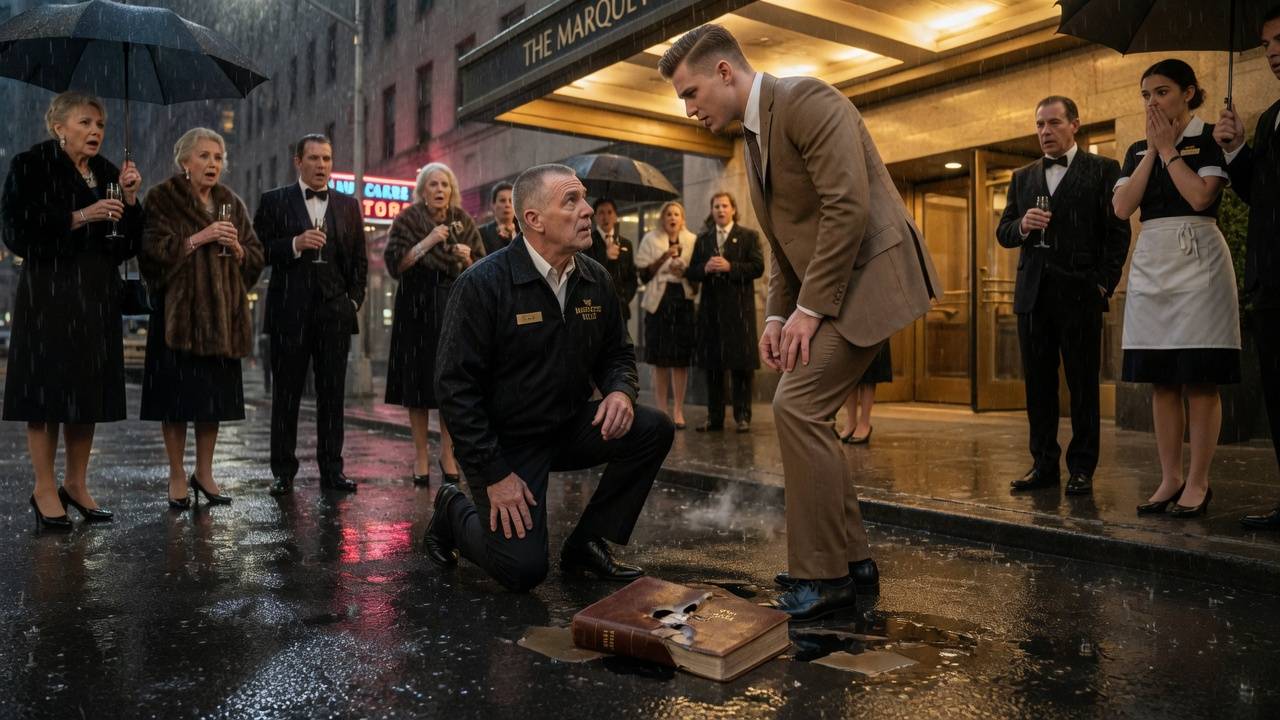
The adrenaline didn’t leave all at once. It leaked out of me like cold water from a cracked pipe, leaving my joints stiff and my skin feeling too tight for my bones. I stood in the rain, the Beaumont’s gold-leaf awning behind me and the broken boy in the tan suit in front of me. Julian Vane was still on the ground, making a sound like a punctured bellows, his expensive shoes scraping uselessly against the wet asphalt. He looked smaller than he had five minutes ago. Everyone looks smaller when the air has been driven out of them by a man who knows exactly where the ribs give way to the lungs.
“Dad?” Sarah’s voice was a thin wire. She was still standing by the stone pillar, the white server’s vest a bright, mocking target against the dark masonry. Her hands were pressed to her mouth, and I could see the tremor I usually carried had somehow transferred to her.
I didn’t go to her. I couldn’t. Not yet. I was still in the “red zone”—that psychological space where every movement is a threat assessment and every shadow is a potential ambush. I looked at Julian’s friends. They were still holding their phones, but the red recording dots seemed like eyes in the dark. One of them, a kid with a silk tie that cost more than my first truck, was shaking so hard the image on his screen must have been a blur.
“Put the phones down,” I said. It wasn’t a shout. It was the voice I used when I wanted a private to know the world was about to end.
They didn’t just lower them; they tucked them into their pockets like they were hiding contraband. Julian finally managed to roll onto his side, coughing up a mixture of rainwater and something darker. He looked at me, and for a second, the entitlement flickered back in his eyes, a dying ember of the Vane family legacy.
“You’re… you’re dead,” he wheezed, his hand clutching his sternum. “My father… he’ll erase you. You’re a valet. You’re nothing.”
I stepped toward him, and he flinched so hard his head hit the pavement with a wet thud. I reached down, not for him, but for the pocket Bible lying in the mud. I picked it up, wiped the grime off the leather with my thumb, and felt the jagged hole where the shrapnel had tried to kill me ten years ago. It felt heavier than it had before.
“Your father is a man who builds empires out of paper and lies, Julian,” I said, my voice steady. “I’ve spent my life in places where paper burns and lies get people buried. Tell him the Last Watchman is tired of being invisible.”
Greg, the valet manager, finally found his legs. He scurried out from the lobby, his face the color of a bruised plum. “Elias! What have you done? My god, the police—I’ve called the police! You’re fired! Do you hear me? You’re finished!”
“I heard you the first time, Greg,” I said. I looked at the hotel—the marble, the gold, the socialites peering through the glass doors like they were at a zoo. It was a beautiful cage, but I was done being the animal.
Before the sirens could get close, a black SUV pulled up to the curb, its tires splashing the gray slush onto Julian’s blazer. The door opened, and Miller stepped out. He didn’t look like a federal agent; he looked like a mid-level insurance adjuster who had missed his morning coffee. But his eyes were like flint. He looked at Julian, then at me, then at the two kids with the phones.
“Get in the car, Elias,” Miller said.
“My daughter,” I said, nodding toward Sarah.
Miller sighed, a sound of pure professional exhaustion. “Her too. Move. Now.”
The drive to the safe house in Queens was silent. Sarah sat in the back, pressed against the door as if she were trying to merge with the upholstery. I sat in the front, watching the city lights smear across the windshield. Miller drove with one hand, his thumb tapping a rhythmic code against the steering wheel.
“You blew it,” Miller said finally, his voice devoid of anger. That was worse. Anger you can negotiate with. Indifference is a closed door. “The defense is going to have that video on every news cycle by morning. ‘Violent, unstable veteran attacks innocent young man.’ It’s a gift-wrapped present for Marcus Vane’s lawyers.”
“He stepped on the Bible, Miller. He shoved my daughter.”
“I don’t care if he spit on the flag while kicking a puppy, Elias. You were the clean witness. The hero. Now? Now you’re just another angry man with a grievance. The jury won’t see the Ranger; they’ll see a liability.”
“Then let them,” I said.
Sarah made a small, choked sound in the back. I turned to look at her. Her face was illuminated by the passing streetlamps—gold, then black, then gold again.
“Is that what you were?” she asked. Her voice was stronger now, but it was edged with a bitterness that tasted like old copper. “A Ranger? Is that why you were never home? Because you were busy learning how to break people in hotel driveways?”
“It’s complicated, Sarah,” I said. The words felt pathetic as soon as they left my mouth.
“Everything with you is ‘complicated,’” she snapped. “Mom’s funeral was ‘complicated.’ My tuition was ‘complicated.’ I spent three years thinking you were a broken man who couldn’t keep his hands still, and tonight I find out you’re just a man who chose a secret life over me. Again.”
“I was protecting you,” I said, and the lie felt heavy in my chest. I wasn’t just protecting her from Marcus Vane; I was protecting her from the version of me that stood over Julian in the rain.
“From what? From knowing who my father is? Or from knowing that the only time you ever stand up for yourself is when you can use your hands?”
Miller pulled the SUV into a nondescript garage beneath a brick apartment building. The air inside smelled of exhaust and damp concrete. He killed the engine and the silence that followed was suffocating.
“The trial starts in forty-eight hours,” Miller said, turning to look at both of us. “Elias, you don’t leave this room. Sarah, you stay here too. We’ve moved your things from the hotel. If you step outside, I can’t guarantee your safety, and I definitely can’t guarantee your father’s legal standing. The Vane family is currently filing assault charges. We’re holding them off with federal priority, but that’s a thin shield.”
He handed me a folder. “That’s the cross-examination prep. They’re going to go for your throat, Elias. They’re going to bring up the valley. They’re going to bring up the tremor. And now, they’re going to bring up Julian. If you break on that stand like you broke in that driveway, Marcus Vane walks, and you spend the next five years in a federal prison for perjury and assault. Think about that while you’re sitting in the dark.”
Miller left us in the safe house—a two-bedroom apartment that looked like it had been decorated by someone who hated comfort. The furniture was particle board, the walls were an institutional beige, and the only window looked out onto a brick wall.
I went to the kitchen and started a pot of coffee, my hands finally beginning to shake again. It wasn’t the tremor; it was the letdown. I felt like a clock that had been wound too tight and was now trying to find its rhythm.
Sarah stood in the doorway, her arms crossed over her white vest. She looked out of place in the dingy kitchen, like a piece of fine china in a scrap yard.
“Tell me about the valley,” she said.
“Sarah, you don’t want to know.”
“Don’t you dare,” she said, her voice rising. “Don’t tell me what I want. I’ve spent my whole life being told what to think of you. I’ve spent years being the daughter of the ‘cowardly valet.’ If I’m going to be locked in this room because of you, I want the truth. Why does your hand shake, Dad? And why did it stop tonight?”
I sat down at the small laminate table and looked at the Bible I’d placed there. I opened it to the middle, where the pages were still stiff and stained.
“It was the Korengal,” I said, my voice barely a whisper. “A rescue mission. We were supposed to pull out a squad that got pinned down in a draw. We went in light, thinking it was just a skirmish. It wasn’t. It was an ambush. We were in a humvee, four of us. Miller was the driver. No, not this Miller. A different one. A kid from Ohio.”
I closed my eyes and I could smell it—the dust, the burnt oil, the sharp, metallic scent of blood. “The IED was buried under a pile of trash. We never saw it. The blast flipped us like a toy car. When I woke up, the world was sideways. Ohio was gone. Everyone was gone. I was pinned under the dashboard, and the engine was on fire. I had this Bible in my chest pocket. A piece of the floor pan tore through the door and hit me right here.” I touched my sternum, the same spot I’d hit Julian. “The book caught it. It didn’t stop the force, but it stopped the steel from going through my heart.”
Sarah sat down opposite me, her anger seemingly replaced by a hollowed-out shock.
“The nerve damage in my hand… it’s from the blast. But the tremor? The doctors said it’s ‘psychosomatic.’ A fancy way of saying my body is trying to vibrate its way out of that humvee every single day. It only stops when I’m in a fight. When the world makes sense again. When there’s an enemy I can see and a move I can make.”
I looked up at her. “Tonight, Julian Vane became the engine fire. He became the ambush. And for the first time in years, I wasn’t sideways anymore.”
Sarah looked at the Bible, then at my hand. She reached out, her fingers hovering just inches from mine. She didn’t touch me, but the distance felt smaller than it had in a decade.
“So you’re not a coward,” she said softly.
“I was a coward for a long time, Sarah. I was a coward for not telling you the truth. I thought if I kept you away from the mess, you’d be clean. But you just ended up being alone.”
The silence that followed wasn’t uncomfortable. It was the sound of air finally reaching a room that had been sealed for too long. But as I looked at the folder Miller had left, the weight of the coming trial settled back onto my shoulders. I had found my daughter again, but I had handed Marcus Vane the weapon he needed to destroy me.
“What happens if they win?” Sarah asked.
“Then I lose everything,” I said. “But at least I’ll lose it as a man you know.”
The night crawled by. We didn’t sleep. We sat at that table, talking about things that didn’t matter—old movies, her mother’s favorite garden, the way the rain sounded in the city. It was a fragile peace, built on the edge of a cliff.
At dawn, the phone on the wall rang. It was Miller.
“We have a problem,” he said. “Julian Vane didn’t just go to the hospital. He went to the press. And he brought his father’s lead defense attorney with him. They’re calling a press conference in front of the Beaumont in two hours. They’re going to name you, Elias. They’re going to show the video and link it to the trial. They’re going to claim the federal government is using a ‘violent mercenary’ to frame an innocent businessman.”
“What do we do?” I asked.
“Nothing,” Miller said. “You stay put. We’re trying to get a gag order, but it’s too late. The story is already viral. You’re not just a witness anymore, Elias. You’re the main event. And right now, everyone in America thinks you’re the villain.”
I hung up and looked at Sarah. She was watching me, her face pale in the morning light.
“They’re coming for us, aren’t they?” she asked.
“They’ve been coming for us for a long time,” I said, standing up. I felt the tremor in my hand, rhythmic and insistent. I didn’t try to stop it. I just squeezed my fist tight and looked at the door. “But this time, I’m not hiding in the garage.”
Chapter 6
The federal courthouse in lower Manhattan felt like a tomb made of granite and glass. The air inside was filtered and cold, tasting of old paper and anxiety. Outside, the world was screaming. I could hear the muffled roar of the protesters through the thick walls—a chaotic blend of people demanding justice for Julian Vane and others who didn’t know what they wanted, only that they were angry.
I sat in the witness room, a small, windowless box that felt remarkably like the safe house in Queens. Sarah was next to me, her hand resting on my forearm. She had traded her server’s vest for a simple navy blazer we’d managed to get from a courier. She looked like a different person—older, sharper, like a woman who had seen the bottom of the world and decided she didn’t like the view.
Miller was pacing the small room, his tie slightly crooked. He looked like he hadn’t slept in a week. “The judge denied the motion to exclude the hotel video,” he said, stopping to look at me. “The defense is going to play it the second you sit down. They’re going to ask you about your discharge papers. They’re going to ask about the ‘psychological instability’ that led to your tremor. They’re going to try to make you snap in front of the jury, Elias. They want the Ranger to come out.”
I looked at my hand. The tremor was there, a steady, low-frequency hum. “The Ranger doesn’t snap, Miller. He executes. That’s what they don’t understand.”
“Just keep it together,” Miller warned. “If you look aggressive, we lose. If you look scared, we lose. You have to be the man who was bullied. You have to be the victim.”
“I’m not a victim,” I said.
The door opened, and a bailiff poked his head in. “The court is ready for Mr. Thorne.”
Walking into a courtroom is like stepping onto a battlefield where the weapons are words and the terrain is made of legal precedent. I felt the eyes of the gallery hit me like a physical force. I saw the sketch artists, their pencils flying. I saw the rows of reporters, their faces illuminated by the blue light of their laptops.
And then I saw Marcus Vane.
He was sitting at the defense table, looking every bit the billionaire titan. His suit was charcoal gray, his hair perfectly coiffed, his expression one of bored amusement. He looked at me not as a threat, but as a minor inconvenience—a bug that had crawled out from under the baseboard. Next to him sat Julian, wearing a neck brace that looked suspiciously new. He didn’t look at me. He kept his eyes fixed on the table, the arrogance from the hotel driveway replaced by a calculated, theatrical fragility.
I took the stand, the wooden chair creaking under my weight. I swore the oath, the words feeling hollow and heavy.
The prosecutor, a sharp-featured woman named Chen, took me through the basics. My time in the Army. My job at the Beaumont. The documents I’d found in the glove compartment of Marcus Vane’s Bentley six months ago—the ledger that detailed the shell companies and the offshore accounts.
I spoke clearly, my voice raspy but steady. I told them about the night I’d found the book, the night I’d realized the man I was parking cars for was the same man who was bleeding the city dry.
Then it was the defense’s turn.
Robert Sterling, Vane’s lead attorney, stood up like a predator scenting blood. He was a man who moved with the grace of a shark, all smooth lines and hidden teeth.
“Mr. Thorne,” Sterling began, his voice a rich, comforting baritone. “You were a Ranger, were you not? A member of an elite killing force?”
“I was a Ranger,” I said.
“And you were discharged with a permanent disability? A neurological condition?”
“Yes.”
Sterling walked toward the jury box, his eyes never leaving mine. “A condition that makes you prone to… outbursts? To involuntary physical reactions?”
“It makes my hand shake,” I said.
“And yet, three nights ago, your hand was quite steady, wasn’t it?” Sterling hit a button on his remote, and the large screen at the front of the courtroom flickered to life.
It was the video. The viral clip.
There I was, kneeling in the rain. There was Julian, his boot on my Bible. I watched myself snap Julian’s arm off-line. I watched the palm strike land. I watched the push kick that sent him flying. On the screen, it looked brutal. It looked like a professional assassin dismantling a child.
Julian made a small, pathetic sound at the defense table. Several jurors flinched.
“Tell me, Mr. Thorne,” Sterling said, his voice dropping to a whisper. “Is that the behavior of a ‘victim’? Or is that the behavior of a man who was looking for an excuse to hurt someone? A man who is so psychologically damaged that he sees an ambush in every shadow?”
“He stepped on my Bible,” I said.
“It’s a book, Mr. Thorne! A piece of leather and paper! And in response, you nearly crushed a young man’s sternum. You used military-grade violence against a civilian. Why? Because you’re angry? Because you’re broken? Or because you wanted to silence the son of the man who can put you in prison?”
“I wasn’t silencing him,” I said, my grip tightening on the edge of the witness stand. “I was stopping him.”
“Stopping him from what? Walking away? You stepped into his space. You escalated. You are a violent man, Elias Thorne. You are a man who carries a war around in his head, and that night, you let it out. How can this jury believe anything you say about my client when you are clearly a man who cannot control his own impulses?”
I looked at Marcus Vane. He was smiling now. A small, thin-lipped smile of triumph. He thought he’d won. He thought he’d turned the Ranger into a monster.
I looked at Sarah. She was sitting in the front row, her eyes fixed on me. She didn’t look scared. She looked… expectant. She was waiting for me to do what I’d told her I would do. To be the man she knew.
I let go of the witness stand. I leaned back in the chair. My hand was shaking—really shaking now—a frantic, rhythmic thrumming that made the wooden armrest rattle.
“You’re right, Mr. Sterling,” I said. My voice was low, carrying across the silent courtroom like a cold wind. “I am a violent man. I spent twenty years being trained to be exactly that. I spent years in places where the only thing that kept me and my brothers alive was the ability to be more violent than the people trying to kill us.”
Sterling opened his mouth to interrupt, but I kept going.
“I am broken. My hand shakes because I watched three of my friends burn to death in a humvee while I was pinned under the dashboard. I carry that war in my head every single day. I carry the smell of the fire and the sound of the screams. And for ten years, I’ve tried to be invisible. I’ve parked cars for men like your client. I’ve let them look through me. I’ve let them treat me like trash because I was terrified of what would happen if the Ranger ever came back.”
I looked at the jury. “That night in the driveway, Julian Vane didn’t just step on a book. He stepped on the only thing I had left of the men I lost. He shoved my daughter. He looked at me and he saw a ‘dirty little glitch.’ And he was right. I am a glitch. I’m a reminder of the price this country pays for the life your client lives. I didn’t hit him because I was angry. I hit him because for the first time in ten years, I saw something that was worth the risk of being seen.”
I pointed at Marcus Vane. “Your client isn’t a businessman. He’s a predator. He thinks money makes him invisible to the law, the same way he thought I was invisible under that awning. But I saw the ledger. I saw the names. And I’m not parking his car anymore.”
The silence in the courtroom was absolute. Sterling was standing in the middle of the floor, his mouth slightly open, the shark-grin gone. The jury wasn’t looking at the video anymore. They were looking at me.
“No further questions,” Sterling said, his voice tight.
The trial lasted another three days, but the air had gone out of the defense. My testimony was the anchor, but it was the weight of the Ranger’s honesty that held it down. Marcus Vane was convicted on twelve counts of racketeering and fraud. Julian’s assault charges against me were dropped after a second video surfaced—taken by a hotel security camera—that showed him escalating the physical contact first.
I stood on the steps of the courthouse on the final day, the afternoon sun feeling strange on my face. I wasn’t wearing the valet jacket. I was wearing a cheap, off-the-rack suit that Sarah had picked out for me.
Miller was there, looking slightly less like an insurance adjuster. “The Feds are moving you,” he said. “New name. New city. Somewhere quiet. Sarah too, if she wants it.”
“I think I’m done with new names, Miller,” I said.
“It’s not safe here, Elias. The Vane empire has deep roots. People will be looking for you.”
“Let them look,” I said. I looked at my hand. It was still. Not the deathly stillness of the fight, but a quiet, resting peace. “I spent ten years being a ghost. I think I’d like to try being a man for a while.”
Miller nodded, a brief, professional acknowledgment of a decision he didn’t agree with but respected. He walked away, disappearing into the crowd like he was never there.
Sarah came up beside me. She wasn’t wearing the server’s vest either. She looked like a woman with a future.
“So,” she said, looking out at the city. “What now?”
“I don’t know,” I said. “Maybe we go find that photo. The one Julian dropped in the drain.”
“It’s gone, Dad. The rain washed it away days ago.”
“Then we’ll take a new one,” I said.
I reached into my pocket and pulled out the Bible. The leather was scarred, the hole was still there, but it was clean. It felt like a book again.
We walked down the steps together, moving into the crush of the city. I didn’t look back at the courthouse, and I didn’t look for the shadows. For the first time in a decade, I wasn’t waiting for the ambush. I was just a father walking with his daughter in the sun, my hands steady and my heart, for the first time, finally out of the valley.