Chapter 5
The drive back to Oxnard was the quietest thirty miles of Miller’s life. The Pacific Coast Highway stretched out ahead of him, a ribbon of asphalt caught between the bruising blue of the ocean and the scorched brown of the cliffs. He kept his hands at ten and two on the steering wheel of his old F-150, his knuckles still humming from the impact. There was no static in his head now. There was only a cold, vibrating clarity that felt like the moment before a breach. He knew that clarity wouldn’t last. It was a chemical spike, a gift from the man he used to be, and eventually, the debt would come due. The grey wall would return, likely higher and thicker than before.
When he pulled into the gravel lot of the apartment complex, he didn’t get out right away. He sat in the cab, the engine ticking as it cooled, and looked at his hands. There was a faint smear of mahogany dust across his right palm, mixed with the pale white of Alistair’s linen suit. He had done it. He had broken the one rule Sarah had set for him when he came home: don’t let them make you a monster again.
The door to the apartment opened before he even reached the stairs. Sarah stood on the landing, her face pale, holding her phone like it was a live grenade. She didn’t say a word as he climbed the steps. She just stepped aside to let him in, the smell of burnt coffee and laundry detergent greeting him—the smells of a life he was currently in the process of losing.
“It’s everywhere, Miller,” she said. Her voice was thin, vibrating with a fear she was trying to mask with pragmatism. “Leo sent me the link ten minutes ago. It’s already been shared by half the local news outlets. ‘Malibu Designer Assaulted by Contractor.’ That’s the headline they’re using.”
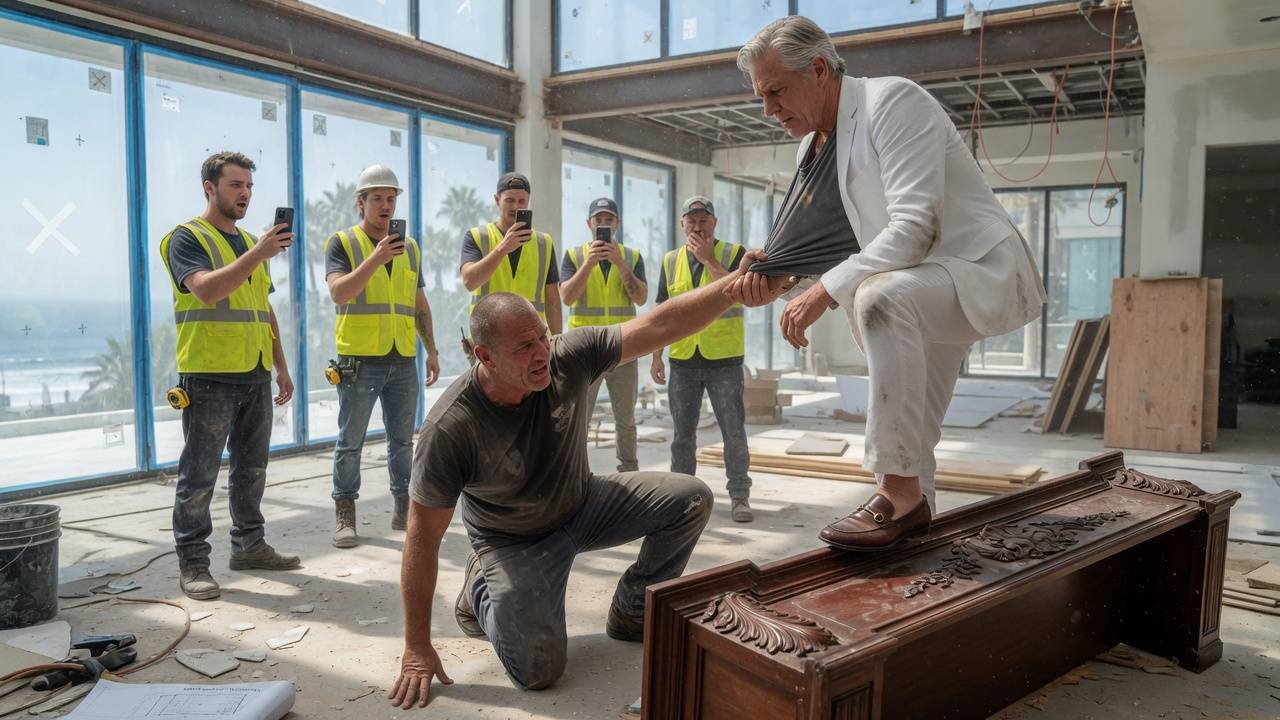
Miller sat at the small kitchen table, the wood scarred and cheap, a world away from the African mahogany he had spent a month finessing. “He touched me, Sarah. He stepped on… he stepped on your tray.”
Sarah walked over and sat across from him. She didn’t look at the viral video playing on the counter. She looked at the man who had been her protector since they were children, seeing the fractures he thought he had hidden. “I know he did. I know he’s a vile human being. But Miller, the insurance. Dr. Aris’s clinic. They’re funded by a private grant from the Architecture Guild. Alistair is on the board of that guild. You didn’t just hit a man. You hit the hand that’s keeping your brain from rotting.”
The weight of it finally landed. It wasn’t the threat of jail—Miller had survived prison camps in places the State Department wouldn’t acknowledge. It was the loss of the “static” management. Without the specialized neuro-rehab, the memory lapses would become permanent. The episodes where he forgot where he parked his truck, or what year it was, would stop being episodes and start being his reality. He would become a ghost in his own skin, a burden for Sarah to carry until there was nothing left of him but the muscle.
“I have the blueprints,” Miller said, his voice dropping an octave. “The panic room. The mechanical override. He doesn’t know it’s there. Nobody does.”
“What are you talking about?” Sarah leaned in, her eyes narrowing.
“Alistair… he’s going to go back there tonight,” Miller said, the words coming more slowly now as the adrenaline began to fade. “The owners… they arrive tomorrow. He’ll be there late, trying to fix the ‘imperfections’ I left behind. He’ll be in the secure suite. He likes the prestige of it.”
“Miller, don’t,” Sarah warned. “You’re talking like you’re back in the teams. This isn’t a mission. This is a lawsuit. This is a police report. If you go back there, if you do anything else, they will put you away for a long time.”
“I’m not going to hurt him,” Miller said, though even as he said it, he wasn’t entirely sure he meant it. He looked at the Trident insignia he had tattooed on his forearm, half-faded but still sharp. “I saw the grain, Sarah. On the door frame. I saw the way the house was settling. The steel core is too heavy for the heat expansion of that glass. If he closes that door tonight… it might not open again.”
The phone on the counter began to buzz. It was a number Miller didn’t recognize, but the area code was Santa Monica. Dr. Aris’s office. Sarah picked it up, her face falling as she listened. She didn’t say much, just a few yes, I understands and a thank you. When she hung up, she looked like she had aged five years in thirty seconds.
“The clinic,” Miller guessed.
“They’ve ‘suspended’ your participation in the trial, effective immediately,” Sarah said. She didn’t cry. She was a Miller; they didn’t leak. “Alistair’s lawyers called them an hour ago. They’re claiming you’re a danger to the staff. They’re citing ‘unstable combat-related trauma.'”
Miller stood up. The static was starting to creep back in, a low hum like a swarm of hornets at the base of his neck. He felt the familiar urge to move, to act, to eliminate the threat. But the threat wasn’t a man with a rifle. It was a man with a pen and a linen suit.
“I have to go back,” Miller said.
“No,” Sarah said, standing to block the door. “You are staying here. We will call a lawyer. We will fight this the right way.”
“The right way doesn’t work for people like us, Sarah,” Miller said gently, placing his hand on her shoulder. His hand was twice the size of hers, calloused and scarred, but he held her with the delicacy of a man holding a bird. “He’s going to get himself trapped in his own arrogance. And if I’m not there to show them the grain of truth, he’ll stay trapped. And then I really will be a monster.”
He didn’t wait for her to agree. He grabbed his keys and walked out. He could hear her calling his name from the landing, but he didn’t stop. He was a master carpenter. He knew how structures failed. He knew how a door could become a tomb. And he knew that Alistair Thorne, for all his talk of design and aesthetics, didn’t understand the first thing about the weight of the wood.
The drive back to Malibu was faster. The sun was dipping below the horizon, painting the sky in violent streaks of orange and purple. Miller felt like he was driving into a storm, the grey wall in his head pulsing in time with the ocean waves. He needed to get there before the night crew left. He needed to be there when the steel met the glass and the heat of the day turned into the cold of the canyon night. Because when that happened, the house would breathe. And if Alistair was in the wrong room when it exhaled, he would find out exactly what it felt like to be a tool that had outlived its usefulness.
Chapter 6
The mansion looked like a fallen star against the darkening cliffs of Malibu. Floodlights illuminated the glass exterior, turning the structure into a cage of light and shadow. Miller parked his truck a quarter-mile down the road, tucked into a turnout hidden by coastal scrub. He didn’t want the security guards to see the F-150; he knew the police had likely already been given his plates.
He moved through the brush with a silent, heavy grace that hadn’t left him, even with the brain injury. The TBI made him forget words, but it hadn’t made him forget how to move through shadows. As he approached the site, he saw the remaining crew packing up. They were whispering, their eyes darting toward the great room. The video had done its work; he was no longer Miller the carpenter. He was Miller the ghost story.
He waited until the last van pulled away before he slipped through the side entrance—a service door he had keyed himself two weeks ago. The house was silent, save for the groan of the structural steel cooling in the night air. It was a sound only a builder would recognize—a rhythmic, metallic clicking as the house settled into its foundations.
He made his way toward the master suite. He could hear music—something classical and aggressive—echoing from the secure room. Alistair was there.
Miller stepped into the hallway. The mahogany mantel he had mounted that morning glowed under the recessed lighting, the waves he had carved looking almost fluid in the half-light. Alistair had tried to ruin it, but the wood had held. The wood was stronger than the man who had stepped on it.
He reached the entrance to the secure suite. The heavy steel-core door was closed. It was a flush-mount design, meant to disappear into the paneling when shut. There were no visible hinges, no handle. It was operated by a biometric scanner on the wall—a scanner that was currently flashing a frantic, rhythmic red.
Alistair’s voice came through the door, muffled but unmistakable. It wasn’t the voice of the world-renowned designer anymore. It was the high-pitched, jagged sound of a man in a cage.
“Hello? Is someone there? The panel… the panel isn’t responding! Open the door!”
Miller stood two feet from the door. He didn’t speak. He just listened to the house. Click. Groan. Snap. The glass walls were contracting, putting thousands of pounds of pressure on the central frame. The door hadn’t just malfunctioned; it had been pinched. The tolerances Miller had warned the architect about—the “grain of truth” in the blueprints—had been exceeded. The steel core was wedged into the frame by the weight of the entire second floor.
“Miller?” Alistair’s voice dropped, becoming a terrified whisper. “Is that you? I know you’re out there. I can hear you breathing.”
Miller leaned his forehead against the cold mahogany paneling next to the door. “I told you, Alistair. Tools can break. And doors can stay locked.”
“Open it! I can’t breathe in here! The vents… the air isn’t coming through!”
“The air is fine,” Miller said, his voice slow and resonant. “The emergency scrubbers haven’t even kicked in yet. You have six hours of oxygen. Plenty of time to think about the wood.”
“I’ll give you anything! I’ll drop the charges! I’ll get you back into the clinic! Just open the damn door!”
Miller felt the static behind his eyes. For a moment, he considered walking away. He could leave Alistair there for the night, let him marinate in his own fear until the homeowners arrived in the morning. It would be a poetic justice. Alistair would be humiliated, his professional reputation ruined when the news got out that he had trapped himself in his own ‘masterpiece.’
But then Miller thought about the Trident. He thought about the men he had served with, men who didn’t walk away from a trapped soul, even if that soul was a coward. He thought about Sarah, who believed he was more than the damage the war had done to him. If he left Alistair here, he would be proving the designer right. He would be the “broken tool.”
“Shut up, Alistair,” Miller said. The silence from inside the room was immediate.
Miller moved to the hidden panel he had installed behind the decorative molding. He pressed his thumb into a specific knot in the wood, a piece of grain that looked like a bird’s eye. The panel clicked and slid back, revealing a manual hydraulic override—a system that bypassed the digital locks and used raw physical leverage to force the bolts.
He gripped the lever. It was cold, solid iron.
“You’re going to hear a sound,” Miller said to the door. “It’s going to be loud. That’s the house fighting you. Don’t stand near the frame.”
Miller braced his boots against the floor. He felt the weight of the mansion pressing down on the mechanism. He pulled.
The sound was like a gunshot. The structural frame screamed as the hydraulic pressure forced the steel bolts back. A hairline fracture appeared in one of the glass panels three rooms away, a spiderweb of white against the black night. Miller pulled again, his muscles bunching, his TBI-induced focus narrowing the world down to this single point of resistance.
The door groaned, then buckled inward an inch. The pressure was released.
Miller stepped back as the door swung open. Alistair Thorne scrambled out, his white suit stained with sweat and floor dust, his face a mask of primal, shaking terror. He collapsed onto the hallway floor, gasping for air that was no fresher than the air inside the room.
He looked up at Miller, his eyes darting to the manual override and then back to the man who had just saved him. The power dynamic in the room had shifted so violently that the air felt thin.
“You… you knew,” Alistair wheezed. “You knew it would happen.”
“I saw the grain,” Miller said. He reached down and closed the hidden panel, the wood clicking back into place with a seamless, perfect seal. “The house doesn’t care about your design, Alistair. It only cares about the truth of the materials. You tried to force it to be something it wasn’t. Just like you tried with me.”
Alistair looked at the mahogany mantel, then at his own hands, which were still shaking. The arrogance was gone, replaced by a hollow, brittle silence. He knew Miller could have left him there. He knew that the video Leo had recorded was only half the story. The other half was here, in the dark, where the master carpenter had proven he was the only one who actually understood how the world was built.
“Go home, Alistair,” Miller said. “The owners will be here at ten. Tell them the door needs a new subframe. Tell them the carpenter who installed it warned you. If you don’t… I’ll make sure the architect gets a copy of the manual override specs. And I’ll tell him exactly why I had to install them in secret.”
Alistair didn’t argue. He got to his feet, leaning against the wall for support, and walked toward the exit without looking back. He looked small. He looked like a man who had finally realized that his white suit and his guild board seat were just thin veneers over a structure that could collapse at any moment.
Miller stayed in the house for another hour. He walked through the rooms, touching the wood, feeling the grain one last time. He found Leo’s apprentice station and left a small, hand-carved mallet on the bench—a passing of the torch.
When he walked out into the Malibu night, the static in his head was gone. It would be back, he knew. The grey wall was patient. But as he looked up at the stars, Miller realized he could remember the five words Dr. Aris had asked him to memorize three days ago.
Mahogany. Ocean. Iron. Sister. Truth.
He climbed into his truck and started the engine. He had a sister to go home to. He had a life to rebuild, one joint and one grain at a time. He wasn’t a broken tool. He was a craftsman. And for the first time since the war, Miller felt like he was exactly where he was supposed to be.
He put the truck in gear and drove away from the glass mansion, leaving the shadows behind him. The road ahead was dark, but for once, the way was clear.