They call him “Cap” Hayes around the marina, but they say it with a smirk or a look of pity now.
Ten years ago, he was a Navy Diver with a chest full of medals, until one “mistake” cost him everything but his boat.
Now, Elias Hayes spends his days scrubbing barnacles and dodging the bank, just trying to keep a roof over his son Leo’s head.
But Richard Belmont doesn’t care about a man’s struggle; he only cares about the gold hidden in the wreckage of the Lady Luck.
Belmont thinks money buys everything, including the soul of a man who’s already lost his reputation.
Standing on that wet pier, Belmont did the one thing you never do to a man with nothing left to lose.
He mocked the uniform, he threatened the boy, and then he stepped on the only thing Elias has left of his father.
He thought Elias was too broken to fight back, too scared of the debt to stand tall.
He didn’t realize that some men are like deep-sea anchors—the more pressure you apply, the harder they hold.
The full story is in the comments.
Chapter 1
The bilge of The Mercy smelled like diesel, rotting shrimp, and the slow, rhythmic heartbeat of a failing dream. Elias “Cap” Hayes wiped a smear of black grease across his forehead, leaving a streak that matched the dark hollows under his eyes. He was forty-two, but in the dim, cramped light of the engine room, the shadows made him look sixty. His knuckles were scarred, the skin thickened by decades of salt water and cold steel, and right now, they were pulsing with a dull ache that usually meant a storm was brewing in the Gulf. He tightened the wrench on a fuel line that had more patches than a veteran’s jacket, feeling the vibration of the aging Detroit Diesel beneath his palms.
It was a losing battle, and Elias knew it. He had been a Navy Diver for fourteen years, a man trained to weld steel in total darkness and navigate currents that would shred a normal man’s lungs. He knew how to fix things that were broken. But he couldn’t fix his bank account, and he couldn’t fix the “Dishonorable” stamp on his discharge papers that effectively erased his fourteen years of service. That stamp was a ghost that followed him into every loan office and every job interview, a silent accusation that he had chosen a single civilian life over a direct command. He didn’t regret saving that woman on the freighter, but he regretted the weight it put on the boy sleeping in the cabin above him.
“Dad? Mr. Miller is here. He looks mad,” Leo’s voice drifted down the hatch, thin and worried.
Elias closed his eyes for a second, leaning his forehead against the vibrating engine block. Bill Miller was the harbormaster, and if he was looking mad at seven in the morning, it meant the grace period on the slip fees had officially expired. Elias hauled himself up the ladder, his joints popping like dry wood. He wiped his hands on a rag that was more oil than cloth and climbed onto the deck, squinting against the white-hot Florida sun.
The marina was a gritty collection of rusted masts, sun-bleached fiberglass, and the constant, low-frequency hum of air conditioners and bait pumps. Bill was standing on the dock, a clipboard tucked under one arm and a look of genuine regret on his weathered face. Behind him, the water of the harbor was a flat, oily grey, mirroring the sky that was already beginning to turn a sickly shade of yellow.
“Elias,” Bill said, skipping the pleasantries. “I can’t float you anymore. The board is on my neck. You’re three months back on the slip, and the insurance on The Mercy lapsed last Friday. I’ve got names on a waiting list who can pay in cash.”
Elias stepped onto the pier, feeling the slight sway of the wood beneath his boots. He felt Leo shift behind him, grabbing the hem of his grease-stained shirt. The boy was eight, with hair the color of sun-dried straw and eyes that saw too much. “I’ve got a charter booked for the weekend, Bill. A big one. Some guys from the university doing a reef survey. That’ll cover two months, easy.”
Bill sighed, looking at his boots. “The university canceled, Elias. They called the office an hour ago. Said they heard the boat wasn’t seaworthy. Said something about a safety violation report.”
Elias felt a cold spark of rage ignite in his gut. He knew the university hadn’t just decided to check his safety records. The Mercy was a rust-bucket, sure, but she was sound. “Who told them she wasn’t seaworthy, Bill?”
Bill hesitated, glancing toward the far end of the marina where the “Gold Coast” slips were located. The boats there were gleaming white monuments to excess, all chrome and satellite domes. One boat stood out—a sixty-foot Hatteras named The Arbitrage. “Richard Belmont was in the office when the call came in. He might have mentioned something about your engine troubles to one of his contacts at the school. He’s been asking about you, Elias. Asking about your Navy record.”
“He’s trying to starve me out,” Elias muttered, his hand finding Leo’s shoulder and squeezing gently.
“He’s succeeding, Elias,” Bill said softly. “Look, just go talk to him. He’s at the Rusty Hook right now. He said if you were looking for work, he had a ‘consulting’ position open. He’s got more money than God and enough ego to fill the Atlantic. Just play the game, man. For the kid.”
Elias watched Bill walk away, the clipboard a silent executioner’s blade. He turned to Leo. The boy was looking at the “The Mercy” painted on the hull in fading blue letters. It was named after Elias’s mother, but to Leo, it was his whole world. It was where he did his homework, where he learned to tie knots, and where he felt safe from the world that didn’t like his father.
“Is the boat going away, Dad?” Leo whispered.
Elias knelt, ignoring the groan in his knees. He put his hands on Leo’s shoulders, feeling the small, fragile bones beneath the boy’s t-shirt. “No, Leo. Not today. I’m going to go have a word with Mr. Belmont. You stay here with Old Pete at the bait shop. Help him sort the shrimp, okay? Don’t go near the water without your vest.”
“I’m a diver like you, Dad. I’m not afraid of the water,” the boy said, sticking out his chin in a gesture that was so painfully familiar it made Elias’s throat tighten.
Elias walked toward the Rusty Hook, the humidity wrapping around him like a wet wool blanket. He wasn’t a man of words; he was a man of action, of physical mechanics. But he knew Richard Belmont was a man of leverage. Belmont was a disgraced investment banker who had moved to the coast after a SEC investigation that had stripped him of his firm but left him with millions in offshore accounts. He was a bully who used money like a scalpel, finding the soft spots in people’s lives and cutting until they bled what he wanted.
What Belmont wanted was the Lady Luck. Three years ago, a luxury yacht had gone down in a freak squall fifteen miles offshore. It had been carrying twelve million dollars in untraceable offshore bonds. The safe was still down there, buried in sixty feet of surge-heavy water, and everyone in the marina knew that Elias Hayes was the only man who had found the debris field. He hadn’t reported it. Not because he wanted the money, but because the Lady Luck was a grave. Three people had died on that boat, and Elias had a superstition about stealing from the dead that even a dishonorable discharge couldn’t erase.
Inside the bar, the air was cool and smelled of stale beer and expensive cigars. Belmont was sitting in a booth by the window, flanked by two men who looked like they’d been built in a factory for tactical gear. They were thick-necked, wearing identical black polos that strained against their biceps. Vance and Miller. They were “security,” which in this town meant they were the ones who reminded people to pay their debts.
“Elias! I was beginning to think you’d lost your sense of direction,” Belmont called out, gesturing to the empty seat across from him. He wore a crisp white linen shirt, a gold watch that cost more than Elias’s boat, and a smile that never reached his eyes.
Elias didn’t sit. He stood at the edge of the table, his shadow falling across Belmont’s expensive appetizer. “You killed my university charter, Richard. Why?”
Belmont picked up a shrimp, dipped it slowly, and took a bite. He chewed with deliberate slowness. “I didn’t kill it. I simply provided an honest assessment of your vessel’s reliability. Safety first, Elias. You of all people should appreciate that. After all, wasn’t it ‘safety’ that led to that unfortunate business in the South China Sea? The part where you ignored an order and got three of your team members injured?”
The air in the bar seemed to vanish. The two muscle-bound men shifted, their eyes locking onto Elias. Elias kept his hands flat on the table, though his fingers were twitching. The South China Sea. The night the currents had turned into a washing machine of death, and Elias had ignored a direct command to abandon a civilian freighter to save his own crew. He’d saved the civilians, but the Navy didn’t care about the lives saved; they cared about the protocol broken. And Belmont knew. He knew exactly where to twist the knife.
“What do you want, Richard?” Elias asked, his voice a dry rasp.
“I want the coordinates to the Lady Luck,” Belmont said, his voice dropping to a sharp, business-like tone. “I know you found the debris field during that hurricane survey last year. I know you didn’t log it. You’re sitting on the location of a twelve-million-dollar payday, Elias. And right now, you’re sitting on a boat that’s about to be sold for scrap. I’ll pay your debt. I’ll buy you a new engine. I’ll even throw in a scholarship fund for that boy of yours. All you have to do is take me there. Dive the safe. One hour of work for a lifetime of security.”
Elias looked at the men flanking Belmont. They weren’t divers. They were recovery specialists. If Elias took them there, he wouldn’t just be a consultant; he’d be a witness to a crime. “The Lady Luck is in sixty feet of water, in a surge zone. You go down there without knowing the currents, and you’re just adding more bodies to the pile.”
“Which is why I have you,” Belmont smiled. “Think about it, Elias. Friday is coming. The impound lot is a lonely place for a boat like The Mercy. And an even lonelier place for a father with no way to feed his son.”
Elias turned and walked out, the taste of salt and bile in his mouth. He had twelve hours before the bank moved in, and the storm was already beginning to scream.
Chapter 2
The tropical storm warning had been upgraded to a hurricane watch by noon. The sky was now a bruised, sickly purple, and the air felt thick enough to chew. The wind was beginning to pick up, whistling through the riggings of the boats like a choir of ghosts. Elias stood on the deck of The Mercy, double-checking the moorings. He had spent the last hour meticulously securing the extra lines, his hands moving with the practiced efficiency of a man who had spent his life fighting the elements.
“Dad, look! They’re putting a sticker on the boat!” Leo’s voice was sharp with panic.
Elias spun around, his heart hammered against his ribs. At the end of the finger-pier, Bill Miller was accompanied by a deputy from the county sheriff’s office. The deputy was holding a bright orange “IMPOUNDED” notice. A small crowd of marina regulars—men who had shared beers with Elias and lent him tools for years—had gathered a few yards back. They were watching in silence, their faces a mix of pity and the grim satisfaction that comes from seeing someone else’s disaster instead of your own.
“Bill, wait!” Elias yelled, jumping onto the dock.
“I can’t, Elias,” Bill said, his eyes avoiding Elias’s. “The bank moved the timeline up. They cited the storm risk. If the boat isn’t insured, she’s a liability to the whole marina if she breaks loose. The deputy has to serve the notice. You’re being evicted from the slip, effective immediately.”
The deputy, a young man who looked like he’d rather be anywhere else, slapped the adhesive notice onto the cabin door. “You have until sunset to remove your personal belongings, Mr. Hayes. After that, the vessel is under lock and key. If you’re caught on board, it’s a trespassing charge.”
Elias felt a cold numbness spreading through his limbs. He looked at Leo, who was staring at the orange sticker as if it were a physical wound. The boy’s lip was trembling, but he wasn’t crying. He was too much like his father for that. He was absorbing the shame, letting it sink into his bones.
“Is this the part where the hero saves the day?”
The voice was smooth, cultured, and utterly poisonous. Richard Belmont was walking down the pier, dressed in a navy windbreaker and expensive deck shoes. His two shadows followed him, their eyes scanning the marina like they were hunting for a reason to snap. The crowd parted for him, the “Gold Coast” money acting like a physical barrier.
“Mr. Belmont,” the deputy said, nodding with a respect that made Elias’s stomach turn.
“Deputy. Bill. I couldn’t help but overhear,” Belmont said, stopping in front of The Mercy. He looked at the boat with a mock expression of sadness, his eyes lingering on the rusted cleats and the faded paint. “Such a shame. A fine vessel like this, reduced to a legal footnote. Elias, I thought we had an understanding.”
“We don’t have anything, Richard,” Elias spat, his hands balling into fists at his sides.
Belmont sighed, turning to the deputy. “Officer, would it be possible to hold off on the locks for twenty-four hours? I’m currently in negotiations to acquire Mr. Hayes’s services for a private project. If we reach an agreement, I’ll be settling his debts in full by tomorrow morning. I’ll even cover the insurance gap.”
The deputy looked at Bill. Bill looked at Elias, a silent plea in his eyes. Just take the deal, Elias. For the kid. The social pressure was a physical weight. The marina regulars were whispering, their phones out, recording the “disgraced” captain being rescued by the very man who had sabotaged him.
“If Mr. Belmont is vouching for the debt, I can delay the final seizure until 08:00 tomorrow,” the deputy said. “But the notice stays on the door. And if he doesn’t pay, the boat is towed to the county yard.”
“Fair enough,” Belmont said. He turned his gaze to Leo. “You’re the little diver, aren’t you? Your father tells me you’ve got quite the future ahead of you. It would be a tragedy if that future involved a homeless shelter in West Palm because your father was too proud to do his job.”
Elias stepped between Belmont and Leo, his chest heaving. “Don’t you talk to him. You don’t even look at him.”
Belmont laughed, a short, sharp sound. “Then give me what I want, Elias. The storm is coming. If the Lady Luck shifts during this surge, she’s gone forever. I have a salvage crew on standby, but I need a lead diver who knows the terrain. I need the hero.” He reached out and tapped the “Dishonorable” discharge papers that Elias had left on the chart table, visible through the cabin window. Belmont had clearly been doing his homework.
“A hero who can’t pay for his son’s breakfast,” Belmont whispered, leaning in close so the others couldn’t hear. “Think about how that looks, Elias. Think about the pride you’re clinging to. Is it worth the boy’s dinner? Because I can make sure you never get a job on this coast again. Not even as a deckhand.”
The witnesses were leaning in now, sensing the kill. Elias could see Sarah, the local Coast Guard officer, standing near the bait shop. She was watching him with a look of intense concern. She knew Belmont was trouble, but she also knew Elias was drowning.
“I need the gear,” Elias said, his voice flat and dead. “My Mark V. And I need a guarantee in writing that the debt is cleared before we leave the dock.”
“I knew you were a practical man,” Belmont said, clapping Elias on the shoulder. The contact felt like a burn. “The contracts are already drawn. Meet me at the Rusty Hook tonight at ten. We’ll finalize the dive plan. Oh, and Elias? Bring the coordinates. Don’t make me ask nicely again.”
Belmont walked away, his laughter trailing behind him like a funeral dirge. Elias stood on the dock, the wind beginning to pick up, whipping the orange impound notice against the glass of the cabin.
“Dad? Are you going to go with the bad man?” Leo asked, pulling on Elias’s hand.
Elias knelt down and hugged the boy, burying his face in Leo’s shoulder. The smell of salt and soap and innocence was almost too much to bear. “I’m going to make sure we keep the boat, Leo. I’m going to make sure everything is okay.”
But as he looked out at the churning gray water of the harbor, Elias knew he was lying. He was about to dive into a secret that had already claimed three lives, and he wasn’t sure he had enough breath left to come back up. He felt the eyes of the marina on him—the pity, the judgment, and the heavy, suffocating expectation of his failure.
Chapter 3
The Rusty Hook was nearly empty at 10:00 PM, the atmosphere thick with the impending storm. The windows were boarded up with plywood, and the only sound was the rhythmic thumping of the wind against the building and the low hum of a television reporting on the hurricane’s path. Richard Belmont sat in the center of the room, a single lamp over his table illuminating the manilla envelopes and GPS charts spread before him. Vance and Miller were at the bar, their backs to the room, but their eyes were reflected in the mirror, watching the door.
Elias walked in, carrying a heavy, waterproof case. He sat down across from Belmont, the weight of the moment pressing into his lungs. He felt like he was back in the decompression chamber, the pressure rising until his ears rang.
“The coordinates,” Belmont said, skipping the pleasantries.
Elias opened the case. Instead of a chart, he pulled out a heavy, tarnished brass diving helmet—a Mark V, the classic “copper hat” of the old Navy divers. It was a beautiful, terrifying piece of history, gleaming dully in the low light. It had been his father’s, and his grandfather’s before that. To Elias, it wasn’t just gear; it was a legacy of duty.
“This belonged to my father,” Elias said, his voice steady. “He was on the recovery team for the USS Thresher. He taught me that the ocean doesn’t forgive mistakes. It doesn’t care about bonds or insurance money. It only cares about weight. You go down there for the wrong reasons, and the sea will keep you.”
Belmont looked at the helmet with mild boredom, as if it were a dusty relic from a museum. “Very poetic, Elias. But I didn’t hire you for a history lesson. I hired you for the numbers. I’ve got a team ready to drop at 04:00. The surge will be at its peak, which means the silt will be cleared. We go in, we take the safe, we’re out before the eye wall hits.”
“The Lady Luck isn’t just sitting there, Richard,” Elias said, ignoring the interruption. “She’s wedged into a limestone shelf at fifty-eight feet. The current there is a four-knot rip during the tide change. If you try to pull that safe out with a standard crane, you’ll snap the hull of the yacht, and the whole thing will slide into the trench. It’s two thousand feet deep there. You won’t just lose the bonds; you’ll lose your divers. I’m the only one who knows the anchor points.”
Elias pulled out a crumpled piece of paper with a set of GPS coordinates scrawled on it. He slid it across the table but kept his hand over it. “I’ll take you there. I’ll lead the dive. But I want the impound release papers in my hand before I hit the water. And I want Vance and Miller to stay on the boat. I don’t want them in the water with me. They’re too heavy, and they’re too slow.”
“Vance and Miller are my insurance, Elias,” Belmont said, his eyes narrowing. “They go where the money goes. And they don’t like being called slow.”
“Then find another diver,” Elias said, starting to pull the paper back.
Belmont’s hand shot out, pinning Elias’s wrist to the table. The strength in the man’s grip was surprising—a cold, predatory force that spoke of years of getting exactly what he wanted. “You don’t have any cards left to play, Cap. The storm hits in twelve hours. The marina is being evacuated. If you’re not on my boat by midnight, The Mercy is going to be a reef by tomorrow afternoon. I’ve already talked to the bank. They’ve sold the note to a holding company I control. I don’t just own your debt, Elias. I own your life. I own your son’s future.”
Elias looked into Belmont’s eyes and saw the truth. This wasn’t about insurance money. It was about power. Belmont wanted to break the “Hero of the South China Sea.” He wanted to prove that everyone had a price, that honor was just a word people used when they couldn’t afford to be corrupt. He wanted to own the one thing the Navy couldn’t take from Elias: his integrity.
“Midnight,” Elias said, his voice a ghost of itself. “The north pier. Bring the papers.”
Elias spent the next two hours at the marina bait shop. Old Pete had already left to inland, but he’d given Elias the keys. Elias sat in the dark, surrounded by the smell of dried salt and cedar, watching the storm clouds roll in. He could hear the waves crashing against the breakwater, a rhythmic thumping like a giant’s footsteps.
He wasn’t thinking about the money. He was thinking about the night in the South China Sea. He remembered the face of the young woman he’d pulled from the sinking freighter. She’d looked just like Leo. That was why he’d stayed. That was why he’d ignored the orders to retreat. He’d saved her, but he’d lost his career. And now, he was about to lose the only thing he had left because he was trying to save himself.
Around 11:30, a shadow appeared in the doorway. It was Sarah, the Coast Guard officer. She was in her thirties, sharp-eyed and weary. She was wearing her rain gear, her radio crackling with storm updates.
“I saw the impound notice, Elias,” she said, leaning against the doorframe. “And I saw you talking to Belmont. Don’t do it. Whatever he’s promised you, it’s a lie. He’s being investigated for fraud in New York. If you help him recover those bonds, you’re an accessory. You won’t just lose your boat; you’ll lose Leo when the feds move in.”
“I don’t have a choice, Sarah,” Elias said, not looking up. “I’m a ‘Dishonorable.’ To the world, I’m already a criminal. I’m just trying to keep the boy from sleeping in the back of a truck.”
“There’s always a choice,” Sarah said, stepping into the light. She put a hand on the brass helmet sitting on the counter. “Your father didn’t dive for the money, Elias. He dived because someone had to go into the dark. Don’t let Belmont turn you into a scavenger. If you take that boat out in this surge, you’re not coming back. And then what happens to Leo?”
“The dark is all I’ve got left,” Elias said.
He picked up the helmet and walked out into the wind. The rain was starting to fall in thin, stinging needles. He walked toward the north pier, where Belmont’s sleek, black-hulled salvage boat, The Predator, was idling. The pier was deserted except for the ghosts and the wind. As Elias approached, he saw Belmont standing under a flickering streetlight, flanked by Vance and Miller. They looked like something out of a nightmare, their silhouettes sharp against the roiling gray sea.
Elias felt a sudden, sharp clarity. He knew what was going to happen. He knew Belmont wouldn’t pay. He knew the papers were a lie. But he also knew something Belmont didn’t. He knew the sea. And he knew that some things, once buried, should never be brought back to the light. He tightened his grip on the brass helmet, the cold metal a reminder of who he was supposed to be.
Chapter 4
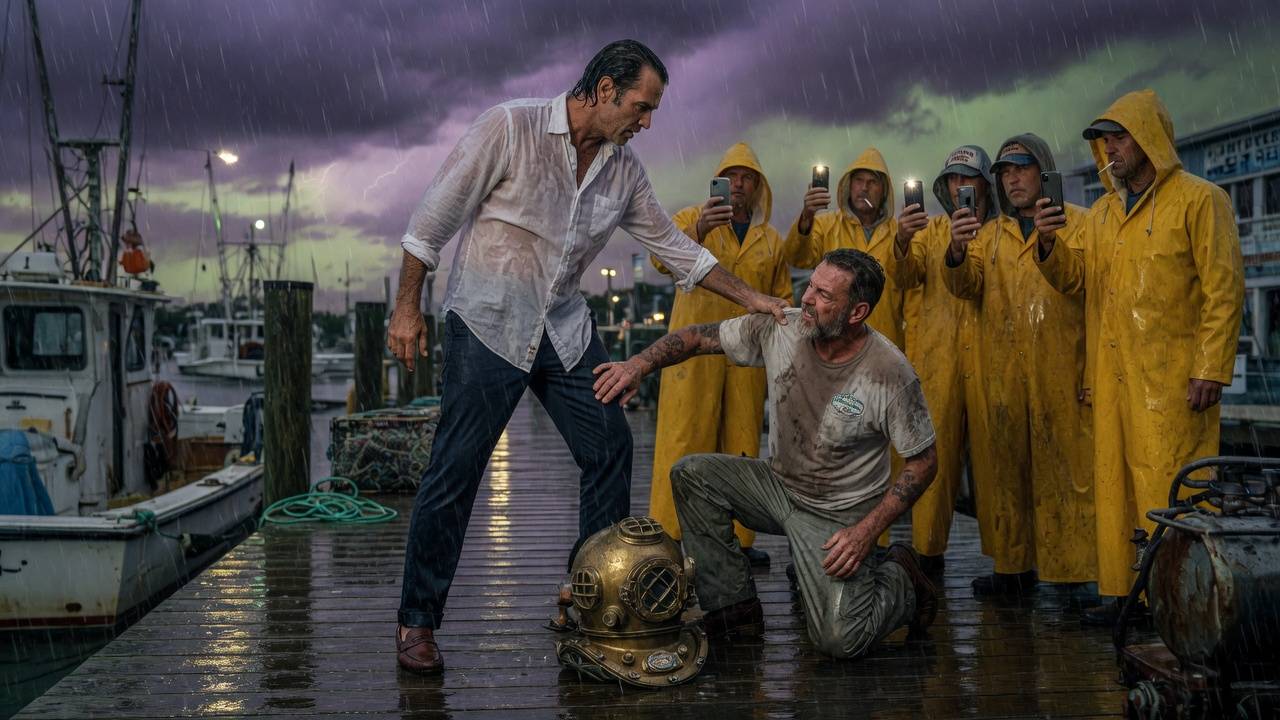
The wind was howling now, a low-frequency roar that rattled the masts of the remaining boats in the marina. The rain was a horizontal sheet of grey, turning the pier into a slick, dangerous runway. Richard Belmont stood in the center of the pier, his white linen shirt plastered to his chest, looking like a manic god of the storm. He was surrounded by a small group of marina workers and fishermen who were desperately securing their own gear, their phones raised to capture the confrontation.
Elias approached, the heavy brass Mark V helmet tucked under his arm. He felt the eyes of the community on him—the “salty” men he’d fished with for a decade. They were watching him sell his soul to the highest bidder, and the shame of it was a physical weight, heavier than any diving suit.
“You’re late, Elias!” Belmont shouted over the wind. “I was beginning to think you’d drowned in your own self-pity.”
“I have the coordinates,” Elias said, stopping ten feet away. The waves were crashing against the pier, sending sprays of cold salt water over them. “Give me the papers. The impound release, signed and notarized.”
Belmont laughed, a jagged sound that the wind tore away. He held up a thick manila envelope. “These? You want these so badly? You’re like a dog begging for a scrap of meat at the table. It’s pathetic, Elias. Truly.”
He turned to the watching fishermen, his voice projecting with practiced ease, the bully enjoying his stage. “Look at him! The Great Cap Hayes! The hero of the Navy! Here he is, selling out his ‘honor’ for a few months of slip fees and a chance to keep his rust-bucket floating. Is this your local legend? A man who would dive into a grave for a paycheck? He’s not a hero. He’s just another broke-down loser looking for a handout.”
Vance and Miller chuckled, stepping closer, boxing Elias in. Vance reached out and shoved Elias’s shoulder, a mocking, testing gesture. “Keep your head down, hero. The boss is talking.”
“Richard, stop,” Elias said, his voice dangerously quiet. “You’ve got what you wanted. Just give me the papers and let’s get on the boat before the surge gets worse.”
“Oh, we’re going on the boat,” Belmont said, his eyes wild with a cruel delight. “But first, I want to see you crawl. I want everyone here to see exactly what you are. You’re a failure, Elias. A failed sailor, a failed businessman, and a failed father.”
Belmont stepped forward and snatched the Mark V helmet from Elias’s arm. Elias reached for it, but Vance shoved him back, his massive hand slamming into Elias’s chest. Elias stumbled, his boots slipping on the wet wood, and he went down on one knee.
“This is the problem with you people,” Belmont sneered, holding the helmet up like a trophy. “You think these trinkets mean something. You think history matters. This is just scrap metal, Elias. Just like you.”
Belmont dropped the helmet. It hit the wooden planks with a heavy, metallic thud that seemed to echo through the entire marina. Then, with a slow, deliberate movement, Belmont lifted his leather loafer and stepped hard on the side of the brass helmet, grinding it into the pier.
“A hero’s helmet for a man who couldn’t even save his own career,” Belmont sneered. He reached down, grabbed the collar of Elias’s grey t-shirt, and jerked him upward, forcing him to look at the laughing faces of the muscle-men. The fishermen were silent now, their phones recording the total degradation of a man they once respected.
Elias felt a white-hot spike of agony in his chest. That helmet was his father’s soul. It was the only thing Leo had to remember his grandfather by. It was the last piece of dignity he had left.
“Take your foot off the brass, Richard,” Elias said. The fear was gone. The hesitation was gone. There was only the cold, pressurized stillness of the deep. “Last warning.”
Belmont’s smile widened into a mask of contempt. “Warning? You’re going to warn me? You’re a broke-down boat captain with a lien on his soul. You don’t give warnings. You take orders. Now get up and get on the boat, or I’ll throw this piece of junk into the harbor right now.”
Belmont shoved Elias’s head back and reached out with his other hand to grab Elias’s throat, his fingers tightening to choke the life out of the moment.
The world slowed down.
As Belmont’s hand closed toward his throat, Elias planted his lead foot into the wet wood, drawing power from the very pier. He snapped his left forearm upward, a sharp, structural block that caught Belmont’s reaching arm at the wrist and elbow, snapping it off-line with a sound like a dry branch breaking. Belmont’s balance vanished. His chest was wide open, his expensive shirt a target.
Elias stepped inside the space, his entire body weight shifting forward. He drove a compact, palm-heel strike into the center of Belmont’s sternum. It wasn’t a punch; it was a detonation. The contact was audible—a heavy, wet thud that sent a jolt through Belmont’s entire frame. Belmont’s breath left him in a ragged wheeze, his eyes going wide with shock.
Elias didn’t stop. He planted his standing foot, lifted his knee, and drove a massive front push kick directly into Belmont’s chest. The sole of Elias’s work boot slammed into the white linen, the force traveling through Belmont’s centerline.
Belmont was launched. He flew backward five feet, his body skipping once across the wet planks before he slammed into a stack of crab traps. The metal groaned under his weight as he crumpled into a heap.
The pier went silent, save for the screaming wind. Vance and Miller froze, their hands halfway to their waistbands, looking at the man on the ground. They looked at Elias, who stood perfectly still, his breathing rhythmic and deep.
Belmont scrambled backward on his elbows, his face a mask of terror. He clutched his chest, gasping for air. He looked up at Elias, his eyes pleading. “Wait… wait—stop! Please!”
Elias stepped forward, his boots echoing on the wood. He stopped inches from the brass helmet, which lay unscathed on the pier. He picked it up, his hands steady. He looked at the manilla envelope that had fallen from Belmont’s pocket. Elias didn’t pick it up.
“The ocean doesn’t take bribes, Richard,” Elias said, his voice cutting through the storm like a sonar ping. “And neither do I. You want the bonds? Go find them yourself. But stay away from my boat.”
Elias turned and walked away, the Mark V helmet held tight against his chest. Behind him, the fishermen began to step forward, their phones still recording. The “Hero” was back, but as the first eyewall of the hurricane hit the marina, Elias knew that the real fight—the one for his son and his future—was only just beginning. He walked back to The Mercy, the orange impound sticker flapping in the wind, a reminder of the debt he still owed to the world. But for the first time in ten years, he didn’t feel like he was drowning.