Chapter 5
The silence that followed Henry’s departure from the solarium was not empty; it was heavy, pressurized, like the air inside a diving bell. Julian St. James stood in the center of the white marble foyer, his tailored suit jacket unbuttoned, his briefcase still clutched in a white-knuckled grip. He didn’t look at the shattered wine glass or the expensive hors d’oeuvres scattered like confetti. He looked at the front door, the heavy oak slab that had just latched shut behind the man with the ruined face.
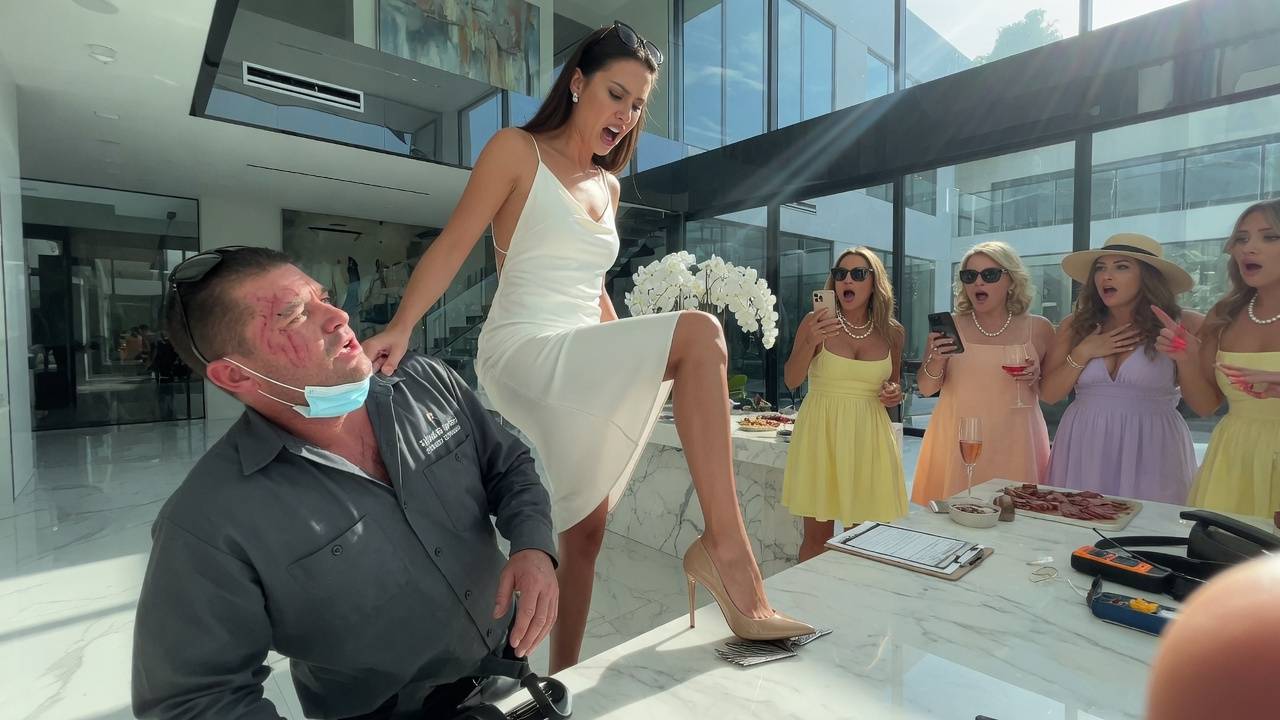
“Julian!” Evelyn’s voice was a jagged shard of glass. She was on her feet now, supported by Brenda and another woman from the bridge club. Her white silk dress was stained with a pale yellow splash of Chardonnay, and a smudge of grey dust from Henry’s boot marked the center of her chest. Her blonde hair, usually a masterpiece of structural engineering, hung in limp, frantic strands. “Did you see? Did you see what that… that animal did to me?”
Julian didn’t turn around. He was breathing hard, his chest rising and falling in a jagged rhythm that had nothing to do with the stairs he’d just climbed. “I saw him, Evelyn.”
“He attacked me!” she shrieked, her voice rising to a frequency that made the nearby crystal decanters ring. “In my own home! In front of my guests! I want him arrested. I want the police here now. I want you to call the precinct—call the Commissioner—I want him in a cell by midnight. And I want his company dissolved. I want him to never hold a wrench in this state again!”
Julian finally turned, but the expression on his face wasn’t the protective fury Evelyn expected. It was a mask of cold, vibrating shock. He looked at his wife, then at the women of the bridge club, who were all clutching their phones like holy relics, their eyes darting between the billionaire and his disheveled wife.
“Do any of you have any idea who that was?” Julian asked. His voice was low, dangerously quiet.
“He’s a repairman, Julian!” Brenda snapped, her courage returning now that the “monster” was gone. “A disfigured, violent repairman who thinks he can put his hands on a woman of Evelyn’s standing. We have it all on video.”
Julian walked toward the glass table. He reached down and picked up the small, weathered leather wallet Henry had left behind in his haste. He flipped it open. The photograph of the young Sergeant Miller stared back at him—brash, grinning, whole. And beside it, the empty slot where the silver wings had been.
“Ten years ago,” Julian said, his voice trembling. “Kandahar. The C-130 went down in a dry creek bed after an engine fire. The pilot was dead. The co-pilot was pinned under the console. The cargo bay was a furnace. The rescue teams were six minutes out, and the secondary fuel tanks were about to go.”
The women went still. Even Evelyn paused her sobbing, her eyes narrowing in confusion.
“The loadmaster had clear orders to egress,” Julian continued, his gaze fixed on the photo. “But he didn’t. He went back in. He didn’t have a suit, just his fatigues and a fire extinguisher that ran out in twenty seconds. He reached into the fire with his bare hands to clear the debris. He dragged the co-pilot out while his own skin was melting off his ribs. He stayed until the last man was clear. When the tanks blew, he was five feet from the fuselage.”
Julian looked up, his eyes burning with a sudden, devastating clarity. “That co-pilot was me, Evelyn. That ‘animal’ is the only reason you have a husband to complain to.”
Evelyn blinked, her mouth working but no sound coming out. “Julian, you… you never said his name. You just said it was a Sergeant.”
“Because he wouldn’t let me thank him!” Julian roared, the sound echoing off the glass walls. “He went into the surgeries, he took his medical discharge, and he vanished. He didn’t want a medal. He didn’t want a payout. He just wanted to do his job. And he comes to my house—my home—to fix the air that you’re breathing, and you treat him like a leper?”
“He was wearing a mask, Julian,” Evelyn whimpered, her defensive instincts kicking in. “He looked terrifying. I was just… I was trying to keep the environment pleasant for the girls. He was aggressive. He threw me!”
“He warned you,” Julian said, stepping closer to her. He didn’t touch her, but the air around him felt hot, as if the heatwave had finally breached the house. “I heard him through the door. I heard him tell you to step off the wings. Your heel was on his wings, Evelyn? The ones he earned while I was screaming for my life in a cockpit?”
The bridge club women began to edge toward the foyer, the social currency of the afternoon having plummeted into a deficit none of them could afford.
“We should probably… go,” Brenda whispered, grabbing her designer clutch.
“No,” Julian said, turning to them. “Stay. I want you to see this. I want you to remember this the next time you decide someone is ‘the help.’ Evelyn, give me your phone.”
“What? No!”
Julian reached out and plucked the device from her hand. He looked at the screen, then at the other women. “If a single frame of that video ends up online, if a single word of this reaches the press in a way that disparages Sergeant Miller, I will personally see to it that every trust fund, every corporate board seat, and every country club membership represented in this room is dismantled. I own the banks you use. I own the developers who built your houses. Do not test me on this.”
One by one, the phones were lowered. The silence returned, deeper and more shameful than before.
Outside, the sun was beginning to dip below the ridge of the hills, turning the sky a bruised, angry purple. Henry sat in his van, his hands gripping the steering wheel so hard the plastic groaned. The adrenaline was receding, replaced by a cold, hollow ache in his chest. His face felt like it was on fire. He’d ripped the mask off, and the dry air was stinging the sensitive tissue.
He looked at the silver wings sitting on the dashboard. They were bent. The pin on the back was twisted at a sharp angle, a permanent reminder of Evelyn’s heel. He felt a sudden, sharp surge of grief—not for the metal, but for the quiet dignity he’d spent ten years trying to build. He’d fought so hard to be just a guy who fixed things. A guy who stayed in the shadows.
He looked at the “model” plumber, a young man named Caleb who had been working on the outdoor pool heater. Caleb was standing by his own truck, a sleek, branded vehicle, watching Henry with an expression that wasn’t disgust. It was something else.
Caleb walked over, his boots crunching on the gravel. He stopped a few feet from the driver’s side window.
“Hey,” Caleb said. He was handsome, the kind of guy who probably did commercial work on the side. “I saw… most of that through the window. Before the husband got there.”
Henry didn’t look at him. “You want to tell me I’m fired? Save the breath. I already know.”
“I was gonna say,” Caleb said, leaning against the van door, “that was the most beautiful thing I’ve seen in three years of working in the Hills. She’s a nightmare, man. We all know it. Nobody ever says anything because of the St. James name.”
Henry finally turned his head, letting the full weight of his scars face the younger man. Caleb didn’t flinch. He didn’t look away.
“You’re a Sergeant?” Caleb asked softly.
“I was,” Henry said.
“My brother is in the 82nd,” Caleb said, nodding toward the wings on the dash. “He’s got a pair of those. He told me what they mean. You shouldn’t have to hide that, man. Not for people like her.”
Henry looked at the wings, then back at the mansion. The glass reflected the dying light, looking like a fortress made of ice. “The mask wasn’t for her, Caleb. It was for me.”
“Well,” Caleb said, pushing off the truck. “For what it’s worth, I think you look like a guy who’s been through it and came out the other side. That’s a hell of a lot better than looking like you’ve never been anywhere at all.”
Caleb walked back to his truck, and Henry sat there for a long time, the engine idling. His phone buzzed in the cup holder. He expected a termination notice. He expected a legal threat.
It was a text from an unknown number.
Sergeant Miller. This is Julian. I am at the house. I am looking at your wings. I am sorry. I am so deeply, profoundly sorry. Please don’t disappear again. My assistant is sending a car to pick up your daughter and her grandmother for the play. I will meet you there. I have something of yours.
Henry stared at the screen. The “Degrees of Contempt” he’d lived with for a decade—the subtle flinches, the overt cruelty, the pity—it all felt like it was shifting. He shifted the van into gear. He didn’t put the mask back on. He just drove down the winding hill, toward the valley, toward the lights, toward the one person who didn’t care what his face looked like as long as he was there to see her be a tree.
Chapter 6
The Van Nuys Elementary auditorium smelled exactly the same as every school auditorium in America: a mixture of floor wax, stale popcorn, and the collective nervous sweat of three hundred parents. The air conditioning was struggling against the lingering heat of the day, a low, rhythmic thumping behind the stage curtains that Henry’s professional ears identified as a failing blower motor.
Under normal circumstances, he would have been looking for the janitor to offer a tip. Tonight, he just walked through the double doors and kept his head up.
He felt the ripple of the room immediately. A few parents glanced his way and then looked at their programs. A group of mothers near the bake sale table went quiet as he passed. He felt the familiar urge to reach for the mask in his pocket, to hide the red, corded landscape of his jaw, but he forced his hands to stay at his sides. He found a seat in the third row, center aisle.
He was early. The stage was set with painted cardboard cutouts of a forest. In the center was a particularly sturdy-looking maple tree with glitter on its leaves. That was Maya’s spot.
“Is this seat taken?”
Henry looked up. It was Julian St. James. He wasn’t wearing the suit jacket anymore. His tie was loosened, his sleeves rolled up. He looked like a man who had been through a long, exhausting day of his own. Behind him stood two men in dark suits—security, likely—but they stayed back, blending into the shadows of the rear exit.
“Julian,” Henry said, his voice level. “You shouldn’t be here. This isn’t your world.”
“You saved my world, Henry,” Julian said, sitting down in the folding chair next to him. “I think that gives me a standing invitation.”
Julian reached into his pocket and pulled out the silver wings. They were different now. The metal was polished to a mirror shine, and the pin on the back had been expertly straightened.
“I have a jeweler on retainer for Evelyn’s… things,” Julian said, handing them over. “He did it in twenty minutes. He said they were the most important thing he’s ever worked on.”
Henry took the wings, the cool metal feeling heavy in his palm. “How is she?”
“Evelyn is at her mother’s house in Bel Air,” Julian said, his voice devoid of emotion. “We’re separating, Henry. It wasn’t just today. Today was just the moment the glass finally cracked. I realized I’ve been living in a house where the aesthetic was more important than the humanity. I can’t do it anymore.”
“I didn’t mean to break your marriage, Julian,” Henry said.
“You didn’t. You just turned the lights on.” Julian looked at the stage. “Which one is yours?”
“The maple,” Henry said, a small, genuine smile tugging at the good side of his mouth. “The one with too much glitter.”
“She’s got her father’s spirit,” Julian said. “Standing her ground.”
The lights dimmed, and a hush fell over the room. A teacher in a floral dress walked to the center of the stage and gave a brief, nervous introduction about the “Magic of the Seasons.” Then, the music started—a tinny, synthesized version of Vivaldi’s Spring.
The children filed out. Maya was in the middle of the line, her face set in a look of grim determination. She took her spot in the center of the “forest,” her arms raised like branches. As her eyes scanned the audience, they landed on the third row.
Henry saw the moment she recognized him. Her eyes widened, her posture straightened, and a grin broke across her face that eclipsed every light in the room. She didn’t wave—she was a professional tree, after all—but she held her position with a new kind of pride.
Halfway through the performance, during a song about the autumn wind, the blower motor in the back finally gave up. The hum died, replaced by a metallic grinding sound, and then silence. The air in the auditorium began to thicken almost instantly.
The parents started to murmur. The children on stage looked confused. The teacher stepped out, looking panicked.
“I’m so sorry,” she said, her voice echoing without a microphone. “It seems our ventilation system has failed. We might have to pause for a moment to open the emergency exits.”
Henry felt a nudge at his elbow. Julian was looking at him, an eyebrow raised.
“You have your tools in the van?” Julian whispered.
Henry looked at the stage. Maya was still standing there, her cardboard leaves beginning to wilt in the rising humidity. He looked at the teacher, then at the crowded room of families who just wanted to see their kids shine.
“Stay here,” Henry said.
He slipped out the side door, the heat of the evening hitting him like a wall. He ran to his van, grabbed his bag and his headlamp, and found the exterior access panel for the auditorium’s rooftop unit.
He didn’t need a mask. He didn’t need to hide. He worked with the frantic, focused energy of a man on a mission. He bypassed the faulty starter, jumped the relay, and manually forced the compressor to engage. Within four minutes, he heard the glorious, deep thrum of the fan blades catching the air.
He climbed down, his shirt streaked with grease, his face covered in a fine layer of dust. He walked back into the auditorium just as a blast of cold, fresh air surged through the vents.
The room erupted in a spontaneous cheer. The teacher looked up at the vents as if they were a miracle. Henry slipped back into his seat next to Julian, breathing hard.
“Nice work, Sergeant,” Julian whispered.
“I’m just the repairman,” Henry said, wiping his forehead.
The play finished to a standing ovation. As the curtains closed, Maya broke character and sprinted off the stage, disappearing into the wings. A few minutes later, she came running up the center aisle, still wearing her cardboard trunk.
“Daddy! Daddy!” She threw herself into his arms, her glitter rubbing off on his work shirt. “Did you see me? I didn’t move! Not once! Even when the air stopped!”
“I saw you, Bug,” Henry said, lifting her up. “You were the best tree in the whole world.”
Maya pulled back, her small hands framing his face. She looked at his scars, then at Julian, then back at Henry. “You didn’t wear the blue thing.”
“I didn’t need it today,” Henry said.
“I told you,” she whispered, leaning in close so only he could hear. “You look like a superhero. Superheroes don’t hide.”
Julian stepped forward, reaching into his pocket. He pulled out a small, gold-embossed card. “Maya, your father is more than a superhero. He’s a legend. My name is Julian, and your dad saved my life a long time ago.”
Maya’s eyes went wide. “With a sword?”
“With something better than a sword,” Julian said, looking at Henry. “With his heart.”
Julian turned to Henry. “I’m moving the service contract for the entire conglomerate to a new independent firm. Your firm, Henry. If you want it. No corporate oversight. No ‘St. James’ branding. Just you, your tools, and as many technicians as you want to hire. I want you to run it.”
Henry looked at the card, then at the silver wings in his hand. The “Degrees of Contempt” had finally reached zero. The temperature had leveled out.
“I’ll think about it, Julian,” Henry said, his voice steady. “But I have to get home first. This tree needs some water.”
As they walked out of the school, the heatwave had finally broken. A cool breeze was blowing in from the coast, smelling of salt and damp earth. Henry didn’t look down. He didn’t look away when people passed. He held his daughter’s hand, his scarred face open to the night air, and for the first time in ten years, he didn’t feel like a monster.
He felt like a man who had finally come home.