Chapter 5
The locker room of the Pierre felt like a tomb. It was a space designed for the invisible—the men and women who polished the marble and folded the linens and moved the cars while the world above them drank champagne. Elias sat on the narrow wooden bench, his back against a locker dented by forty years of frustrated valets. The steam from the showers was thick, smelling of cheap soap and the metallic tang of New York City grit.
Miller stood by the door, his massive frame blocking the exit. He was still wearing his security blazer, but the brass buttons seemed duller in the fluorescent light. He was looking at his phone, his thumb swiping rhythmically.
“It’s at twelve million views, Elias,” Miller said. His voice was a low, heavy rumble that vibrated in the small room. “Twelve million in three hours. Someone uploaded it to a ‘Justice Served’ subreddit, and then a major news site picked it up. They’re calling you ‘The Ghost of Manhattan.'”
Elias didn’t look at the screen. He was staring at his right hand. The tremor was back, but it was different now. It wasn’t the frantic, panicked twitch of a victim. It was a low-frequency hum, the vibration of an engine that had been redlined for too long. He could feel the heat where the cigarette had almost touched his skin, a phantom burn that served as a reminder of how close he’d come to losing everything.
“The manager wants to see you,” Miller added, his tone softening. “He’s in a panic. The Thorne family’s legal team has already called three times. They’re threatening to sue the hotel into the bedrock. They’re claiming you’re a deranged former soldier who stalked Sterling.”
“I was standing at my post,” Elias said. He sounded tired. Not the tiredness of a long shift, but the bone-deep exhaustion of a man who had spent three years trying to hold back a flood with his bare hands, only to watch the dam burst.
“Doesn’t matter,” Miller said. “In this city, the truth is whatever the person with the most lawyers says it is. You know how this ends, Elias. I can’t protect your job. Not after that.”
“I know.”
Elias stood up. He reached into his locker and pulled out his civilian clothes—a faded flannel shirt and a canvas jacket that had seen better days. He began to peel off the grey valet uniform, the fabric damp and smelling of rain. He felt exposed without the nametag. For three years, “Elias the Valet” had been a suit of armor. Now, he was just Elias again, and the world was very, very small.
He walked out of the locker room and up the service stairs to the manager’s office. Mr. Henderson was a man who lived and died by the hotel’s Yelp rating and the approval of the board. He didn’t look at Elias when he entered. He was staring at a printed screenshot of the video—a blurry frame of Sterling Thorne hitting the wet pavement.
“There’s a check on the desk, Elias,” Henderson said, his voice thin and reedy. “It includes your back pay and a severance amount that I’m told is ‘generous’ in exchange for your immediate departure. You are barred from the property. If you speak to the press, the severance is void, and we will cooperate fully with the Thorne family’s assault charges.”
Elias picked up the check. He didn’t look at the number. He folded it once and put it in his pocket. “Is that all, sir?”
Henderson finally looked up. There was no anger in his eyes, only a desperate, shivering fear. “Why did you do it? You were the best we had. You were quiet. You never made a scene.”
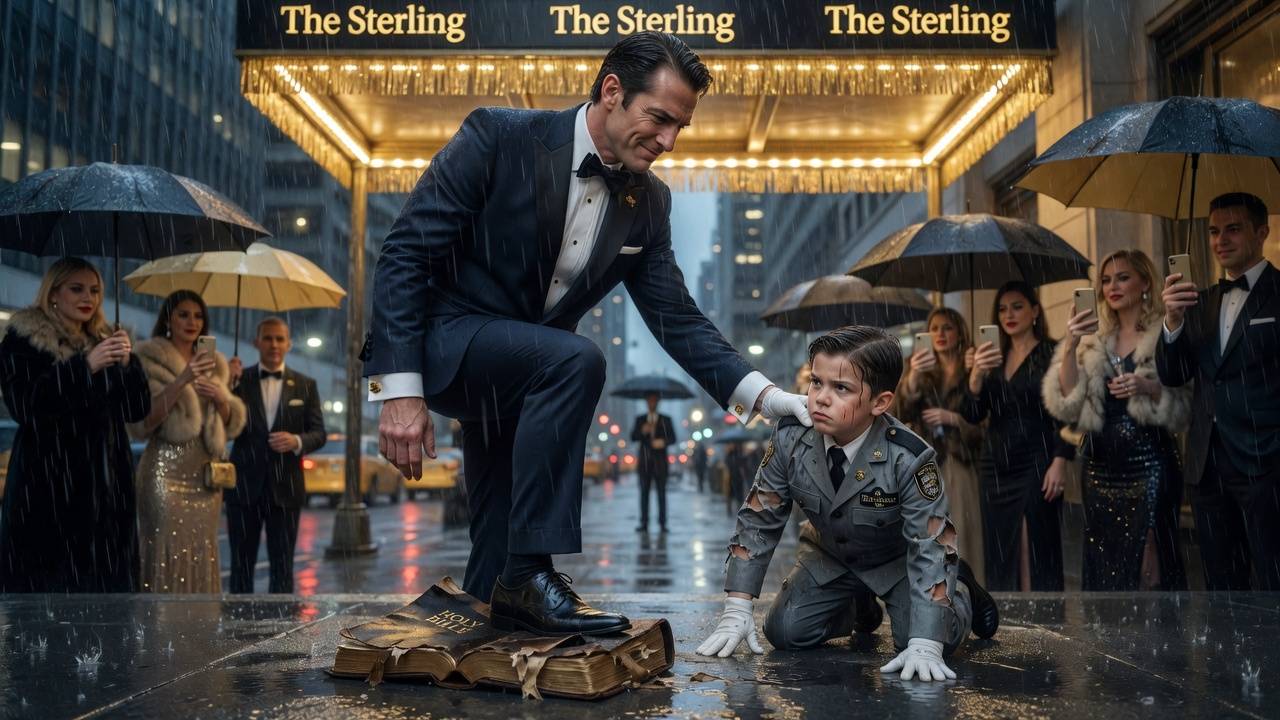
“He stepped on my Book,” Elias said.
Elias walked out of the Pierre for the last time. The rain had stopped, leaving the city in a cold, shimmering dampness. He walked toward the subway, his collar turned up against the wind. He could feel people looking at him. A group of teenagers outside a 7-Eleven pointed and whispered. A woman on the platform glanced at his face, then at her phone, her eyes widening.
He was no longer a ghost. He was a target.
He took the Q train toward Brooklyn, sitting in the corner of the car with his hands buried in his pockets. Every time the doors opened, he expected to see a man in a beige suit or a man with a tattoo of a coiled snake on his neck. The world had become a tactical map again. Every exit was a choke point. Every passenger was a potential threat.
He got off at DeKalb and walked four blocks to a nondescript apartment building. He didn’t go to his own place. He went to the park across the street and sat on a bench, watching the entrance. Ten minutes later, a black sedan with tinted windows pulled to the curb. Vance stepped out. He didn’t look like a paper salesman anymore. He looked like a man who had just watched a billion-dollar investment go up in smoke.
Vance saw Elias on the bench and walked over, his stride long and angry. He didn’t sit down.
“Do you have any idea what you’ve done?” Vance hissed. “The Thorne family has trackers on every social media platform in the Western Hemisphere. The Cartel has facial recognition software that the CIA would envy. Your face is the most famous thing on the internet right now, Elias. You’re a dead man walking.”
“He was going to burn me, Vance,” Elias said, his voice flat. “And he was doing it in front of Sarah.”
“Sarah is the reason you should have taken it!” Vance shouted, a few pigeons fluttering away in alarm. “Now we have to move you. Tonight. I’ve got a safe house in rural Pennsylvania. No phones, no internet, no daughter. You leave in two hours.”
“No,” Elias said.
Vance blinked. “Excuse me?”
“I’m not leaving her. If I go to Pennsylvania, they’ll find her here. Sterling Thorne knows she was there. He saw the way she looked at me. He’s a predator, Vance. He’s going to go after the only thing I have left to get back at me.”
“We can’t protect her if you stay!” Vance argued. “The Cartel—”
“The Cartel wants the witness,” Elias interrupted. “Thorne wants revenge. If I stay near her, I can pull them toward me. I can end this.”
“You’re a valet with a hand tremor, Elias. You’re not a one-man army.”
Elias looked at Vance. The tremor in his hand was gone. His eyes were cold, dark pits of calculated intent. “I was a Ranger in the Korengal for three tours, Vance. I spent fourteen months hunting men in caves. You think a tech-heir and a few hired guns in Queens are going to be a problem?”
“You’re out of the program,” Vance said, his voice dropping to a dangerous whisper. “If you refuse to relocate, we pull your protection. No more wire. No more backup. You’re on your own.”
“I’ve been on my own since the day the chopper left without my team,” Elias said. He stood up and started walking toward the subway.
“Where are you going?” Vance called out.
“To see my daughter,” Elias said. “Before they do.”
Sarah lived in a cramped third-floor walk-up near the NYU campus. The hallway smelled of overcooked cabbage and the faint, sweet scent of marijuana from a neighboring apartment. Elias stood outside her door for a long minute, his hand hovering over the wood. He could hear music playing inside—something soft and melancholic.
He knocked. The music stopped.
“Who is it?” Sarah’s voice was guarded, filled with a tension that hadn’t been there twenty-four hours ago.
“It’s me, Sarah. Open the door.”
He heard the slide of a deadbolt and the rattle of a chain. The door opened six inches, and Sarah looked out. Her eyes were red-rimmed, her face pale. She was wearing a thick sweater that looked too big for her.
“The video,” she said. “I’ve watched it fifty times.”
“Can I come in?”
She stepped back, letting him enter. The apartment was a mess of textbooks and laundry. A laptop sat on the small kitchen table, the screen still showing a frozen image of the hotel canopy.
“You lied to me,” she said, her voice trembling. She wasn’t looking at him. She was looking at the laptop. “All those letters from Jersey. The ‘logistics’ job. You were parking cars for three years? You were living in a basement while I was going to school on your money?”
“I did what I had to do to keep you safe, Sarah,” Elias said. He sat on the edge of her sofa, feeling the heavy weight of the room.
“Safe from what? You said you were retired. You said the war was over.” She finally turned to him, her eyes flashing with a sudden, sharp anger. “And then I see that video. That wasn’t a valet, Dad. I saw your face. I saw what you did to that man. You looked… you looked like you enjoyed it.”
“I didn’t enjoy it,” Elias said softly. “I just knew how to do it.”
“Who are those people?” she asked, gesturing to the screen. “Sterling Thorne’s father is on the news saying you’re a dangerous criminal. There are people on Twitter saying you’re a hero. There are people outside my building, Dad. Men in cars. I saw them when I came home from class.”
Elias felt a cold spike of adrenaline hit his system. “How many men? What kind of cars?”
“I don’t know! A black SUV. They were just… sitting there. Looking at the entrance.” She started to cry, her shoulders shaking. “I’m scared. I don’t know who you are anymore. I thought you were just a man who came home broken. Now I think you’re a man who never came home at all.”
Elias stood up and walked to the window. He moved the curtain a fraction of an inch. A black Escalade was parked at the fire hydrant across the street. Two men were inside. He didn’t need to see their faces to know they weren’t Feds. Vance wouldn’t be that obvious. These were Thorne’s people, or worse, the men Thorne’s father paid to keep the “witness” from ever reaching the stand.
“Pack a bag,” Elias said. His voice was no longer the voice of a father or a valet. It was the voice of a sergeant.
“What? No, I’m not going anywhere with you—”
“Sarah, listen to me,” Elias said, turning to her. He grabbed her by the shoulders, his grip firm but not painful. “I am a witness in a federal case against the Thorne family and the people they do business with. The valet job was a cover. The letters were a lie. But the reason for all of it was to make sure you had a life. Right now, that life is in danger. Those men outside? They aren’t here to talk. They’re here to make sure I don’t talk.”
She stared at him, the reality of the situation finally beginning to sink in. “You… you’re in witness protection?”
“I was. Until I hit Sterling.” He let go of her shoulders. “I broke the rules to protect the Book. And to protect you. Now we have to move. Fast.”
“Where are we going?”
“I have a place,” Elias lied. He didn’t have a place. He had a city of eight million people and a set of skills he had prayed he would never have to use again. “Get your coat. And your phone—turn it off. Right now.”
She obeyed, her movements mechanical and numb. She threw a few things into a backpack while Elias watched the street. The men in the Escalade hadn’t moved. They were waiting for something. A signal. Or the cover of total darkness.
“I’m ready,” she whispered.
Elias checked his pocket. He had the check from the hotel, his pocket Bible, and a folding knife he’d kept hidden in his boot. It wasn’t much, but it would have to be enough.
“Stay behind me,” Elias said. “And whatever happens, don’t look back.”
They walked out of the apartment and down the stairs. Elias could feel the pressure rising in his chest, the old Korengal hum returning to his ears. He wasn’t a valet anymore. He wasn’t a failure. He was the only thing standing between his daughter and a very dark world. And as they stepped out into the cold New York night, Elias realized that the price of the key hadn’t been paid in full yet.
Not by a long shot.
Chapter 6
The back exit of Sarah’s apartment building led into a narrow alleyway choked with overflowing trash bins and the rusted skeletons of abandoned bicycles. The air was cold and sharp, smelling of wet brick and exhaust. Elias held Sarah’s hand, his grip tight, pulling her through the shadows toward the street that ran parallel to her block.
“Keep your head down,” he whispered.
They reached the end of the alley. Elias peered around the corner. A silver sedan was idling fifty yards away, its headlights off. Another spotter. Thorne wasn’t just looking for him; he had a net spread.
“We can’t use the subway,” Elias muttered to himself. “They’ll have the stations flagged.”
“Dad, what are we doing?” Sarah’s voice was thin, vibrating with a panic she was struggling to contain.
“We’re going to ground,” Elias said. He led her across the street, timing their movement with the passing of a noisy garbage truck.
They walked for twenty minutes, weaving through the side streets of Brooklyn, doubling back, checking for tails. Elias felt the city differently now. It wasn’t a grid of streets and shops; it was a series of sightlines and cover. Every dark doorway was a potential ambush. Every siren in the distance was a possible escalation.
He led her into a 24-hour laundromat on a quiet corner. The room was empty except for an elderly man dozing in a chair near the back. The rhythmic thumping of the dryers provided a low-level acoustic screen.
“Sit,” Elias said, gesturing to a plastic bench.
He walked to the window, watching the street. His hand was steady. The tremor had completely retreated, as if his body had finally accepted that the time for shaking was over.
“I need to tell you the truth, Sarah,” Elias said, his back still to her. “About why I didn’t come home.”
“You said you were in the hospital. In Germany.”
“I was. But not for the reason you think.” He turned to face her. The fluorescent lights overhead hummed, casting harsh shadows across his face. “My team was sent into a valley called the Korengal. We were supposed to be the rescue force for a downed pilot. We got pinned down in a goat path. Mortars, small arms, everything. I was the RTO. I was the one who had to call for the extraction.”
He paused, the memory of the dust and the screaming hitting him like a physical weight.
“The coordinates I gave… the pilot misread them. Or maybe I screamed them wrong. I don’t know. The fire mission landed on our position. I was the only one in a deep enough crevice to survive. I watched my brothers burn because of a mistake I might have made.”
Sarah stared at him, her eyes wide. “Dad…”
“I couldn’t look at you,” Elias said, his voice a jagged rasp. “Every time I saw your face in the photos, I saw their faces. I felt like a murderer who had been rewarded with a life he didn’t deserve. So when the Feds approached me in the hospital—when they told me they needed a witness against the Thorne family’s laundering operations—I took it. I took it because it meant I could disappear. I could be a valet. I could be nothing. And I could send you money so you could be something.”
“You thought I wanted the money more than I wanted you?” she asked, a tear tracking through the dust on her cheek.
“I thought I was a poison, Sarah. I thought if I stayed away, you’d be clean of me.”
A sudden, sharp glare of headlights swept across the laundromat windows. A black SUV slowed down, its engine a low, predatory growl. Elias didn’t hesitate. He grabbed Sarah and shoved her behind a row of industrial washers.
“Stay down!” he hissed.
The SUV stopped. The doors opened with a series of synchronized thuds. Three men stepped out. They weren’t wearing suits. They were wearing tactical jackets and earpieces. These weren’t Thorne’s lawyers. These were the professionals—the ones the Cartel sent when the “disruptors” failed.
One of them held a suppressed handgun. He didn’t look for a door. He just kicked the glass out of the laundromat’s front entrance.
The sound of the shattering glass was the starter pistol.
Elias moved. He didn’t have a gun, but he had the environment. He grabbed a heavy metal laundry cart and shoved it with all his strength toward the first man entering. The cart hit the man’s shins, sending him stumbling.
Elias was on him before he could recover. He used a palm-strike to the man’s throat, followed by a sharp elbow to the temple. The man went down, his gun skittering across the tile. Elias reached for it, but the second man was already firing.
Thwip. Thwip. Thwip.
The bullets hissed past Elias’s ear, thudding into the plastic washers. Elias rolled, his movements a blur of practiced muscle memory. He kicked a stack of plastic baskets into the second man’s path, creating a split-second of chaos.
“Sarah, the back door! Go!” Elias shouted.
The third man—the largest of the group—blocked the way to the back. He was a wall of muscle and scar tissue. He lunged for Elias, a serrated knife flashing in his hand.
Elias didn’t retreat. He stepped into the attack, the way he had with Sterling Thorne, but this time there was no restraint. He snapped the man’s wrist with a sickening crack, the knife falling to the floor. Elias didn’t stop there. He drove a knee into the man’s ribs and a headbutt to the bridge of his nose.
The giant collapsed, clutching his face.
Elias grabbed the suppressed handgun from the floor. He checked the magazine. Twelve rounds.
“Sarah!”
She was huddled in the corner, her hands over her ears. He reached out and pulled her up. “We have to go. Now.”
They ran out the back door just as the second man managed to clear the baskets. They burst into the alleyway, but Elias stopped. He could hear more engines. More sirens. The net was closing.
“The roof,” Elias said. “We go up.”
He led her to a rusted fire escape. They climbed, their boots clanging against the metal. From the top of the five-story building, Elias could see the city laid out like a battlefield. He saw three more black SUVs converging on the laundromat.
He felt a hand on his arm. Sarah was looking at him, her face pale but her eyes steady.
“You’re not a coward, Dad,” she whispered. “A coward wouldn’t have come for me.”
Elias looked at the gun in his hand. He looked at the Bible in his pocket. He felt the weight of the last three years finally beginning to lift. He wasn’t hiding anymore. He was the witness. And it was time to give his testimony.
“I’m going to end this, Sarah,” he said. “I’m going to call Vance. I’m going to tell him where we are. And then I’m going to make sure the Thorne family never touches another key in this city.”
He pulled his phone from his pocket—the one he’d kept hidden. He dialed a number he’d memorized three years ago.
“Vance,” Elias said when the line picked up. “I’m at the corner of DeKalb and Willoughby. On the roof. I have Sarah. And I have three of Thorne’s hitmen in the laundromat below me. If you want the testimony, you come and get us. Now. Or I’ll take the deal the Cartel is going to offer me to stay silent.”
He hung up.
“Will they come?” Sarah asked.
“They have to,” Elias said. “I’m the only thing they have left.”
They sat on the edge of the roof, the cold wind whipping around them. In the distance, the first real police sirens began to wail—the NYPD, called in by the Feds to secure the area. The black SUVs below began to scramble, realized the game had changed.
Elias felt his hand. It was still. Perfectly, terrifyingly still.
The sun began to bleed over the horizon, casting a long, golden light over the Brooklyn skyline. It wasn’t a cinematic ending. There was no applause. There were only the cold facts of a life lived in the shadows and the hard-won clarity of a man who had finally found his way home.
“Is it over?” Sarah asked.
“No,” Elias said, looking at the rising sun. “But the tremor is gone. And for the first time in a long time, I think I can hold on to something without it breaking.”
He reached into his pocket and pulled out the Bible. He handed it to her.
“Keep this,” he said. “It’s been through a lot. Just like us.”
Sarah took the Book, her thumb tracing the shrapnel hole. She looked at her father, really looked at him, and for the first time, she didn’t see a valet. She saw a man who had survived the fire, and who was finally ready to stop running.
As the first helicopter circled overhead, Elias stood up and walked toward the edge of the roof, ready to meet the world he had spent so long trying to escape. The debt was paid. The key was turned. And the Ranger was finally home.