Gregory Hall has everything. The senate seat. The multimillion-dollar book deal. The “War Hero” title that he wears like a designer suit.
I have a delivery route, a prosthetic leg that aches when it rains, and the original handwritten journals that prove his entire life is a lie.
I was the one in the dirt in Helmand. I was the one who pulled my best friend out of the wreckage while Gregory was sipping scotch in a green zone office.
Now, he’s using my friend’s death to sell copies of a memoir I ghostwrote for him in exchange for the funding my VA clinic desperately needed.
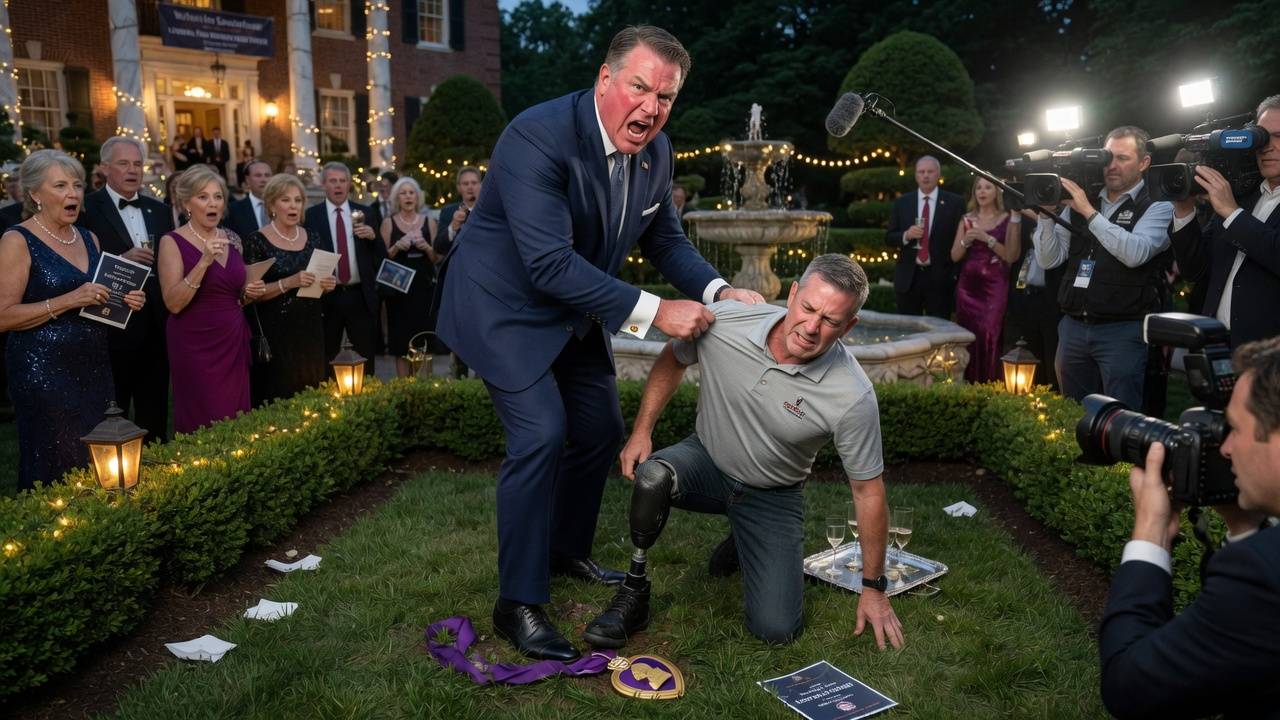
Tonight, at his $5,000-a-plate gala, he decided to remind me of my place. He “accidentally” tripped me in front of the donors.
He stepped on the Purple Heart I was carrying—the one that belongs to a man who actually earned it.
He whispered that I was just a prop. A one-legged beggar who should be grateful for his charity.
But Gregory forgot one thing about the men he tries to use as footstools. We know how to find the center of gravity.
He thought I was broken. He thought the cameras would protect him. He was wrong.
When the thief finally met the soldier, the truth didn’t just come out—it hit him at 100 miles per hour.
The full story is in the comments.
Chapter 1
The humidity in Northern Virginia didn’t care about your service record. It clung to the skin like a wet wool blanket, making the socket of Gabe’s prosthetic itch with a dull, persistent heat. He shifted his weight behind the wheel of the brown delivery van, feeling the familiar bite of the carbon-fiber frame against his residual limb.
“Almost there, Maya,” he muttered to the empty passenger seat.
On the seat sat a small, battered shoebox. It wasn’t a delivery for a customer. It was the only thing he had left of her father—his journals, his sketches, and the Purple Heart that the Army had sent to a grieving widow who didn’t know what to do with it. Gabe had spent three years turning those scattered thoughts into a narrative, a book that was supposed to honor the man who hadn’t made it back from the valley.
Instead, that book was currently sitting at number one on the New York Times bestseller list under a different name: The Senator’s Shield by Gregory Hall.
Gabe pulled the van into the gravel lot of a community center in Arlington. This was the “safe” part of his day. No cameras, no high-society sharks, just the smell of floor wax and the low hum of the VA physical therapy wing.
“Hey, Gabe,” the receptionist, Sarah, said without looking up. “Dr. Aris is running late. Budget meetings. Again.”
Gabe leaned against the counter, his gait favoring his left side just enough to be noticeable to a trained eye. “Budget meetings? I thought the Senator’s new initiative was supposed to cover the shortfall.”
Sarah finally looked up, her eyes tired. “The ‘Hall Hero Fund’? Gabe, that money is like a ghost. It shows up for the press release and vanishes when the bills come due. We’re already cutting hours for the prosthetics lab.”
The phantom itch in Gabe’s missing foot flared. He’d signed the NDA because Hall’s people promised that the clinic—the one that had taught Maya’s father to walk again before he went back for his final tour—would be endowed for a decade. It was a trade: Gabe’s words and his friend’s legacy for the survival of the men left behind.
“He’s a good man, Gabe,” a voice said from the waiting area.
Gabe turned. It was Miller, a kid barely twenty, sitting in a wheelchair with a blanket over his lap. He was holding a copy of Hall’s book. The cover featured Hall in a crisp flight suit, looking rugged and resolute against a sunset.
“He says here that he never left a man behind,” Miller said, his voice full of a desperate kind of hope. “He says the pain of the survivors is his own burden. It makes me feel… like someone actually sees us.”
Gabe felt a sick twist in his stomach. He’d written those exact words. He’d sat in a cramped apartment with a bottle of cheap bourbon, trying to channel the grief he felt for his friend into a voice that sounded like “leadership.” He’d crafted the “burden” Gregory Hall claimed to carry.
“It’s a good story, Miller,” Gabe said, his voice tight. “Just remember it’s a book. Real life doesn’t always have a sunset.”
“Gabe?”
He turned to see Maya standing in the doorway. She was twelve now, with her father’s stubborn chin and eyes that saw too much. She was supposed to be at her dance class, but her ride had fallen through.
“You got the box?” she asked, ignored the rows of broken men in the waiting room.
“I got it. We’re going to the estate tonight, Maya. Like I promised. I’m going to make sure he sees you.”
“Why does he have to see me?” she asked, her voice dropping to a whisper. “He already has the book. Mom says he’s a hero. Why do you look so angry every time someone says his name?”
“Because, kiddo,” Gabe said, reaching out to ruffle her hair, “some people buy their medals. Your dad paid for his.”
He didn’t tell her that he was the one who sold it. He didn’t tell her that every time he saw Hall’s face on a news crawl, he felt like he was desecrating a grave. He just led her back to the van, the weight of the box in his hand feeling heavier than the lead-lined containers he delivered for the tech firms in Dulles.
As he pulled out of the lot, his phone buzzed in the cup holder. A text from a blocked number: The Senator expects you at the service entrance by 1800. Bring the original drafts. Final payment pending. Don’t be late, Gabe. The cameras are waiting.
He gripped the steering wheel until his knuckles went white. He wasn’t going to the service entrance. Not tonight.
Chapter 2
The Sterling Estate was a sprawling monument to old Virginia money and new political power. Rows of black SUVs lined the manicured driveway, their drivers standing in loose clusters, whispering into earpieces. Gabe slowed the delivery van at the gate, the rusted muffler rattling against the silence of the evening.
“Name?” the guard asked, looking at the “Express Courier” logo on the side of the van with visible disdain.
“Delivery for the Senator. Personal,” Gabe said, his voice flat.
“Service entrance is a mile back, around the bend.”
“I have a signed manifest for the front gallery. High-value assets,” Gabe lied, holding up a clipboard with a bunch of old shipping receipts.
The guard sighed, checked a tablet, and waved him through. He didn’t see the little girl crouched in the footwell of the passenger side, hidden under a moving blanket.
“Stay quiet, Maya,” Gabe whispered. “I just need to give him the papers and get out.”
“Is this where the hero lives?” Maya peered over the dashboard as they approached the main house—a neo-classical nightmare of white pillars and golden light.
“This is where the man who took credit for your father’s life lives,” Gabe said.
He parked the van in a shadow near the catering tents. He didn’t put on his delivery vest. Instead, he straightened the silver-gray polo he’d worn for his physical therapy session. It was clean, but it was cheap. It marked him as a “civilian” in a world of silk and wool.
He took the shoebox and the envelope of original manuscripts. As he stepped out, he felt the familiar hitch in his stride. The gravel was uneven, and his prosthetic didn’t have the “feel” for it. He had to look down to ensure his foot was planting correctly.
He didn’t notice the group of men in suits until he was almost on top of them.
“Well, look at this,” a voice boomed.
Senator Gregory Hall stepped out from behind a line of boxwoods, flanked by two younger men who looked like they’d been grown in a lab for “Political Consultant” clones. Hall was tan, his hair perfectly coiffed, his smile a masterpiece of predatory warmth.
“Gabe! My favorite wordsmith,” Hall said, walking forward. He didn’t offer a hand. He just gestured to Gabe like he was an interesting piece of driftwood he’d found on the beach. “Boys, this is the man I told you about. The veteran I’ve been… mentoring.”
The two consultants, Mark and Steve, nodded dismissively. Mark checked his watch. “Senator, the donors are in the rotunda. We have five minutes before the live feed starts.”
“In a moment, Mark. Gabe has something for me,” Hall said, his eyes locking onto the shoebox. “The journals? And the drafts?”
“I have them,” Gabe said, his voice low. “But the clinic, Gregory. Sarah says the funds haven’t cleared. They’re cutting the lab hours.”
Hall’s smile didn’t falter, but his eyes turned cold. He stepped closer, invading Gabe’s personal space. He smelled of expensive cologne and old bourbon.
“We’re in a campaign cycle, Gabe. Optics first, operations second. Once the book hits the top of the list for a tenth week, the endowment will be finalized. Don’t be small-minded. Think of the legacy.”
“It’s not your legacy,” Gabe said. “It’s his. His daughter is in the van.”
Hall stiffened. He looked toward the van, then back at Gabe. “You brought a child here? Are you soft in the head? This is a high-security event.”
“She wanted to see the man who wrote the book about her father,” Gabe said, the bitterness finally leaking through.
Hall let out a short, sharp laugh. He reached out and patted Gabe’s shoulder—a gesture that felt more like a shove. “She’s seeing him, Gabe. She’s seeing the man who’s going to make sure she never has to worry about a college tuition. Now, give me the box and get back to your van. You’re starting to sweat, and it’s not a good look for the guests.”
“The money, Gregory. I need a confirmation tonight.”
“You’ll get what I give you when I’m ready to give it,” Hall whispered, his voice dropping into a snarl. “Now move. You’re blocking the path.”
Gabe didn’t move. He stood his ground, his prosthetic foot sinking slightly into the soft mulch of the garden bed.
“Senator!” a woman’s voice called. A reporter from a local news affiliate was approaching with a cameraman. “Can we get a quick word on the ‘Hall Hero Fund’?”
Hall’s face transformed instantly. The snarl vanished, replaced by the mask of the grieving statesman. He grabbed Gabe by the arm, pulling him into the light.
“Of course! In fact, I was just speaking with one of our local heroes. This is Gabe. He’s the living embodiment of why we do what we do.”
Gabe felt the heat of the camera light. He felt the weight of the box in his hands. He looked at the lens and wondered if Maya was watching. He wondered if she could see the shame on his face.
“Gabe here has struggled,” Hall told the reporter, his hand gripping Gabe’s bicep with painful force. “He’s a bit slow on his feet these days, but we’re making sure he’s taken care of. Aren’t we, son?”
Gabe didn’t answer. He just looked at the Purple Heart sitting on top of the journals inside the box.
“He’s a man of few words,” Hall chuckled, leaning into the mic. “But he knows who his friends are.”
As the reporter turned to the cameraman to check a shot, Hall leaned in close to Gabe’s ear. “Smile, you one-legged charity case. Or the clinic closes tomorrow.”
Chapter 3
The fundraiser moved into the main rotunda, a glass-domed room that felt like a terrarium for the elite. Gabe stayed on the fringes, the shoebox tucked under his arm. He’d told Maya to stay in the van, but he knew she wouldn’t. She was her father’s daughter. She was somewhere in the shadows of the veranda, watching the man in the navy suit tell lies to a room full of people in diamonds.
Gabe found a quiet corner near the bar. He needed a drink, but he knew better. He needed his head clear.
“You’re the one who wrote it, aren’t you?”
Gabe turned. A woman in a sharp charcoal suit was standing there, a notebook in her hand. She didn’t look like the other donors. She looked like she worked for a living.
“I’m a delivery driver,” Gabe said, his voice practiced.
“I’m Claire Vance. Investigative reporter for the Standard,” she said, stepping closer. “I’ve read the book three times, Gabe. The tactical descriptions of the Khash Valley ambush? They don’t match Hall’s service record. He was in Stuttgart during that window. Doing logistics.”
Gabe felt a chill. “He says he was on a classified attachment.”
“He says a lot of things. But the voice in that book? It’s not a politician’s voice. It’s the voice of someone who was actually there. Someone who knows what it smells like when a humvee burns.” She looked at Gabe’s leg. “Someone who left a piece of himself over there.”
“I don’t know what you’re talking about,” Gabe said, turning to walk away.
“The clinic funding is being diverted, Gabe,” she called after him. “I have the tax filings. Hall is using the ‘Hero Fund’ to pay off his campaign debts. He’s not saving anyone but himself.”
Gabe stopped. The air in the rotunda felt suddenly thin. He looked across the room to where Hall stood center stage, a microphone in his hand.
“Tonight isn’t about me!” Hall’s voice echoed through the speakers. “It’s about the men like my brother-in-arms, Sergeant Miller, who didn’t come home. It’s about the legacy we leave behind. That’s why I wrote The Senator’s Shield. To make sure their stories are never forgotten.”
The room erupted in applause. Gabe looked down at the shoebox. He opened it. Inside, nestled among the yellowed pages of the journals, was the Purple Heart. He’d brought it because he wanted to give it to Hall—to let him have the physical symbol of the lie. But now, it felt like a weapon.
He saw Maya then. She was standing by the glass doors, her face pressed against the pane. She wasn’t looking at the glitter or the lights. She was looking at the book on the podium. She was looking at her father’s life being sold for $5,000 a plate.
Hall gestured toward the back of the room. “And we have a special guest tonight. A man who was there with me. Gabe, come on up here! Let the people see a real hero.”
The spotlight swung, blinded Gabe. The crowd turned, their faces expectant, their eyes filled with a shallow, comfortable pity.
Gabe felt the pressure. It was the same pressure he’d felt in the valley—the moment before the world turned into fire. He had a choice. He could walk up there, take the “charity,” and let the lie live. Or he could end it.
He started walking. The hitch in his gait was pronounced now, the sound of his prosthetic foot clicking against the marble floor echoing in the sudden silence of the room.
As he reached the edge of the stage, Hall stepped down to meet him. The Senator’s face was a mask of benevolence, but his eyes were darting toward the cameras. He wanted the shot. The Great Man helping the Broken Soldier.
“Easy does it, son,” Hall said, reaching out to “steady” Gabe.
But as Gabe reached for the Senator’s hand, Hall’s foot moved. It was subtle—a quick, sharp hook of his heel behind Gabe’s prosthetic calf.
Gabe stumbled. His center of gravity shifted. He tried to compensate, but the marble was slick. He went down hard, the shoebox flying from his hands.
The journals scattered across the floor. The Purple Heart skittered across the marble, stopping right at the toe of Hall’s polished leather shoe.
The room gasped. A few people tittered. The cameras zoomed in.
Hall didn’t help him up. Instead, he looked down at Gabe with a look of feigned disappointment. He stepped forward, his shoe coming down heavily on the Purple Heart.
“Careful, Gabe,” Hall said, his voice projecting to the room. “We wouldn’t want you to break anything else, would we?”
He leaned down then, ostensibly to help Gabe, but his hand gripped Gabe’s hair at the base of his neck, pulling him close.
“Stay down and play the hero for the cameras, you pathetic cripple,” Hall whispered, his voice a jagged blade. “Without my ‘charity,’ you’re just a one-legged beggar in a cheap suit.”
Gabe looked up. He saw the crowd. He saw the cameras. And then he saw Maya. She was crying.
The fear vanished. The hesitation, the shame, the worry about the clinic—it all burned away in a single, cold flash of clarity.
Gabe reached out and grabbed the edge of the podium. He didn’t look at Hall. He looked at the medal under the Senator’s shoe.
“Take your foot off his medal,” Gabe said. His voice wasn’t loud, but it cut through the room like a gunshot. “Now.”
Chapter 4
The silence that followed was absolute. Even the cameramen seemed to freeze, their lenses locked on the two men at the foot of the stage. Gregory Hall’s face didn’t change at first—the practiced, empathetic mask stayed in place—but his foot pressed harder into the Purple Heart. Gabe could hear the faint, sickening crunch of the ribbon’s metal mounting plate against the marble.
“Gabe, you’re confused,” Hall said, his voice echoing with a patronizing warmth. “The fall must have rattled you. Let’s get you some air.”
Hall reached down, grabbing Gabe by the collar of his silver-gray polo. He didn’t lift; he pulled Gabe forward, forcing him into a cramped, subservient posture, his face inches from the Senator’s knee. The crowd was leaning in now, phones raised. This wasn’t the heroic photo op they’d paid for. This was something raw.
“I told you to take your foot off the medal, Gregory,” Gabe said again. His voice was deathly calm. He wasn’t looking at the Senator’s face. He was looking at the way Hall’s weight was distributed. He was looking at the opening.
“You’re making a scene, son,” Hall hissed, his grip tightening until the cheap fabric of the polo began to tear. “Think about the clinic. Think about your ‘friends.’ You want to be a delivery driver for the rest of your life? Or do you want to be a footnote in a tragedy?”
Hall gave Gabe a sharp shove, trying to knock him back onto his haunches, to keep him in the position of the supplicant. He assumed Gabe was what he appeared to be: a broken man with a missing limb and a heavy heart.
He forgot that Gabe was a Navy SEAL. He forgot that the man who had ghostwritten his “heroism” had earned his knowledge in the blood-slicked dirt of a valley Hall had never seen.
Gabe didn’t wait for the next shove.
As Hall’s hand came forward to push again, Gabe’s world narrowed to three distinct beats.
Beat one: Structure break.
Gabe planted his left foot—the real one—and used the pivot of his prosthetic to snap his torso off-line. As Hall’s hand contacted air, Gabe’s right arm came up in a blur, his forearm snapping against Hall’s bicep with the force of a hammer. The Senator’s arm went wide, his chest opening up, his balance shifting onto his back heel. Hall’s eyes widened, the realization of the shift in power hitting him a split second before the physical strike.
Beat two: The body-weight strike.
Gabe didn’t use a fist. He didn’t want to break his knuckles. He drove the heel of his palm directly into the center of Hall’s sternum. He didn’t just push; he drove his entire body weight through the strike, his hips rotating with a precision that turned a short movement into a devastating impact.
The sound was a dull, heavy thud that carried through the silent room. Hall’s navy suit jacket jolted. His lungs seized, the air leaving his body in a ragged gasp. His shoulders snapped backward, his torso following the momentum of the strike while his feet scrambled to find purchase on the slick floor.
Beat three: The knockdown.
Gabe didn’t let him recover. He planted his standing foot, lifted his right knee, and drove a front push-kick into the center of Hall’s chest. It was a piston-like movement, his heel making solid contact with the expensive wool of the Senator’s suit.
Hall went airborne for a fraction of a second. He hit the marble three feet back, his body skidding across the floor until he collided with the base of the podium. The heavy oak stand rattled, the stack of The Senator’s Shield books tumbling down around him like falling leaves.
The room was no longer silent. It was a cacophony of gasps and shouted questions, but Gabe didn’t hear them. He stepped forward, his gait steady now, his prosthetic foot clicking rhythmically as he approached the man on the floor.
Hall was gasping, his face a pale, mottled gray. He tried to scramble backward, his hands pawing at the marble. He looked up at Gabe, and for the first time, there was no mask. There was only the naked, trembling fear of a man who had been exposed.
“Please,” Hall wheezed, raising a hand defensively. “Please, stop! I’ll give you anything! The clinic… the money… I’ll double it!”
Gabe stopped a foot away from him. He didn’t look at the cameras. He didn’t look at the donors. He reached down and picked up the Purple Heart. He wiped the dust from the purple ribbon and tucked it into his pocket.
Then he leaned over the Senator, his shadow falling across the man’s terrified face.
“You aren’t a hero, Gregory,” Gabe said, his voice cold and clear. “You’re just a thief in a suit. And you’re done telling other people’s stories.”
Gabe turned and walked away. He didn’t look back as the security team finally broke their paralysis and rushed the stage. He didn’t look back as Claire Vance, the reporter, stepped into his path with her phone already recording.
He walked straight to the glass doors. Maya was there, her eyes wide, her face streaked with tears. But she wasn’t crying anymore. She was looking at him.
“Let’s go home, Maya,” he said.
“Did you get it?” she whispered.
“I got it.”
As they walked toward the van, the sound of the chaos behind them began to fade. The night air was still humid, and his leg still ached, but the itch was gone. For the first time in three years, Gabe felt like he was standing on two feet.
But as he started the engine, he saw the flash of blue and red lights in the distance. The Senator was a powerful man, and the truth was a dangerous thing to own. The story wasn’t over. It was just finally being written in the right name.