Chapter 5
The silence that followed the front door’s heavy click was worse than the screaming. Henry stood on the gravel driveway of the St. James estate, his chest heaving, the adrenaline that had fueled his movements now curdling into a cold, hollow dread. The Hollywood Hills were quiet, the air cooling as twilight took a firm grip on the canyons, but inside his head, the sound of Evelyn hitting the marble floor echoed like a gunshot.
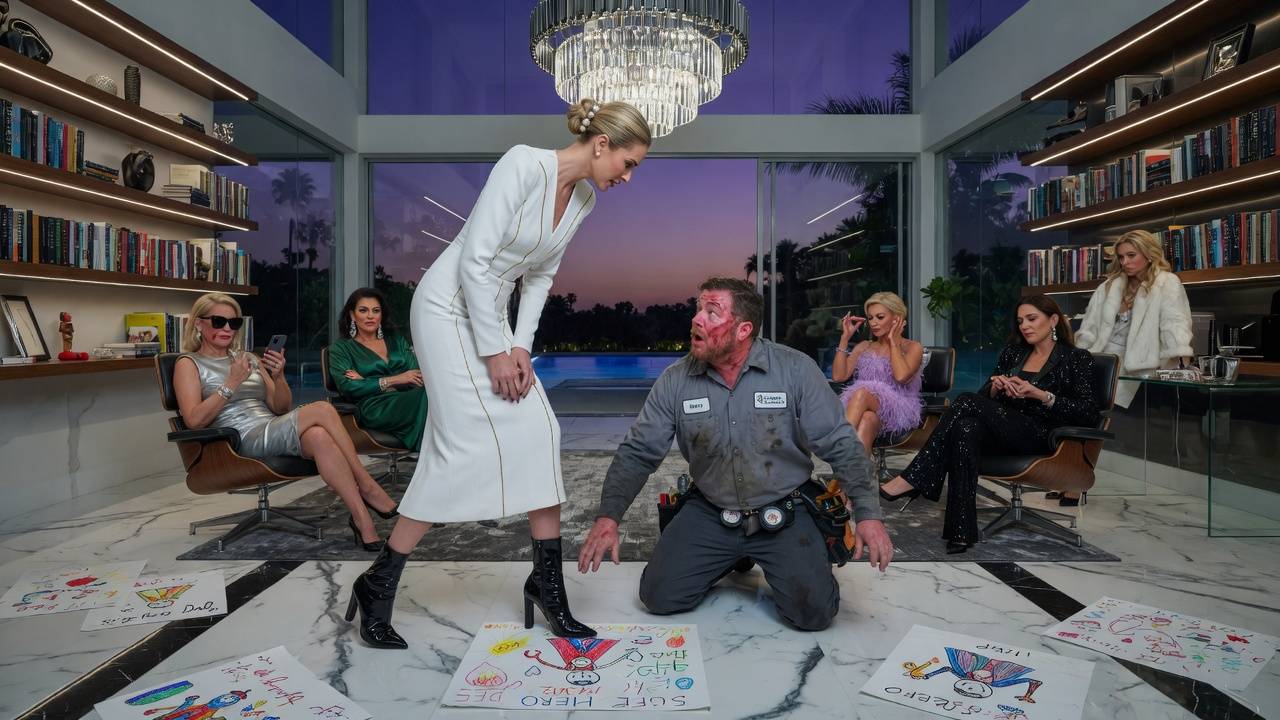
He reached into his pocket and felt the crumpled, torn remains of Maya’s drawing. His fingers traced the jagged edge where Evelyn’s heel had shredded the paper. He should have felt a sense of triumph—the classic “little guy” standing up to the tyrant—but all he felt was the crushing weight of the fallout. He was a veteran with a history of “emotional instability” on his medical record, a man with a face that made people uncomfortable, and he had just laid hands on one of the most well-connected women in the city.
He climbed into his van, his hands shaking so violently he struggled to get the key into the ignition. He didn’t look back at the glass-walled fortress. He didn’t look for Arthur. He just needed to get down the hill. He needed to get to the school.
The drive to the community center where Maya’s play was being held felt like a fever dream. Every set of headlights in his rearview mirror looked like a squad car. Every siren in the distance was coming for him. By the time he pulled into the crowded parking lot, he was drenched in a fresh layer of sweat that had nothing to do with the broken AC units he’d spent the day fixing.
He sat in the van for a moment, staring at his reflection in the visor mirror. The scars on the left side of his face were flushed a deep, angry purple. He looked exactly like the monster Evelyn had called him. He grabbed a rag from the dashboard and wiped his face, trying to breathe, trying to find the Sergeant, the pilot, the man who could compartmentalize a cockpit fire.
“For her,” he whispered. “Do it for her.”
He walked into the auditorium just as the lights were dimming. He found a seat in the back row, sinking into the shadows. On stage, a group of ten-year-olds in cardboard costumes were moving with the earnest, clumsy grace of children who believed the world was a simple place. When Maya walked out, dressed as a tree with glitter-covered leaves, she scanned the audience. Her eyes found him instantly. Even in the dark, even from the back row, she knew his silhouette. She beamed, a gap-toothed smile that nearly broke what was left of his heart.
He sat through the play in a trance. When it was over and the families flooded the lobby, he stood by the water fountain, waiting. Maya came running toward him, still wearing her cardboard trunk.
“Daddy! You made it!” she squealed, throwing her arms around his waist.
“I told you I would, bug,” he said, burying his face in her hair. She smelled like tempera paint and excitement.
“Did you see my solo? I was the tallest tree!”
“The best tree in the forest,” he said, pulling back to look at her.
She paused, her small hand reaching up to touch his cheek. She didn’t touch the smooth skin on the right; she touched the ridged, uneven grafts on the left. “You’re sweaty, Daddy. Was it a hard house?”
Henry swallowed hard. “Just a long day, Maya. A lot of heat.”
“Did you keep my drawing safe?”
He hesitated, his hand hovering over his breast pocket. “I… I have it right here. It got a little wrinkled in my bag, okay? But I kept it.”
She didn’t seem to care about the wrinkles. She just nodded, satisfied. As they walked toward the exit, Henry’s phone vibrated in his pocket. He ignored it. Then it vibrated again. And again. A relentless, rhythmic buzzing that felt like a hornet trapped against his thigh.
He waited until Maya was buckled into the backseat of the van, humming a song from the play, before he pulled the phone out.
There were seventeen missed calls. Twelve were from his boss at the HVAC conglomerate. Five were from an unknown number with a 310 area code. And then there was the text message from his supervisor, Gary.
Henry, what the hell did you do? Security footage from the St. James place is already being sent to corporate. They’re talking about assault charges. Do NOT go home. Stay off the grid until I talk to the lawyers. You’re done, man. Truly done.
Henry stared at the screen until the words blurred. He looked back at Maya in the rearview mirror. She was drawing on a napkin with a stray crayon, completely oblivious to the fact that the fragile world he’d built for her had just been incinerated.
“Daddy? Can we get ice cream?” she asked, looking up.
Henry looked at the phone, then at the dark road ahead. “Not tonight, bug. We have to go see Grandma for a bit. It’s… it’s a surprise trip.”
“Now? But it’s late!”
“I know,” Henry said, pulling out of the parking lot. “But sometimes, superheroes have to move fast.”
He drove toward the 101, his mind racing. He knew how these things went. Evelyn wouldn’t just fire him; she would ruin him. She would make sure no one in the valley ever hired him again. She would use her husband’s influence to turn a defensive reaction into a criminal assault. And Arthur… Arthur had seen him walk out. Had Arthur recognized him? Or was Henry just another “shambling creature” to the man whose life he’d saved?
He was halfway to his mother’s house in Ventura when his phone rang again. This time, it wasn’t Gary. It wasn’t the office. It was a number he didn’t recognize, but the caller ID didn’t say ‘Unknown.’ It said St. James, Arthur (Personal).
Henry’s heart hammered against his ribs. He wanted to throw the phone out the window. He wanted to vanish into the desert. But he looked at Maya, sleeping now with her head against the window, and he realized he couldn’t run. Not from this.
He swiped to answer. He didn’t say anything.
“Henry?” The voice on the other end was deep, gravelly, and tired. It wasn’t the voice of a billionaire real estate mogul. It was the voice of a Colonel.
“I’m here,” Henry said, his voice cracking.
“I just watched the feed, Henry. The whole thing. From the moment you walked in the door to the moment you walked out.”
Henry gripped the steering wheel so hard the plastic groaned. “She stepped on the drawing, Arthur. She told me to wear a mask because my face was upsetting her friends. I told her to move. She put her hands on me.”
There was a long silence on the other end. Henry could hear the sound of a glass being set down on a table.
“I know,” Arthur said. “I saw. I also saw the way you moved. I haven’t seen a structure break that clean since the sandbox. It took me an hour to figure out why a repairman knew how to dismantle a person in three seconds.”
“I was just trying to leave,” Henry said.
“Henry, look at me—well, listen to me. I pulled your file. Or what’s left of it. Captain Henry ‘Hank’ Miller. 77th Fighter Squadron. You flew the Lead in Operation Southern Watch. You’re the man who pulled a panicked Major out of a burning F-16 cockpit in ’09 while the fuel tanks were liquefying.”
Henry pulled the van onto the shoulder of the highway, the gravel crunching under the tires. He put the car in park, his breath coming in ragged gasps. “That was a long time ago, Colonel.”
“I was that Major, Henry,” Arthur said, his voice dropping to a whisper. “I spent ten years trying to find the man who saved me, but the Air Force red-taped the incident because of the engine failure investigation. I didn’t know your last name. I only knew ‘Hank’.”
Henry leaned his head against the steering wheel. The irony was a physical weight, pressing the air out of his lungs. He had spent the afternoon being treated like a monster by the wife of the man who owed him his life.
“Evelyn is calling for blood, Henry,” Arthur continued. “She’s got the lawyers on the phone. She’s demanding an arrest. She’s making a lot of noise about ‘disfigured thugs’ attacking innocent women.”
“What are you going to do?” Henry asked, his voice hollow.
“I’m going to do what I should have done fifteen years ago,” Arthur said. “I’m going to stand by my wingman. But you need to come back here. Tonight. We’re going to settle this in the library, where it started. And Henry? Bring the drawing.”
Chapter 6
The drive back to the Hollywood Hills felt different. The fear was still there—a cold, sharp spike in his gut—but it was being crowded out by a grim, military focus. Henry had dropped Maya off at his mother’s house, kissing her forehead while she was still half-asleep. She’d mumbled something about being a superhero, and he’d promised her that the cape was being fixed.
When he pulled up to the St. James gates for the second time that night, they swung open automatically. The mansion was ablaze with light, looking like a crystal palace perched on the edge of the world. He didn’t go to the service entrance this time. He parked the battered Ford Transit right in front of the grand portico, next to a silver Maybach.
As he stepped out, the front door opened. Arthur St. James was waiting. He was a tall man, silver-haired and sharp-eyed, wearing a silk robe over his clothes as if he’d been dragged out of bed, though Henry suspected he hadn’t slept a wink.
“Captain,” Arthur said, stepping forward. He didn’t look at the scars with disgust. He looked at them with a somber, haunting recognition. “I’m sorry it took this long.”
“Colonel,” Henry replied, standing straight.
“She’s in the library. She’s been screaming for three hours. The lawyers are on Zoom, and the head of your conglomerate is on the other line. They’re ready to crucify you to save their contract.”
“Then why am I here?”
“Because,” Arthur said, placing a heavy hand on Henry’s shoulder, “in this house, I still command the theater. Follow me.”
The walk through the mansion felt like a march to a tribunal. The marble floors that Henry had scrubbed with his eyes downcast earlier that day now felt like a stage. When they entered the library, the scene was chaotic. Evelyn was sitting on a velvet sofa, a silk wrap around her shoulders, looking pale and fragile—a masterpiece of victimhood. Two men in expensive suits stood near her, and a laptop on the central table showed the faces of three more men in high-back chairs.
Evelyn looked up as Henry entered. Her eyes went wide, and then narrowed into slits of pure venom. “Arthur! What is he doing here? I told you to have him arrested! Look at me! I have a bruise on my chest the size of a dinner plate!”
“Sit down, Evelyn,” Arthur said, his voice like iron.
“I will not sit down! This… this animal attacked me in my own home! He’s a danger to society! Gary, tell him!”
The man on the laptop screen, the CEO of the HVAC company, cleared his throat. “Henry, this is an indefensible breach of conduct. We’ve already drafted the termination papers. We’re cooperating fully with the St. James legal team.”
Henry didn’t look at the screen. He didn’t look at the lawyers. He looked at the floor, where the shredded remains of Maya’s drawing had been replaced by a fresh, cold polish.
“Arthur, call the police,” Evelyn demanded, her voice rising to a shriek. “Now!”
Arthur walked over to the central marble table. He picked up a remote and pressed a button. The massive 98-inch screen on the library wall flickered to life. It was the security feed from earlier that evening.
“We’ve all seen the end, Evelyn,” Arthur said. “The part where Henry defends himself. But the lawyers haven’t seen the ten minutes leading up to it. And the CEO hasn’t seen the way his ‘top-tier’ employee was treated.”
The video began to play. It showed Henry working, the surgical mask tight against his face. It showed Evelyn walking into the room, tossing the mask at his feet like he was a leper. The room went silent. The lawyers on the Zoom call shifted in their seats.
“That’s… that was for safety,” Evelyn stammered. “He looked like a monster, Arthur. He was frightening the guests.”
“He was a Captain in the United States Air Force, Evelyn,” Arthur said, his voice dropping to a dangerous whisper. “He got those scars pulling me out of a cockpit that was melting into the sand of the Al Dhafra. He was frightening the guests? He was the only man in that room who knew the meaning of the word ‘service’.”
The video continued. It showed the bridge club laughing. It showed Evelyn grabbing Henry’s collar. And then, it showed the drawing. The camera was high-definition; you could see the bright red cape Maya had colored. You could see the look on Henry’s face—not rage, but a profound, shattering grief—as Evelyn’s heel came down on the paper.
“Stop the tape,” the CEO said, his voice suddenly very small.
“No, let’s watch the rest,” Arthur said. “Let’s watch my wife assault a war hero because she didn’t like his face. Let’s watch her destroy a child’s gift because she thought he was beneath her notice.”
Evelyn was shaking now, her face transitioning from pale to a mottled, ugly red. “He hit me, Arthur! He kicked me!”
“He neutralized a threat,” Arthur corrected. “And if I were him, I would have done a hell of a lot more than a push-kick.”
Arthur turned to the lawyers. “Here is how this is going to go. There will be no charges. There will be no ‘assault’ on the record. In fact, my wife is going to issue a formal apology, in writing, to Captain Miller and his daughter. And as for the HVAC contract…”
He looked at the CEO on the screen. “You will not fire him. In fact, you will promote him to Regional Director of Operations. You will give him a salary that reflects his rank and his skill. Because if you don’t, I will buy your parent company tomorrow morning and fire every single person in that Zoom window. Am I clear?”
The silence on the other end was absolute. The CEO nodded, a frantic, jerky movement. “Perfectly clear, Colonel. Perfectly.”
Arthur turned back to the room. “Everyone out. Now.”
The lawyers and the staff scrambled, fleeing the room as if the mansion were on fire. Evelyn stood up, her mouth opening to speak, but Arthur pointed a single finger toward the door.
“Go to the guest house, Evelyn. Don’t come back to the main building until you’ve learned how to look a man in the eye without judging the price of his skin.”
She left, her silk wrap trailing on the floor, her power stripped away in a single, surgical strike.
Henry and Arthur were left alone in the library. The city lights twinkled outside the glass walls, indifferent to the lives being dismantled and rebuilt inside.
Henry leaned against the marble table, his legs finally giving out. “You didn’t have to do that, Colonel.”
“I did,” Arthur said, walking over to him. He reached into his pocket and pulled something out. It was a silver flight-wing pin, identical to the one Henry had in his tool bag. He set it on the table between them. “I’ve carried this for fifteen years, Henry. Waiting for the man who saved me to come and collect the debt. I’m just sorry it took my wife being a monster to bring you through the door.”
Henry looked at the wings, then at the man. The rage was gone, replaced by a strange, quiet peace. He reached into his pocket and pulled out the shredded drawing. He smoothed it out on the table, the taped-together pieces of the red cape looking like a battle flag.
“My daughter… she thinks I’m a superhero,” Henry said, his voice thick.
“She’s right,” Arthur said. “And tomorrow, we’re going to find the best artist in the city to frame that. Not as a ‘shredded drawing,’ but as a reminder of what happens when you try to break a man who has already walked through fire.”
Henry looked out at the hills. He thought of Maya, sleeping in her grandmother’s spare bed, dreaming of trees and capes. For the first time in fifteen years, he didn’t feel like a ghost. He didn’t feel like a monster. He felt like a man who was finally, truly home.
He picked up the silver wings, his fingers tracing the cool metal. He looked at Arthur, a nod of silent understanding passing between them—a wingman’s bond that no amount of marble or silk could ever touch.
“I have to get back to Maya,” Henry said, standing tall.
“Go,” Arthur said, smiling for the first time. “And Henry? Take the Maybach. Your van sounds like a lawnmower, and a Regional Director shouldn’t be seen in it.”
Henry laughed, a genuine, rusty sound he hadn’t heard in years. “I think I’ll stick with the Ford, Colonel. It’s got character. Just like me.”
He walked out of the library, through the grand foyer, and into the cool night air. As he drove down the winding canyon roads, the scars on his face felt like what they always were: not a source of shame, but the armor of a life lived, a war won, and a father who would always, always come home.