Chapter 5
The aftermath of the lobby confrontation didn’t feel like a victory. It felt like the air after a lightning strike—charged with ozone, heavy with the smell of scorched earth, and vibrating with a silence that was louder than the screaming.
Sam didn’t stay to watch the security team haul Marcus Thorne out. He didn’t wait for the board members to stop gaping at him like he was a glitch in the simulation. He simply walked to the janitor’s closet, leaned his forehead against the cold metal door, and breathed. His prosthetic leg felt heavy, the hydraulics hissing as he shifted his weight. The adrenaline was draining out of him, leaving behind a hollow, metallic ache.
He heard the door behind him creak open. He didn’t turn. He knew the gait—the hesitant, clicking heels of someone who wasn’t sure if they were walking into a lion’s den.
“Sam?”
It was Elena, the board member who had looked at her lap while Marcus insulted him. She was standing in the doorway of the cramped, ammonia-scented closet, her expensive silk blouse a sharp contrast to the shelves of industrial bleach and spare mop heads.
“I’m still on the clock, Elena,” Sam said, his voice flat. “There’s a mess in the lobby. I should go finish it.”
“The mess is being handled, Sam. By a professional cleaning crew,” she said softly. “The board is in the conference room. They’re… they’re terrified. Half of them want to offer you a throne, and the other half are looking for ways to sue you for assault.”
Sam turned then, his eyes hard. “Assault? He put his hands on me. He escalated. I ended it. That’s how it works.”
“In the world you come from, yes,” Elena said, stepping further into the room. “In this world, Marcus is a golden boy with a thousand-member PR firm and a legal team that eats veterans for breakfast. There’s already a video. Maya—the intern—she posted it. It has six million views, Sam. People are calling you a hero, but they’re also calling for the company’s head. The stock is plummeting. Thorne International is losing four percent of its value every ten minutes.”
Sam looked at the small, cracked mirror on the back of the closet door. He saw a man in a navy polyester uniform, graying at the temples, with a secret in his pocket that had just become a nuclear weapon. “Good. Let it burn. My grandfather wouldn’t recognize what this place has become anyway.”
“If it burns, ten thousand people lose their jobs,” Elena countered. “Ten thousand families. Is that the ‘military values’ you were talking about? Collateral damage?”
The words hit Sam harder than Marcus’s shove. He thought of the men he’d served with—men who had lost limbs and lives for people they’d never meet. He thought of the people in the coding departments, the sales reps, the security guards he’d shared coffee with for a year. He wasn’t just the owner anymore. He was the commander. And his command was currently under fire because of his own hand.
“What do they want?” Sam asked.
“They want a statement. They want to know if the majority shareholder is going to stabilize the ship or if he’s going to sink it out of spite.”
Sam reached into his pocket and pulled out his phone. It was vibrating incessantly. A hundred missed calls from Mr. Aris. A dozens of texts from numbers he didn’t recognize. And one from Sarah.
Dad, why didn’t you tell me? Everyone at the station is talking. They’re saying you’re a billionaire. They’re saying you’re a fraud. Where are you?
The word fraud stung. He hadn’t been a fraud. He’d been a witness. But to Sarah, the girl who had been embarrassed by his mop and bucket, he was now a stranger.
“I need an hour,” Sam told Elena. “And I need a suit. Not one of Marcus’s. Something that fits a man who knows how to walk on a limb that isn’t his.”
The hour was a blur of high-stakes logistics. Mr. Aris arrived, his usually unflappable face tight with anxiety. He spent forty minutes in a corner of the supply room, barking orders at a legal team on speakerphone.
“The trust is technically fulfilled, Sam,” Aris said, wiping sweat from his brow. “Eleven months and twenty-nine days. Close enough for any court. But Marcus’s lawyers are already filing an injunction. They’re claiming you created a hostile work environment to force a takeover. They’re going to dig into your discharge. They’re going to frame you as a violent, unstable veteran who conned his way into the company.”
“Let them dig,” Sam said, standing as a tailor—brought in through the service elevator—pinned the hem of a dark charcoal suit. “The ‘Bad Conduct’ discharge happened because I refused to sign off on a report that said our CO was in the wire when he was actually two miles back in a bunker. The truth is in the encrypted files I gave Maya. If they want a fight, I’ve got the receipts.”
“It’s not just about the fight, Sam,” Aris said, dropping his voice. “It’s about the soul of the thing. You came here to see if this place had one. What’s the verdict?”
Sam looked at the charcoal sleeve of the suit. It felt like a uniform. A different kind, but a uniform nonetheless. “The soul is buried under Marcus’s ego. But the people… the people are still there. Maya is there. The security guards are there. They’re the company. Not the guy in the charcoal suit.”
The walk back to the boardroom was different this time. The glass-and-steel hallways felt colder, but the people in them had changed. As Sam walked past the developer bays, the typing stopped. People stood up. They didn’t cheer—they were too scared for that—but they watched him with an intensity that made the hair on his neck stand up.
He reached the boardroom doors. Two security guards—the same ones who had taken Marcus away—nodded to him.
“Mr. Thorne,” one of them said, his voice respectful.
“Just Sam,” he replied, and pushed the doors open.
The board members were all standing. The room smelled of expensive coffee and panic. At the head of the table, Marcus Thorne sat in a chair, his face bruised, his collar still damp. He wasn’t in handcuffs—not yet—but his lawyers were flanking him like a human shield.
“This is a coup!” Marcus screamed as soon as Sam entered. “You think you can just walk in here after assaulting the CEO and take over? I built this! I am this company!”
Sam didn’t go to the head of the table. He went to the side, leaning against the glass wall, looking out at the city. “You didn’t build it, Marcus. You just decorated it. My grandfather built it. I wrote the code that keeps the lights on. You? You just made sure the people doing the work felt like they didn’t matter.”
“I made us billions!”
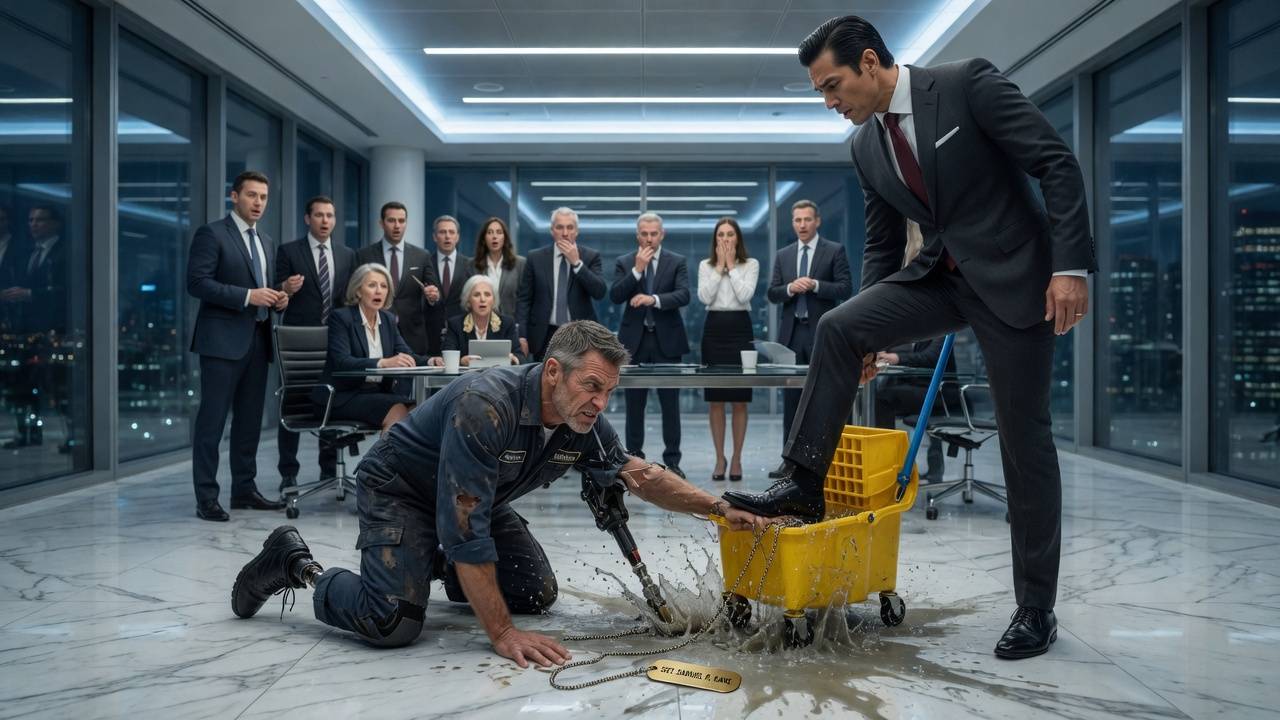
“And you lost us billions in ten seconds because you couldn’t keep your foot off a janitor’s bucket,” Sam said, turning to face him. “The board is here to vote on your removal for cause. Physical harassment of an employee, financial impropriety in the R&D department, and fraudulent claim of intellectual property. I have the files, Marcus. Maya found the author’s signatures. Your name isn’t on them.”
Marcus’s lead lawyer, a man with a face like a hawk, stepped forward. “These are unverified allegations. My client—”
“Your client is a liability,” Elena interrupted, her voice clear and sharp. She stood up, looking at the other board members. “We’ve all spent years looking the other way because the dividends were high. But the world just watched Marcus Thorne kick a disabled veteran in his own lobby. There is no coming back from that. Not for him. And if we don’t act, not for us.”
The vote was swift. It was a massacre. Marcus sat in stunned silence as person after person—people who had laughed at his jokes for years—voted to strip him of his title.
When it reached Elena, she looked at Sam. “Yes. To remove Marcus Thorne. And a motion to appoint Sam Thorne as interim CEO, pending a full review of the trust.”
“I don’t want the chair,” Sam said.
The room went quiet again.
“What?” Elena asked.
“I’m not a CEO,” Sam said, walking toward the table. He looked at Marcus, who was trembling with rage. “And I’m not a monster. If I take that chair, I’m just the next version of you, Marcus. I’m here to fix the culture, not to rule it.”
He turned back to the board. “I’m staying as the majority shareholder. I’ll appoint a management team that understands that the people in the basement matter as much as the people in the penthouse. But I’m not sitting in that seat. I’ve spent enough time in this building to know that the view from the top makes you forget what the ground feels like.”
“You’re a fool,” Marcus hissed, his voice cracking. “You’re throwing away the greatest power in the world.”
“Power isn’t sitting in a chair, Marcus,” Sam said, leaning down until he was eye-to-eye with him. “Power is knowing when to stand up. And you’re done sitting.”
As security finally led Marcus out—this time for good—Sam felt a vibration in his hand. His phone. A FaceTime request.
It was Sarah.
He stepped into the hallway, away from the board members who were already trying to swarm him. He hit ‘accept.’
Her face appeared on the screen. She was in the news van, the background blurred. She looked like she’d been crying.
“Dad?”
“I’m here, Sarah.”
“I… I saw the video. Not the one where you hit him. The one before that. Where he… where he kicked your bucket.” She choked on the words. “I’m so sorry. I was so embarrassed by you, and you were just standing there taking it. Why didn’t you tell me you were the owner?”
Sam looked at his reflection in the glass—the suit, the tired eyes, the man who had finally stopped hiding. “Because I needed to know if I was still the man your grandfather thought I was. I needed to know if I could be the ‘help’ and still keep my soul.”
“You’re a hero, Dad. Not because of the money. Because you didn’t let him break you.”
“I’m just a janitor who finished his shift, Sarah,” Sam said, a small, weary smile breaking through. “And I think I’m ready to come home.”
Chapter 6
The transition wasn’t clean. It never is when an empire changes hands. The next two weeks were a hurricane of depositions, press conferences, and the slow, grinding work of structural change. Sam stayed in a hotel near the office, but he didn’t spend much time in the penthouse suite. He spent it in the breakrooms.
He’d officially handed the interim CEO duties to Elena, who had proven her spine in the boardroom. His role was now “Chairman of the Board,” a title that sounded like a tombstone to him, but it gave him the leverage he needed to do what he’d come for.
The first order of business was the “Legacy Fund”—a massive reinvestment of Marcus’s clawed-back bonuses into a scholarship and healthcare fund for the service staff of every Thorne-owned building. The second was the reinstatement of the engineering transparency act.
But the hardest part wasn’t the corporate work. It was the residue of the violence.
The video of the lobby fight had become a cultural touchstone. “The Janitor’s Justice,” the headlines called it. People saw it as a triumph, a underdog story for the digital age. But Sam saw something else. He saw the flicker of the man he’d been in the desert—the man who knew exactly where to strike to cause the most damage. He saw the monster he was afraid of.
He was sitting in his new office—the one Marcus had used—late on a Tuesday night. The mahogany desk felt like an altar. He had a glass of water and a stack of personnel files Maya had flagged for review. There were hundreds of people Marcus had “phased out” for questioning him.
A knock on the door.
“It’s open,” Sam said.
Maya walked in. She wasn’t an intern anymore. She was the head of the new Internal Ethics and Code Audit team. She looked tired, but there was a light in her eyes that hadn’t been there when she was crying in the stairwell.
“The audit is done, Sam,” she said, dropping a tablet onto the desk. “Marcus didn’t just steal your code. He’d been selling back-door access to the security protocols to a third-party data broker in Singapore. He wasn’t just arrogant; he was a traitor to the company’s mission.”
Sam looked at the data. It was the final nail. Marcus wouldn’t just be losing his job; he’d be losing his freedom. The federal investigators were already building the case.
“Thank you, Maya,” Sam said. “For seeing me when I was just the guy with the mop.”
“You were the guy who taught me how to fix the coffee machine without breaking the gasket,” she smiled. “That’s more important than the code, honestly.”
She paused, looking at him. “Are you okay? You look like you’re waiting for the other shoe to drop.”
“I spent a year being invisible,” Sam said, looking out at the city lights. “Now I’m the sun. Everyone’s looking at me, waiting for me to shine. It’s exhausting.”
“You don’t have to be the sun,” Maya said softly. “You just have to be the guy who doesn’t kick the bucket. That’s enough for most of us.”
After she left, Sam sat in the silence. He thought about his old unit. He thought about the man who had betrayed him—the CO who was now a “consultant” in D.C. He’d realized something in the last two weeks: revenge was easy. You just had to be stronger or richer. But justice? Justice was slow. It was boring. It was a pile of paperwork and a commitment to not being the person who hurt you.
The following Saturday, Sam drove his old truck—he refused to give it up for a town car—to the suburbs. He parked in front of his ex-wife’s house.
Sarah was waiting on the porch. She didn’t look at the truck with that tight, pinched expression anymore. She ran down the driveway and threw her arms around him, her head hitting his chest.
“Hey, kiddo,” Sam said, his voice thick.
“You’re late,” she said, pulling back to look at him. She was wearing a Thorne International hoodie. “The ceremony started ten minutes ago.”
“I’m the Chairman, Sarah. They can’t start without me.”
“Actually, the janitors said they’d start without you if you didn’t bring the donuts,” she teased.
They drove to the local community center. It wasn’t a corporate event. It was a gathering of the local veterans’ chapter. Sam had funded a new wing for their vocational training center—not with company money, but with his own.
As he walked into the room, he saw the same kind of men he used to be. Men with scars, men with prosthetics, men who felt like the world had moved on without them. They didn’t see a billionaire. They saw Sam.
He gave a short speech. No monologues. No “thank me for my service.” Just a promise that Thorne International would be a place where their skills were translated, not discarded.
Afterward, he sat on the back porch of the center with an old sergeant he’d served with. They watched the sun set over the trees.
“So,” the sergeant said, nursing a soda. “You’re the king of the mountain now. How’s the air up there?”
Sam shifted his prosthetic, the hydraulic click a familiar comfort. “Thin. Cold. And too much glass.”
“You coming back to the meetings?”
“Every Tuesday,” Sam said. “I still need someone to tell me my code is outdated and my hair is turning gray.”
“I can do that for free, billionaire,” the sergeant laughed.
Sam looked at his hands. They were clean now. No ammonia. No gray water. But he could still feel the weight of the mop. He realized then that he hadn’t won because he’d taken the company. He’d won because he hadn’t lost the janitor. He hadn’t lost the part of himself that knew what it was like to be at the bottom, to be humiliated, and to choose to stay kind anyway.
He saw Sarah through the window, talking to a group of young veterans, showing them something on her phone. She looked proud. Truly proud.
The secret was out. The ghost of the boardroom had been given a name and a face. But as Sam watched the stars begin to poke through the twilight, he knew the real power wasn’t in the trust or the black card or the gold-plated dog tag.
It was in the ability to walk into a room—any room, whether it was a supply closet or a boardroom—and know that you didn’t owe anyone your dignity.
The empire was safe. The bully was gone. And for the first time in a decade, Sam didn’t feel like he was holding his breath, waiting for the impact. He was just a man, standing on his own two feet—one of flesh, one of steel—ready for whatever shift came next.
The mop was leaning against a wall somewhere else now. But the man who held it was finally home.