Chapter 5
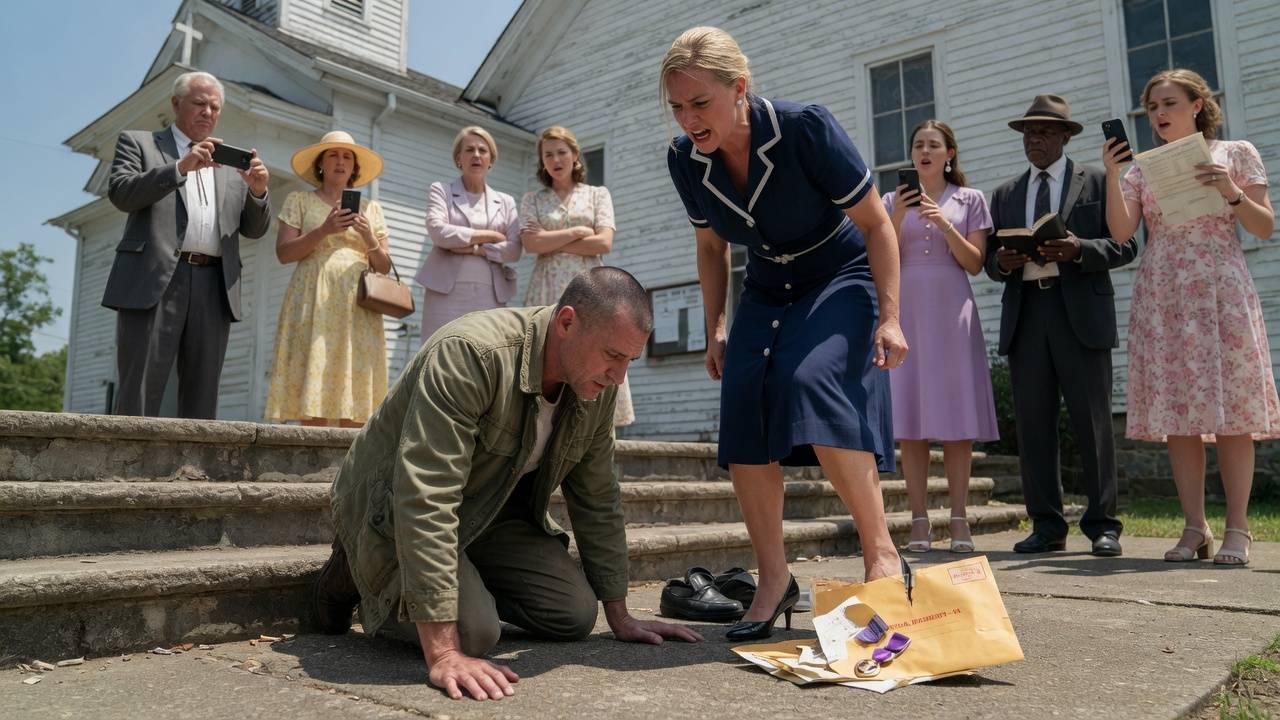
The aftermath of the church steps did not feel like a victory. To Caleb, it felt like the final collapse of a dam he had spent three years building with his own bones. By the time he reached the outskirts of town, the adrenaline had curdled into a cold, sick weight in his stomach. He didn’t go back to his apartment—a cramped room above a laundromat that smelled of industrial detergent and loneliness. Instead, he drove his rusted Chevy toward the Blue Ridge foothills, parking on a gravel turnout that overlooked the valley.
Below him, the lights of Oak Ridge twinkled with a deceptive, peaceful glow. Somewhere down there, Marcus Jenkins was likely in the back of an ambulance or a cruiser, and Sarah was probably being consoled by the very people who had watched her brother try to bury Caleb under a boot.
He pulled the manila envelope from his jacket. The paper was torn, the edge darkened by the grease and dirt of the church steps. He carefully pulled out the silver medal and the after-action report. The official seal was smeared where Marcus had ground his heel into it. Caleb ran a thumb over the metal. It felt heavy, a cold anchor tying him to a desert half a world away.
His phone buzzed in the cup holder. He ignored it. Then it buzzed again. And again.
He finally picked it up. There were sixteen missed calls and forty-two text messages. Most were from unknown numbers—townspeople who had likely filmed the encounter and were now either praising him or threatening him. But one name stood out: Pastor Graham.
Caleb hit the voicemail.
“Caleb, it’s Elias,” the Pastor’s voice sounded weary, older than it had that morning. “The police are looking for you. Marcus is at the County General. He’s got two cracked ribs and a punctured lung. He’s claiming you attacked him unprovoked. Caleb… the video is everywhere. People are seeing what he did to you, but they’re also seeing what you’re capable of. You need to come in and talk to the Sheriff. And Caleb… Sarah knows about the receipts. I couldn’t keep it anymore. Not after what happened. Please, son. Come back.”
Caleb dropped the phone. The air in the truck felt thin. Sarah knew. The one thing he had fought to prevent—the exposure of his penance—had been ripped open because he couldn’t keep his hands down. He hadn’t just broken Marcus; he had broken the silence that protected Sarah from the truth of her husband’s death.
He sat there for an hour, watching the moon climb over the ridge. He thought about the desert. He thought about the moment Miller had looked at him, eyes wide with the realization that the world was about to end, and how Caleb had failed to see the danger in time. He had killed the wrong person that day because he’d been too sure of himself. And tonight, on those church steps, he’d been sure again.
The violence hadn’t been an accident. It had been a choice.
He put the truck in gear and began the slow descent back into town. He didn’t go to the Sheriff’s office. He went to the hospital.
County General was a squat, brick building that felt more like a tomb than a place of healing. Caleb walked through the sliding doors, his olive green jacket attracting immediate attention. The nurse at the intake desk looked up, her expression shifting from professional boredom to sharp recognition.
“You shouldn’t be here,” she whispered.
“I need to see Sarah Jenkins,” Caleb said.
“She’s in the pediatric wing. With Lily. But the police—”
“I know,” Caleb said. “I’m not here to hide.”
He walked the halls, the sterile smell of bleach and floor wax stinging his nose. Every step felt like walking through a minefield. When he reached the pediatric ward, he saw her through the glass of a small waiting room. Sarah was slumped in a plastic chair, her head in her hands. She looked small, stripped of the sharp, righteous anger that usually acted as her armor.
Caleb pushed the door open. The soft hiss of the hinges made her look up.
Her eyes were red, her face puffy. She didn’t scream. She didn’t call for help. She just looked at him with a hollow, haunted expression. On the table between them lay a stack of papers—the hospital billing records the Pastor had given her.
“Three years,” she said, her voice a ghost of itself. “Every month. For three years.”
“Sarah,” Caleb started, but the words felt like dry sand.
“Why?” she asked, leaning forward, her voice rising in a jagged arc. “Why didn’t you tell me? Why let me hate you? Why let the whole town treat you like garbage while you were working yourself to death to save my daughter?”
Caleb looked at his boots. “Because David deserved a better story than the one I gave him. If I told you I was paying, I’d have to tell you why. I’d have to tell you that he died because I pulled the trigger on a target I shouldn’t have seen. He died trying to fix my mistake, Sarah. He was a hero because he saved an innocent life from me.”
Sarah stood up, the chair scraping harshly against the linoleum. She walked toward him, stopping just inches away. She didn’t shove him this time. She reached out and touched the collar of his jacket, her fingers trembling.
“You think I didn’t know?” she whispered. “You think I didn’t see the way you looked at the memorial? You think I didn’t feel the guilt coming off you in waves? I hated you because it was easier than hating the war. It was easier than hating the fact that my husband left me alone with a sick child.”
“I’m sorry,” Caleb said.
“Marcus is going to press charges,” she said, pulling her hand back. “The Sheriff is waiting for you downstairs. He’s giving you ten minutes because he knew David, too. But the town… they’ve seen the video, Caleb. They saw the medal in the dirt. They saw what Marcus was doing.”
“It doesn’t change what I did in the desert,” Caleb said.
“No,” Sarah said, looking toward the door where her daughter was sleeping. “But it changes what you’re doing here. My brother is a bully, Caleb. He’s been using David’s name to act like a king in this town, and I let him. I let everyone treat you like a pariah because I was drowning.”
She picked up the billing receipts. “You saved her. Not David. You.”
A shadow fell across the doorway. Sheriff Miller—no relation to David, just a man who had seen too much of Oak Ridge’s dark side—stood there, his hat in his hand. He didn’t have his cuffs out, but his expression was grim.
“Caleb,” the Sheriff said. “Time’s up.”
Caleb turned to Sarah. He wanted to say more. He wanted to explain the weight of the silence, the way it had become the only home he knew. But there were no more words. The service of silence was over.
“Tell Lily…” Caleb started, then stopped. “Just tell her goodbye.”
He walked out of the room, leaving the receipts and the ghosts behind. As he followed the Sheriff down the hallway, he didn’t feel like a hero or a victim. He felt like a man who was finally stepping out of a shadow, even if the light was going to burn him.
Chapter 6
The legal storm that followed was swift, but it didn’t land the way anyone expected. Marcus Jenkins, buoyed by his own sense of grievance, tried to paint Caleb as a violent, unhinged veteran. But the video—taken by a teenager who had been hoping for a fight but caught a reckoning instead—told a different story. It showed Marcus grinding a Silver Star into the dirt. It showed him physically assaulting a man who refused to lift a finger until his dignity was literally under a boot.
By the end of the week, the public outcry in Oak Ridge had shifted. The same people who had whispered about Caleb were now whispering about the Jenkins family. The “hero’s brother” was suddenly the man who had desecrated a veteran’s honor.
Caleb spent three days in the county lockup before the charges were downgraded to a misdemeanor, and eventually, under pressure from the Pastor and Sarah herself, they were dropped entirely. Marcus, facing his own legal trouble for the initial assault, slunk out of town two weeks later, headed for a gym in Richmond where nobody knew his name.
But for Caleb, the real resolution didn’t happen in a courtroom. It happened on a rainy Tuesday, three weeks after the fundraiser.
He was back at the garage, the familiar smell of oil and old metal grounding him. Mick was in the office, arguing with a parts supplier, when the bell above the door chimed. Caleb didn’t look up from the brake assembly he was cleaning.
“We’re closed for lunch, Mick told you,” Caleb said.
“I’m not looking for a tune-up.”
Caleb froze. He slowly wiped his hands and stood up. Sarah was standing in the bay door, wearing a simple yellow sweater. Beside her, holding her hand, was Lily. The little girl was wearing a knit cap to cover her head, her face fuller than it had been at the fundraiser.
“Chú Caleb!” Lily chirped, breaking away from her mother and running toward him.
Caleb stepped back, reflexively protective of his grease-stained clothes, but the girl didn’t care. She hugged his knees, her small arms barely reaching around his work pants. Caleb looked at Sarah, his heart hammering against his ribs.
“We’re leaving,” Sarah said, her voice steady. “My sister has a place in North Carolina, near the Duke medical center. It’s better for Lily. Better for all of us.”
Caleb nodded, his throat tight. “That’s good. That’s a good move.”
“I sold the house,” Sarah continued, walking closer. She reached into her purse and pulled out a small, velvet-lined box. She set it on the workbench next to Caleb’s torque wrench. “I found this in Marcus’s things. He’d kept it.”
Caleb opened the box. It was the Silver Star. It had been cleaned, the scratches from the stone steps polished away, though a small dent remained on the edge of one of the points—a permanent reminder of the night the silence broke.
“I can’t take this,” Caleb whispered. “It belongs to David.”
“No,” Sarah said, her eyes meeting his with a clarity that was both painful and kind. “David had his medals. He had his parade. This one… this one belongs to the man who stayed. The man who worked double shifts to make sure my daughter didn’t die in a state ward. You’ve done enough, Caleb. The debt is paid.”
She reached out and squeezed his hand. Her palm was warm, the first human contact he’d had in years that wasn’t a strike or a shove.
“I told the Sheriff the truth about the desert,” Caleb said, the confession finally coming out. “I told the Pastor to put it in the church bulletin. People need to know who David really was. Not a saint. Just a man.”
“I know,” Sarah said softly. “And some people are angry. Some people think you’re lying to save your own skin. But the ones who matter… they know.”
Lily looked up at him, her eyes bright. “Are you coming with us, Chú Caleb?”
Caleb looked at the small girl, then at the open road beyond the garage door. He thought about the mountain of grease and the cold apartment. He thought about the three years he’d spent as a ghost.
“No, sweetheart,” Caleb said, kneeling down so he was eye-level with her. He reached into his pocket and pulled out a small, hand-carved wooden bird he’d been working on in his cell. He placed it in her hand. “I have to stay here and finish a few things. But you keep that. It’s for luck.”
Lily beamed, clutching the bird to her chest. Sarah looked at him, a silent understanding passing between them. There wouldn’t be a movie ending. There was too much blood and history between them for a clean slate. But the air was clear. The pressure was gone.
“Goodbye, Caleb,” Sarah said.
“Goodbye, Sarah.”
He watched them get into their car and drive away, the taillights disappearing into the Virginia mist. He stood in the doorway of the garage for a long time, the Silver Star heavy in his pocket.
Mick came out of the office, leaning on his cane. He looked at the empty road, then at Caleb. “You okay, son?”
Caleb took a deep breath. The air didn’t feel like wet wool anymore. It felt cold and sharp and real. He looked at his hands—scarred, stained, and shaking slightly—and felt the weight of the future for the first time in a decade.
“I think so, Mick,” Caleb said. He turned back to the Ford F-150 on the lift. “Let’s get this brake job finished. We’ve got work to do.”
He picked up his wrench and got back to it. The ghosts were still there, drifting in the corners of the garage, but they weren’t shouting anymore. They were just watching. And for the first time since the desert, Caleb didn’t feel the need to look away.