Silas spent three years in the shadows, scrubbing floors and buffing the marble of a company built on the very code they stole from him.
He didn’t want trouble. He just wanted to earn enough to pay for his mother’s surgery and keep his head down during his probation.
But Julian Vane, the billionaire CEO who built an empire on lies, couldn’t let him have even that little bit of dignity.
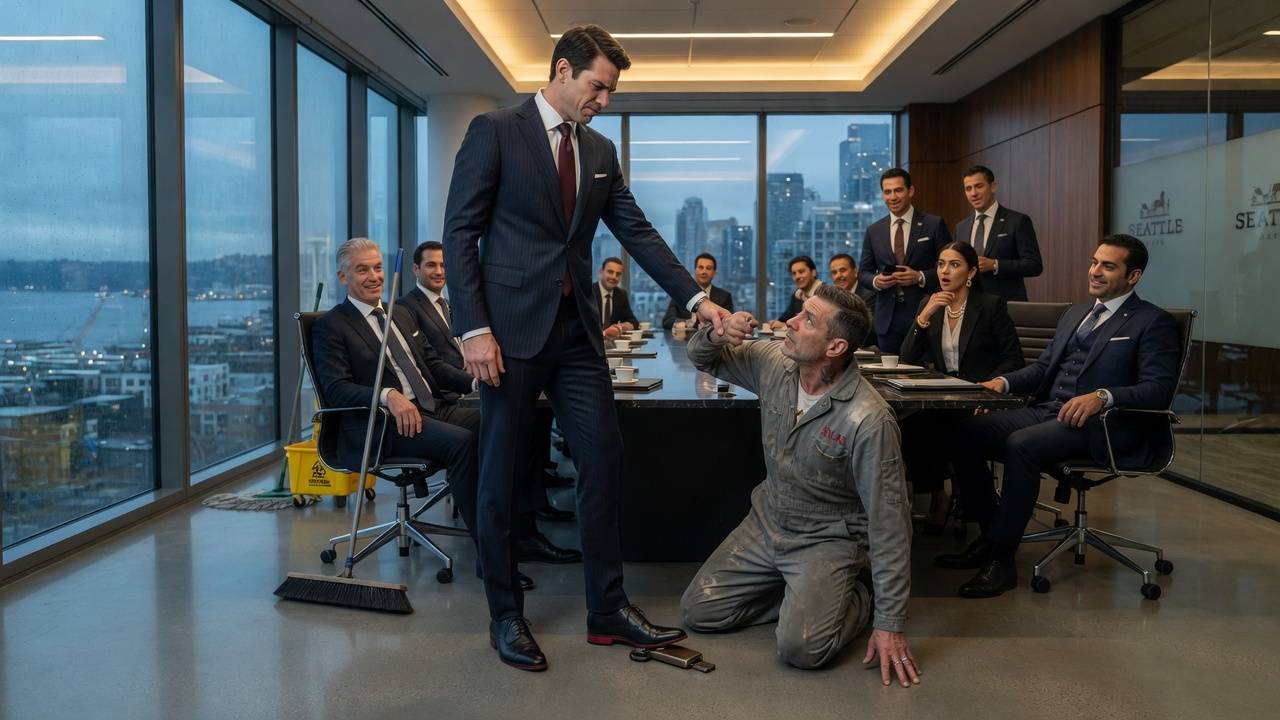
In the middle of a high-stakes board meeting, with the world’s elite watching, Julian decided to make Silas his footstool.
He poured hot coffee over Silas’s head and stepped his $2,000 shoes onto the only thing Silas had left—his father’s military USB drive.
The room was filled with laughter, phones recording every second of the “janitor’s” public shaming.
They thought he was a coward because he didn’t fight back, but Silas wasn’t afraid of Julian—he was afraid of the man he used to be.
When Julian grabbed him by the throat, the “missing” military training everyone claimed Silas lacked finally clawed its way to the surface.
In six seconds, the power in that room didn’t just shift—it shattered, leaving the tech industry’s golden boy begging for mercy on the floor.
The full story is in the comments.
Chapter 1
The smell of lemon-scented floor wax was the only thing that kept Silas grounded. It was a clean smell, a simple smell, unlike the complicated stench of the people who inhabited the sixty-fourth floor of the Vane Tower. At 5:00 AM, the glass-walled corridors of Seattle’s most prestigious tech firm were silent, save for the rhythmic shuck-shuck of Silas’s mop.
He moved with a mechanical precision that most people mistook for mindlessness. They didn’t see the way his eyes tracked the security camera rotations or how he timed his movements to stay in the blind spots. He wasn’t planning a heist; it was just a habit—a leftover instinct from a life he’d been told was a failure.
“Hey, Floor Boy. You missed a spot.”
Silas didn’t look up. He knew the voice. It belonged to Marcus, one of the junior security analysts who liked to arrive early just to feel superior to the cleaning crew. Marcus stood by the breakroom door, a smirk playing on his soft, over-privileged face. He tipped his paper cup of coffee, letting a dark, steaming puddle spread across the freshly buffed linoleum.
Silas stopped the mop. He felt the familiar heat rising in the back of his neck—the old Silas, the sergeant who had led men through the mountains of Kandahar, wanted to put Marcus through the drywall. But that Silas was dead, or at least buried under a pile of dishonorable discharge papers and a three-year probation order.
“I’ll get it, sir,” Silas said, his voice flat and raspy.
“You’re damn right you will,” Marcus sneered. “And make sure it’s shiny. Mr. Vane is hosting the Pentagon delegation today. We can’t have the place smelling like… well, like you.”
Silas waited until Marcus walked away before he knelt. He didn’t use the mop for this. He used a cloth, getting close to the floor. As he wiped the coffee, his hand brushed the pocket of his gray jumpsuit. He felt the hard, cold weight of the bronze USB drive. It was his anchor. It held the original kernel of the Aegis System—the security software that Julian Vane was currently trying to sell to the Department of Defense for four hundred million dollars.
Julian called it his “visionary breakthrough.” Silas called it “Section 4.” It was the project Silas had designed while serving as a tactical communications specialist, the one his commanding officer had stolen before framing Silas for the very corruption the officer was committing.
Silas stood up, his knees popping. He looked out the floor-to-ceiling windows at the gray Seattle morning. He was thirty-four years old, and he was a ghost. To the world, he was a “lack of aptitude” discharge with a criminal record for “unauthorized access to government files.” To his mother, he was the son who had promised to be home more, who was now working double shifts just to keep her out of a state-run nursing home.
The elevator chimed. Silas pulled his cart to the side, pressing his back against the wall, head bowed. A group of men in sharp, tailored suits stepped out, led by a man whose presence felt like a sudden drop in barometric pressure.
Julian Vane was thirty-two, handsome in a way that felt engineered, and possessed a smile that never reached his eyes. He was talking rapidly to a woman in a charcoal suit—Sarah, the lead intern who always looked like she’d forgotten how to sleep.
“If the military wants a demo, we give them a show, Sarah,” Julian was saying. “I want the live-fire simulation running by 10:00 AM. If the firewall flickers once, you’re back to filing papers in the basement.”
Julian stopped abruptly. His gaze landed on Silas. It wasn’t a look of recognition; it was the way a man looks at a smudge on his sleeve.
“You,” Julian said, snapping his fingers.
Silas stepped forward. “Yes, Mr. Vane?”
“The executive washroom. Someone left a mess. Fix it now. And don’t use that cheap soap. I want it smelling like sandalwood.”
“I’m on it, sir.”
Julian started to turn, then stopped. He reached out, his manicured fingers brushing the shoulder of Silas’s jumpsuit, picking off a stray piece of lint. “You know, Silas—that’s your name, right? I saw your file when HR hired the ‘rehabilitation’ batch. A soldier who couldn’t follow orders. It’s funny, isn’t it? Now your only order is to keep my toilet clean. Seems the universe found your true aptitude.”
The suits behind Julian chuckled. It was a rehearsed, sycophantic sound. Silas kept his eyes on Julian’s silk tie. The urge to snap Julian’s radius was so strong it made Silas’s vision vibrate.
“The universe is funny that way, sir,” Silas said.
Julian patted Silas’s cheek—a light, patronizing slap. “Good lad. Now go. The sandalwood, Silas. Don’t forget.”
As the group walked away, Sarah, the intern, lingered for a second. She looked at Silas, then at the mop, then back at Silas’s eyes. There was something in her expression—not pity, but a sharp, analytical curiosity. She had seen Silas’s notebook once, left open on a desk while he was emptying the trash. She had seen the lines of handwritten C++ that shouldn’t have made sense to a janitor.
Silas didn’t give her a second look. He turned his cart and headed for the washroom, the bronze USB burning a hole in his pocket. He had sixty seconds to decide if he was going to save this company or let it burn.
Chapter 2
By mid-morning, the Vane Tower was humming with the kind of nervous energy that preceded a multi-million dollar disaster. Silas was in the hallway outside the main server room, buffing the brass handles. He could hear the muffled shouts coming from inside.
“The handshake is failing! Why is the handshake failing?” Julian’s voice was a jagged blade.
“Mr. Vane, the encryption layer is rejecting the Pentagon’s handshake because the logic is… it’s inconsistent with the original build,” Sarah’s voice was trembling but precise. “It’s like the system is looking for a signature that isn’t there.”
Silas paused his polishing. He knew exactly why it was failing. Julian had tried to “optimize” the code Silas had written, adding layers of flashy GUI that created backdoors big enough to drive a tank through. The system wasn’t rejecting the handshake; it was protecting itself from a perceived intrusion.
The door swung open, and Marcus, the security analyst, stormed out, nearly knocking Silas over. “Watch it, trash-man!” he barked, his face flushed with panic.
Marcus slammed a hand against the wall. He was holding a tablet, the screen flashing red. He looked at Silas, his eyes narrowing. “You. You were in here last night, weren’t you? Cleaning the consoles?”
“I was, sir. Standard schedule,” Silas said, keeping his voice low.
“Did you touch anything? Did you bump a drive? Answer me!” Marcus stepped into Silas’s space, the smell of his expensive cologne mixing with the sour scent of stress sweat.
“I only touch what I’m paid to clean, sir.”
Marcus grabbed the front of Silas’s jumpsuit, twisting the fabric. “If I find out you messed with the hardware, I’ll make sure you’re back in a cell by dinner. You people are all the same. Bitter, broken, looking for a way to ruin things for those of us who actually contribute.”
The pressure in Silas’s chest was becoming a physical weight. He could feel his heart rate slowing—the combat calm. His hands stayed open at his sides. “I’m sure you’ll find the problem, sir. It’s usually in the foundation.”
Marcus shoved him back against the brass-handled door. “Get out of my sight.”
Silas watched him go. He didn’t feel humiliated; he felt a cold, clinical detachment. He moved to the employee breakroom to refill his water bucket. Inside, a group of developers were huddled around the coffee machine, ignoring him as if he were part of the furniture.
“It’s a disaster,” one whispered. “The North Korean group, ‘The Silent Bridge,’ has been pinging our external nodes for twenty minutes. If they get in during the Pentagon demo, Vane is finished. The whole company goes under.”
“Good,” another muttered. “Maybe then I’ll get a boss who doesn’t fire people for the color of their socks.”
Silas moved to the sink. He thought about his mother. He thought about the surgery. If Vane Tower collapsed, his paycheck vanished. If his paycheck vanished, his mother would end up in a bed in a hallway at the county hospital, waiting for a surgery that would never come.
He reached into his pocket and touched the USB drive. He had the fix. Ten lines of code. A digital signature that would authorize the handshake and lock the backdoors Julian had accidentally kicked open.
He walked back toward the server room. He didn’t need to get inside. He knew the maintenance terminals in the janitor’s closets were hardwired into the climate control system, which shared a bus with the main security network—a massive security flaw he’d noted on his first day.
He entered the small, cramped closet on the north side of the floor. He sat on a crate of industrial detergent and pulled a small, battered laptop from his supply cart. He’d built it from salvaged parts he found in the company’s e-waste bins.
He plugged in the bronze USB. The screen flickered to life.
Signature Verified: Sgt. S. Vance.
His fingers danced over the keys. He wasn’t the “floor boy” anymore. He was the architect. He watched the lines of code scroll by—the beautiful, brutal logic of a system designed to survive a war. He saw the intrusion. The Silent Bridge wasn’t just pinging; they were already inside the buffer. In three minutes, they’d trigger a logic bomb that would wipe the Vane servers clean.
He began to type.
IF {Intrusion_Vector == ‘Silent_Bridge’} THEN {Execute_Vault_Protocol}
“What are you doing?”
Silas didn’t jump. He didn’t even stop typing. He knew the voice. Sarah.
She stood in the doorway of the closet, her face pale, her eyes wide as she looked at the screen. She saw the code. She saw the signature.
“You’re the one,” she whispered. “The ‘S. Vance’ in the original source headers. I thought it was a ghost. Julian told us he wrote it.”
“Julian can’t even write a coherent email without a ghostwriter,” Silas said, his eyes never leaving the screen. “Go back to the server room, Sarah. Tell them the handshake is coming. Now.”
“How are you doing this from a janitor’s closet?”
“Because the people running this building don’t think the help is smart enough to be dangerous,” Silas said. He hit Enter. “Go. Before they notice the traffic.”
Sarah lingered for a second, a look of profound realization on her face. “He’s going to kill you if he finds out.”
“He has to catch me first,” Silas said.
He closed the laptop and tucked it back into the cart. He picked up his mop and stepped out into the hall just as the alarms began to blare. But they weren’t intrusion alarms. They were the sound of the system locking down, the handshake completing.
He had saved the company. He had saved his mother’s surgery. And he had just painted a target on his back that no amount of floor wax could hide.
Chapter 3
The afternoon sun hit the Seattle glass with a blinding glare. The Vane Tower felt like a cathedral after a miracle. The Pentagon demo had been a resounding success. Julian Vane was currently on a conference call with the Secretary of Defense, his laughter echoing through the executive suite.
Silas was in the hallway, emptying the trash bins. He felt the “residue” of the morning—the sharp, electric hum of adrenaline that hadn’t quite faded. He was back to being a ghost, but the ghost was tired.
“Silas!”
He turned. Marcus was walking toward him, but he wasn’t alone. He had two of the larger security guards with him. Marcus didn’t look happy. He looked like a man who had been humiliated and was looking for someone to bleed for it.
“Office. Now,” Marcus said.
They didn’t take him to an office. They took him to the “War Room”—the high-tech boardroom where the demo had just happened. The room was empty except for Julian, who was sitting at the head of the long mahogany table, swirling a glass of scotch.
Julian didn’t look like a man who had just won a four hundred million dollar contract. He looked like a man who had discovered a cockroach in his soup.
“Sit,” Julian said, not looking up.
Silas sat in one of the leather chairs. The two guards stood behind him. Marcus stood by the door.
“The demo was perfect,” Julian said softly. “The Pentagon was impressed. They loved the ‘Vault Protocol’ that activated at the last second. The problem is, Silas… I didn’t program a Vault Protocol. And neither did my team.”
Julian finally looked at him. His eyes were cold, calculating. “Sarah told me an interesting story. She said she found a janitor playing with a laptop in a closet. She said the janitor’s name is on the source code.”
Silas felt the room shrinking. He looked at Sarah, who was standing in the corner, her face tight with guilt. She had talked. Of course she had. She was twenty-two and wanted a career.
“I don’t know what she’s talking about, sir,” Silas said, his voice steady. “I was just checking my schedule.”
Julian stood up. He walked slowly around the table until he was standing directly behind Silas. He leaned down, his breath smelling of expensive peat and tobacco. “Don’t lie to me, Sgt. Vance. I know who you are now. I know why you were kicked out of the Army. ‘Lack of aptitude.’ It’s a nice way of saying you’re a thief who got caught.”
“I didn’t steal anything,” Silas said, his hands gripping the armrests. “I built it.”
Julian laughed. He walked back to the head of the table and picked up a bronze object. Silas’s heart stopped. It was the USB drive. He must have dropped it in the closet.
“This?” Julian held it up. “This is government property. Found in the possession of a convict on probation. That’s a violation, Silas. That’s ten years, easy. No surgery for Mom. No more buffing floors. Just a concrete box.”
“What do you want, Julian?” Silas asked, dropping the ‘sir.’
Julian’s smile vanished. “I want you to understand your place. You are a tool. A piece of equipment. I own the Aegis system. I own the copyright. And I own you. If you ever—ever—touch a computer in this building again, I’ll call your PO before you can reach the lobby.”
Julian walked toward Silas, his leather shoes clicking on the floor. He stopped a foot away. “But first, we need to address the disrespect. You made my team look like idiots. You made me look like I didn’t know my own system.”
Julian turned to the guards. “Hold him.”
The guards grabbed Silas’s arms, pinning him into the chair. Silas didn’t struggle. He knew the math. If he fought, he went to jail. If he went to jail, his mother died.
Julian picked up a cup of cold, dreg-filled coffee from the table. He stood over Silas, a look of pure, unchecked malice on his face. “You think you’re better than me because you can code? You’re a janitor, Silas. And you need to remember what janitors do.”
Julian tipped the cup. The cold, brown liquid poured over Silas’s head, soaking into his buzzed hair, dripping down his forehead and into his eyes. The executives by the door chuckled.
“Clean it up,” Julian whispered. “With your hands. Right now.”
Julian dropped the empty cup. It shattered against the floor. He then stepped his foot—his custom-made, two-thousand-dollar Oxford—directly onto the bronze USB drive that Silas had left on the floor. He pressed down, grinding the metal into the polished wood.
“My shoes are dirty, Silas,” Julian said, his voice loud enough for the whole room to hear. “The coffee splashed. Get down there and make them shine. Use your jumpsuit. It’s the only thing it’s good for.”
Silas looked at the USB drive under Julian’s heel. He looked at the faces of the people watching—the “witnesses” to his final breaking. He felt the cold coffee dripping off his chin.
He didn’t move.
“I said get down there!” Julian shouted, grabbing Silas’s collar and jerking him forward, forcing him out of the chair and onto his knees.
Silas hit the floor. The coldness in his chest finally turned to ice. He looked up at Julian. The fear was gone. The hesitation was gone. The “Floor Boy” was dead.
“Julian,” Silas said, his voice a low, vibrating growl that silenced the room. “Take your foot off the drive. Now.”
Chapter 4
The silence in the boardroom was absolute. Julian’s face went through a rapid transformation—from triumph to confusion, then finally to a bright, hot rage. He laughed, but it was a thin, brittle sound.
“What did you just say to me?” Julian asked, leaning down until his face was inches from Silas’s. He gripped Silas’s collar tighter, the fabric of the gray jumpsuit straining. “You’re a felon on a leash, Silas. You’re a bug I haven’t decided to squash yet. You don’t give me orders.”
Julian looked back at the crowd of executives and partners, playing to his audience. “Did you hear that? The help is talking back.”
He turned back to Silas, his voice dropping to a hiss. “I should have you arrested right now. But I think I’d rather see you crawl. Clean the shoe, Silas. Use your tongue if you have to. Show them how much you love your mother’s medical bills.”
Silas didn’t blink. He felt the weight of every humiliation he’d endured since the day he’d been escorted off the base in handcuffs. He felt the eyes of the two guards behind him, their hands resting on their belts.
“Julian,” Silas said again, his voice calm, terrifyingly so. “This is your last warning. Take your foot off my father’s drive.”
Julian’s eyes widened. “Your father’s? Oh, so it’s a family of losers. That explains a lot.”
Julian didn’t just keep his foot there. He shifted his weight, grinding his heel into the bronze casing with a sickening crunch. Then, he reached back with his free hand and slapped Silas—a hard, stinging crack that snapped Silas’s head to the side.
“You’re nothing but the help, Silas. Stay in the dirt,” Julian sneered.
The room held its breath. Julian pulled Silas closer, his hand twisting the collar, preparing to shove him back down.
Silas’s world narrowed to a single point of focus. The “combat calm” took over.
Move 1: Silas didn’t pull away. He planted his lead foot and snapped his left arm upward, his forearm striking the crook of Julian’s elbow with the force of a hammer. Julian’s grip vanished instantly. Before Julian could even register the pain, Silas stepped deep into Julian’s personal space, his shoulder turning off-axis, catching Julian’s chest and sending the taller man stumbling back. Julian’s balance was gone, his arms flailing as his chest opened up.
Move 2: Silas didn’t wait. He drove a short, compact palm-heel strike into the center of Julian’s chest—exactly over the sternum. He didn’t just use his arm; he drove from his rear foot, his hip rotating with the precision of a piston. The impact was a dull, heavy thud that echoed in the glass room. Julian’s navy suit jacket jolted, the air rushing out of his lungs in a strangled wheeze. His shoulders snapped backward, his torso following a split second later.
Move 3: As Julian scrambled backward, trying to find his feet, Silas planted his standing foot and launched a driving front push-kick. His heavy work boot caught Julian squarely in the chest. Silas didn’t just touch him; he pushed through him, his hip driving the force home.
Julian didn’t just fall; he was launched. He hit the mahogany table, sliding across the polished surface before tumbling off the other side and hitting the floor with a bone-jarring crash. A chair was knocked aside, its legs scraping harshly against the wood.
Julian lay on the floor, gasping for air, his face a mask of pure, unadulterated shock. The crowd of executives gasped, several of them stumbling back, their phones still raised, recording the impossible.
The two guards moved forward, but Silas didn’t turn to look at them. He didn’t have to. He stood in a low, balanced stance, his eyes fixed on Julian.
“Wait—stop! Please, don’t!” Julian wheezed, scrambling backward on his elbows, raising one hand defensively as Silas stepped toward him. The billionaire CEO, the “visionary,” was trembling, his expensive suit rumpled and covered in the very coffee he’d poured.
Silas stopped three feet away. He didn’t look angry. He looked like a man who had finally finished a long, unpleasant chore.
He bent down and picked up the bronze USB drive. It was scratched, the metal dented, but it was whole. He tucked it into his pocket.
“Don’t ever put your hands on me again,” Silas said. His voice wasn’t loud, but it carried to every corner of the room.
He looked at the guards. They stayed where they were. They had seen the speed. They had seen the efficiency. They weren’t paid enough to fight a ghost.
Silas turned and walked toward the door. The executives parted for him like the Red Sea. Sarah was standing near the exit, her eyes wet with tears.
“Silas,” she whispered. “What are you going to do?”
Silas didn’t stop. “I’m going to go see my mother. And then I’m going to wait for the police.”
As he stepped into the elevator, he saw Julian finally getting to his feet, assisted by Marcus. Julian was screaming something, his face purple with rage, but the doors slid shut, cutting off the sound.
The elevator began its long descent. Silas leaned against the glass, watching the Seattle skyline. He was going to jail. He knew that. But as he wiped the cold coffee from his forehead, he felt something he hadn’t felt in years.
He felt clean.