Chapter 5
The aftermath of the boardroom explosion felt less like a victory and more like a car crash in slow motion. Silas didn’t go home. He couldn’t. He knew the protocols of the building better than the people who owned it. Instead of taking the main elevator to the lobby where the police would surely be waiting, he took the service lift to the basement, shed his coffee-stained gray jumpsuit in a laundry bin, and walked out of the loading dock wearing a plain black hoodie he’d kept in his locker for three years.
He walked six blocks in the pouring Seattle rain before he allowed himself to stop. His hand was shaking—not from fear, but from the residual surge of cortisol. He looked at his knuckles. They weren’t bruised. He’d hit Julian with precision, using the soft parts of his palm and the flat of his foot to maximize displacement without breaking his own hands. It was a soldier’s economy of motion, a ghost he hadn’t wanted to summon.
He found a payphone near a bus stop—a rarity in the city, but he knew where every analog relic was located. He dialed his mother’s nurse.
“Mrs. Vance is fine, Silas,” the nurse said, her voice sounding tired over the static. “But the hospital called again. They need the insurance authorization by tomorrow morning or they’re giving her surgical slot to someone else. Is everything okay? You sound out of breath.”
“Everything is fine, Claire,” Silas lied, his voice rasping. “Tell Mom I’ll be there tonight. I just have to finish some paperwork at the office.”
He hung up and leaned his forehead against the cold metal of the phone booth. Paperwork. He had the bronze USB drive in his pocket. He had the “Vault Protocol” active on the Vane servers. And he had a video of a billionaire CEO being dismantled by a janitor currently uploading to every major tech blog in the country, courtesy of the “delayed send” script he’d triggered from the janitor’s closet.
By the time Silas reached his mother’s small apartment in Renton, the world had already caught fire. He turned on the television to find Julian Vane’s face plastered across the news. Julian was being led out of the Vane Tower in a different navy suit, his face pale and swollen, surrounded by lawyers. But he wasn’t the victim.
“Federal authorities have raided the headquarters of Vane Tech following a massive data leak,” the anchor reported. “The leak, which originated from an internal server, allegedly contains evidence of systemic contract fraud involving the Aegis security system. Most shocking, however, is a viral video showing CEO Julian Vane physically assaulting an employee before being neutralized by the individual, who has been identified as Silas Vance—a former Army specialist.”
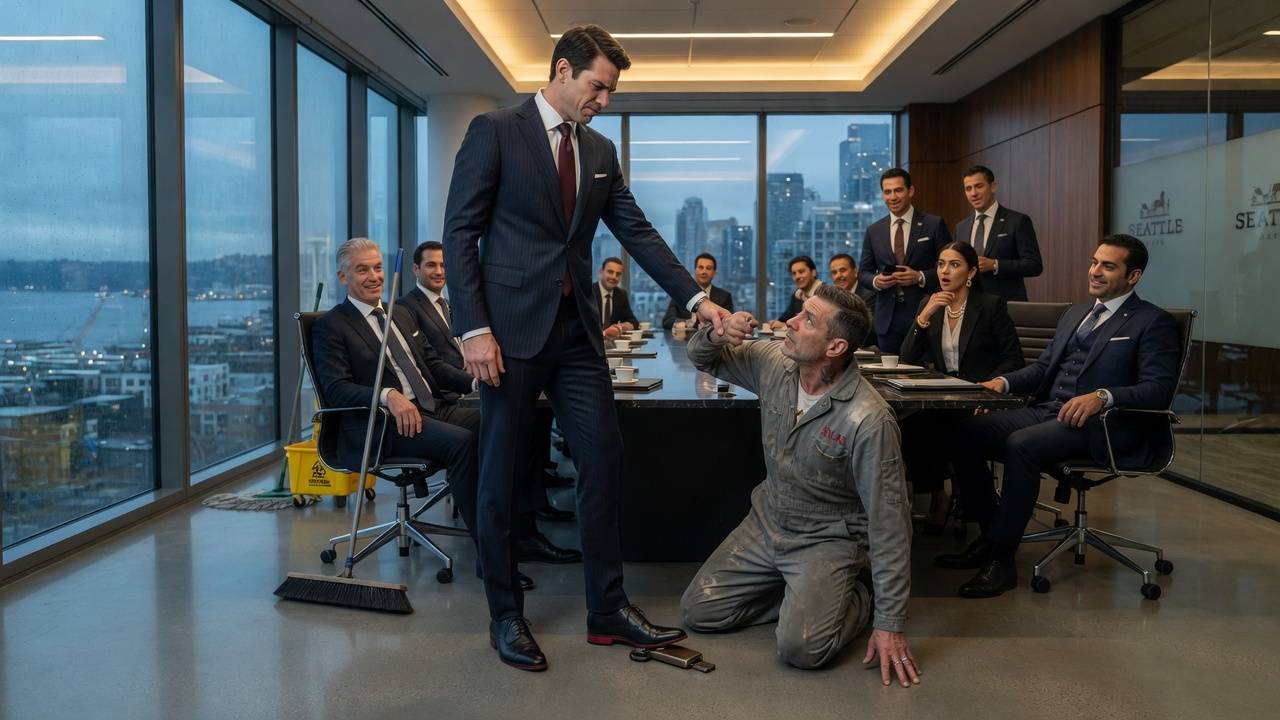
Silas sat on the edge of the worn sofa, watching the screen. He saw the video. It was raw, shaky, and devastating. It showed the coffee being poured. It showed Julian stepping on the drive. It showed the three-beat combo that had ended Julian’s reign.
The door to the apartment opened. It was Sarah, the intern. She was pale, her eyes red-rimmed, and she was holding a thick manila envelope.
“How did you find me?” Silas asked, not moving.
“I’m an analyst, Silas. I looked up your mother’s medical billing address months ago because I wanted to send her flowers when I thought you were just a nice guy who liked code,” she said, her voice trembling. “The police are looking for you. Not for the fight—Julian isn’t pressing charges because his lawyers told him it would make the ‘assault’ part of the video worse. They’re looking for you because of the drive.”
She held out the envelope. “This is the internal audit Julian tried to delete. It proves the Army contract was based on your stolen designs. It proves they framed you three years ago to keep you quiet.”
Silas looked at the envelope, then at the television. He saw the “Mirror”—the head of security, the man who had taken credit for Silas’s work, being handcuffed in the background of the news shot. The residue of the humiliation was still there, a cold weight in his stomach, but the power had shifted. He wasn’t the target anymore. He was the evidence.
“I can’t go to the police, Sarah,” Silas said. “I’m on probation. The moment I walk into a precinct, they’ll revoke it for the ‘unauthorized access’ I used to leak the files.”
“You won’t be going to the police,” a new voice said.
A man in a dark, unremarkable suit stood in the doorway behind Sarah. He held up a badge. “My name is Miller. Department of Justice. We’ve been looking for the architect of the Aegis system for a long time, Mr. Vance. We didn’t expect to find him holding a mop.”
Silas stood up slowly. He looked at his mother’s bedroom door. He could hear her soft, rhythmic snoring.
“Is she going to get the surgery?” Silas asked.
Miller looked at the envelope in Sarah’s hand, then back at Silas. “If what’s in that file is true, the government owes you a lot more than a hip replacement. But first, we need to talk about that USB drive.”
Chapter 6
The federal courthouse in Seattle was a fortress of marble and quiet desperation. Six weeks had passed since the day the “Janitor’s Star” had crashed into the tech world. Silas sat in a small side room, wearing a charcoal suit that felt like a suit of armor—stiff, unfamiliar, and expensive.
His mother was in the front row of the courtroom, sitting in a wheelchair, her hip successfully replaced and her face glowing with a pride that Silas felt he hadn’t earned.
“You ready?” Miller asked, leaning into the room.
“No,” Silas said. “I’d rather be buffing the floors.”
“The floors are clean enough,” Miller said with a rare, dry smile. “Julian Vane took a plea deal this morning. Ten years for corporate espionage and fraud. He’s currently learning that orange isn’t his color.”
Silas walked into the courtroom. The room was packed with the same people who had watched him kneel in the coffee six weeks ago. But today, they didn’t laugh. They didn’t pull out their phones to mock him. When he walked to the witness stand, the silence was different—it was the silence of people realizing they had been standing on the wrong side of a giant.
He spent four hours testifying. He spoke about the Aegis system, the stolen code, and the corruption that had cost him his career. He didn’t speak with anger; he spoke with the same mechanical precision he’d used with the mop. He laid out the truth until there was nowhere left for the lies to hide.
As he stepped down from the stand, he passed the defense table. Julian Vane was sitting there, looking diminished, his arrogance stripped away like cheap plating. Julian looked at Silas, his mouth opening as if to say something—a final insult, perhaps—but he stopped. He saw the look in Silas’s eyes. It wasn’t hatred. It was nothing. Silas looked through him as if he were a smudge on a window.
Outside the courthouse, the Seattle rain had finally stopped, leaving the streets shimmering under a pale sun. Sarah was waiting for him by the steps. She wasn’t an intern anymore; she had been hired by the DOJ to help clean up the Aegis mess.
“What now, Silas?” she asked.
“Now I take my mother home,” he said.
“The Pentagon called,” she said, stepping closer. “They’re rebuilding the communications wing. They want a new architect. Someone who knows how to build things from the foundation up. They said the salary would cover a lot more than medical bills.”
Silas looked down at his hands. They were the hands of a soldier, a janitor, and a creator. They were clean.
“I’ll think about it,” Silas said. “But I think I’m done with towers for a while.”
He walked down the steps to where his mother was waiting in a specialized van. He helped her into the seat, his movements careful and tender.
“You did good, Silas,” she whispered, patting his hand. “You kept it shiny.”
“I did, Mom,” he said.
As he drove away from the courthouse, he reached into his pocket and felt the bronze USB drive. He pulled over near the Elliott Bay waterfront, walked to the edge of the pier, and looked at the water. The drive held everything—his father’s memory, his stolen work, the secret that had almost destroyed him.
He didn’t need it anymore. The code was out. The truth was settled.
He flicked his wrist, and the bronze drive arched through the air, catching a glint of the afternoon sun before vanishing into the dark, cold depths of the Pacific. It wasn’t a grand gesture. It was just a man putting down a weight he’d carried for too long.
Silas got back in the car and drove toward the horizon, the city skyline reflecting in his rearview mirror like a world he had finally finished cleaning. The janitor was gone. The star was still there, but for the first time in his life, Silas Vance was just a man going home.