Chapter 5
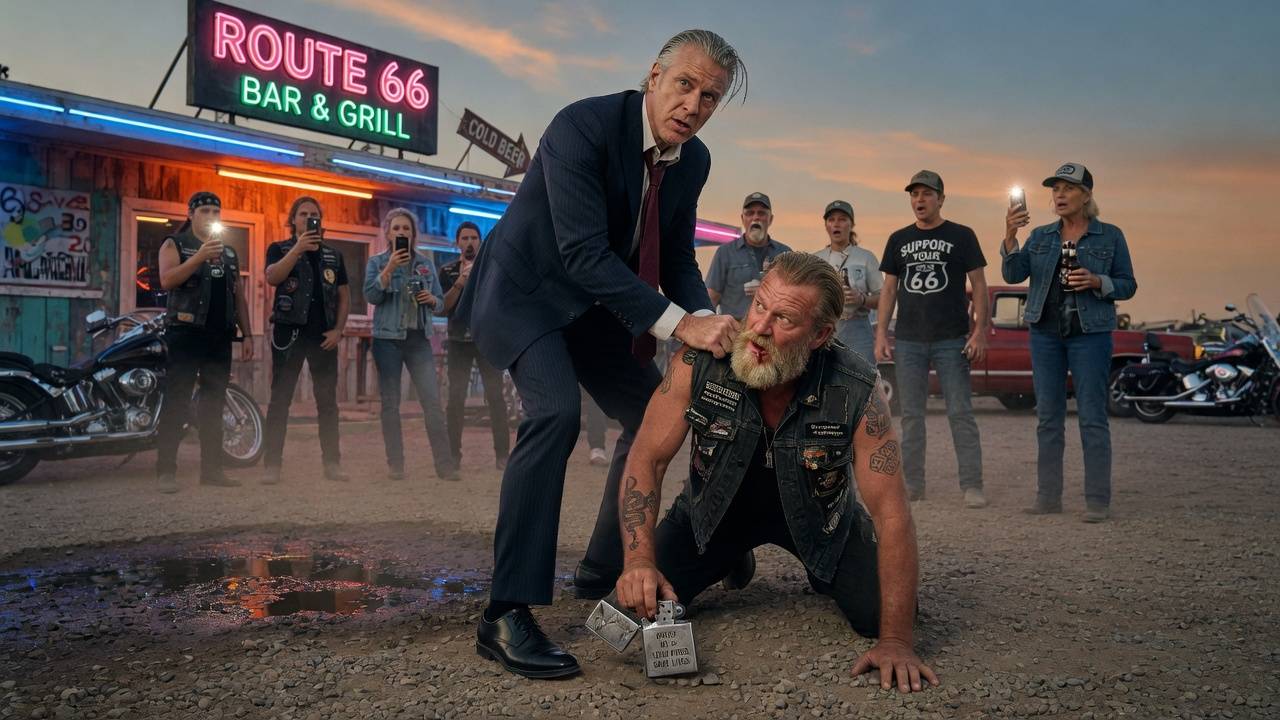
The silence that followed the roar of Dutch’s Shovelhead was more violent than the confrontation itself. Richard “Blade” Miller remained in the dirt for nearly a minute, his silver hair matted with gravel and the expensive navy fabric of his suit stained a dark, muddy brown. His security detail, paralyzed by the speed of the reversal and the presence of rolling news cameras, finally moved in, lifting him like a broken doll.
“Get them,” Richard wheezed, his voice thin and trembling, lacking any of the gubernatorial authority he had wielded moments before. “Get those cameras. Delete that. Now!”
But the crowd—the young bikers who had watched Dutch with a mix of pity and skepticism—were already moving. They didn’t run; they surrounded the scene with their phones held high, a digital wall that the secret service agents couldn’t penetrate without creating a second, even worse scandal.
By the time Dutch reached the small, clapboard house he rented on the outskirts of town, the video had three million views. Maya was waiting on his porch, her face a mask of pale fury and terror.
“What did you do, Dutch?” she whispered as he kicked the kickstand down. He didn’t answer. He reached into his vest, pulled out the bent, silver Zippo, and stared at it. The hinge was gone. The “Loyalty Until Death” engraving was scratched nearly into illegibility.
“He stepped on it,” Dutch said. He looked at Maya, his eyes old and tired. “He thought because I was old, the ground belonged to him. I had to remind him who paved it.”
“He’s going to destroy you,” Maya said, stepping off the porch to meet him. “He’s already calling it an unprovoked assault by a known felon. He’s moving to freeze the insurance payout for Sarah’s surgery. He’s going to use the state’s attorney to issue an emergency warrant. You won’t make it through the night before they have you in a cell, and this time, you won’t be coming out.”
Dutch walked past her into the house. It smelled of motor oil and the peppermint tea Sarah liked. He went to the kitchen table and sat down. “The ledger is in the tank, Maya. I moved it before I went to the bar. I knew he’d send people to the garage.”
“The ledger doesn’t matter if you’re dead or in solitary!” she shouted, her voice cracking. “My father died for that club, Dutch. He died so Richard could have a clean record and a political career. If you let him take you now, Mike’s death means nothing. Sarah’s life means nothing.”
Dutch looked at the phone on the counter. It was ringing. The hospital. He picked it up with a trembling hand.
“Mr. Callahan?” the nurse’s voice was hesitant. “There’s… there’s been a change in Sarah’s status. Not her health, sir. Her billing. We received a notice from the Governor’s office. The experimental trial coverage has been revoked. They’re saying it was a clerical error, but the hospital can’t proceed with the morning procedure without a new guarantee of payment.”
Dutch felt a coldness settle into his bones that no engine heat could ever warm. Richard wasn’t just coming for him; he was pulling the plug on an eight-year-old girl.
“I’ll be there,” Dutch said, his voice flat. He hung up and looked at Maya. “He’s stopped the surgery.”
Maya went still. The professional lawyer veneer shattered, replaced by the raw grief of the girl who had lost her father to the same man’s greed. “He’s a monster.”
“No,” Dutch said, standing up. “He’s a politician who thinks he’s a monster. A monster doesn’t care about a ledger. A monster doesn’t care about a video. Richard is terrified. He’s acting out because he knows the world just saw him beg in the dirt.”
Dutch went to the corner of the room and picked up a heavy, oil-stained canvas bag. He began packing—not clothes, but tools. A heavy-duty wrench, a siphon, and a burner phone he’d kept in a drawer for ten years.
“Where are you going?” Maya asked.
“To see some old friends,” Dutch said. “Richard thinks the Sons of the Road are dead because we stopped wearing the patches. He’s about to find out that the brotherhood wasn’t in the leather. It was in the debt.”
“Dutch, you can’t go to the capital. You’ll never get near him.”
“I’m not going to the capital,” Dutch said, heading for the door. “I’m going to the graveyard. And then I’m going to the press. You have three hours to get to the hospital. If anyone tries to move Sarah, you call the local news. Not the big stations Richard owns—the local ones. Tell them the ‘Biker Grandpa’s’ granddaughter is being evicted from her deathbed.”
He left her standing in the dark. As he rode through the night, the Route 66 neon flickered past like ghost lights. He felt the weight of every year he’d spent in that cell, every minute he’d missed of his daughter’s life, and every breath Sarah was struggling to take.
He pulled into a graveyard five miles outside of town. It was a private plot, overgrown with weeds and guarded by a rusted iron fence. He didn’t go to Big Mike’s grave. He went to a small, unmarked stone in the back corner. Beneath it sat a steel box he’d buried the night he was paroled.
He dug with his bare hands, the cold earth wedging under his fingernails. When he hit metal, he hauled the box up. Inside wasn’t a weapon. It was a collection of tapes—micro-cassettes from the late nineties. Richard had been a “Blade” then, the club’s enforcer and strategist. He had liked to record their meetings, a habit he’d picked up from the mobsters he admired. He thought he’d destroyed them. He didn’t know Dutch had made copies.
Dutch sat on the grass, the moon casting long shadows over the headstones. He listened to a fragment of one tape. Richard’s voice, younger and sharper, talking about the “accident” that would take out Big Mike.
“It’s just business, Dutch,” the voice on the tape said. “The club is a vehicle. I’m the driver. Everyone else is just fuel.”
Dutch closed the box. He had the ledger, and now he had the voice.
He looked up to see a pair of headlights cutting through the cemetery gates. A black SUV. Not the Governor’s security—these were the “New” Sons, the ones Richard had hired to act as his unofficial muscle. Leo was driving.
The SUV stopped ten feet away. Leo got out, looking uncomfortable in the moonlight. He had a pistol tucked into his waistband, but he didn’t draw it.
“Give it up, Dutch,” Leo said. “The Governor said if I bring him the box and the ledger, he’ll let Sarah have the surgery. He’ll even give you a head start to the border.”
“You believe him, Leo?” Dutch asked, his voice steady.
“I have to,” Leo said, his voice cracking. “I have a mortgage. I have a life. I’m not like you. I’m not a martyr.”
“You’re right,” Dutch said, standing up. “You’re a man who’s about to watch a little girl die because you’re afraid of a guy in a suit. Richard isn’t the driver anymore, Leo. He’s the fuel. And I’m about to set the match.”
Dutch didn’t reach for a gun. He reached for his burner phone and hit a speed dial.
“Now,” he said into the phone.
A mile away, at the Last Stop Bar, the young bikers who had filmed the humiliation at the bar hit ‘send’ on a coordinated data dump. The video of Richard begging was just the bait. Attached to it was a digital scan of the first ten pages of the ledger—pages that listed the bribes Richard had paid to current judges and senators.
Leo’s phone chirped in his pocket. Then again. And again.
“What did you do?” Leo whispered, pulling out his phone. His face paled as he scrolled. “Dutch… you just ended everything. You just burned the whole state down.”
“No,” Dutch said, walking toward the SUV. “I just cleared the road. Now move, Leo. I have a surgery to pay for.”
Leo looked at the gun in his belt, then at the old man who had nothing left but his word. He stepped aside.
Dutch drove the Shovelhead out of the graveyard, the engine screaming. Behind him, the state of Oklahoma was beginning to wake up to a political earthquake, but all Dutch could hear was the steady, rhythmic beep of a heart monitor he refused to let go silent.
Chapter 6
The morning sun hit the glass towers of the city with a cold, unforgiving light. By 8:00 AM, the capital was a fortress. Protesters, many of them on motorcycles, had clogged the streets surrounding the Governor’s mansion and the state capitol building. The video of Richard “Blade” Miller in the dirt had become the rallying cry for every person who felt stepped on by the system he represented.
Dutch didn’t go to the capitol. He was sitting in the hospital waiting room, his leather vest draped over the plastic chair next to him. He looked like any other grandfather waiting for news, except for the two state troopers standing ten feet away, watching him with a mix of professional wariness and reluctant respect.
Maya walked through the double doors, her eyes red-rimmed but her stride confident. She was carrying a briefcase and a stack of legal documents.
“The warrant was blocked,” she said, sitting down next to him. “The state supreme court is in emergency session. Three of the judges Richard named in the ledger have already recused themselves. The others are terrified. They won’t touch you, Dutch. Not with the world watching.”
“And Sarah?” Dutch asked, his voice a dry rasp.
“She’s in,” Maya said, a small, genuine smile breaking through. “The hospital board overruled the Governor’s office. They cited ‘public interest’ and a sudden influx of private donations. People are calling from all over the country, Dutch. They’re calling her ‘The Daughter of the Road.'”
Dutch closed his eyes for a moment, the tension that had held his spine straight for twenty years finally beginning to fracture. “She’s safe?”
“She’s in surgery. It’ll be a few hours.”
They sat in silence for a while, the hum of the hospital a stark contrast to the violence of the previous night. The troopers stayed back, their radios crackling with reports of Richard Miller’s resignation being demanded by both sides of the aisle.
Around noon, the television in the corner of the waiting room flickered to a live news feed. Richard was standing at a podium in the capitol press room. He looked ten years older than he had forty-eight hours ago. The navy suit was clean, but the man inside it was hollow. His silver hair was disheveled, and his eyes darted nervously toward the doors, as if expecting the ghosts of the Sons of the Road to come through them.
“I am stepping down,” Richard said, his voice devoid of its usual resonance. “Due to… personal health reasons and a desire to focus on my family. The allegations regarding my past are… under investigation.”
“He didn’t even mention the ledger,” Maya whispered.
“He doesn’t have to,” Dutch said. “The ledger is talking for him now.”
The news cut to a shot of the capitol steps, where hundreds of bikers had parked their machines. They weren’t revving their engines or shouting. They were standing in silence, many of them wearing old, dusty vests they’d pulled out of closets—vests with missing patches, just like Dutch’s. They were a silent army of the forgotten, standing watch over the end of an era.
Two hours later, a doctor in blue scrubs walked into the waiting room. He looked tired but satisfied. He scanned the room and locked onto Dutch.
“Mr. Callahan?”
Dutch stood up, his heart hammering against his ribs harder than any engine.
“The surgery was successful,” the doctor said. “She’s stable. She’s got a long road ahead of her, but the heart is strong. She’s a fighter.”
Dutch didn’t say anything. He couldn’t. He just nodded, his throat tight. He walked to the window and looked down at the street. He could see the line of motorcycles stretching for blocks.
He reached into his pocket and pulled out the Zippo. He’d spent the morning in the hospital shop, using a small vice and a pair of pliers to straighten the metal. The hinge was still a little crooked, and the top didn’t snap shut with that perfect ping anymore, but when he flicked it, the flame caught on the first try.
Maya stood beside him. “What happens now, Dutch? The FBI is going to want your testimony. The club’s history is going to be dragged through the mud. You might have to go back to court.”
“I don’t care about the mud, Maya,” Dutch said, watching the flame. “And I’ve spent enough time in courtrooms. If they want the truth, they can read the book. I’m done being a keeper of secrets.”
He flicked the lighter shut.
“I’m going to take Sarah to the coast,” he said. “Just like I promised. We’re going to find a place where the air doesn’t smell like asphalt and the only thing we have to worry about is the tide.”
“And the bike?”
Dutch looked at the Shovelhead parked in the hospital lot below. It was covered in dust, the chrome dulled by the miles. “The bike stays. I think Leo needs it. He needs to remember what it feels like to have the wind in his face instead of a leash around his neck.”
A month later, a small house on the Oregon coast smelled of salt spray and cedar. Dutch sat on the porch, a cup of coffee in his hand. Inside, he could hear Sarah laughing as she chased a seagull away from the door. Her color was back, her laughter bright and rhythmic.
He pulled a small leather-bound book from his lap. It wasn’t the ledger. It was a photo album Maya had sent him. It was full of old pictures of the Sons—Big Mike, a young Dutch, even a smiling Richard before the power took him.
Dutch looked at a picture of himself and Mike standing in front of the Route 66 sign, their bikes gleaming, their patches proud. They had been young, arrogant, and convinced they were kings of the world.
He realized then that the “Biker’s Vow” wasn’t about the club. It wasn’t about the patches or the rules. It was about the people you were willing to bleed for when the world tried to grind them into the dirt.
He heard a low rumble in the distance—the sound of a V-twin engine approaching. He didn’t tense up. He didn’t reach for a tool. He just waited.
A single motorcycle pulled into the gravel driveway. It wasn’t the Shovelhead. It was a modern cruiser, clean and well-maintained. The rider killed the engine and took off his helmet. It was Leo.
He looked different. The suit was gone, replaced by a simple flannel shirt and jeans. He looked like a man who had finally stopped running.
“Dutch,” Leo said, walking up the porch steps.
“Leo,” Dutch replied. “You’re a long way from the capitol.”
“The capitol is a ghost town,” Leo said, leaning against the railing. “Richard’s trial starts next week. They’re calling it the ‘Trial of the Century.’ Everyone’s talking about the old man who broke the Governor with a push kick and a notebook.”
“I didn’t break him,” Dutch said, looking out at the ocean. “He broke himself. I just showed everyone the cracks.”
Leo reached into his pocket and pulled out a small package wrapped in brown paper. He handed it to Dutch. “I found this in the garage. Thought you might want it back.”
Dutch unwrapped it. It was his old patch. The “Sons of the Road” center-piece, cleaned and mended. The wings were bright silver again, the wheel solid black.
Dutch looked at it for a long time, then handed it back. “Give it to Maya. Tell her to put it in a frame. Her father earned it.”
“And you?” Leo asked.
Dutch looked inside the house, where Sarah was calling his name, her voice full of life and tomorrow.
“I’ve got everything I need right here,” Dutch said.
Leo nodded, put the patch in his pocket, and walked back to his bike. As the engine roared to life and the rider disappeared back down the coast road, Dutch sat back in his chair. He pulled out the silver Zippo, flicked it open, and watched the small, steady flame dance in the ocean breeze.
The debt was paid. The road was open. And for the first time in a very long time, the old veteran was finally home.