Chapter 5
The silence in the alleyway didn’t last. It was replaced by the frantic, wet sound of Leo Thorne trying to pull air into lungs that had been momentarily paralyzed by Wyatt’s strike. Leo stayed on the ground, his palms flat against the dirty slush, his head hanging between his shoulders as he coughed—a ragged, desperate sound that seemed to vibrate through the brick walls of the corridor.
Wyatt didn’t move. He stood with his weight balanced on his left leg, his hands at his sides, fingers still curled into the loose tension of someone who hadn’t quite stepped out of the “red zone.” He could feel the eyes of the neighbors on him—not the frightened, pitying looks they’d given him earlier, but something sharper. Something colder. They had seen the carpenter, the quiet man with the dog, turn into a machine of precise, violent efficiency. They had seen the “hero” bleed into the “soldier,” and the transition was too fast for them to process.
Sarah, the reporter, was the first to move. She lowered her phone, her face pale, the screen still glowing with the image of Leo hitting the pavement. “Wyatt,” she whispered, her voice trembling. “You… you shouldn’t have done that.”
Wyatt didn’t look at her. He looked at Leo, who was finally managed to roll onto his side. Leo’s charcoal suit was ruined, a dark map of salt and mud spreading across the expensive wool. He looked up at Wyatt, and for the first time, the arrogance was gone, replaced by a raw, naked fear that made him look like the four-year-old Wyatt had pulled from the fire twenty years ago.
“I’m calling the police,” Leo wheezed, his hand shaking as he reached for the inner pocket of his jacket. “You’re dead, you hear me? You’re going to rot in a cell for this.”
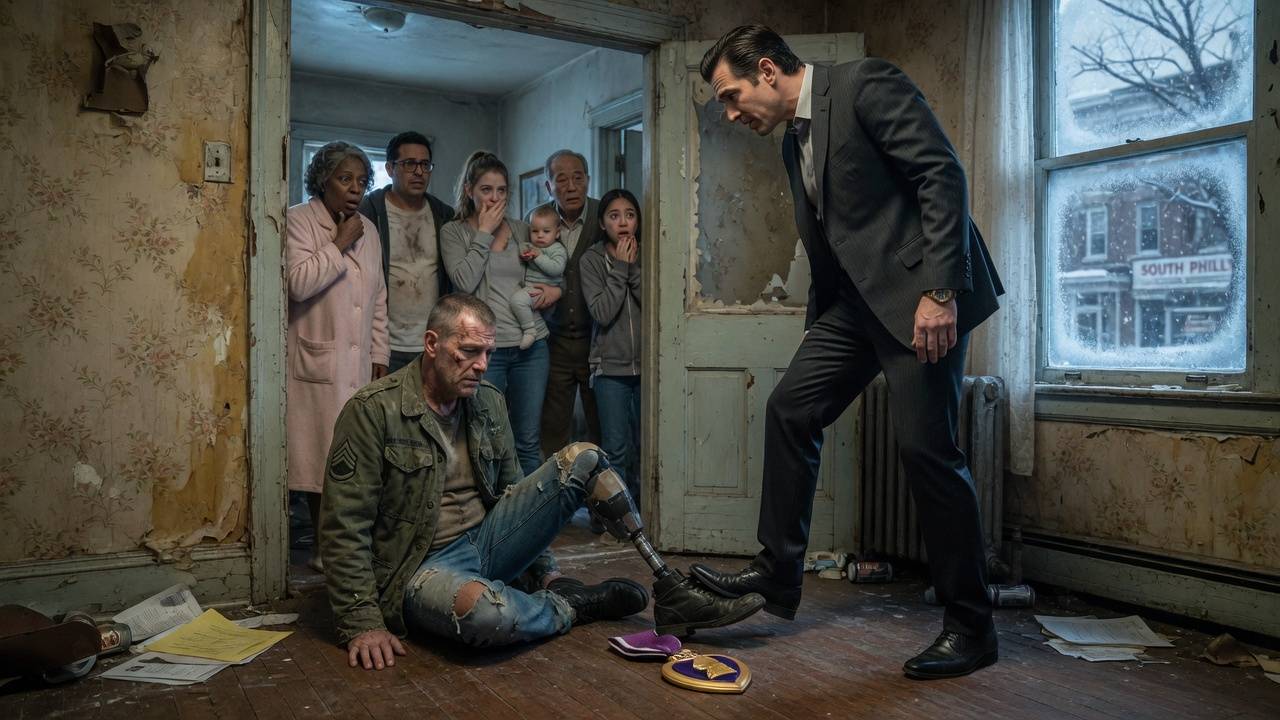
“Call them,” Wyatt said. His voice was steady, devoid of the adrenaline-fueled tremor that usually followed a confrontation. “Tell them exactly what happened. Tell them how you threw a veteran’s prosthetic out a window. Tell them how you stood on a Purple Heart. I’m sure the local precinct will be very interested in your side of the story.”
Leo’s hand froze. He looked around the alley. He saw the phones. He saw the faces of the people he had spent the last hour belittling. He realized, with a sudden, sickening clarity, that the video Sarah had just captured wasn’t just a record of an assault—it was a record of his own character being dismantled in front of the world.
One of Leo’s assistants, a tall man who had been lurking near the service entrance, finally stepped forward. He looked at Wyatt, then at Leo, and then back at Wyatt. He didn’t make a move to help Leo up. He just stood there, his eyes wide.
“Mr. Thorne, we should go,” the assistant said quietly. “Now.”
Leo didn’t argue. He allowed the assistant to help him to his feet. He was shaky, his knees buckling slightly as he tried to find his footing. He didn’t look at Wyatt again. He leaned heavily on his assistant, his head bowed, as they moved toward the black SUV idling at the mouth of the alley.
As the SUV pulled away, the crowd began to disperse. It wasn’t a sudden exodus; it was a slow, uncomfortable drifting. People went back into their apartments, closing their doors with a finality that felt like an ending. Only Sarah remained.
“Wyatt, that video… it’s already uploading,” she said, her voice more professional now, though still strained. “People are going to see this. The board of Thorne Developments, the city council, the VA. You’ve just handed Leo Thorne his own head on a platter.”
“I didn’t do it for the video, Sarah,” Wyatt said. He bent down, his prosthetic clicking as he retrieved the Purple Heart. He rubbed the dirt from the gold profile of Washington with his thumb.
“I know,” she said. “But that doesn’t change the fallout. He’s going to come for you with everything he has. Lawyers, lawsuits, harassment. You can’t stay here. Not now.”
“I was already leaving,” Wyatt said. He looked at the pile of his life’s work—the workbench, the half-finished carvings—scattered across the sidewalk. “He just made sure I didn’t leave anything behind.”
He spent the next three hours in a state of mechanical detachment. He found his prosthetic limb in the snow, the carbon-fiber casing scratched but intact. He wiped it down with his sleeve and strapped it back on, the familiar weight providing a grim sort of comfort. He packed a single duffel bag with his essentials: a few changes of clothes, Barnaby’s food, and the small wooden bird he had carved for his mother.
Miller, the homeless veteran from the alley, helped him move the workbench into the back of a rusted pickup truck belonging to an old neighbor who had finally found his courage.
“Where you going, Wyatt?” Miller asked, leaning against the truck bed.
“I don’t know,” Wyatt said. “Away from the skyline.”
“You did the right thing,” Miller said, his eyes reflecting the yellow light of the streetlamps. “Most people, they spend their whole lives letting the Leos of the world step on ’em. They think if they’re quiet enough, the boot will eventually lift. It never does.”
Wyatt didn’t feel like he’d done the right thing. He felt a deep, hollow ache in his chest. He had spent twenty years trying to be more than the sum of his damage. He had tried to build things that would last, things that would provide beauty in a world that felt increasingly ugly. And in thirty seconds of violence, he had reaffirmed exactly what the world thought he was: a weapon that didn’t know the war was over.
As he drove away from Philadelphia, the skyline fading into a blur of gray and white in the rearview mirror, he felt a strange sensation. The phantom itch in his missing foot was gone. For the first time in fifteen years, he felt the full weight of his body. He felt the cold, the hunger, and the uncertainty of the road ahead.
He didn’t know where he was going, but he knew he wasn’t a ghost anymore.
Chapter 6
The workshop was small, a converted garage on the outskirts of a town in the Poconos that didn’t even have a stoplight. It smelled of pine needles and damp earth, a sharp contrast to the stale, industrial scent of the Philadelphia apartment. Wyatt sat on a stool, his good leg tucked under him, watching the snow fall through the single window.
Two months had passed since the day in the alley. The video Sarah had taken had done exactly what she’d predicted—it had detonated Leo Thorne’s career. The board of Thorne Developments had moved quickly to distance themselves from the “public relations disaster,” forcing Leo into a “voluntary resignation” that stripped him of his power and most of his assets. The luxury high-rise project had been halted indefinitely, caught in a web of city council investigations and public outcry.
Wyatt had watched none of it. He had disconnected his phone, sold what furniture he could, and disappeared into the mountains. He didn’t want the fame of a “viral hero.” He didn’t want the interviews or the GoFundMe pages that Sarah had tried to set up for him. He just wanted the silence.
There was a knock on the garage door. Barnaby, older and slower now, let out a soft, perfunctory woof but didn’t leave his spot by the wood-burning stove.
Wyatt opened the door. It was Leo Thorne.
He didn’t look like the man in the charcoal suit anymore. He was wearing a heavy, ill-fitting parka and work boots that looked brand new. His face was thinner, the arrogance replaced by a hollow, haunted expression. He looked like someone who had spent the last eight weeks learning the true cost of gravity.
“How did you find me?” Wyatt asked, his hand resting on the doorframe.
“Sarah,” Leo said. His voice was low, stripped of its edge. “She didn’t want to tell me. I had to convince her I wasn’t here to serve papers.”
Wyatt stepped back, allowing Leo to enter. The two men stood in the center of the small workshop, surrounded by the skeletons of half-finished chairs and the scent of sawdust.
“I came to say… I saw the photo,” Leo said. He reached into his pocket and pulled out a crumpled piece of paper. It was a photocopy of the picture Wyatt had kept in his drawer—the one of the blood-stained soldier holding the crying child. “Sarah found it in the trash you left behind. She tracked down the reporter who took it. She told me everything.”
Wyatt didn’t say anything. He just watched Leo’s hands tremble as he held the paper.
“I didn’t know,” Leo whispered. “I spent my whole life thinking I was special. Thinking I was the ‘miracle child’ because I was born for greatness. My father… he never told me how we got out of that village. He told me he’d paid for our safety. He told me the Americans were just hired help.”
“Your father was a man who wanted you to feel invincible,” Wyatt said. “Most fathers do. He just forgot that invincibility is a lie.”
Leo looked around the workshop, his eyes lingering on the workbench—the one Wyatt had spent years meticulously restoring. “I lost everything, Wyatt. The company, the money, the reputation. My father won’t even take my calls. He says I’m a liability.”
“You’re not a liability, Leo,” Wyatt said. “You’re just a man. For the first time in your life, you’re exactly like everyone else.”
Leo looked at him, a flicker of the old anger touching his eyes before fading into something closer to grief. “Why didn’t you tell me? That day in the apartment. Why didn’t you just show me the photo? You could have kept your home. You could have destroyed me without even lifting a hand.”
“Because I didn’t save a debt,” Wyatt said. “I saved a child. If I used that to pay my rent, then the boy I carried out of that fire would have died anyway. I wouldn’t let you kill him.”
Leo lowered his head. He stood in the silence of the workshop for a long time, the only sound the crackle of the wood stove and the distant whistle of the wind. When he finally looked up, his eyes were wet.
“I can’t give you back your leg, Wyatt,” Leo said. “And I can’t give you back the twenty years you spent in that building.”
He reached into his parka and pulled out a legal-sized envelope. He set it on the workbench, his movements slow and deliberate.
“The Thorne family still owns the land,” Leo said. “But I still have a small trust. It’s not much, but it was enough to buy the deed to this place. And the five acres around it. It’s in your name. No rent. No developers. Just wood and dirt.”
Wyatt looked at the envelope. He didn’t reach for it. “I don’t want your charity, Leo.”
“It’s not charity,” Leo said, his voice cracking. “It’s a down payment. On a soul I’m trying to find.”
Leo turned and walked toward the door. He stopped at the threshold, looking out at the snow-covered valley. “I’m going to the VA tomorrow. Sarah found a program… they need people to help with the housing paperwork. People who know how the system works. I figured I’d start there.”
He didn’t wait for a response. He walked out into the cold, his boots crunching in the fresh powder.
Wyatt watched him go until the tail lights of his car vanished into the white blur. He walked over to the workbench and picked up the envelope. He didn’t open it. He set it down next to the Purple Heart, which sat polished and gleaming under the workshop light.
He picked up his chisel and went back to work. He was carving a new bird, this one with its wings spread wide, ready for flight. He worked with a steady hand, the rhythm of the wood providing the only map he needed.
The phantom itch was still gone. But for the first time in a very long time, Wyatt didn’t feel the weight of his body at all. He just felt the wood. He felt the air. He felt the quiet, cold dignity of a man who had finally settled his accounts with the world.
He looked at Barnaby, who was dreaming by the fire, his paws twitching as he chased ghosts in his sleep. Wyatt smiled—a small, tired movement of his lips.
The winter was long, but for the first time in fifteen years, he knew he was going to be warm.