Jonah was the kind of man who carried his grief like a lead weight in his pockets.
For twenty years, the town of Port Haven watched him walk the docks, a ghost in a yellow slicker.
He didn’t want trouble; he just wanted to keep the memory of his wife and son alive.
But Alistair Vance didn’t believe in memories—he only believed in land and leverage.
On a cold Tuesday, Vance decided to end the “Jonah problem” in front of the whole harbor.
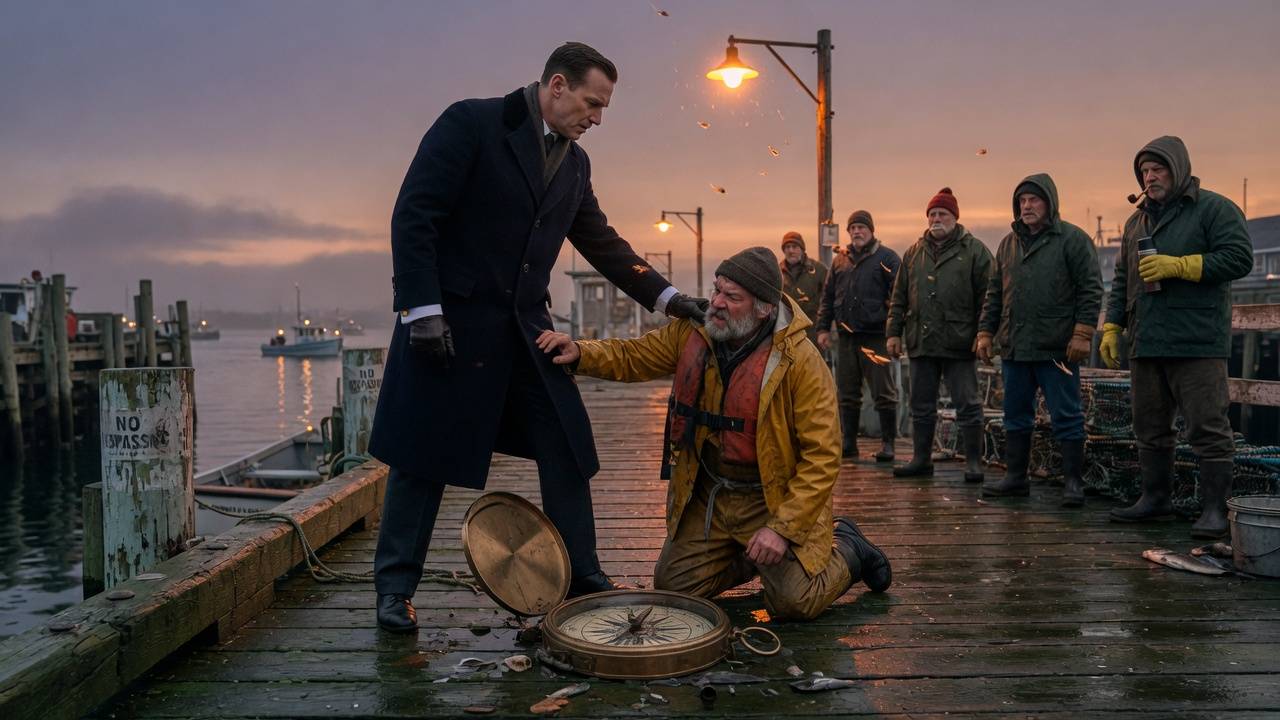
He took Jonah’s only heirloom, a brass compass that survived the wreck, and threw it in the dirt.
The crowd watched in a sickening silence as the billionaire ground the glass under his heel.
Vance leaned in, whispering loud enough for everyone to hear that Jonah was a failure who let his family drown.
The old man didn’t cry and he didn’t beg for the money Vance was waving in his face.
Something in Jonah’s eyes shifted—the look of a man who had already lost everything and had nothing left to fear.
In three seconds, the power on that pier shifted in a way no one expected to see.
The billionaire ended up in the salt and mud, begging for a mercy he never gave.
But the real shock wasn’t the fight; it was what Jonah said before he walked away.
The sea finally coughed up a secret, and now the whole town is waiting for the tide to come in.
The full story is in the comments.
Chapter 1
The salt air in Port Haven doesn’t just smell like the ocean; it smells like rust, rotting kelp, and things that should have stayed buried. Jonah felt it in his lungs every morning at 4:00 AM as he stepped onto the Eliza Mae. The boat was thirty years old, a patchwork of fiberglass repairs and stubborn diesel engine fumes, but it was all he had left. It was named after a woman who had been gone for twenty-two years, and a son who would have been twenty-eight this summer.
Jonah moved with the slow, deliberate grace of a man whose joints were full of Atlantic brine. He hauled the first crate of lobsters onto the pier, the plastic skidding against the weathered wood. The harbor was quiet, save for the rhythmic slap-slap of water against the pilings and the distant cry of a lone gull. He liked the quiet. It allowed him to talk to them.
“Going to be a blow today, Eliza,” he muttered, adjusting his cap. “Sky looks like an old bruise.”
He felt a presence before he heard it. The silence of the docks was broken by the sound of expensive leather soles—a sharp, rhythmic tapping that didn’t belong in a place where everyone wore rubber boots. Jonah didn’t look up. He knew that cadence.
“You’re late with the slip fee, Jonah,” a voice said. It was smooth, groomed, and entirely devoid of the local Maine lilt.
Jonah straightened his back, a sharp pain radiating from his L5 vertebra. Alistair Vance stood at the edge of the pier, flanked by two men in dark windbreakers who looked like they’d been grown in a vat labeled Security. Vance was in his fifties, but his skin was taut from procedures and his hair was a silver that cost more than Jonah’s boat. He was the man who owned the cruise line, the luxury condos rising like glass teeth on the north shore, and, increasingly, the very water Jonah fished.
“Harbor Master says I have until Friday,” Jonah said, his voice gravelly. He wiped a smear of fish scales onto his yellow slicker.
“The Harbor Master works for the Port Authority. And the Port Authority just sold the management rights of this pier to Vance Maritime,” Alistair said, stepping closer. He looked at the Eliza Mae with a faint, theatrical twitch of his nose. “It’s an eyesore, Jonah. It’s a liability. You’re leaking oil into a harbor I’m trying to turn into a world-class marina.”
“She’s clean enough,” Jonah said. He reached into his pocket and felt the cold, hard edges of the brass compass. It was his anchor.
“I offered you a settlement years ago,” Vance said, his voice dropping to a condescending hum. “A very generous one. Most men would have taken the money and retired to Florida. Instead, you linger here like a bad smell. Why?”
Jonah looked Vance in the eye. He saw the cold calculation of a man who viewed people as obstacles on a spreadsheet. “Because you were at the helm of the Ocean Queen that night, Alistair. And because ‘generous’ doesn’t cover the cost of two caskets.”
The air between them turned brittle. One of the security guards stepped forward, but Vance raised a manicured hand. A slow, cruel smile spread across his face.
“Still the same story,” Vance sighed. “The grieving widower. But we both know the Coast Guard report said you were in the shipping lane. You killed them, Jonah. I just happened to be the one who hit you. You’ve spent twenty years trying to blame me for your own incompetence.”
Jonah’s hand tightened around the compass. The glass was cracked, a jagged spiderweb across the face, but the needle still hunted for north. He felt the familiar surge of displaced rage, the hot coal in his chest that he usually kept doused in work.
“I’m not leaving,” Jonah said.
“We’ll see,” Vance replied. He looked around at the other fishermen who were beginning to gather on their decks, watching the exchange in a heavy, uneasy silence. “Friday, Jonah. If the slip isn’t vacated, I’ll have the Eliza Mae towed to the scrapyard. I’m sure they can find a use for all that rusted iron.”
Vance turned on his heel and walked away, his guards trailing like shadows. Jonah stood there, the smell of Vance’s expensive cologne lingering in the air, clashing with the honest stink of the sea. He felt the eyes of the other fishermen on him—men like Elias and Miller, who had known him for decades. They didn’t say a word. They couldn’t. Vance held their leases, too.
Jonah looked down at his hands. They were shaking. He stepped back onto his boat, the deck tilting under his weight, and sat on the engine cover. He pulled the compass out and traced the crack in the glass.
“He’s wrong, Eliza,” he whispered. “I know what I saw. I know where we were.”
But the doubt, that old, jagged hook, dug in deep. He looked at the water, dark and unforgiving, and wondered if he was just a ghost haunting a town that had already moved on.
Chapter 2
The pressure didn’t come all at once. It was a slow tightening of the screws.
By Wednesday, the local bait shop told Jonah his credit was no longer good. By Thursday morning, the diesel pump at the end of the pier was “under maintenance” specifically for him. Jonah spent the afternoon hauling his traps by hand, a grueling process that left his muscles screaming and his breath coming in ragged gasps.
He was pulling his last trap near the Devil’s Throat—a treacherous stretch of water where the currents raked over submerged granite—when he saw the shimmer.
For years, Jonah had fished these specific coordinates. Not because the lobster were plentiful, but because this was where the Eliza Mae had gone down. He had dived these waters in his mind a thousand times. But today, something was different. A storm had passed through the night before, shifting the silt on the ocean floor.
The trap came up heavy, snagged on something. Jonah braced his feet and hauled, his heart hammering against his ribs. When the trap broke the surface, it wasn’t empty. Tangled in the nylon mesh was a piece of debris—a rectangular housing of reinforced steel, encrusted with barnacles but unmistakably industrial.
It was a flight data recorder. Or rather, a voyage data recorder. From a ship.
Jonah’s breath hitched. He hauled the heavy object onto the deck, the barnacles scraping the fiberglass. He knew the Ocean Queen had claimed they lost their VDR in the collision, that it had been swept away by the current. The inquiry had relied on Vance’s bridge logs—logs that had cleared him of all fault.
He knelt beside the box, his fingers trembling as he brushed away the silt. If this was it, and if the data was still intact, it didn’t matter what the Coast Guard had said twenty years ago. It didn’t matter what Vance’s lawyers had written.
“I found it,” he breathed. “Eliza, I found it.”
He covered the box with a tarp and headed back to the harbor, his mind racing. He needed a lawyer, but not just any lawyer. He needed someone who wasn’t on the Vance Maritime payroll.
That evening, Jonah sat in the back booth of The Rusty Anchor, the town’s only remaining dive bar. He was nursing a coffee when a woman sat down across from him. She was young, maybe thirty, with tired eyes and a briefcase that had seen better days. Her name was Sarah Miller, the daughter of one of the fishermen, who had gone off to law school and come back to open a struggling practice in the strip mall.
“My dad told me what happened on the pier,” Sarah said softly. “Jonah, you can’t fight him alone. He’s going to crush you.”
“I have something, Sarah,” Jonah said, leaning in. He told her about the box.
Sarah went pale. “If that’s the VDR from the Ocean Queen… Jonah, that’s not just evidence. That’s a death warrant. Vance will do anything to keep that from being opened. Do you understand? Anything.”
“I’ve been dead for twenty years,” Jonah said. “I’m just waiting for the paperwork to catch up.”
“Give it to me,” she urged. “Let me take it to the District Attorney in Portland. Don’t keep it on the boat.”
“Not yet,” Jonah said, his voice hardening. “I want to see his face. I want him to know it was me who took him down.”
“That’s pride talking, Jonah,” Sarah said, reaching across the table to touch his hand. Her skin was warm, a sharp contrast to the cold he felt in his bones. “Pride is what Vance uses to bait his traps. Please. Don’t go back to the boat tonight.”
Jonah looked at her, seeing the genuine fear in her eyes. He felt a flicker of something—a sense of responsibility he hadn’t felt in a long time. But the weight of the compass in his pocket was heavier.
“I have to go back,” he said. “It’s the only home I have.”
As he walked back to the docks, the fog was rolling in, thick and white, swallowing the masts of the boats. He felt the eyes of the town on him—from the windows of the darkened shops, from the silhouettes of men smoking on their porches. He was a man walking toward a cliff, and everyone was just waiting to hear the splash.
He reached the pier and saw a figure standing by the Eliza Mae. It wasn’t Vance. It was Miller, Sarah’s father. He was holding a bottle of cheap whiskey, his face etched with shame.
“Jonah,” Miller said, his voice thick. “Vance called me. He said if I didn’t get you to leave, he’d pull my slip too. My boy needs that boat, Jonah. He’s got a baby on the way.”
Jonah looked at his old friend. He saw the desperation, the way the man couldn’t meet his eyes.
“I’m sorry, Miller,” Jonah said quietly.
“Just take the money, man,” Miller pleaded, a sob breaking his voice. “Just take it and go. Why does it have to be you? Why do you have to be the one who stands up?”
“Because if I don’t,” Jonah said, stepping onto his boat, “then no one ever did. And they’ll just be gone. Like they never mattered.”
He watched Miller walk away into the fog, a broken man. Jonah sat on the deck, the tarp-covered box a silent passenger, and listened to the ocean. It sounded like a heart beating. Or a clock ticking down.
Chapter 3
Friday morning arrived with a sky the color of lead.
The harbor was unusually crowded. Word had spread that this was the day Jonah was being evicted. Men who should have been out at sea were lingering on the pier, mending nets they’d already mended, talking in low, urgent tones. There was a palpable sense of dread, a collective holding of breath.
Jonah spent the morning cleaning the Eliza Mae. He polished the brass, scrubbed the deck, and made sure the engine was topped off. He moved with a strange, calm purpose. He had hidden the VDR in a lobster trap and dropped it back into the shallow water near his slip, a buoy marking the spot that only he would recognize.
At 10:00 AM, the black SUVs appeared at the head of the pier.
Alistair Vance stepped out, looking like he was attending a ribbon-cutting ceremony. He wore a navy overcoat and a silk scarf, his presence an insult to the grit and grease of the docks. He was followed by his guards and a man in a cheap suit carrying a clipboard—a representative from the Port Authority.
“Mr. Thorne,” Vance said, his voice carrying easily over the wind. “I trust you’ve made arrangements?”
Jonah stood on the pier, his feet planted wide. He felt the brass compass in his pocket, its jagged crack pressing against his thigh.
“I’m staying,” Jonah said.
Vance sighed, a sound of mock disappointment. “I gave you every chance. You’re a stubborn man, Jonah. It’s a shame. It’s that same stubbornness that kept you in the shipping lane that night, isn’t it? You thought the Ocean Queen would blink first. You thought the world would move for you.”
“I was where I was supposed to be,” Jonah said, his voice steady. “And you were drunk on the bridge. I smelled it on you when they pulled me out of the water.”
The crowd shifted. A low murmur went through the fishermen. This was the truth everyone knew but no one spoke.
Vance’s face darkened, the mask of civility slipping for a fraction of a second. “Careful, old man. Slander is an expensive hobby.”
“It’s not slander if it’s true,” Jonah said. He reached into his pocket and pulled out the compass. “This was on the dash when you hit us. It stopped at 2:14 AM. The same time your logs say you were five miles south. You lied, Alistair. You lied to the Coast Guard, and you lied to this town.”
Vance looked at the compass, a flash of recognition—and something like panic—crossing his eyes. Then, he laughed. It was a cold, brittle sound.
“That piece of junk?” Vance stepped forward, his guards moving with him. “That’s your proof? A broken toy from a dead woman?”
Vance reached out with a lightning-fast movement and snatched the compass from Jonah’s hand. Jonah, caught off guard by the younger man’s agility, stumbled back.
“Give it back,” Jonah said, his voice trembling.
“This?” Vance held the compass up for the crowd to see. “This is Jonah’s ‘truth.’ A rusted bit of brass that doesn’t even work.”
Vance dropped the compass onto the wet, salt-stained wood of the pier.
“Look at it,” Vance sneered. “Just like your life, Jonah. Broken. Useless. Forgotten.”
Vance raised his polished leather shoe and brought it down hard on the compass. There was a sickening crunch as the brass frame buckled and the already cracked glass shattered into a thousand tiny shards.
Jonah let out a sound—a choked, animal cry of grief. He dropped to his knees, his hands reaching for the fragments. The crowd flinched. Sarah Miller, standing at the edge of the pier, moved forward, but one of the guards blocked her path.
“You couldn’t save your wife,” Vance said, leaning down, his face inches from Jonah’s. “You’re just a senile failure living in a fantasy world. And now, you don’t even have your toy.”
Vance grabbed Jonah by the collar of his yellow slicker and hauled him up, forcing him to look at the wreckage of the compass. He shoved Jonah back, crowding his space, making him look small and pathetic in front of the men he had worked with for forty years.
“Get off my pier,” Vance hissed. “Before I have you arrested for trespassing on your own grave.”
Jonah looked down at the shattered glass. He felt the cold spray of the ocean on his face. He felt the eyes of the harbor on his back. And then, he felt something else. A sudden, crystalline clarity. The fear was gone. The doubt was gone. There was only the cold, hard weight of the truth.
Chapter 4
The silence on the pier was absolute, broken only by the rhythmic creak of the docks and the distant, low moan of a foghorn.
Jonah stood on his knees, his fingers hovering over the ruined brass. He could see the tiny, bent needle of the compass, still trying to find north even in the wreckage. Alistair Vance stood over him, a towering figure of polished cruelty, his shadow stretching long across the wet planks.
“Pick it up, Jonah,” Vance mocked, his voice echoing in the stillness. “Pick up your ‘truth’ and get out of here.”
Vance reached down and grabbed Jonah by the collar again, his knuckles white against the yellow slicker. He pulled Jonah closer, his breath smelling of expensive mints and old malice.
“You’re a ghost,” Vance whispered. “And it’s time you stopped haunting me.”
Vance shoved Jonah backward, forcing him to stumble. The crowd of fishermen—Elias, Miller, and the others—stood paralyzed, their phones raised, capturing the humiliation of the man they once respected.
Jonah regained his balance. He didn’t look at the crowd. He looked at Vance.
“Take your foot off that compass, Alistair,” Jonah said. His voice wasn’t loud, but it had a strange, resonant quality, like a bell rung underwater.
Vance laughed, a sharp, ugly sound. “Or what? You’ll hit me with a lobster? You’re nothing, Jonah. You’re a footnote in a report I wrote.”
Vance stepped forward, ignoring the warning. He reached out to grab Jonah’s shoulder, intending to spin him around and shove him toward the head of the pier.
In that moment, the “senile failure” vanished.
Jonah’s Navy training, buried under twenty years of grief and salt, roared to the surface. As Vance’s hand touched his shoulder, Jonah planted his left foot firmly into the wet wood. In one fluid, explosive motion, he snapped his left forearm upward, striking Vance’s reaching arm and knocking it off-line with a sharp crack.
Vance’s shoulder turned off-axis, his chest opening up, his balance shifting onto his heels. His eyes widened in a split second of pure, unadulterated shock.
Jonah didn’t hesitate. He stepped inside Vance’s guard, his rear foot driving into the pier. He rotated his hips and shoulders, driving a compact, devastating palm-heel strike into the center of Vance’s chest, right on the sternum.
The impact was heavy and hollow. Vance’s navy overcoat jolted at the contact point. His upper body snapped backward, his lungs catching in a sharp, wheezing gasp as the air was driven out of him. He scrambled backward, his leather soles sliding on the wet planks.
Before Vance could even begin to recover, Jonah planted his lead foot and drove a powerful front push kick into Vance’s solar plexus. Jonah’s boot sole made a sickening thud against the expensive wool. He pushed through the strike, his leg extending with the full weight of his anger and his history.
Vance was launched backward. He didn’t just fall; he collapsed. He hit the pier hard, his head narrowly missing a rusted cleat, his body skidding a foot across the wood. A cloud of salt dust kicked up from the planks.
The crowd gasped. Several phones dropped. The two security guards froze, caught between their orders and the sheer, impossible reality of what they had just seen.
Vance lay on the ground, his face pale, clutching his chest. He looked up at Jonah, his eyes wide with a terror he had never known. He scrambled backward on his elbows, his polished shoes kicking at the air.
“Wait—Jonah, stop!” Vance wheezed, his voice thin and desperate. “I’ll pay you! Double the settlement! Triple! Just… stay away!”
Jonah didn’t move toward him. He didn’t need to. He stood tall, the yellow slicker bright against the gray sky, looking every bit like the storm he had endured.
“The sea doesn’t take bribes, Alistair,” Jonah said, his voice cold and final. “And neither do I.”
He looked down at the shattered compass.
“You think you broke this,” Jonah said, his voice rising so the whole pier could hear. “But all you did was show everyone what’s inside. The needle still points the way. And tomorrow morning, the District Attorney is going to see what I found at the Devil’s Throat.”
Vance’s face went from white to a sickly, mottled gray. He looked at the crowd, at the dozens of phones that had just recorded a billionaire begging for mercy from a man he had called a failure.
Jonah turned his back on him. He walked to the edge of the pier, reached down, and hauled up the lobster trap he had dropped earlier. He pulled out the encrusted steel box and held it up.
“The Ocean Queen lost her memory twenty years ago,” Jonah said. “I think it’s time she got it back.”
He walked past the silent, stunned fishermen, past the broken man on the ground, and headed toward Sarah Miller’s car. He didn’t look back. He didn’t have to. The air in Port Haven finally smelled like something else.
It smelled like justice.