Chapter 5
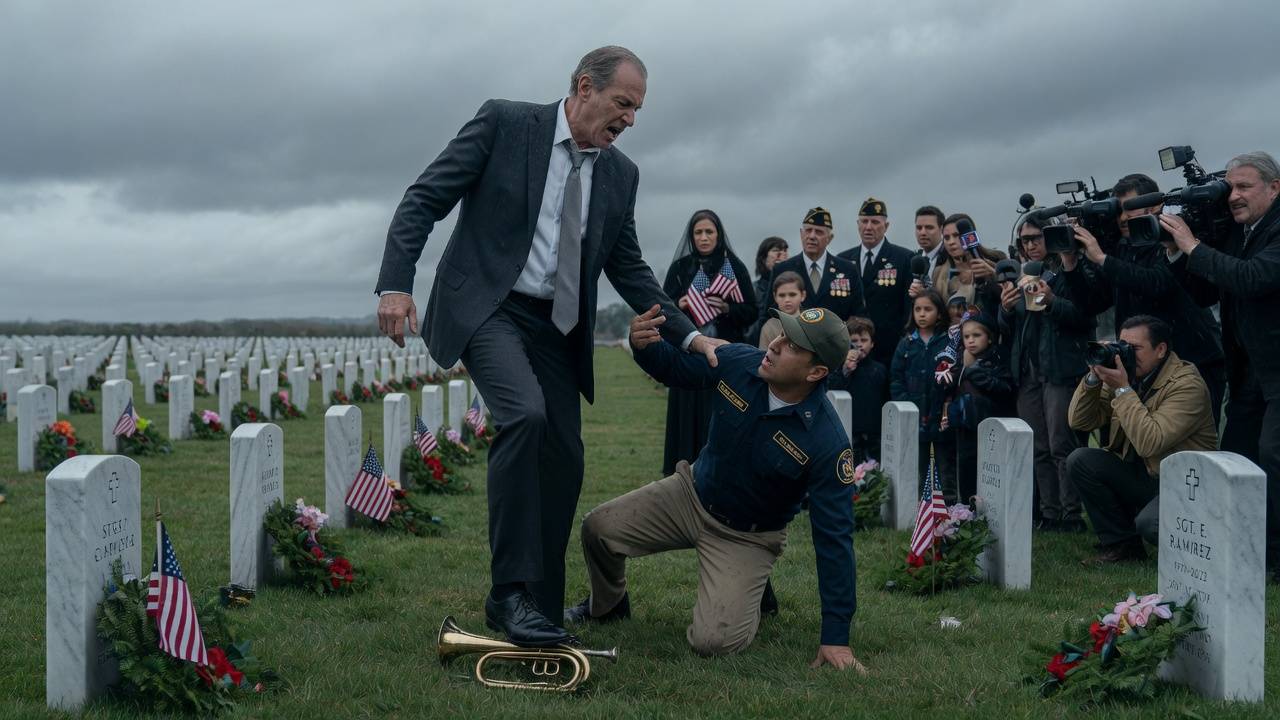
The silence that followed the dull thud of Arthur Sterling hitting the grass was the loudest thing Malachi had ever heard. It wasn’t a peaceful silence; it was the sound of a vacuum forming, a collective intake of breath from fifty people who had just watched a god fall into the mud.
Malachi stood over him, his knuckles throbbing, his chest heaving with a rhythmic, jagged heat. He looked down at Sterling. The man wasn’t a General anymore. He was an old man in a ruined suit, his silver hair plastered to his forehead with sweat and grit, his eyes wide with a terrifyingly naked vulnerability. He was trembling.
“You… you struck a superior officer,” Sterling wheezed, his hand still raised in that pathetic, defensive claw. “You’re finished. Do you hear me? You’re dead.”
“I don’t have a superior officer,” Malachi said, his voice coming from somewhere deep and cold. “And I don’t work for you. I work for the men under these stones. And they’re disgusted by you.”
The crowd began to break its paralysis. The “volunteers” in the camouflage jackets started forward, their faces twisted in a mix of shock and performative rage. Elias was at the front, his eyes darting toward the cameras, sensing a moment to prove his loyalty.
“Hey! Get away from him!” Elias shouted, though he kept a safe five-foot buffer between himself and Malachi. “Someone call the MPs! He just assaulted a candidate for the Senate!”
“I have it all on video!” a reporter yelled, thrusting a camera forward.
Malachi didn’t run. He didn’t even look at Elias. He reached down and picked up the crushed brass bugle. The metal was cold and jagged, the bell flattened into a heart-shaped wreck. He tucked it into his waistband and began to walk.
The “volunteers” parted for him. It wasn’t because they respected him; it was the way he walked—with the terrifying, focused calm of a man who had already accepted his own destruction. He walked past the idling excavator, past the tomb of the “hero” Julian Sterling, and straight toward the main administrative building.
He didn’t make it to his locker.
Four security cruisers, blue and red lights strobing against the white marble headstones, screeched to a halt near the chapel. Within seconds, Malachi was shoved against the hood of a Ford Interceptor, his face pressed against the hot metal. The zip-ties bit into his wrists with a familiar, biting pinch.
“Malachi, what the hell did you do?”
The voice belonged to Miller, the Chief of Security. He was a man Malachi had shared coffee with every morning for three years. Miller’s face was pale, his eyes darting toward the crowd of reporters beginning to swarm the scene.
“I took out the trash, Miller,” Malachi said into the metal.
“You’re an idiot,” Miller whispered, his voice shaking. “He’s going to bury you. Literally.”
They took him to the holding cell in the basement of the admin building—a cinderblock room that felt like a tomb. For six hours, nobody spoke to him. He sat on the metal bench, staring at the floor, listening to the muffled sounds of chaos upstairs. He could hear the phones ringing incessantly, the heavy footfalls of people in a panic, and the distant, rhythmic thrum of news helicopters circling overhead.
Around midnight, the door opened. It wasn’t Miller. It was Sarah.
She looked like she hadn’t slept in a week. Her hair was a mess, and her eyes were red-rimmed behind her sliding glasses. She sat down across from him, clutching a thick manila folder to her chest like a shield.
“It’s everywhere,” she said softly. “The video. It’s gone viral. Ten million views in four hours. They’re calling it ‘The Arlington Knockdown’.”
“How’s the General?” Malachi asked.
“Livid. He’s at a private clinic. His team is already drafting a narrative about ‘post-traumatic stress’ and ‘unprovoked violence by a disgruntled employee with a history of disciplinary issues’. They’re going to paint you as a monster, Malachi.”
“I don’t care about the narrative, Sarah. Did you get the letters?”
Sarah looked at the door, then leaned in close. “I got them. But it doesn’t matter. The General’s lawyers have already filed an emergency injunction. They’re claiming the records I found are classified and were obtained illegally. They’re moving to have them seized.”
“And the grave?”
“The concrete truck is arriving at 6:00 AM,” she whispered. “Once that slab is poured over the Sterling plot, no judge in this country is going to authorize a jackhammer based on the word of a man who just assaulted a national hero’s father on live television.”
Malachi closed his eyes. The weight of it felt like a physical shove. He had won the battle in the dirt, but he was losing the war. The system was closing ranks. The white stones were being forced to keep their secrets.
“There’s one thing,” Sarah said, her voice trembling. “Your father’s bugle. You had it on you when they arrested you.”
“They took it.”
“No,” she said, reaching into her bag. “Miller didn’t log it. He gave it to me. He said he didn’t want the General’s lawyers ‘accidentally’ losing it in evidence.”
She handed him the crushed piece of brass. Malachi took it, his fingers tracing the deep dent Sterling’s heel had made.
“Look at the bell, Malachi,” Sarah urged. “The way it’s bent. Something’s sticking out.”
Malachi turned the horn over. Because of the way Sterling had crushed the metal, the inner seam of the bell had split. Tucked inside the double-walling of the antique brass—a place no one would think to look—was a small, silver-plated dog tag.
Malachi pulled it out. It was tarnished, covered in twenty years of dust, but the embossed letters were still clear.
NAME: MILLER, ROBERT L.
SERIAL: 88-432-109
Malachi stared at it. His heart skipped a beat.
“That’s not Julian Sterling’s tag,” Malachi whispered.
“No,” Sarah said, her voice hitching. “Robert Miller was the boy from Ohio. The one who went missing the same week Julian ‘died’. My research suggested he was the body, but I didn’t have proof. This tag… it’s the physical link. Your father must have snatched it off the body before they closed the casket. He didn’t just leave a confession, Malachi. He left a witness.”
“But I’m in a cell,” Malachi said, looking at the bars. “And the concrete is coming in six hours.”
“Not if the press sees this,” Sarah said, her eyes flashing with a sudden, desperate fire. “Sterling wants to be a Senator. He needs the public to believe he’s the guardian of honor. If we show them he’s the one who desecrated it…”
“He’ll kill the story,” Malachi said. “He owns the channels.”
“He doesn’t own the internet,” Sarah replied. “And he doesn’t own the historian who’s about to walk out of here with the only thing that can destroy him.”
She stood up, clutching the folder and the dog tag. She looked at Malachi, her expression a mix of terror and grim resolve.
“If I don’t come back in two hours, call Miller. Tell him everything.”
She disappeared into the hallway. Malachi was left alone in the silence, the crushed bugle in his lap. He realized then that his father hadn’t been a coward. He had been a strategist. He had waited for a moment when the truth would hurt the most.
He just hadn’t expected his son to have to throw a punch to set it free.
Chapter 6
The sun began to bleed over the horizon at 5:45 AM, turning the white marble of Arlington into a graveyard of pink and gold.
Malachi sat in the back of a police cruiser, his hands still cuffed. Miller was driving. They were parked on the ridge overlooking Section 4. Below them, the concrete truck was backing into position, its drum rotating with a heavy, grinding mechanical roar.
“I can’t stop them, Malachi,” Miller said, his voice thick with regret. “The permits are valid. The General’s office pushed them through at 3:00 AM. If I interfere, I lose my badge.”
“You already lost it, Miller,” Malachi said, staring at the excavator as it lowered its bucket over the grave. “The second you let him step on that bugle and did nothing.”
Miller gripped the steering wheel so hard his knuckles turned white. He didn’t answer.
Suddenly, a fleet of black sedans and white news vans swerved into the cemetery, ignoring the “Closed” signs and the protests of the gate guards. It wasn’t just one or two. It was a caravan.
Out of the lead car stepped Sarah, followed by a man in a crisp suit who Malachi recognized as the Chairman of the Veterans’ Affairs Committee—a man who had been a fierce rival of Sterling’s for decades.
“What is this?” Miller whispered.
“The truth,” Malachi said.
Sarah didn’t go to the grave. She went to the cameras. She held up the silver dog tag and the letters, her voice amplified by a dozen microphones. She told the story of Robert Miller, the boy who had been erased so a General’s son could be a ghost-hero.
She told the world about the bugler who had carried the secret in his horn for twenty years, waiting for someone brave enough to speak it.
Down at the grave site, the concrete truck stopped. The driver climbed out, looking confused.
A black SUV tore across the grass, ignoring the paths. General Sterling jumped out, his face purple with rage. He wasn’t wearing his suit anymore; he was in his full dress uniform, an attempt to wrap himself in the flag one last time.
“Stop this!” Sterling screamed, his voice cracking. “This is a desecration! This is my son’s resting place!”
The Chairman of the VA Committee stepped forward, his face like stone. “Arthur, it’s over. The DNA results from the Thailand lab were leaked an hour ago. We know Julian didn’t die in Marjah. We know who’s in that grave.”
Sterling froze. The “General” persona withered in real-time. He looked around at the cameras, at the veterans who were now stepping back from him as if he were plague-ridden, and finally, at the police cruiser on the hill.
He saw Malachi through the glass.
For a long moment, their eyes locked. There was no anger left in Malachi, only a deep, hollow exhaustion. He had done what his father couldn’t. He had held the line.
The Chairman waved his hand. “Chief Miller, release the prisoner.”
Miller fumbled with the keys, his hands shaking. The cuffs fell away with a heavy clink. Malachi stepped out of the car, the morning air cold against his face.
He walked down the hill, his boots crunching on the gravel. He didn’t go to the reporters. He didn’t go to the Chairman. He walked straight to the Sterling plot.
Sterling tried to block his way, his breath coming in ragged gasps. “You destroyed me. You took everything.”
“You took it yourself, Arthur,” Malachi said quietly. “The day you decided a lie was worth more than a soldier’s name.”
Malachi looked at the excavator. “Move it,” he told the operator.
The machine roared to life, but this time, it didn’t pour concrete. It began to dig.
It took four hours. The world watched in a silence that felt like a long-overdue prayer. When the casket was finally raised and opened, there was no Julian Sterling inside. There was a young man with a gap between his front teeth and a small scar on his chin—Robert Miller, the boy from Ohio who had been lost for twenty years.
The fallout was a hurricane. Sterling was arrested for fraud, obstruction of justice, and a dozen other charges that would ensure he died in a cell. Elias was fired, his reputation as a sycophant cemented in every local news report.
Three weeks later, the cemetery was quiet again.
Malachi stood in Section 4. The grass was already starting to knit back together over the spot where the lie had been buried. Beside it, a new headstone had been placed—plain white marble, just like the others.
PVT. ROBERT L. MILLER. HE IS FOUND.
Malachi felt a hand on his shoulder. It was Sarah. She looked tired, but for the first time, her glasses weren’t sliding.
“What now?” she asked.
“Now I go back to work,” Malachi said.
“They offered you the supervisor position, Malachi. You don’t have to be a groundskeeper anymore.”
Malachi looked at the rows of white stones, stretching out toward the horizon like an eternal guard. He felt the weight of the crushed bugle in his pocket—the metal had been straightened, but the scars would always be there.
“I like the grass,” he said softly. “It’s the only thing that doesn’t lie.”
He picked up his shears and knelt by his father’s grave. He trimmed the edges with a slow, rhythmic click. He didn’t need a medal. He didn’t need a headline. He just needed to know that when he blew “Taps” in his mind, the notes were finally playing for the right people.
The sun climbed higher, warming the cold stone, and Malachi kept digging, making sure the truth stayed exactly where it belonged—under the feet of the honest and over the heads of the brave.