Ash was a man who lived in the silence of the grid, a veteran who traded a rifle for a wire-cutter and half his hearing for a country that forgot him.
He was just a line-worker, a ghost in an orange vest, trying to keep the lights on for a city that never looked up at the poles.
But Vance didn’t just want the lights; he wanted the silence to be permanent, especially after Ash found the signal that proved the city’s biggest tragedy was a lie.
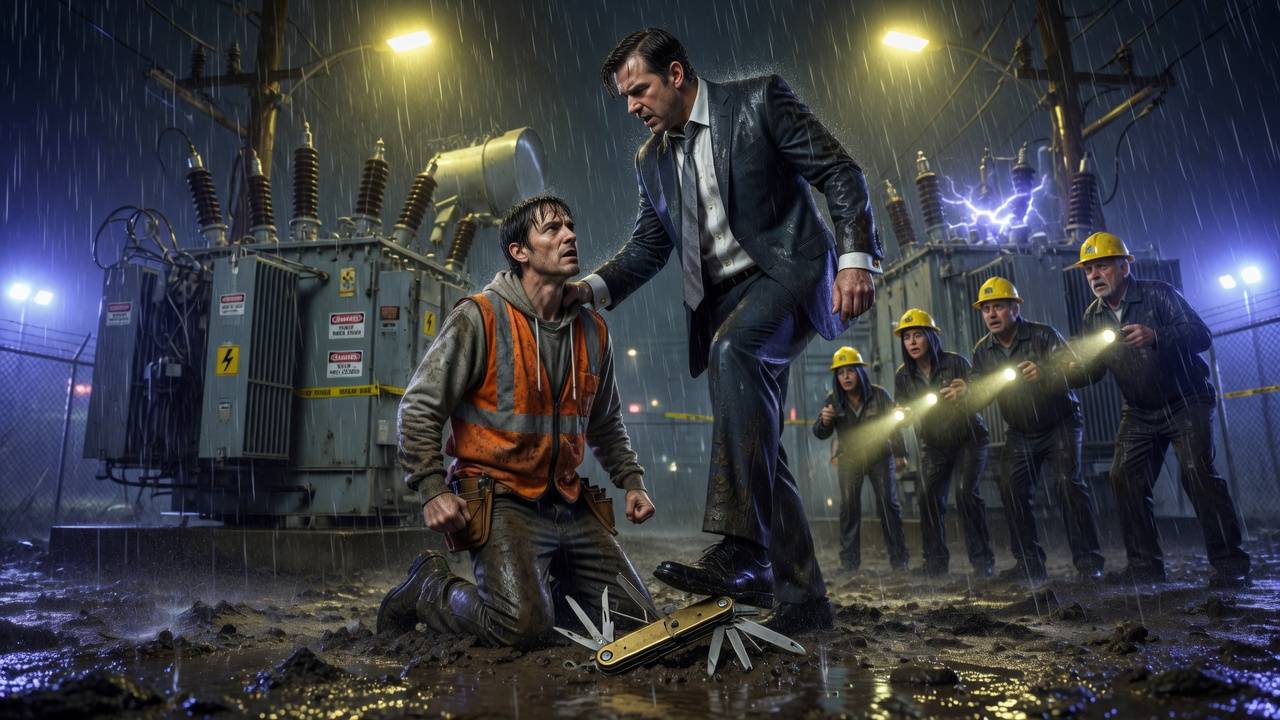
In the mud of the substation, in front of the whole night shift, Vance decided to break the one thing Ash had left.
He put his designer boot on the brass multi-tool Ash’s father had carried through the desert, grinding it into the dirt like it was trash.
Vance grabbed his collar, shouting insults into Ash’s good ear, laughing while the crew watched in terrified silence.
He thought a man with half his hearing had no fight left, that the “electronic waste” would just crumble under the weight of a suit and a paycheck.
He didn’t realize that when you live in silence, you learn to see the strikes coming before the mouth even moves.
The lights flickered, the rain turned to ice, and the man they called “broken” finally decided to show them what a dead circuit looks like.
The full story is in the comments.
Chapter 1
The hum of the high-voltage lines was a vibration Ash felt in his teeth more than he heard in his ears. To the rest of the crew, the substation was a cacophony of buzzing transformers and the rhythmic slapping of rain against metal. To Ash, it was a lopsided world. The left side was crisp, filled with the wet crunch of gravel under boots; the right side was a muffled ghost, a thick layer of cotton wool that had stayed lodged in his skull since a broadcast tower in Kandahar turned into a vertical furnace.
“Ash! Get the lead out!”
Miller’s voice came from the left. Ash didn’t turn his head immediately. He finished crimping the connector, his hands steady despite the forty-first hour of the shift. He was forty-two, lean in a way that suggested hard miles rather than a gym, and his orange reflective vest was stained with the grey sludge of the city’s industrial underbelly.
“I’m on it,” Ash said. His voice was low, gravelly, and lacked the melodic lilt of a man who heard himself clearly.
He climbed down the ladder, his joints popping. Below, the night shift was gathered under the harsh, buzzing floodlights of Substation 42. Miller was there, looking nervous, and three other guys from the Grid team. But standing in the center of the gravel lot, looking entirely too clean for a rainy Tuesday at 3:00 AM, was Julian Vance.
Vance was the CEO of Atlantic Power, but he carried himself like the black-ops officer he used to be before he traded the field for a boardroom. He was tall, silver-haired, and wore a navy wool coat that probably cost more than Ash’s truck.
“We’re behind schedule, Miller,” Vance said. He wasn’t looking at Miller. He was looking at the tool belt slung over Ash’s shoulder.
“The storm took out the secondary relays, sir,” Miller stammered. “Ash is the only one who can—”
“Ash is a liability,” Vance interrupted. He stepped forward, his polished boots clicking on the wet stones. He stopped inches from Ash, invading his space. He deliberately moved to Ash’s right side—the dead side. “Did you hear me, Elias? Or did the army leave you too hollowed out to understand a simple directive?”
Ash kept his gaze on the transformer behind Vance. He knew the game. Vance had been leaning on him for weeks, ever since Ash had started asking questions about the “signal bleed” coming from the decommissioned sector of the grid. Ash had found a recurring encrypted loop on an old military frequency, something that shouldn’t exist.
“I heard you, Mr. Vance,” Ash said, his voice level.
“Then you heard that your employment is under review,” Vance said, leaning closer, his breath smelling of expensive coffee and cold malice. “A man who can’t hear a faulty breaker is a man who gets people killed. You’re lucky I haven’t reported that ‘missing’ military hardware yet.”
Ash felt a cold spark in his chest. The “missing hardware” was a signal interceptor Ash had legally salvaged from a scrap heap years ago, now tucked into his personal kit. Vance knew what it was. And they both knew what Ash had caught on it: the voice of a man who was supposed to have died in a “random” car fire three years ago—a political rival of the board members who put Vance in power.
“I’m just doing the job,” Ash said.
Vance smiled, a thin, razor-like expression. He reached out and tapped the right side of Ash’s head with a gloved finger. “No. You’re occupying space. You’re electronic waste, Ash. Dented, obsolete, and about to be recycled.”
Vance turned to the crew, his voice rising for the witnesses. “If the grid isn’t fully operational by dawn, I’ll find a team that isn’t led by a deaf cripple. Miller, get him out of my sight.”
Ash stood there as the crew dispersed, the rain soaking through his vest. His right ear rang with a high, piercing whistle—the phantom sound of the explosion that never truly ended. He reached into his pocket and felt the cold brass of his father’s multi-tool, the weight of it the only thing keeping him from drifting away into the grey.
Chapter 2
The apartment smelled of toasted bread and the faint, metallic tang of the prenatal vitamins Sarah took every morning. It was a small two-bedroom in a part of the city where the streetlights hummed and occasionally flickered out for days.
Sarah was sitting at the kitchen table, her hand resting on the swell of her stomach. She was seven months along, and the glow that books promised was replaced by a weary, sharp-eyed anxiety. She watched Ash as he set his tool kit on the counter with a heavy thud.
“You’re shaking,” she said softly.
“Just cold,” Ash lied. He pulled the vintage brass multi-tool from his pocket and set it on the laminate surface. It was a heavy, notched piece of engineering with his father’s unit number engraved near the hinge. It was the only thing he’d brought back from his father’s estate besides a box of old radio tubes.
“Vance was there again,” she said. It wasn’t a question.
“He’s pushing. He wants me to trip up. Give him a reason to call the auditors on the scrap I’ve got.” Ash moved to the sink, splashing cold water on his face. He felt the phantom pressure on his right ear again. “I found more on the loop, Sarah. It’s not just a recording. It’s a handshake protocol. They’re using the old grid nodes to move data that the internet can’t trace.”
“Ash, stop,” Sarah said, her voice trembling. “We have a daughter coming in eight weeks. I don’t care about the grid. I don’t care about Vance’s secrets. I care about you having a pension and a pulse.”
“If I stay silent, he’ll bury me anyway,” Ash said, turning to her. “He’s already starting. He called me ‘electronic waste’ in front of the whole crew. He’s setting the stage to make my ‘accidental’ death look like a result of my disability.”
The phone on the counter buzzed. It was a text from a blocked number. Dead zone at 5th and Main. 10 PM. Don’t bring the wife.
Ash stared at the screen. He knew who it was. Elena, the tech reporter who had been digging into the “Vance Doctrine” for months. She was the rescue force he didn’t want—a woman with a camera and a death wish.
“I have to go back out,” Ash said.
“No,” Sarah stood up, her face pale. “The storm is getting worse. The news said the winds are hitting fifty knots.”
“Vance ordered a mandatory double-shift for the ‘unreliable’ elements,” Ash said, his voice bitter. “If I don’t show, I’m fired for cause. No insurance. No hospital coverage.”
He grabbed his vest and the brass tool. He didn’t look at her as he walked out, because if he did, he might stay. And if he stayed, the shadow of Julian Vance would eventually find its way into this kitchen.
The wind was a howling beast as he reached the 5th and Main substation. It was an old brick structure, half-covered in rusted ivy. Elena was waiting in the shadows of a transformer vault. She looked small in her heavy parka, her eyes bright with caffeinated desperation.
“I found the link,” she whispered, leaning into his good ear. “The data isn’t just political. It’s financial. Vance is skimming the city’s emergency power reserves to fuel a private server farm. That’s why the ‘dead zones’ are popping up. He’s literally stealing the city’s light.”
“I have the handshake codes,” Ash said. “But I need to get into the primary hub at Substation 4. That’s Vance’s backyard.”
“If you go there, you’re walking into a trap,” Elena said.
“I’m already in the trap,” Ash said, looking up at the swaying power lines overhead. “I’ve been in it since I came home.”
Chapter 3
The social pressure at the yard was a physical weight the next evening. The other workers wouldn’t look Ash in the eye. They’d heard what Vance said. In the hyper-masculine, high-stakes world of line-work, weakness was a contagion. If Ash was “electronic waste,” then standing too close to him might get you scrapped too.
Miller, usually a friend, kept his distance, fussing with a spool of copper wire. “Look, Ash,” Miller muttered when they were alone in the breakroom. “Vance is looking for a sacrificial lamb. Just… stay low. Do the work. Don’t talk about the signals.”
“He’s stealing from the city, Miller. He’s the reason the East Side went dark during the freeze last month. People died.”
“And people will keep dying if you get yourself killed!” Miller hissed. “You have a kid on the way. Think about that for once.”
Ash felt the sting of it. The moral choice was a serrated blade. Keep his head down and let the corruption rot the city, or fight back and risk leaving his daughter fatherless.
The shift began at midnight. The rain had turned to a biting sleet. They were sent to the North Ridge—the most dangerous section of the grid, where the lines ran over a steep ravine. Vance himself arrived in a black SUV to “supervise” the repairs.
“Elias!” Vance’s voice boomed over the wind. He was standing on a raised metal platform, flanked by two private security guards in tactical gear. “The main coupling on Tower 7 is arcing. Get up there.”
“The wind is over the safety limit for a climb,” Ash shouted back.
“The safety limit is what I say it is,” Vance sneered. “Unless you’re telling me your balance is as gone as your hearing? Maybe you’re just a coward?”
The crew watched, huddled in the glow of the truck lamps. Ash looked at the tower. It was a skeleton of steel screaming in the gale. He knew what this was. If he refused, he was done. If he climbed, Vance would have a hundred ways to make it his last.
Ash strapped on his harness. He felt the brass tool in his pocket, a silent anchor. He began the climb.
Fifty feet up, the world was nothing but screaming wind and the smell of ozone. He reached the coupling. It was vibrating violently. Below, he saw Vance talking into a radio. Suddenly, the tension in his primary safety line vanished.
He looked down. One of the security guards was standing by the winch, his hand on the release lever. The line hadn’t snapped; it had been disengaged. Ash was hanging by a single, secondary carabiner that wasn’t meant to hold his full weight in a storm.
“Having trouble up there, Ash?” Vance’s voice came through his headset, distorted and cruel. “It’s a long way down for a man who can’t hear the wind coming.”
Ash locked his legs around the steel strut. His heart was a hammer in his ribs. He didn’t panic. He had been in worse spots in the Panjshir Valley. He reached out, grabbed the primary line, and manually threaded it back into the lock, his fingers numb with cold.
When he finally climbed down, his boots hitting the gravel with a heavy jar, he was vibrating with a rage so cold it felt like ice in his veins.
Vance was waiting at the bottom of the ladder. “A bit slow, Elias. But I suppose we have to make allowances for the handicapped.”
He reached out and flicked a glob of grease onto Ash’s orange vest. “Clean yourself up. You’re an embarrassment to the uniform.”
Ash didn’t say a word. He walked past Vance, his eyes fixed on the black SUV. He had seen the laptop open in the backseat. He had seen the signal lights. The evidence wasn’t at Substation 4. It was right here.
Chapter 4
The final confrontation happened two hours before dawn at the West End relay station. The sleet had turned into a steady, freezing rain that slicked everything in a treacherous glaze of ice. The crew—six men, including Miller—were exhausted, huddled near the heaters of the service trucks.
Vance was pacing the gravel lot, his navy suit jacket covered by a long, dark raincoat. He was agitated. The “dead zone” Ash had been tracking was fluctuating wildly.
“Elias!” Vance barked. “Your kit. Give it to me.”
Ash stopped. He was holding his tool bag. Inside was the military interceptor, currently recording the final handshake of Vance’s skimming operation. “It’s my personal gear, Mr. Vance. Not company property.”
“Everything on this site is my property,” Vance said, his voice dropping to a dangerous low. He gestured to his security guards, who stepped forward, flashlights cutting through the dark. “I know what you’ve been doing. I know about the girl reporter. You’re not just a cripple; you’re a thief.”
“I’m not the one stealing from the city,” Ash said. The crew drifted closer, sensing the explosion.
Vance laughed, a harsh, jagged sound. “Who are they going to believe? A decorated executive or a half-deaf grunt with a history of ‘mental instability’ and ‘equipment theft’? You’re nothing, Ash. You’re the static between the real stations.”
Vance stepped into Ash’s personal space. He reached out and violently jerked Ash’s tool bag from his shoulder. The strap snapped. Tools spilled into the wet gravel—wrenches, testers, and the vintage brass multi-tool.
Vance looked down at the brass tool. He knew it was the only thing Ash valued. He stepped on it, grinding his heavy heel into the mud, pinning the heirloom under his weight. Then, he reached up and grabbed Ash by the collar of his orange vest, twisting the fabric until Ash was forced to lean down, humiliated in front of his peers.
“Look at you,” Vance hissed, his face inches from Ash’s. “Kneeling in the dirt where you belong. You want to listen to the grid? Listen to this.” He leaned into Ash’s right ear—the dead ear—and shouted, “You’re finished! Do you hear me? Or is that side of your brain as useless as the rest of you?”
The workers stood in a semi-circle, their faces pale in the flashlight beams. Nobody moved. The power asymmetry was absolute.
Ash looked up at Vance. His eyes weren’t filled with fear anymore. They were focused. “Take your foot off my father’s tool,” Ash said, his voice calm, terrifyingly quiet.
“Or what?” Vance sneered. “You’ll file a grievance?” He shoved Ash backward, then grabbed his collar again, pulling him in for another round of verbal spit.
Vance ignored the warning. He pulled his fist back to strike Ash, physically escalating the moment into a full assault.
Ash didn’t hesitate. He planted his left foot in the gravel, feeling the solid earth. As Vance’s arm came forward, Ash’s hand snapped upward—a sharp, military-honed structure break. He caught Vance’s forearm and redirected the energy downward, snapping Vance’s shoulder off-axis and opening his chest.
Before Vance could even gasp, Ash stepped inside the executive’s guard. He drove a compact, heavy palm-heel strike into the center of Vance’s chest. The impact was a dull thud that sent a shockwave through Vance’s frame. Vance’s breath left him in a ragged wheeze, his feet scrambling for purchase on the ice.
Ash didn’t let up. He planted his standing foot, drove his hip forward, and launched a powerful front push kick. His boot caught Vance square in the sternum. It wasn’t a tap; it was a total transfer of body weight.
Vance was launched backward. He flew three feet, his boots skidding through the mud before his legs gave out. He hit the ground hard, his expensive coat soaking up the freezing sludge.
The silence that followed was heavier than the storm.
Vance scrambled on the ground, his slicked-back hair falling over his face, his eyes wide with a sudden, primal terror. He looked up at Ash, who was standing like a pillar of orange and granite.
“Wait! Don’t—please!” Vance stammered, raising a mud-stained hand defensively. He was no longer the CEO. He was a cornered animal.
Ash stepped forward, stopping just inches from the brass tool. He didn’t look at the crew. He didn’t look at the guards, who were frozen in shock. He looked down at the man who had tried to erase him.
“I don’t need to hear you to break you, Vance,” Ash said, his voice cutting through the wind like a wire. “And the grid? It just finished recording every word you said into that radio.”
Ash reached down, picked up his father’s tool, and wiped the mud off on his vest. He walked toward the SUV. The night wasn’t over, and the consequences were only just beginning to spark.