Chapter 5
The aftermath of the outage was a physical weight that pressed down on the city. By the time Ash walked back into his apartment, the sun was fighting a losing battle against a thick, iron-grey sky. His orange vest was shredded at the shoulder, stained with a cocktail of mud, grease, and Julian Vance’s sweat. His hands were still vibrating, the fine motor control of a communications specialist replaced by the heavy, dull thud of a man who had finally used his body as a weapon.
Sarah was standing in the kitchen. She didn’t ask what happened. She didn’t need to. The news was already running a looped clip of the “massive technical failure” at the West End relay, though they were calling it a localized surge caused by the storm. But she saw the way he carried himself—the rigid spine, the way he didn’t immediately move to the right side of the room to hear her better.
“The reporter called,” she said, her voice tight. “Elena. She said you did it. She said the data transfer was interrupted, but Ash… she sounded scared. She said Vance has friends who don’t care about electricity. They care about the silence.”
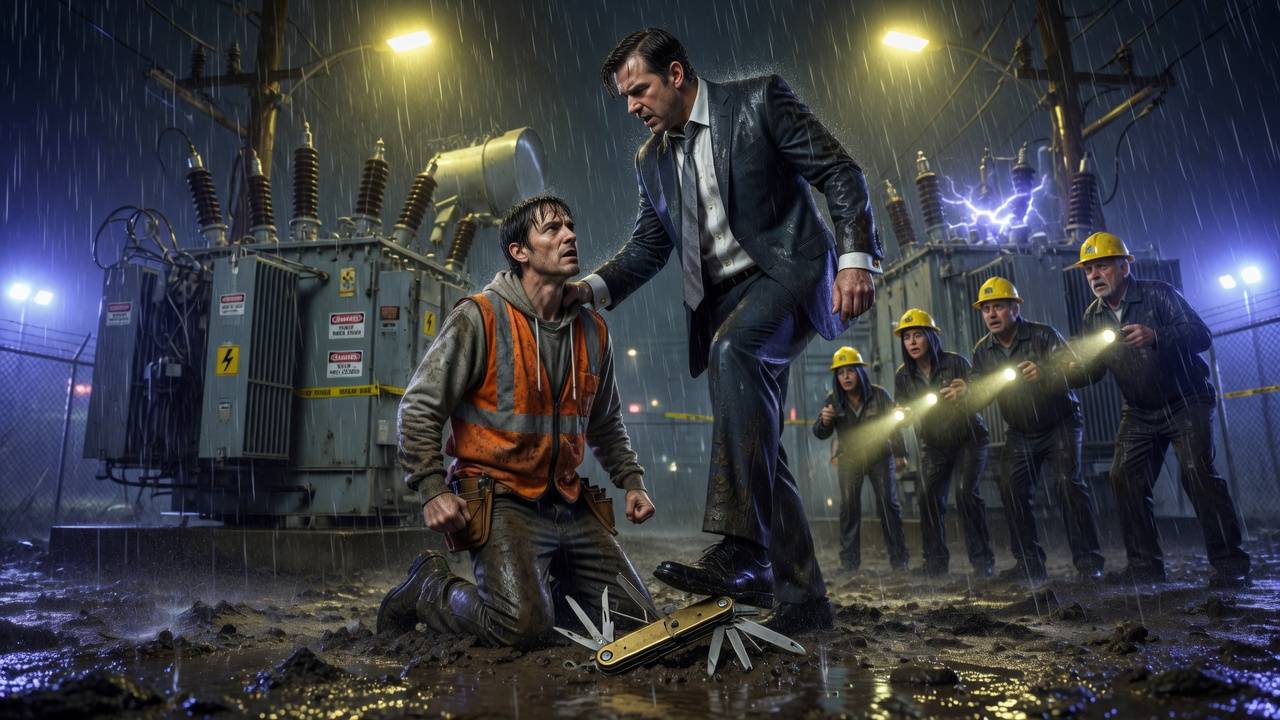
Ash set his father’s brass tool on the table. It was bent slightly at the hinge where Vance’s boot had ground it into the gravel. “He won’t be coming here, Sarah.”
“You don’t know that,” she snapped, her eyes brimming with a sudden, sharp terror. “You hit him. You didn’t just stop him, Ash. You humiliated him in front of his men. Men like Vance don’t sue. They erase.”
“I have the handshake,” Ash said, his voice low and gravelly. “If I go dark, Elena has the key to broadcast it. Not to the news—to the federal oversight board. They’ve been looking for a reason to audit Atlantic Power for years.”
But the cost was already manifesting. An hour later, the first black-and-white cruiser pulled up to the curb. Not the city police, but the private security contractors for the utility company, empowered by a city charter that gave them “emergency enforcement” rights during a grid crisis. They didn’t knock. They stood on the lawn, their strobe lights painting the nursery walls in rhythmic flashes of blue and red.
Ash stepped onto the porch. The lead officer was a man he’d seen at the yard—Vance’s shadow, a man named Halloway.
“Elias,” Halloway said, his hand resting on his belt. “We have a report of a theft of high-value equipment and an assault on a corporate officer. You’re coming with us for questioning at the main facility.”
“I’m not going anywhere without a warrant from the actual PD,” Ash replied.
“This is a state of emergency, Ash. Read the fine print on your employment contract. You’re technically a strategic asset under the Governor’s mandate. If you refuse, it’s a felony.”
Ash looked back through the screen door. Sarah was there, her hand on her belly, her face a mask of grief. She knew. This was the escalation. Vance wasn’t going to let this go to a courtroom where facts mattered. He was bringing Ash back into the dark, into the “dead zones” where things could be handled quietly.
“I’ll go,” Ash said. He turned to Sarah. “Call Elena. Tell her the circuit is closed.”
The ride to the Atlantic Power headquarters was silent. Ash sat in the back of the SUV, watching the city go by. Every flickering streetlight, every humming transformer felt like a nerve ending he could still feel. He realized then that he hadn’t just fought for a secret; he had fought for the grid itself. He was part of it now.
They didn’t take him to an office. They took him to the lower levels, where the massive cooling fans for the server banks created a low-frequency thrum that made his deaf ear ache. Vance was there, waiting in a small, windowless room. He had a bandage on his cheek and a brace on his wrist, but his eyes were wide, feverish with a cold, corporate fury.
“You think you’re a hero, Ash?” Vance whispered, leaning over the table. “You’re a line-worker who hit his boss. You’re a thief who stole encrypted property. I can keep you in this room until your daughter is old enough to drive.”
“The data is already out, Julian,” Ash said. “Elena has the loop.”
Vance smiled, but it didn’t reach his eyes. “Elena is a persistent girl. But even she has a price. Or a breaking point. Do you know how easy it is to cut the power to a single apartment building? To make a fire look like a faulty wire?”
The threat was explicit. Ash felt the room go cold. He realized the moral choice hadn’t ended at the substation. It was just beginning. He could hand over the decryption key and save his family, or he could hold on and watch the world burn.
Chapter 6
The final hour of the night was the quietest. Ash sat in the interrogation room, the humming of the servers a constant, mocking reminder of the power Vance held. He had been there for six hours. No lawyer. No phone call. Just the steady, rhythmic pressure of a system designed to wear a man down into a ghost.
Vance walked back in, carrying a tablet. He looked refreshed, as if the cruelty of the situation was a tonic. “The reporter is at the 12th Street bridge,” Vance said, showing the screen. It was a grainy feed from a traffic camera. Elena’s car was parked on the shoulder. A black SUV was idling behind it. “She’s waiting for a signal that isn’t coming. Give me the key, Ash, and I’ll tell my men to let her drive home. I’ll even give you a severance package that clears your mortgage.”
Ash looked at the screen. He thought about the brass tool on his kitchen table. He thought about his father, a man who had died in a VA hospital waiting for a country to recognize the damage it had done to him. He thought about the “dead zones”—the neighborhoods that went dark so Vance could make an extra percentage point on a server farm.
“You don’t understand the grid, Vance,” Ash said. His voice was suddenly clear, the muffle in his head receding. “You see it as a series of switches. I see it as a conversation.”
“What are you talking about?”
“You think you’re in control because you have the keys to the building. But I’m a communications veteran. I don’t need a key to talk to the machines.”
Ash reached down to his belt. They had taken his tools, but they hadn’t taken the small, integrated circuit he’d sewn into the lining of his vest—a simple, high-frequency jammer he’d built from scrap parts. He’d triggered it the moment he walked into the room.
“Look at the lights, Julian,” Ash said.
The overhead fluorescent tubes began to flicker. Not a random stutter, but a rhythmic pulse. Long-short-long.
“What is that?” Vance demanded, standing up.
“It’s Morse,” Ash said. “I’m slaving the localized relay to the building’s emergency broadcast system. Every monitor in this facility, every smart-bulb in your executive suite… it’s all screaming your handshake protocol out into the open air. Anyone with a ham radio or a basic scanner is hearing it right now.”
Vance lunged for him, but the door to the room suddenly hissed open. It wasn’t Halloway. It was a man in a dark suit with a federal badge pinned to his lapel, followed by three city police officers.
“Mr. Vance,” the lead agent said. “We’ve been monitoring a massive, unauthorized data burst originating from your local servers. It seems you’ve been broadcasting some very interesting financial records on an open channel for the last ten minutes.”
Vance froze. He looked at Ash, then at the flickering lights. The power was no longer his. The silence he had spent a career building had been shattered by the very man he called “electronic waste.”
The fallout was swift. By noon the next day, Atlantic Power was under federal receivership. Vance was escorted out in handcuffs, his navy suit wrinkled and his legacy in ashes. The “dead zones” began to hum back to life, one neighborhood at a time.
Ash sat on his front porch, the sun finally breaking through the clouds. His right ear still rang, a constant reminder of the price of his service. But for the first time in years, the ringing didn’t sound like an alarm. It sounded like the city breathing.
Sarah came out and sat beside him, leaning her head on his shoulder. She didn’t say anything, and she didn’t have to. On the small table between them sat the brass multi-tool. Ash had fixed the hinge. It was scarred, the metal pitted and worn, but it functioned perfectly.
“Is it over?” she asked.
Ash looked out at the streetlights, standing like silent sentinels along the curb. He knew that power always sought a vacuum, and that there would always be men like Vance looking to turn the lights out for a profit. But he also knew that as long as there were people willing to climb the poles in a storm, the dark wouldn’t win.
“The circuit is open,” Ash said, taking her hand. “We’re going to be okay.”
He closed his eyes and listened. To the left, the sound of a neighbor’s lawnmower. To the right, the faint, distant hum of the transformers. It wasn’t perfect, and it was far from quiet. But it was the sound of a world that was finally, truly, turned back on.