Chapter 5
The aftermath of the fight at the forge didn’t feel like a victory. It felt like an ending. After the dust from Miller’s SUV had settled back into the Georgia red clay, a heavy, suffocating silence descended over the property. Silas stood in the middle of the drive for a long time, his chest heaving, his hands still vibrating with the phantom hum of the impact. He looked down at his palms—the same palms that had spent twenty years mending tractor hitches and shaping decorative iron—and saw them for what they had just become again. Weapons.
Jamal was the first to move. The boy hopped the fence, his eyes wide, his phone still clutched in a white-knuckled grip. “Mr. Silas… you… you just…”
“Go home, Jamal,” Silas said, his voice sounding like it was coming from the bottom of a well. He didn’t look at the boy. He couldn’t. He didn’t want to see the reflection of the violence in those young eyes.
“But they’re gonna come back! You saw them, they were filming! They’re gonna call the cops!”
“I know,” Silas rumbled. “That’s why you need to be nowhere near here. Go.”
By sunset, the silence had been replaced by the rhythmic strobe of blue and red lights. Two Sheriff’s cruisers and an unmarked black sedan pulled into the drive. Silas was sitting on his porch, the broken photograph of the Iron Disciples resting in his lap. He’d spent the last hour meticulously picking the glass shards out of the faces of his dead friends.
Sheriff Miller—no relation to the contractor, but just as cold—stepped out of the lead car. He was a man Silas had known for a decade, a man who had brought his own department’s cruisers to the forge for frame repairs. He didn’t look like a friend today. He looked like a man with a quota.
“Silas,” the Sheriff said, stopping at the base of the porch steps. He didn’t put his hand on his holster, but his deputies did. “I just spent an hour at the hospital with a man whose sternum is cracked in two places. He says you lured him onto the property and assaulted him.”
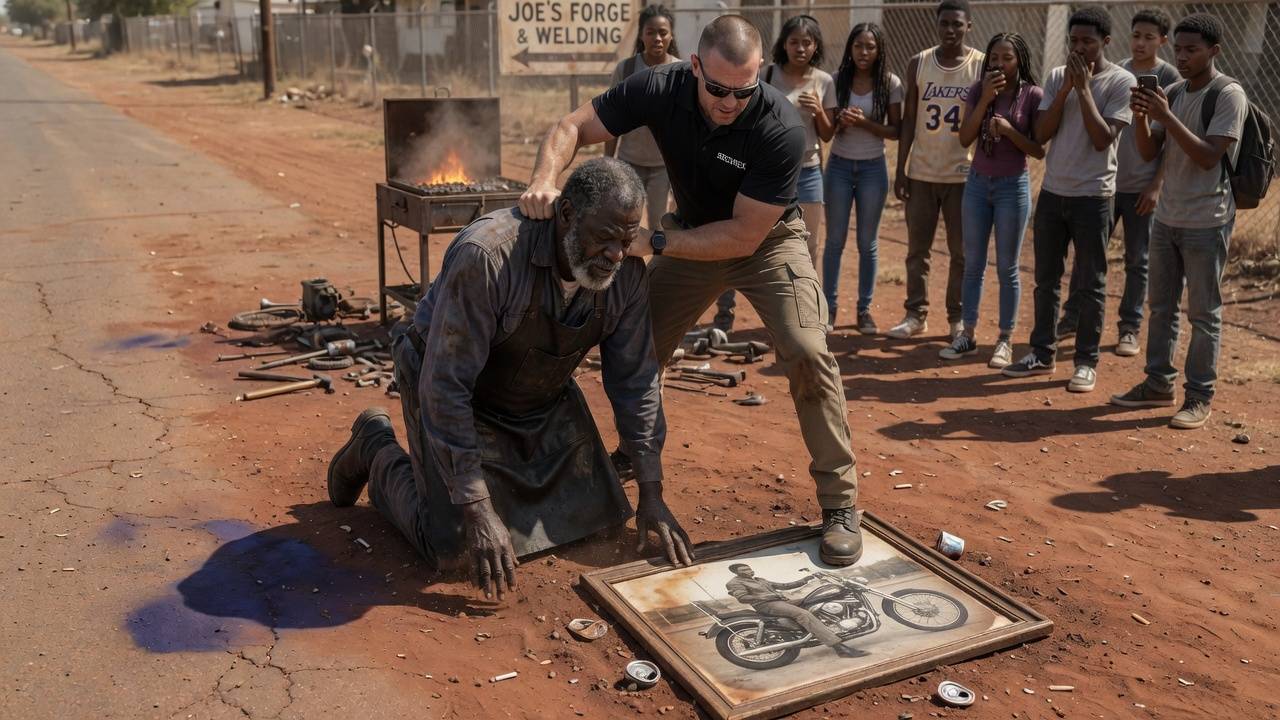
“He was trespassing, Tom,” Silas said, his voice flat. “He smashed my sign. He put his hands on me. He put his boot on the face of a dead man.”
“The video I saw doesn’t show the sign, Silas. And it doesn’t show the picture. It starts right when you’re snapping his arm and kicking him into the dirt like a dog. It looks like a professional hit.” The Sheriff sighed, rubbing his face. “The developers are screaming ‘domestic terrorism.’ They’re saying you’re a high-risk liability to the community. They filed for an emergency injunction to seize the property for public safety.”
Silas felt a cold spike of dread. “They can’t do that.”
“They can when the owner is sitting in a county cell awaiting a felony aggravated assault charge,” the Sheriff said. “I’m sorry, Silas. I really am. But you gave them exactly what they wanted. You gave them a reason to call you a monster.”
The night in the county lockup was the longest of Silas’s life. The cell was cold, smelling of industrial bleach and old sweat. His bad leg cramped up, the muscles seizing until he was forced to pace the tiny space, dragging his foot in a rhythmic hitch-scrape, hitch-scrape that echoed off the cinderblock walls. He kept seeing Miller’s face—the transition from arrogance to absolute terror. It hadn’t felt good. It had felt like a relapse.
The next morning, a man in a rumpled suit appeared at the bars. It was Davis, a local lawyer who usually handled property disputes and minor DUIs. He looked like he hadn’t slept either.
“Silas, we’ve got a problem,” Davis said, skipping the pleasantries. “The developers aren’t just going after the assault. They’ve dug up the old club records. They’re tying you to the Disciples’ racketeering cases from the nineties. They’re arguing that the land was purchased with ‘tainted funds’ and should be forfeited under civil asset forfeiture laws.”
“That land was Dutch’s,” Silas growled. “He bought it with a legal settlement from a trucking accident.”
“The paperwork is ‘missing,’ Silas. Conveniently.” Davis leaned closer. “They’re offering a deal. You sign the deed over to the corporation today, and the assault charges go away. You walk out of here a free man with a fifty-thousand-dollar ‘relocation stipend.’ You don’t sign… and they’re going to push for ten years in state prison. And they’ll bulldoze that cemetery by Monday morning anyway.”
Silas sat back on the metal cot. He thought about the men buried behind the forge. Dutch, who had taught him how to read a blueprint. Slim, who had shared his last cigarette after a three-hundred-mile run through a thunderstorm. They were more than names on a missing deed. They were his only family.
“I need to talk to Jamal,” Silas said.
“The kid? Silas, the kid is the reason you’re in here. His video went viral. The whole town has seen you break that man. Half the people think you’re a hero, the other half are terrified you’re going to snap and burn the neighborhood down.”
“Just get him here, Davis. Please.”
Two hours later, Jamal stood on the other side of the glass in the visiting room. The boy looked smaller than usual, his shoulders hunched.
“I’m sorry, Mr. Silas,” Jamal whispered into the phone. “I thought… I thought if people saw what he was doing, they’d help you. I didn’t mean to get you locked up.”
“Listen to me, J,” Silas said, his voice urgent. “There’s a loose floorboard in the back of the forge, under the welding table. You know the one?”
Jamal nodded slowly.
“There’s a metal box under there. I need you to take it to Sarah, Dutch’s daughter. Tell her the key is the one I gave her for her graduation. Tell her to look at the papers inside. Not the deeds—the photos. The ones of the construction site from 1992.”
“What’s in there?”
“The reason they want the land, Jamal. It’s not about a shopping center. It’s about what’s buried under the cemetery. And I don’t mean my brothers.”
As Jamal left, Silas watched him go with a heavy heart. He was putting a fourteen-year-old boy in the crosshairs of a multi-billion-dollar corporation. It was the very thing he’d tried to avoid. But as he looked at the bruise on his own knuckles, he realized the time for avoiding was over. The giant wasn’t just patient anymore. He was awake.
Chapter 6
The release happened at 3:00 PM on Friday. No fanfare, no stipend, no deal signed. Davis had walked into the Sheriff’s office with Sarah and a stack of documents that had turned the Sheriff’s face the color of old parchment.
When Silas stepped out of the station, the Georgia sun felt like a physical weight on his shoulders. Sarah was waiting by her Lexus, her eyes red-rimmed but her jaw set firm.
“You should have told me, Silas,” she said as he climbed into the passenger seat. “All these years, you stayed there guarding that… that filth.”
“I promised Dutch I’d never let it come to light,” Silas said, staring out the window at the passing pines. “He didn’t want the club’s legacy to be that. He wanted the Disciples to be remembered for the road, not the secrets.”
The “secrets” were thirty-year-old industrial waste barrels, illegally dumped by the very corporation—then operating under a different name—that was now trying to “revitalize” the area. The developers didn’t want a shopping center; they wanted to dig up the evidence and dispose of it before the new EPA regulations caught up to them. The cemetery was sitting directly on top of a toxic time bomb.
As they turned onto the highway leading to the forge, Silas saw the smoke.
“Sarah, drive faster,” he whispered.
They rounded the bend, and Silas’s heart shattered. The forge was an inferno. The corrugated tin roof had collapsed inward, and orange flames licked at the sky, fueled by the oil and acetylene tanks inside. But the fire wasn’t the worst part.
Two massive yellow bulldozers were idling at the edge of the cemetery. Miller was there, his chest heavily bandaged under a fresh tactical vest, standing next to a man in a suit who was pointing at the headstones.
“Stop the car!” Silas barked.
He didn’t wait for Sarah to pull over. He rolled out of the moving Lexus, his bad leg hitting the dirt with a jarring crack of pain, but he didn’t stumble. He ran. He ran with a fluid, terrifying grace that ignored the limp, his eyes fixed on the lead bulldozer.
“Silas, don’t!” Sarah screamed, but he was already gone.
He reached the first bulldozer just as the blade touched the small stone marking Slim’s grave. Silas didn’t go for the driver. He grabbed a heavy iron pry-bar from the back of a nearby utility truck and jammed it into the machine’s hydraulic lines with a roar of pure, unadulterated fury. Fluid sprayed like blood, and the massive machine groaned to a halt.
Miller saw him then. The contractor pulled a sidearm, his face contorted with a mixture of pain and rage. “You’re dead, old man! You’re a dead man!”
Silas didn’t stop. He walked toward the barrel of the gun, his shadow long and dark against the backdrop of his burning home. “Shoot me, Miller,” Silas challenged, his voice a low, terrifying vibration. “Shoot me in front of the news crews.”
Miller blinked, looking past Silas. Three news vans from the city had pulled into the drive, followed by Jamal and a dozen other neighborhood kids on bikes. They were all holding their phones up. The “Forgotten Giant” wasn’t alone anymore. He was being broadcast to the world.
“The barrels are under there, Miller!” Silas shouted, his voice carrying over the roar of the fire. “We have the photos. We have the manifests. You move one more inch of this dirt, and you’re not just committing a crime—you’re starting an environmental disaster on live television!”
The man in the suit grabbed Miller’s arm, whispering urgently. Miller looked at the cameras, then at Silas, his hand shaking on the grip of the pistol. For a second, Silas thought the man might actually pull the trigger. He almost hoped he would. It would be a clean end to a messy life.
But Miller lowered the gun. He spat into the red dirt and turned away, retreating toward the SUVs as the suit-clad executive scrambled to hide his face from the reporters.
The fire department arrived an hour later, but there was nothing left to save of the forge. Silas stood among the blackened ruins of his life, the smell of burnt iron and charred wood thick in the air. Jamal walked up to him, handing him a soot-covered object. It was the metal box from under the floorboards.
“I got it out before they started the fire, Mr. Silas,” Jamal said, his voice trembling. “I saw them with the gasoline. I tried to stop them, but…”
Silas took the box, then reached out and pulled the boy into a one-armed hug. “You did enough, J. You did more than enough.”
The legal battle that followed lasted two years. The corporation was dismantled by federal lawsuits, and the land was declared a protected historical site. They couldn’t move the graves, and they had to pay for a specialized cleanup of the toxic waste that cost them more than the shopping center would have ever made.
Silas never rebuilt the forge. He didn’t have the heart for the fire anymore. Instead, with the settlement money Sarah helped him secure, he turned the property into a community garden and a workshop for the local kids.
On a warm Georgia evening, Silas sat on a new porch, his bad leg propped up on a stool. He looked out over the rows of green vegetables and the neatly kept cemetery. Jamal was at a workbench nearby, teaching a younger boy how to weld a garden gate.
Silas reached into his pocket and pulled out a small, laminated square. It was the old photo of the Iron Disciples, restored and preserved. He looked at Dutch’s face, then at the faces of the brothers he’d spent his life protecting.
He wasn’t a giant anymore. He was just a man who had kept his word. And as the sun dipped below the pines, casting a golden light over the land, Silas realized that being forgotten wasn’t such a bad thing. As long as you weren’t the only one who remembered who you were.
He closed his eyes and listened to the sound of the wind in the trees and the steady, rhythmic clink-clink-clink of Jamal’s hammer. It was the only music he needed.