Chapter 5
The sound of the Softail’s engine wasn’t just a noise; it was a barrier Otis built between himself and the rest of the world. As he pulled out of the rest stop, the vibration traveled up through his boots, into his shins, and settled in his chest, humming against the photo tucked inside his vest. He didn’t look at the rearview mirror. He didn’t need to see the blue and red lights or the cluster of truckers on the porch. He knew what he’d left behind: a ruined uniform, a broken ego, and a room full of people who had just seen a ghost come back to life.
He rode for three hours through the blind, driving heart of the storm. The rain didn’t let up until he crossed the state line into Virginia, the sky turning a bruised, pre-dawn purple. His hands were locked in a claw-like grip on the bars, his knuckles aching from the cold and the residual adrenaline. He needed to get off the main artery. I-95 was too exposed, too monitored. He took a series of winding backroads, the kind where the asphalt is more patch than road, until he found a derelict fishing camp near the Nottoway River.
He parked the bike under a rusted corrugated tin shed and sat there for a long time, listening to the rain drip off the metal. His body was starting to scream. The palm-heel strike had sent a jar through his own shoulder that felt like an electric shock, and his knees were stiff from the damp. He reached into his vest and pulled out the photo.
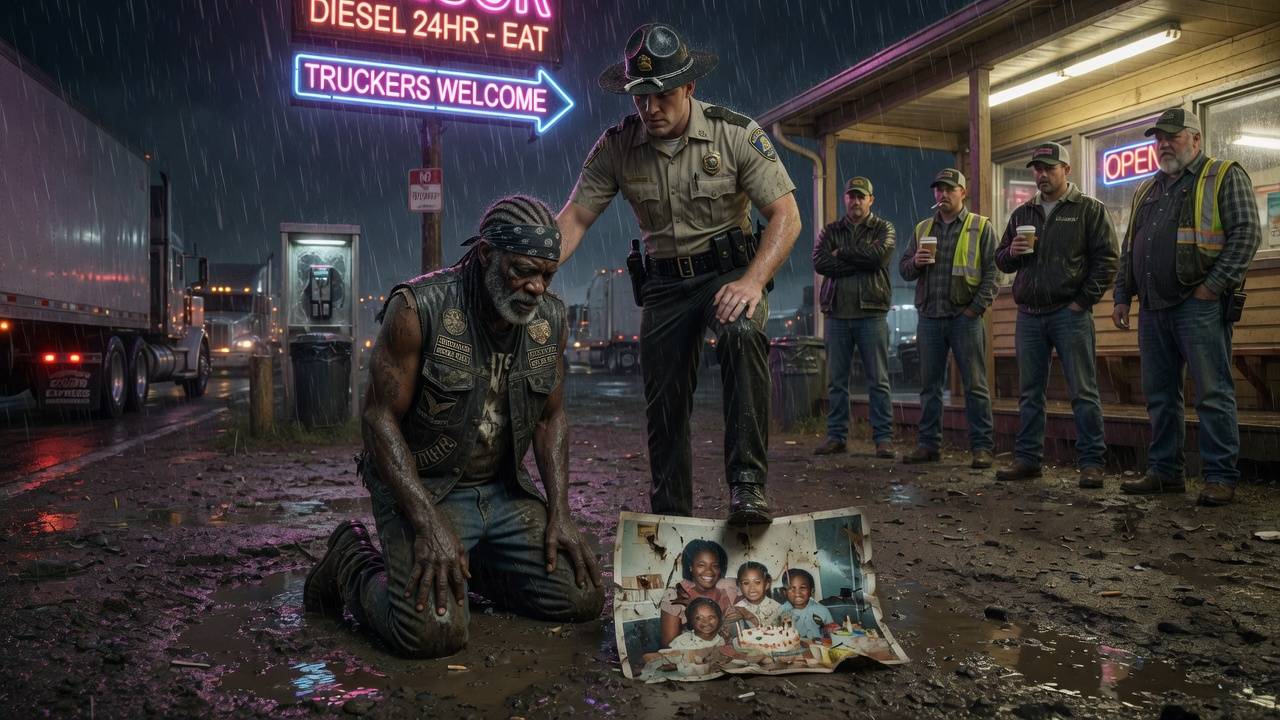
He held it under the dim light of his biker’s flashlight. The laminate was definitely cracked. A jagged white line ran through Martha’s shoulder and across Elena’s forehead. He felt a sudden, sharp pang of guilt—not for hitting the cop, but for letting the boy’s boot touch them at all. He had spent twenty years trying to keep them clean, keep them safe in his mind, and now they were literally stained with the mud of a North Carolina truck stop.
“I’m sorry,” he whispered, his voice rasping.
He stayed in the shed until the sun was fully up, though the light was grey and watery. He knew he couldn’t stay in the area. Vance wasn’t just a random patrolman; he was the legacy of the rot Otis had fled. The older cop, Miller, had looked like a man who knew exactly who Otis was, or at least recognized the name on the ID. If they connected Otis to the 2004 tape, the hunt wouldn’t just be about a simple assault on an officer. It would be an execution order.
By mid-morning, Otis found a small diner in a town that looked like it hadn’t changed since the Eisenhower administration. He sat in a back booth, his back to the wall, and watched a small television mounted above the counter. He didn’t have to wait long.
“…viral footage from a rest stop near Fayetteville,” the news anchor was saying. The video was grainy, shot from a phone, but the contact was unmistakable. It showed Otis—though his face was shadowed—snapping Vance’s arm and driving him into the mud with that final, piston-like kick. The clip played on a loop. The headline at the bottom of the screen read: ATTACK ON LAW ENFORCEMENT: SEARCH FOR ‘GHOST RIDER’.
“Crazy world,” the waitress said as she poured his coffee. She didn’t look at him, just at the screen. “That old man move like a snake. Cop probably deserved it, though. They’ve been riding people pretty hard lately.”
Otis grunted, keeping his head down. He ate his eggs without tasting them. He was thinking about the tape. It was hidden inside the frame of his bike, wrapped in lead foil and plastic. It was the only leverage he had, but leverage only worked if you were alive to pull the lever.
He was halfway through his second cup of coffee when a young woman slid into the booth across from him. She wasn’t a local. She wore a high-end waterproof parka and carried a leather messenger bag that looked expensive. She was maybe twenty-eight, with sharp, intelligent eyes and a camera hanging around her neck.
“You’re not a very good ghost, Otis,” she said quietly.
Otis didn’t reach for his knife, but his posture shifted. His eyes went flat. “I don’t know who you are, lady. And I’m just a man eating breakfast.”
“I’m Chloe,” she said, leaning in. She didn’t look scared. “And I’ve been looking for you for three years. I’m the one who sent those letters to the post office boxes in Georgia and Tennessee. I’m the daughter of the man they killed in that basement in 2004.”
The air left Otis’s lungs. He remembered the man. David Vance. The one honest detective in a precinct full of wolves. The man who had been Vance’s uncle.
“You shouldn’t be here,” Otis said, his voice a low growl. “That business is dead. Everyone involved is either buried or running a city.”
“It’s not dead,” Chloe whispered, her eyes burning. “Vance’s nephew—the kid you just put in the mud—he’s been bragging for years about how his family ‘cleaned up the trash’ back in the day. They’re coming for you, Otis. Not just for the assault. They know you have the recording. They saw your face on that trucker’s phone, and they realized the man who escaped is back.”
“I’m not a hero, Chloe,” Otis said, sliding out of the booth. “I’m just a man who wants to be left alone.”
“They won’t leave you alone,” she said, standing with him. “They’ve already put a tracker on your bike’s plates. You have about twenty minutes before this town is crawled with county black-and-whites. Give me the tape, Otis. Let me finish what my father started.”
Otis looked at her. She had her father’s chin. The same stubborn set to her jaw that David Vance had right before they put a bullet in his head. Otis felt the weight of the twenty years pressing down on him. He could keep running, let the photo rot in his pocket, and wait for the inevitable bullet in the back of the head. Or he could finally stop being a ghost.
“The bike’s in the alley,” Otis said. “Follow me.”
Chapter 6
The final confrontation didn’t happen in a basement or a back alley. It happened in the middle of a bridge over the Nottoway River, the fog rolling off the water like thick, grey smoke.
Otis had sent Chloe ahead with the tape, giving her a ten-minute head start toward the state capital where her editors were waiting. He knew they would follow the bike. The Heritage Softail was loud, heavy, and impossible to hide. He rode it onto the bridge and stopped in the center, the engine idling with a rhythmic, guttural throb.
Three cruisers pulled onto the bridge from the north side, their sirens silent but their lights casting a strobe-like glare through the mist. They didn’t stop at a distance. They hemmed him in, the bumpers of the lead car inches from his front tire.
Officer Vance stepped out of the first car. His face was a mess—his nose was bandaged, and he walked with a visible limp, his hand pressed against his ribs. But he wasn’t alone. Standing next to him was a man in a tailored suit, his hair silver and his eyes like flint. It was the Commissioner. The man Otis had seen holding the bag of money twenty years ago.
“You really should have stayed dead, Otis,” the Commissioner said. His voice was smooth, cultured, and utterly devoid of mercy. “You’ve caused a lot of paperwork. My nephew here is very upset.”
“He’s lucky he’s still breathing,” Otis said, sitting relaxed on the bike. He looked at Vance, who was shaking with a mixture of pain and humiliated rage. “I told you, son. Don’t mistake my peace for weakness.”
“Where is it?” Vance spat, stepping forward. He reached for his holster, but the Commissioner put a hand on his arm.
“The tape, Otis,” the Commissioner said. “Give it to me, and I’ll make sure you get a quiet cell. Maybe you’ll even live long enough to see a parole board. If you don’t… well, this bridge is very high, and the current is very fast.”
Otis looked at the water. It was dark and cold. He thought about Martha. He thought about how she had told him, the night she left, that he was a man who lived in the shadows because he was afraid of the light. She was right. He had been hiding in the dark for two decades, protecting a piece of plastic while his life turned to ash.
“I don’t have it,” Otis said.
The Commissioner’s face didn’t change, but his eyes narrowed. “Don’t lie to me. We’ve tracked you since the rest stop. You haven’t stopped long enough to bury it.”
“I didn’t bury it,” Otis said. He pulled out his phone—the cheap burner he’d used to coordinate with Chloe. He turned the screen toward them. It showed a live upload bar. 98%. 99%. Upload Complete.
“It’s at the Richmond Dispatch,” Otis said. “And the Attorney General’s office. And a dozen other places. I didn’t just record you twenty years ago. I recorded the last ten minutes of our conversation on this bridge, too. Modern technology is a hell of a thing, isn’t it?”
Silence fell over the bridge, broken only by the sound of the river below. The Commissioner’s hand dropped from Vance’s arm. The power in the room—the power of the uniform, the name, the legacy—suddenly felt thin. It felt like paper.
“You’re a dead man,” Vance whispered, his hand finally closing on his service weapon. “I’ll kill you right here.”
“Go ahead,” Otis said, and he actually smiled. It was a terrifying, weary expression. “Kill me in front of those dashboard cameras. Kill me while the whole world is watching the footage of your uncle murdering a cop. See how that works out for your career.”
Vance hesitated. He looked at his uncle, looking for the command, for the assurance that they were still gods. But the Commissioner was looking at his own shoes. He knew the game was over. The ghost had finally stopped running and started haunting.
Otis kicked the kickstand up. He didn’t wait for them to move their cars. He turned the bike around in a tight, expert circle, the tires screaming against the wet asphalt. He rode toward the south end of the bridge, passing within inches of the cruisers.
Nobody stopped him. They were too busy looking at their own reflections in the dark water.
Otis rode until the sun came up for real this time, burning through the fog and the memory of the rain. He found a small cemetery on a hill overlooking the valley. He parked the bike and walked through the rows of headstones until he found a small, modest marker.
MARTHA REED. 1968 – 2021.
He hadn’t been there for the funeral. He hadn’t even known she was gone until a year later. He knelt in the grass, his knees no longer aching. He took the cracked photo out of his vest and looked at it one last time.
He didn’t need the paper anymore. He had the memory, and for the first time, it didn’t feel like a weight. It felt like a foundation. He took a small trowel from his saddlebag and dug a tiny hole at the base of the headstone. He placed the photo inside, facing up, and covered it with the rich, dark earth.
“I’m done running, Martha,” he said.
He stood up and looked down the hill. In the distance, he could hear the faint sound of sirens—not the predatory hunt of Vance and his crew, but the official, inevitable approach of the state police coming to take his statement. He didn’t reach for his bike. He didn’t reach for his knife.
He just stood in the light, waiting for the world to catch up to him. He was Otis Reed, a man who had been a ghost for twenty years, and he was finally, painfully alive.