Chapter 5
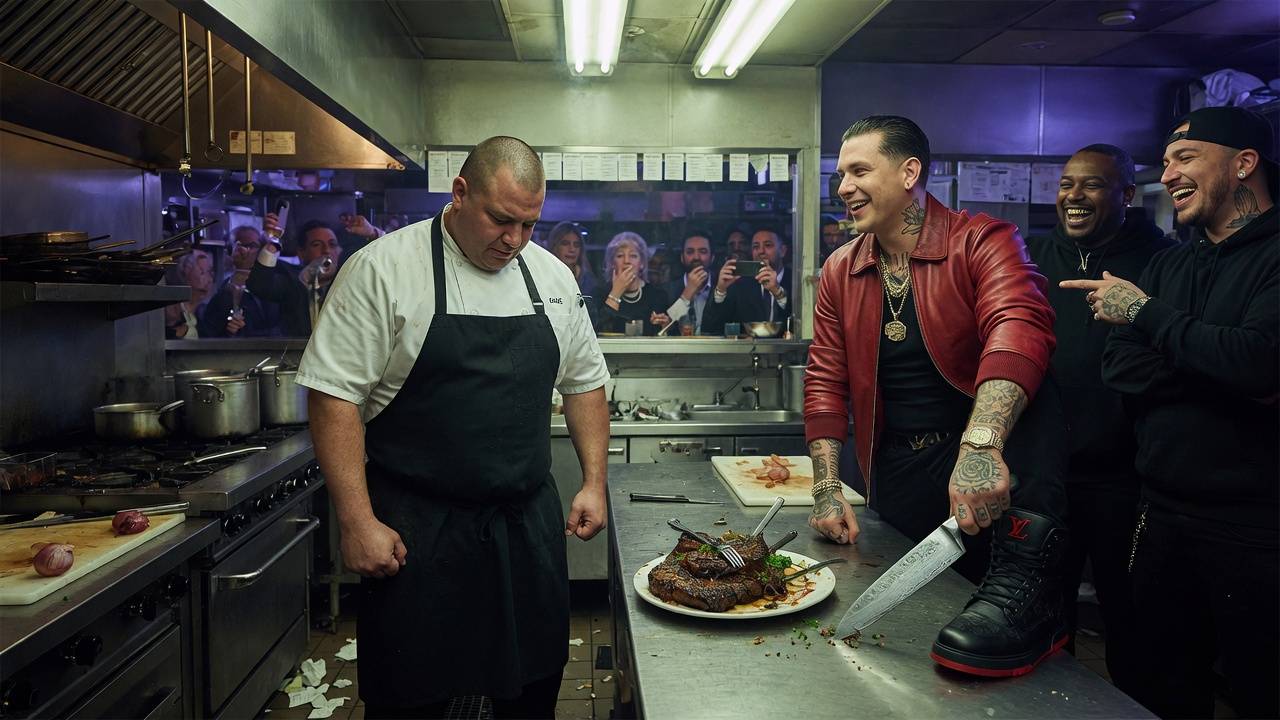
The silence that followed the departure of the police was heavier than the noise of the confrontation. Gabe stood in the center of the Iron Kitchen, the fluorescent lights buzzing overhead like a trapped hornet. The restaurant was empty now, the front door locked, the “Closed” sign flipped with a trembling hand by Sarah.
Gabe looked down at his hands. They weren’t shaking, but they felt heavy, as if the gravity in the room had doubled. He could still feel the phantom vibration of the impact in his palm—the moment his strike had met Rico’s sternum. It was a sensation he had spent ten years trying to forget. It was the feeling of a man breaking.
Linda sat at the small prep table in the corner, her face buried in her hands. She hadn’t spoken since the cruiser pulled away. The police hadn’t arrested Gabe—not yet. They had taken statements, watched the grainy security footage, and looked at Rico’s battered face before the paramedics loaded him up. The lead officer, a weary man named Miller who had seen Gabe’s file a dozen times, had just shaken his head.
“You should have called us, Gabe,” Miller had said. “Now, it’s a ‘he said, she said’ with a violent prior on your jacket. I have to file this. The DA is going to see it by morning.”
“He was stepping on my knife, Miller,” Gabe had replied, his voice barely a whisper. “He was touching her restaurant.”
Now, Gabe moved toward Linda. He wanted to reach out, to put a hand on her shoulder, but he stopped himself. He was a weapon that had been unsheathed in her sanctuary. He felt like he had stained the floor more than Rico’s spit ever could.
“Linda,” he said.
She looked up. Her eyes were red-rimmed, but there was no anger in them. Only a profound, exhausting sadness. “He’s going to come back, Gabe. Or his brothers will. You know how they work. They can’t let a cook put their golden boy on the floor and walk away.”
“I know,” Gabe said.
“They’ll burn us out,” she whispered. “Or they’ll wait until you’re back in Stateville and then they’ll come for me. Why did you do it? I told you I had the money.”
Gabe felt a surge of something sharp and bitter in his throat. “It wasn’t about the money, Linda. It was about the way he looked at you. It was about the way he treated this place like it was his to break. If I let him do that, then the ten years I spent inside didn’t mean anything. I didn’t learn how to be a better man; I just learned how to be a coward.”
“Being a coward keeps you alive, Gabe,” she said, standing up. She walked to the sink and began to wash a stray dish, her movements mechanical. “Being a hero just gets you a longer sentence.”
The back door creaked open. Leo, the young prep cook, stepped in. He looked terrified but exhilarated. “Gabe… have you seen the internet? Sarah’s friend filmed it. It’s everywhere. They’re calling you the ‘Iron Chef of East River.’ Millions of views in three hours.”
Gabe didn’t look at the phone Leo held out. He didn’t need to see it. He knew exactly what he looked like in that video—a monster returning to form.
“Delete it,” Gabe said.
“What? Gabe, everyone is on your side! People are saying Rico got what he deserved. They’re calling for the Vultures to be run out of town.”
“You don’t understand, kid,” Gabe said, his voice hardening. “To the people watching, it’s a movie. To the Parole Board, it’s a violation of Condition Four: ‘Refrain from any and all violent contact.’ To the Vultures, it’s a declaration of war. Go home, Leo. There’s no more prep tonight.”
Leo’s face fell, the excitement draining away. He nodded slowly, set the phone on the counter, and slipped back out the door.
Gabe turned back to Linda. “I have to leave.”
“What?”
“If I stay, the fire they set for me catches you too. I’ll go to my sister’s in the city. I’ll call Miller in the morning and tell him I’m turning myself in for the violation. Maybe if I’m already in custody, they’ll leave the restaurant alone.”
“No,” Linda said, turning around, her voice suddenly fierce. “You aren’t going back there. Not for that piece of trash.”
“Linda, look at the reality—”
“I am looking at it!” she snapped. She walked over to the shelf and grabbed Gabe’s leather knife roll. She shoved it into his chest. “You spent ten years in a cage for a mistake. This wasn’t a mistake. You protected me. You protected yourself. If the law can’t see the difference, then the law is blind. But I’m not.”
She took a deep breath, her hands clenching the fabric of her apron. “We aren’t closing. We’re opening tomorrow at noon. If the Vultures come, they come. But if you walk out that door now, Gabe, then they’ve already won. They didn’t just take my money; they took the only man who ever stood up for this place.”
Gabe looked at the knife roll in his hands. He felt the weight of his father’s legacy, the cold steel and the hard wood. He thought about the cell, the gray walls, and the endless, crushing silence. Then he looked at Linda, who was standing her ground in a kitchen that smelled of burnt butter and old dreams.
“They’ll kill me, Linda,” Gabe said softly.
“They might,” she said. “But you’ll die a free man. Which is more than most people in this neighborhood can say.”
Gabe stood there for a long time, the shadows of the kitchen stretching across the floor. Finally, he reached out and took a towel from the counter. He tucked it into his apron.
“We need more onions for the morning,” he said. “Leo didn’t finish the mirepoix.”
The night was long. Gabe didn’t sleep. He sat in the darkened dining room, his back to the wall, watching the front door. He kept the Damascus knife on the table beside him. Every car that passed, every flickering streetlamp, felt like a threat. He thought about Rico’s brothers—Sal and Marco. They were older, smarter, and infinitely more cruel. They didn’t spit on plates; they disappeared people.
But as the sun began to bleed through the grime of the front windows, Gabe felt a strange peace. He wasn’t the man he was ten years ago. He wasn’t a biker looking for a fight. He was a man who had found a home, and for the first time in his life, he knew exactly what it was worth.
Chapter 6
The “Iron Kitchen” didn’t open at noon. It opened at eleven, because by ten-thirty, a line had formed down the block.
The viral video had done something Gabe hadn’t expected. It hadn’t just brought curiosity; it had sparked a quiet, simmering rebellion. People who had lived under the thumb of the Vultures for years—the dry cleaner from across the street, the woman who ran the bodega, the mechanics from the shop on the corner—they were all there. They sat in the booths, ordered their coffee, and waited.
Gabe stayed in the kitchen. He worked with a feverish, silent intensity. The grill was a roar of heat, the tickets were piling up, and Leo was moving faster than he ever had in his life.
“Gabe,” Leo whispered, peering through the pass-through. “Black SUV. Just pulled up at the curb.”
The kitchen went cold. Gabe stopped mid-flip on a burger. He didn’t need to look. He knew the sound of that engine. It was a Cadillac Escalade, the engine idling with a low, predatory growl.
The dining room went quiet. The clinking of silverware stopped.
The front door opened. Two men walked in. They weren’t wearing red leather or cheap gold. They wore dark suits and overcoats that cost more than Gabe made in a year. Sal and Marco. The heads of the family.
They didn’t look like thugs. They looked like businessmen who had just discovered a discrepancy in their ledgers. They walked to the center of the room. The diners pulled back, their chairs scraping the floor, creating a wide, empty circle around the two men.
Linda stepped out from the hallway. She looked small, her shoulders hunched, but she didn’t look away.
“We’re full,” she said, her voice trembling but clear. “You’ll have to wait for a table.”
Sal, the older one, looked at her with a thin, bloodless smile. “We aren’t here for lunch, Linda. We’re here for the help.”
Gabe wiped his hands on his apron and stepped through the swinging doors. He didn’t carry a knife. He didn’t carry a spatula. He just carried himself. He stood beside Linda, his massive frame casting a shadow over her.
“I’m the help,” Gabe said.
Sal looked Gabe up and down. He wasn’t impressed by the muscles. He was looking for the crack in the armor. “My brother is in the ICU, Gabe. A collapsed lung. A broken rib that nearly pierced his heart. The doctors say he might have permanent nerve damage in his arm.”
“He should have kept his foot off the steel,” Gabe said.
“He’s a kid,” Marco spat, stepping forward. He was younger, hotter. “He’s a kid who was doing his job. You’re a convict who doesn’t know his place.”
“My place is here,” Gabe said. “And your brother wasn’t doing a job. He was being a dog. I just put a leash on him.”
Marco reached into his coat, his hand disappearing into the darkness of the fabric. The room held its breath. People reached for their phones, but Sal put a hand on his brother’s arm.
“Not here, Marco,” Sal said, his eyes never leaving Gabe’s. He looked around the room—at the dry cleaner, at the mechanic, at the dozens of people who were watching them with a new, dangerous light in their eyes.
Sal realized something then. The video hadn’t just humiliated Rico; it had broken the spell of fear. If he shot Gabe here, in front of thirty witnesses and twenty cameras, he wouldn’t just be killing a cook. He’d be starting a riot he couldn’t control.
“You think you’re a hero now?” Sal asked, leaning in close to Gabe. “You think these people will protect you when the lights go out? When the cameras are off?”
“I don’t need them to protect me,” Gabe said, his voice a low, steady rumble. “I’ve been in the dark for ten years, Sal. I know my way around. If you come for me, you better bring more than a suit. You better bring a shovel. Because I’m not going back to a cage, and I’m not leaving this kitchen.”
The two men stared at each other. It was a clash of two different kinds of power—the power of the predator and the power of the man who has nothing left to lose.
Finally, Sal stepped back. He adjusted his tie. “The DA is looking at that footage, Gabe. They’re going to revoke your parole by sunset. You’ll be back in Stateville by Monday. We don’t have to touch you. The system will do it for us.”
“Maybe,” Gabe said. “But until then, I have steaks to cook. Get out of my restaurant.”
Sal and Marco turned and walked out. The Escalade roared to life and pulled away, leaving a cloud of exhaust in the cold air.
The restaurant didn’t erupt in cheers. It was a slow, quiet return to life. People went back to their meals. Linda leaned against the counter, her eyes closed, breathing hard.
Gabe went back to the kitchen. He stood over the grill, the heat washing over his face. He felt the exhaustion now, a deep, bone-weary fatigue that settled into his marrow.
“Gabe?” Leo asked. “What now?”
“Now we work,” Gabe said.
The call came at 4:00 PM. It wasn’t the police. It was a woman named Elena, a high-priced defense attorney who specialized in civil rights. She had seen the video. She had seen the history of the Vultures in East River. She told Gabe she was taking his case pro bono. She told him the DA was hesitant to prosecute because of the public outcry.
“They don’t want a martyr, Mr. Jackson,” she said over the phone. “They want this to go away. If we can prove Rico initiated the contact—which the video clearly shows—we can argue self-defense under the new statues. Your parole might be safe.”
Gabe hung up the phone and looked out the small, high window of the kitchen. The sun was setting, casting long, orange bars across the stainless steel.
He wasn’t out of the woods. The Vultures would wait. They would look for a moment of weakness, a dark alley, a night when Gabe was alone. He would have to live the rest of his life with his head on a swivel, with a knife in his pocket and a shadow at his back.
But as he looked at Linda, who was laughing with a customer at the counter, Gabe knew it was a fair trade.
He picked up his father’s knife. The Damascus pattern shimmered in the fading light, a map of a thousand hammered layers, each one a memory of fire and pressure. He began to slice an onion, the blade moving with a precise, lethal beauty.
He wasn’t just a biker. He wasn’t just a convict.
He was Gabe. And he was home.