Chapter 5
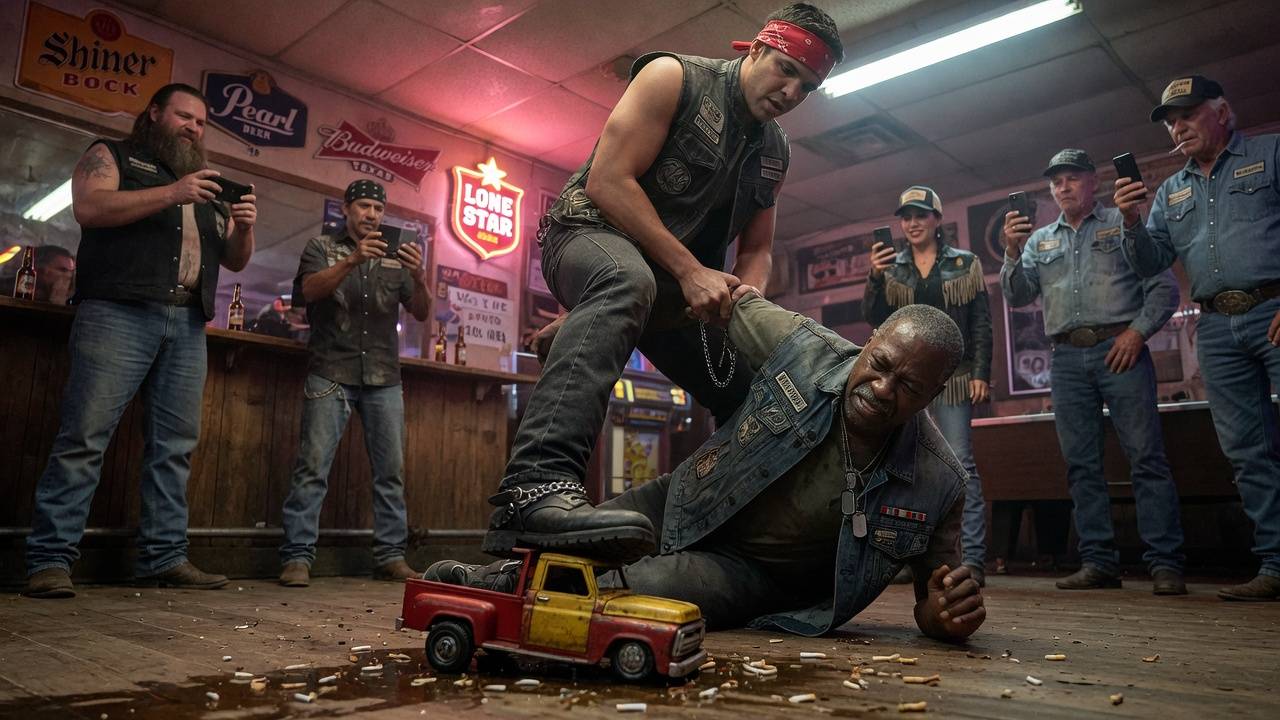
The silence that followed the crack of Drake’s ribs against the pavement was heavier than the roar of the bikes had ever been. Tank stood over him, the splintered pieces of Toby’s wooden truck clutched in his left hand. His right hand was still coiled into a fist, the knuckles humming with the vibration of the impact. He wasn’t breathing hard; his lungs were moving with the slow, terrifying precision of a machine that had been designed for exactly this purpose and then forgotten in a shed for fifteen years.
Behind them, the small crowd at the gas station was frozen. Three travelers near the soda machines held their phones out like shields, the lenses capturing the image of the legendary Tank Jefferson standing over the broken king of the Shadow Riders. Drake’s two companions, men half Tank’s age with twice his muscle mass, hadn’t moved. They weren’t just shocked by the speed of the reversal; they were paralyzed by the look in Tank’s eyes. It wasn’t rage. It was the flat, topographical stare of a man who had already mapped out exactly how he would dismantle them if they took a single step forward.
“Get him up,” Tank said. His voice wasn’t loud, but it carried through the desert air like a gavel.
The two bikers scrambled forward, grabbing Drake by his leather vest and hauling him to his feet. Drake’s face was a mess of dust and shock, his breath coming in jagged, hitching gasps. He clutched his chest, his swagger replaced by a primal, stuttering fear. He looked at the phones recording him, then back at Tank, and his lip trembled.
“You’re dead,” Drake wheezed, though the words lacked any conviction. “The board… they’ll hunt you to the coast.”
“Let them,” Tank replied. He turned his back on them—a deliberate, insulting show of unconcern—and walked toward the Dodge Ram.
Inside the truck, Toby was huddled against the door, his headphones pushed back off his ears. His face was tear-streaked and pale. As Tank opened the driver’s side door, the boy didn’t move. He just stared at the broken wood in Tank’s hand.
“I’m sorry, Little Man,” Tank whispered, sliding into the seat. “I couldn’t save the wheels.”
He started the engine. The old V8 groaned to life, a low, guttural protest against the heat. Tank backed the truck out of the lot, his eyes never leaving the rearview mirror. Drake was leaning against a gas pump, being held up by his men, staring at the dust cloud the Ram left behind.
For the first thirty miles, the only sound in the cabin was the hum of the tires on the asphalt. Tank’s mind was racing. He had broken the first rule of the road: never leave a witness who has something to prove. Drake wouldn’t go to the police; that wasn’t how the Riders worked. He would go to the people who paid for his bikes and his ego. He would go to the people who wanted that silver drive.
“Uncle Tank?” Toby’s voice was barely a breath.
“Yeah, kiddo?”
“Are you a bad man?”
The question hit Tank harder than any of Drake’s shoves ever could. He looked at his hands—the hands that had just efficiently broken a human being in front of a dozen witnesses. He thought about the fire he’d seen in the war, the blood on the chrome of his old bike, and the list of names on the drive that proved the world was built on a foundation of rot.
“I’ve done bad things, Toby,” Tank said, keeping his eyes on the shimmering horizon. “I’ve done things I’m not proud of. But right now, I’m trying to be the man your daddy wanted me to be. Does that make sense?”
Toby looked down at the shattered oak in his lap. He ran a small finger over the jagged edge where the wood had split. “Daddy said you were a giant. He said giants have to be careful because they can break things by accident.”
“Your daddy was right,” Tank said, a lump forming in his throat.
They reached the outskirts of El Paso by dusk. Tank knew they couldn’t stay in a motel. The video of the fight had likely already hit the private forums of the motorcycle clubs, and the Shadow Riders would have scouts at every major interchange. He steered the truck toward an industrial district, a labyrinth of warehouses and shipping containers where the shadows stayed long even at midday.
He pulled up to a corrugated metal building that looked like it had been abandoned since the seventies. He killed the lights and the engine, sitting in the sudden, ringing silence of the desert night.
“We staying here?” Toby asked.
“Just for a bit. I need to make a call.”
Tank stepped out of the truck, moving into the shadow of a rusted shipping container. He dialed Sarah’s number. She picked up on the first ring.
“Tank, where are you?” Her voice was tight with panic. “The video is everywhere. I’ve got people calling me from the DA’s office asking who the man in the denim vest is. You shouldn’t have done it, Tank. Not in public.”
“He touched the kid, Sarah. He broke Marcus’s toy. I wasn’t going to let him do that.”
“I get it, I really do, but you just put a neon sign over your head. The Senator’s people are terrified that you’re going to go to the press now. They aren’t sending bikers anymore, Tank. They’re sending professionals. People who don’t care about ‘club honor’ or ‘legacy.'”
“I’m forty miles from the border,” Tank said. “I can disappear into Mexico.”
“No, you can’t. They’ll have the crossings watched. Listen to me. There’s a safe house in the Franklin Mountains. It’s an old ranch owned by a retired judge who hates the Senator as much as I do. I’m sending you the coordinates. Get there, stay dark, and don’t use your phone again until I call you from a burner.”
“Sarah,” Tank said, his voice dropping. “If I don’t make it… if something happens to me, you take Toby. You find his aunt in Georgia. You don’t let him end up in the system.”
“Nothing is going to happen to you, Tank.”
“Don’t lie to me. We’re past that.”
He hung up and threw the phone into a nearby trash can. He felt lighter, but more vulnerable. He walked back to the truck and looked through the window. Toby was asleep, his head resting against the glass, the broken pieces of the truck still clutched in his hand.
Tank climbed back in and started the drive. The road up the mountains was a series of punishing switchbacks, the engine straining as the air grew thin. He watched the lights of El Paso fall away, a sea of amber jewels in the darkness.
He found the ranch at the end of a long, unpaved track. It was a low-slung stone building, tucked into a crease in the mountainside. An old man in a flannel shirt stood on the porch, a shotgun resting across his knees.
“Jefferson?” the man called out as Tank stepped out of the truck.
“Sarah sent me.”
The old man nodded and lowered the gun. “I’m Miller. Get the boy inside. The wind is picking up, and you look like hell warmed over.”
The house was warm, smelling of cedar and woodsmoke. Miller led Toby to a spare bedroom, the boy too exhausted to even wake up as Tank laid him on the bed. Tank stood in the doorway for a long time, watching the rhythmic rise and fall of the boy’s chest.
In the living room, Miller was pouring two glasses of amber liquid. He handed one to Tank.
“Sarah says you’ve got enough dirt to bury half the state house,” Miller said, sitting in a worn leather armchair.
“I’ve got enough to get myself killed,” Tank replied, sinking into the sofa. The adrenaline of the afternoon had finally drained away, leaving him feeling every one of his fifty years. His knuckles were swollen, and his back ached.
“You did a brave thing today,” Miller said, nodding toward the TV in the corner, which was muted but showing a grainy clip of the fight. “Most people would have just given them what they wanted.”
“I’ve spent my whole life giving people what they wanted,” Tank said. “The Army wanted my youth, the Riders wanted my loyalty, and the Senator wanted my silence. I’m tired of giving.”
“The problem with not giving,” Miller said, taking a slow sip of his drink, “is that they eventually decide to just take. And when they take, they don’t care what else they break in the process.”
Tank looked at the silver drive hanging from his neck. He thought about the names on it—men he had protected, men he had bled for, men who were now probably sitting in air-conditioned offices deciding how best to erase him from the world.
He realized then that the fight at the gas station wasn’t the end. It was just the opening bell. Drake was a symptom; the Senator was the disease. And you didn’t cure a disease with a palm strike and a push kick. You cured it with fire.
Chapter 6
The dawn broke over the Franklin Mountains in shades of bruised purple and hard gold. Tank stood on the porch of the ranch, watching the shadows retreat from the valley floor. He hadn’t slept. He’d spent the night in the kitchen with Miller, going through the files on the thumb drive.
The scale of the corruption was staggering. It wasn’t just bribes; it was a systematic looting of state infrastructure funds, laundered through the Shadow Riders’ front companies. Marcus had found out because he was the one signing the invoices, thinking they were for legitimate construction gear. When he tried to walk away, they’d staged the accident.
“They’re coming,” Miller said, stepping onto the porch with two mugs of black coffee. He pointed a gnarled finger toward the valley.
Three clouds of dust were rising from the access road, miles away but closing fast. No sirens. No flashing lights. Just three black SUVs moving with lethal intent.
“Toby,” Tank called out, his voice sharp.
The boy appeared in the doorway, rubbing his eyes. He looked small and fragile against the backdrop of the rugged mountains.
“Listen to me, Little Man,” Tank said, kneeling so he was eye-level with the boy. “I need you to go with Mr. Miller. He knows a trail that leads over the ridge to the highway. Sarah is going to meet you there in a blue car. Do you understand?”
Toby’s lower lip trembled. “What about you, Uncle Tank?”
“I have to stay here and finish the job. I have to make sure they don’t follow you.”
“But they’re bad men,” Toby whispered. “They’ll hurt you.”
Tank reached into his pocket and pulled out the broken pieces of the wooden truck. He’d spent an hour in Miller’s workshop that morning, using wood glue and a few small brass screws to piece it back together. It was scarred, the wood darkened by the orange juice, but it was whole. The wheels turned again.
He pressed it into Toby’s hands. “This belonged to your daddy. It’s tough, just like he was. And just like you are. You keep it safe for me, okay?”
Toby hugged the toy to his chest and then threw his arms around Tank’s neck. For a moment, Tank allowed himself to close his eyes and feel the warmth of the boy’s embrace. It was the only thing in his life that didn’t feel like a mistake.
“Go,” Tank said, gently pushing the boy toward Miller.
Miller grabbed his shotgun and a small pack. “We’ll be at the rendezvous in an hour. Don’t be a hero, Jefferson. Just be a problem.”
Tank watched them disappear into the scrub brush behind the ranch. Then he turned back to the house. He had forty-five minutes.
He went to the shed Miller had pointed out. Inside, under a tarp, was a collection of old mining supplies—blasting caps, rolls of fuse, and a few crates of degraded dynamite that Miller had “acquired” years ago. Tank’s hands moved with practiced ease. He wasn’t a biker now. He was a combat engineer.
He rigged the front gate first, a simple pressure plate connected to a small charge. Then he moved to the house. He didn’t want to destroy Miller’s home, but he needed to funnel the attackers. He set up “distractions” along the perimeter—small pops and flashes designed to draw fire and create confusion.
Finally, he sat in a chair in the middle of the driveway, right where the SUVs would have to stop. He didn’t have a gun in his hand. He had the thumb drive, held up between his thumb and forefinger.
The SUVs screeched to a halt twenty yards away. Six men piled out. They weren’t wearing leather. They were wearing tactical vests and carrying suppressed submachine guns. In the center was a man in a charcoal suit—the Senator’s chief of staff, a man Tank recognized from the files as “The Architect.”
“Jefferson!” the man shouted. “Throw the drive over and we can talk about a pension.”
“I already had a pension,” Tank shouted back. “I spent it on a lawyer.”
“Don’t be a fool. You’re one man against a machine. You think that video made you a hero? It made you a liability. Nobody is coming to help you.”
“I don’t need help,” Tank said. He stood up, the drive glinting in the morning sun. “I just need you to look at the gate.”
At that moment, the first SUV’s front tire settled into the dirt. A sharp crack-boom echoed through the canyon as the pressure plate blew, shredding the tire and sending a cloud of shrapnel into the side of the vehicle.
The men dived for cover, opening fire. Tank hit the dirt and rolled behind a stone planter. He didn’t fire back. He didn’t have to. Every time they moved, another one of his small “surprises” went off—a flashbang under a porch step, a small charge in a woodpile.
In the chaos, Tank moved. He didn’t run away from them; he moved through the shadows of the ranch buildings, using the layout he’d memorized. He appeared behind the man in the suit, who was huddled behind an SUV door.
Tank didn’t use a gun. He used his hands. He grabbed the man’s collar and slammed him against the vehicle, the same way Drake had done to him. But there was no hesitation this time.
“The files are already with the DA,” Tank hissed into the man’s ear. “Sarah uploaded them ten minutes ago. You aren’t here to get the drive. You’re here to be the first one arrested.”
The man’s face went white. “You’re lying. You’d never risk the kid.”
“The kid is gone,” Tank said. “And I’m all that’s left.”
He shoved the man toward the other gunmen, who were now reloading, their eyes darting around the smoke-filled yard. “Drop the weapons!” Tank roared. “State police are five minutes out! You want to be accessories to murder on top of everything else?”
It was another bluff, but with the smoke and the explosions, it felt real. Two of the gunmen hesitated. They weren’t fanatics; they were mercenaries. And mercenaries don’t die for a lost cause.
Sirens actually did begin to wail in the distance—not five minutes out, but close enough. Sarah had come through.
Tank retreated toward the ridge, watching as the black SUVs tried to coordinate a retreat, only to find their path blocked by a phalanx of DPS cruisers screaming up the mountain road. He saw the Architect being shoved against a car, his expensive suit ruined by the Texas dust.
Tank climbed higher, his breath coming in ragged gasps. He reached the top of the ridge just as the sun fully cleared the peaks.
Down on the highway, he saw a small blue sedan pulled over on the shoulder. Two figures stood beside it. One was a woman in a business suit. The other was a small boy holding a wooden truck.
Toby looked up toward the mountains. Tank couldn’t see the boy’s face, but he saw him raise his hand in a slow, steady wave.
Tank didn’t wave back. He didn’t want to be a giant anymore. He just wanted to be still.
He sat down on a rock, the silver drive still clutched in his hand. He looked at his knuckles, the skin torn and bleeding, the chrome of his old life finally polished away by the grit of the truth. He had lost his club, his reputation, and his peace. But as he watched the blue car pull away, merging into the flow of traffic heading toward a new life, Tank Jefferson finally felt like he was standing on his own two feet.
The wind picked up, carrying the scent of pine and the distant, fading sound of sirens. Tank closed his eyes and, for the first time in fifteen years, he wasn’t afraid to dream.