Chapter 5
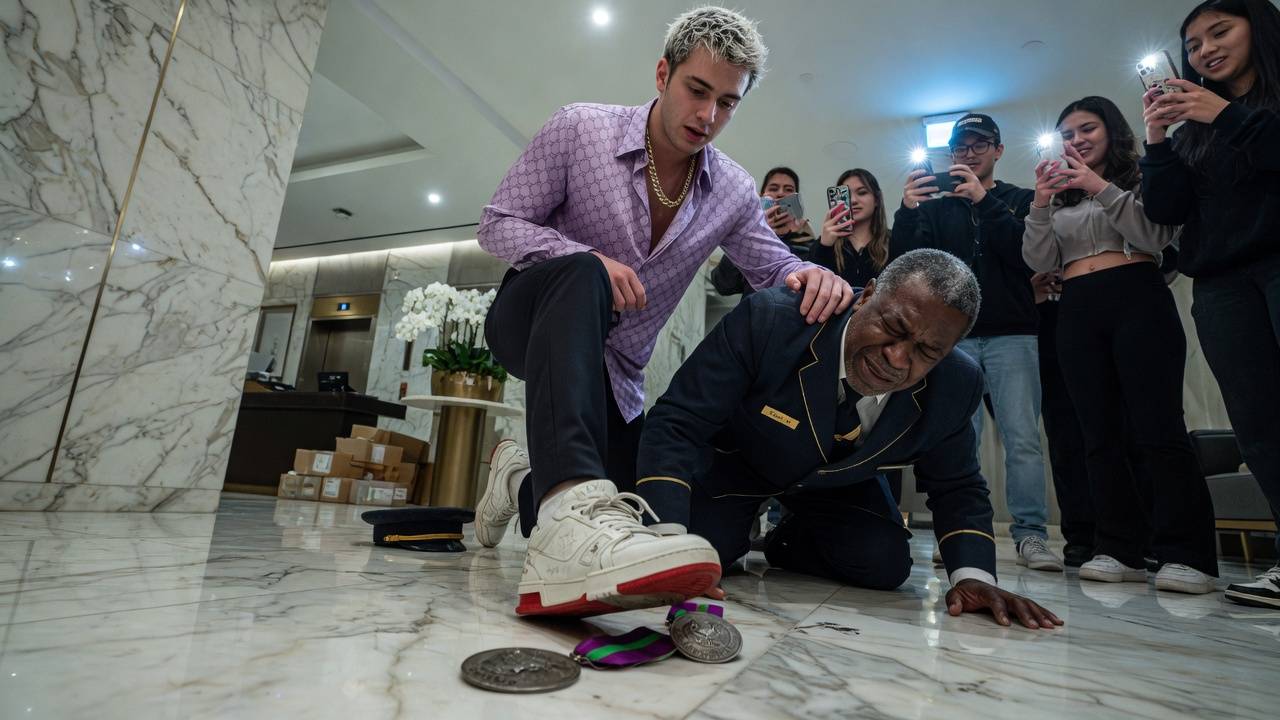
The silence that followed the glass doors closing behind Elijah was a vacuum, one that Julian’s friends didn’t know how to fill. They stood there, high-end cameras still gripped in their hands, their expensive LED panels casting a cold, artificial glare on the scene of the disaster. On the floor, Julian Vane, the boy who had never been told “no,” was gasping for air, his face a mottled mask of shock and terror. His designer shirt was ruined, the perfect white fabric stained with the dust of the marble floor he’d just been driven into.
It was Sarah, the former teacher, who moved first. She didn’t go to Julian. She walked to the center of the lobby, picked up the scattered twenty-dollar bills Julian had thrown earlier, and then looked at the crowd of young influencers with a disgust so cold it seemed to drop the temperature of the room.
“I hope you got what you wanted,” she said, her voice trembling with a quiet, lethal fury. “I hope the views are worth it. Because you just broke a man who has spent his entire life being better than all of you combined.”
“He attacked me!” Julian finally wheezed, rolling onto his side. He clutched his chest, his breath coming in ragged, shallow hitches. “Did you see that? He’s crazy! I’m calling the police. I’m suing this whole building!”
The manager, Henderson, finally emerged from his office, his face the color of damp parchment. He had seen the whole thing through the security feed. He looked at Julian on the floor, then at the empty space where Elijah used to be. He knew his career was over. Whether he fired Elijah or didn’t, the Vane family would have his head for allowing a “servant” to lay hands on their son.
“Call an ambulance,” Henderson whispered to the receptionist, who was frozen behind the mahogany desk. “And get the police here. Now.”
Within twenty minutes, the Obsidian lobby was a sea of blue and red strobes. Two officers, young and looking out of place in the luxury setting, stood over Julian as he was loaded onto a gurney. Julian was already talking, his voice rising in pitch as he realized he had an audience again.
“He just snapped! I was just trying to help him, give him some money for his wife, and he just went psycho,” Julian told the officers, his eyes darting toward his friend who was still—unbelievably—filming the interaction. “It’s all on camera. He’s a dangerous man.”
One of the officers, a man named Miller who had a veteran’s pin of his own on his collar, looked at the silver medal Julian had been grinding into the floor. It was sitting on the desk now, where Sarah had placed it. He looked at the tarnished silver, then at the bruised, arrogant kid on the gurney. He didn’t say anything, but he didn’t write as fast as Julian wanted him to.
Elijah, meanwhile, was walking.
He didn’t take the bus. He didn’t call a cab. He walked the four miles to the hospital, his boots heavy on the cracked pavement of the neighborhoods that sat in the shadow of the Obsidian. The adrenaline was leaving him now, replaced by a crushing, hollow exhaustion. He felt the familiar rattle in his lungs, the sharp, needle-like pain that told him his time was accelerating.
He reached the hospital and went straight to Martha’s room. She was asleep, the rhythmic hum of the machines the only sound in the dim light. He sat in the plastic chair, his hands resting on his knees. They were bruised, the knuckles swollen. He looked at them and felt a strange lack of regret. For years, he had been a man of restraint, a man who swallowed his pride to keep a roof over their heads. But today, the debt had been called in.
He stayed there until the sun began to set, watching the light change on the hospital walls. He knew the police would come here. They knew where he worked, they knew his wife was ill. He didn’t try to run. There was nowhere left to go.
The knock on the door came at 7:00 PM. It wasn’t the police. It was Silas Henderson.
The manager looked older, his tie pulled loose, his eyes bloodshot. He stepped into the room, looking at Martha, then at Elijah. He didn’t sit down.
“Julian’s father is at the building,” Henderson said, his voice barely a whisper. “He’s seen the footage. All of it. Not the edited crap Julian’s friends put up, but the raw security feed from the lobby. The one where Julian steps on your medal.”
Elijah didn’t move. “Is he pressing charges?”
“He wanted to,” Henderson said. “He wanted you in a cell by midnight. But then that woman, Sarah, and a few other residents… they stepped in. They told him if he touched you, they’d take their business elsewhere. They’d go to the press with the full story of how the Obsidian lets its residents abuse the staff.”
Henderson paused, rubbing his face. “But it’s not enough, Elijah. Vane is powerful. He made a deal. No police, no lawsuit. But you’re done. Not just here. In this city. He’ll make sure no firm touches you. And your insurance… it’s been terminated as of five o’clock.”
Elijah closed his eyes. The blow he’d expected had finally landed. He had traded Martha’s life for his dignity. He felt a sudden, sharp sob rise in his throat, but he choked it down.
“I know,” Elijah said.
“There’s something else,” Henderson said, reaching into his coat pocket. He pulled out an envelope and laid it on the bedside table. “The residents… they took up a collection. It’s not much, but it’ll cover her surgery and a few months of care. Sarah led it. She said it was the least they could do for the man who actually kept them safe.”
Elijah looked at the envelope. He didn’t touch it. “Why are you here, Silas?”
Henderson looked at the floor. “Because I’m the one who told you to take it. I’m the one who told you to be a punching bag. I have to live with that. You don’t.”
He turned and walked out, leaving Elijah alone in the dark with the sound of Martha’s breathing. Elijah reached out and took her hand. It was cold. He realized then that he wasn’t just waiting for her to die. He was waiting for himself to follow. The biker, the firefighter, the concierge—they were all gone now. All that was left was a man with a scarred heart and a tarnished medal, sitting in the dark, waiting for the end of the world.
Chapter 6
The surgery was a success, but the recovery was slow. Martha spent three weeks in the intensive care unit before she was moved back to a regular ward. During those weeks, the video of what happened in the Obsidian lobby went viral, but not in the way Julian Vane had intended.
A local news station had gotten hold of the unedited security footage. They ran it alongside Julian’s “prank” videos. The narrative shifted overnight. Julian wasn’t a victim; he was the poster child for the “cruel elite.” He was forced to delete his social media accounts, and his father, embarrassed by the public outcry, reportedly sent him to a “disciplinary ranch” in the Midwest.
Elijah watched none of it. He spent his days at the hospital and his nights in their small apartment, surrounded by the ghosts of a life he no longer recognized. He had stopped wearing the suit. He had stopped looking at the clock.
One afternoon, Martha was sitting up in bed, some color finally returning to her cheeks. She looked at Elijah, who was peeling an orange for her. She saw the way his breath caught in his throat, the way his shoulders slumped when he thought she wasn’t looking.
“Eli,” she said softly. “Talk to me.”
“I’m just tired, baby,” he said, not looking up.
“You’re not just tired. You’re gone,” she said, her voice stronger than it had been in months. “I heard what happened. Sarah came to see me. She told me everything. About the medal. About the boy.”
Elijah stopped peeling the orange. He felt the shame wash over him again, a hot, suffocating wave. “I lost the job, Martha. I lost everything I was supposed to provide for you.”
“You provided me with a husband who has a soul,” she snapped, her eyes flashing. “Do you think I wanted to live on the blood of your dignity? Do you think I wanted you to be a slave to those people just so I could have another year of breath?”
She reached out and grabbed his hand, her grip surprisingly firm. “Look at me, Elijah.”
He looked up. Her eyes were wet, but they were clear.
“You didn’t lose anything,” she said. “You found yourself again. You’re the man I married. The man who wouldn’t let a fire stop him. The man who wouldn’t let a bully break him. That’s the man I need. Not a concierge. Not a ghost.”
Elijah felt a crack in the armor he’d built around his heart. He leaned his head against her hand and finally, for the first time since the fire twenty years ago, he wept. He wept for the friends he’d lost, for the lungs that were failing him, and for the sheer, brutal weight of being a good man in a world that didn’t value it.
A week later, Elijah was sitting on the small balcony of their apartment, watching the rain hit the street below. He heard a knock at the door. When he opened it, he found a man he hadn’t seen in a decade.
It was Jack Riley, his old captain from the fire department. He was retired now, his face a map of old scars and hard-won wisdom.
“I saw the video, Elijah,” Jack said, leaning against the doorframe.
“Everyone did,” Elijah muttered, stepping back to let him in.
Jack didn’t sit down. He looked around the small, tidy apartment, then back at Elijah. “The department… we’ve been talking. There’s a position open at the academy. Teaching the recruits about structural safety and emergency protocols. It’s a desk job, mostly, but they need someone who’s actually been in the heat. Someone who knows what it means to stay calm when the world is burning.”
Elijah shook his head. “Jack, look at me. I can barely walk a flight of stairs without gasping. I’m a liability.”
“You’re a legend,” Jack countered, his voice booming in the small room. “And you’re a veteran who was treated like dirt by a spoiled brat. The union heard about the insurance. They’re reinstating your benefits under a special disability clause. You’ve got a job if you want it, Eli. A real one. One where you don’t have to open doors for anyone.”
Elijah looked at the silver medal sitting on the mantelpiece. He had cleaned it, the scratches from Julian’s shoe still visible but the metal shining again. He thought about the recruits, young and eager, needing to know that being a hero wasn’t about the glory—it was about the weight you were willing to carry for someone else.
“I’ll think about it,” Elijah said.
“Don’t think too long,” Jack said, heading for the door. “Classes start in a month. And Eli… nice right hook. Or palm strike. Whatever that was. The guys at the station have been playing it on a loop.”
When Jack left, Elijah went back to the balcony. The rain had stopped, and a pale, watery sun was breaking through the clouds. He felt the rattle in his chest, the constant reminder of his own mortality. He knew he didn’t have twenty years left. He might not even have five.
But as he stood there, he felt a strange sense of peace. He had paid his debt. He had stood his ground in the lobby of the Obsidian, and the world hadn’t ended. In fact, for the first time in a long time, it felt like it was just beginning.
He went back inside, picked up the medal, and held it in his palm. It was heavy, cool, and real. He walked into the bedroom where Martha was reading a book, the sunlight catching the grey in her hair.
“Martha,” he said.
“Yeah, Eli?”
“I think I’m going to take the job.”
She looked at him and smiled—the same sunflower smile from the old photo. “I know,” she said. “I already told Sarah to bring over some of those ‘congratulations’ muffins she’s always making.”
Elijah sat on the edge of the bed and pulled her into his arms. Outside, the city moved on, indifferent to the small victory that had taken place in an apartment two miles away. But inside that room, the air was clear, the debt was paid, and for the first time in his life, Elijah wasn’t a ghost. He was exactly where he was supposed to be.