The smell of lemon-scented floor wax and stale tater tots usually acted as a sensory anchor for Elias Thorne. It was a mundane, civilian smell—a smell that meant he was safe, far away from the iron-tang of desert dust and the static of a tactical radio.
But today, the cafeteria at Sterling Prep smelled like a trap.
Elias sat at the end of a long oak table, his eyes fixed on a page of his AP Physics textbook. At eighteen, he was broader and steadier than most of the seniors, but he carried himself with a hunched, deliberate invisibility. He was the “charity case” from the South Side, the ghost in the hallway who never spoke and never smiled.
He didn’t want friends. He wanted a diploma, a scholarship to MIT, and a way to ensure his younger sister, Maya, never had to worry about rent again.
“Hey, 404,” a voice boomed, cutting through the low hum of five hundred teenagers.
Elias didn’t look up. He knew the voice. Caleb Sterling—the son of the man whose name was etched in bronze over the school’s library. Caleb was the star quarterback, the king of a hill built on offshore accounts and unearned arrogance.
“I’m talking to you, ghost,” Caleb said, his shadow falling over Elias’s book.
Before Elias could move, the world went cold and wet.
A plastic tray hit the table with a hollow clack. A cascade of lukewarm spaghetti, red sauce, and chocolate milk drenched Elias’s head, soaking into the collar of the only white button-down shirt he owned—the one his mother had ironed before she passed away.
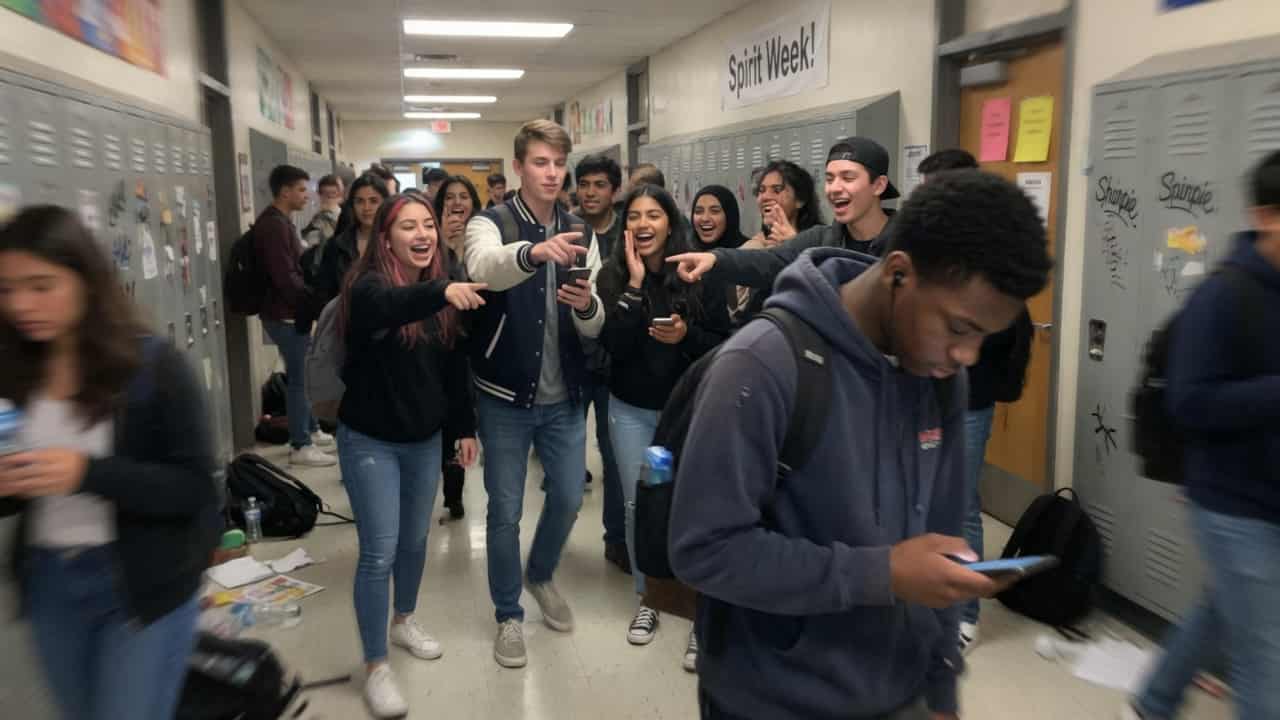
The laughter was instantaneous. It wasn’t a roar; it was a high, sharp sound of five hundred people realizing they weren’t the ones in the crosshairs today.
“Whoops,” Caleb laughed, leaning down so close Elias could smell the expensive cologne and the cowardice. “I guess you’re not as invisible as you thought. Clean it up, scholarship. And do it on your knees. That’s how your kind usually works for a Sterling, right?”
Then came the slur. It was tossed out like a piece of trash, casual and venomous.
Caleb shoved Elias’s shoulder. It wasn’t a hard shove, but it was enough to knock Elias off his balance. He hit the linoleum floor with a heavy thud, the chocolate milk pooling around his knees.
Elias stayed down for a heartbeat. He stared at the red sauce on his hands. To the kids at Sterling Prep, it was just marinara. To Elias, the color triggered a tectonic shift in his brain. 60 beats per minute. 70. 80. The “civilian” Elias began to retreat into a dark room, and the “Ghost” reached for the door.
He didn’t growl. He didn’t shout. He rose.
He didn’t use the table for support. He stood up in one fluid, rhythmic motion that felt less like a teenager getting up and more like a machine being powered on. He wiped a streak of chocolate milk from his eye, his gaze finally meeting Caleb’s.
“Caleb,” Elias said. His voice was a low, vibrational hum that seemed to rattle the heavy oak tables. “You have exactly three seconds to apologize. Not to me. To the shirt.”
The cafeteria went deathly quiet. Caleb’s grin flickered. He saw the change in Elias’s eyes—the slate gray turning into a cold, ancient void.
“Or what, boy?” Caleb sneered, raising a fist.
The countdown ended. And the lesson began.
Chapter 2: The Anatomy of a Shadow
To understand why Elias Thorne moved the way he did, you had to understand the “The Midway” gym in North Philly. It was a windowless basement where the air was thick with the scent of old leather and blood. It was where Elias’s father, a disgraced former Ranger, had taught him that the world was a collection of hinges and levers.
“A man who fights with anger is a man who’s already lost,” his father had whispered during their midnight drills. “A man who fights with precision? He’s the one who decides who goes home.”
Elias had spent three years in a specialized youth program before a brief, intense stint in a tactical unit he wasn’t allowed to name. He had seen the way a human body breaks. He had seen the way a “Golden Boy” looks when he realizes the world doesn’t care about his father’s bank account.
After being shoved in the cafeteria, Elias didn’t go to the principal. He didn’t go to the nurse. He walked toward the locker rooms, leaving a trail of red sauce on the floor.
“Elias! Wait!”
It was Sarah Miller. She was the only person at Sterling Prep who didn’t treat Elias like a ghost. She was the daughter of the head custodian, a girl who knew the weight of the “scholarship” label. She was eighteen, with sharp eyes and a heart that was too big for this zip code.
“Elias, don’t do this,” she whispered, catching up to him in the hallway. “Caleb’s dad is the Chairman of the Board. If you touch him, you’re gone. Maya’s future is gone.”
Elias stopped. He looked at his hands—the knuckles white, the fingers steady. “He touched the shirt, Sarah. He mocked the man who ironed it.”
“He’s a bully, Elias! He wants you to snap!”
“He doesn’t know what ‘snapping’ looks like,” Elias said. his voice sounding like gravel in a blender. “He thinks violence is a tantrum. I’m going to show him it’s a science.”
Elias walked into the locker room and stripped off the ruined shirt. Beneath it, his body was a topographical map of a life spent on the line—scars from a training accident in Georgia, a jagged line from a night in a place he couldn’t talk about.
He didn’t feel like a student. He felt like a weapon that had been left out in the rain.
Caleb Sterling walked in five minutes later, flanked by Jace and Silas. They were laughing, their phones out, ready to record a “Part 2” for their social media followers.
“Hey, 404! I thought I told you to stay on your knees!” Caleb shouted, the tiled walls echoing his unearned confidence.
Elias didn’t look at the cameras. He didn’t look at the varsity jackets. He looked at Caleb’s center of gravity. He looked at the tilt of his jaw.
“This isn’t a locker room anymore, Caleb,” Elias said, his voice terrifyingly calm. “This is a laboratory. And you’re the subject.”
Caleb roared and lunged forward, a sloppy, over-telegraphed tackle.
Elias didn’t retreat. He stepped into the storm.
Chapter 3: The Clinical Strike
The fight lasted exactly twelve seconds.
Elias didn’t use his fists at first. As Caleb charged, Elias slipped to the left—a movement so small it looked like a trick of the light. He caught Caleb’s wrist, redirected his momentum, and delivered a short-range palm strike to Caleb’s bicep.
The sound was like a whip cracking. Caleb’s arm went limp, his nervous system overwhelmed by the surgical precision of the strike.
“What did you do?!” Silas yelled, lunging from the side.
Elias didn’t even turn his head. He dropped into a crouch, swept Silas’s lead leg, and delivered a rhythmic series of three taps to Silas’s ribs. They weren’t haymakers. They were clinical applications of force. Silas collapsed, gasping for air that wouldn’t come.
Jace, the cameraman, dropped his phone. The red “Record” light flickered on the floor.
Caleb was back on his feet, his face a mottled purple of rage and primal fear. “I’ll kill you! I’ll have your whole family on the street!”
He swung a wild, desperate punch.
Elias caught it. He didn’t just block it; he caught the fist in his palm. The sheer difference in strength was absolute. Elias leaned in, his face inches from Caleb’s.
“You think money makes you a lion,” Elias whispered. “But a lion knows how to respect the jungle. You? You’re just a boy playing with matches in a room full of gasoline.”
Elias executed a controlled shoulder throw. Caleb hit the tile floor with a bone-jarring thud. He didn’t bounce. He just stayed there, the air leaving him in a long, rattling wheeze.
Elias stood over him. He reached into his pocket and pulled out a small, tarnished brass coin—his father’s Ranger challenge coin. He dropped it onto Caleb’s chest.
“Keep that,” Elias said. “It’s a reminder that some ghosts carry a lot of weight.”
Elias walked out of the locker room. He didn’t feel triumphant. He felt a deep, hollow exhaustion. He had broken his promise to Maya. He had let the Ghost out.
Sarah was waiting in the hallway. She saw the look on his face. She saw the blood on his knuckles—Caleb’s blood.
“Elias…”
“Call your dad, Sarah,” Elias said, his voice cracking. “Tell him he’s going to need to mop the locker room. There’s some trash on the floor.”
By the time the sun set over Sterling Prep, the “Golden Boy” was in the hospital with a shattered ego and a hairline fracture, and Elias Thorne was sitting in the back of a police cruiser.
But the video—the real video, the one Jace had accidentally recorded on the floor—was already going viral. And the town of Sterling was about to find out that when you push a ghost, the ghost pushes back.
Chapter 4: The Board of Shadows
The holding cell at the Sterling Police Department smelled like old cigarettes and bleach. Elias sat on the metal bench, his hands folded in his lap. He didn’t ask for a lawyer. He didn’t ask for a phone call. He sat in the center of the dark, waiting for the system to swallow him whole.
The door to the cell block opened. It wasn’t a guard. It was Sarah Vance—not the student, but her father, Coach Vance, the man who had seen Elias’s “Ghost” eyes in the hallway.
“The Sterling family is calling for your head, Elias,” Vance said, leaning against the bars. “The Chairman wants you charged with domestic terrorism. He wants the ‘professional’ nature of the fight used as evidence that you’re a threat to the state.”
“I was defending a white shirt,” Elias said, his voice a low vibration.
“I saw the video, kid. The one on the floor. I saw the way you moved,” Vance said, his eyes narrowing. “That wasn’t high school wrestling. That was Tier-1 defensive maneuvering. Where did a scholarship kid from the South Side learn to dismantle a varsity linebacker in six seconds?”
Elias didn’t answer.
“Your dad was Marcus Thorne, wasn’t he? The ‘Ghost of the 75th’?” Vance asked.
Elias went still. “He was a mechanic.”
“He was the best close-quarters specialist the Army ever produced until the system broke him,” Vance said, his voice softening. “I served under him in ’04. I recognized the footwork. You’re his legacy, aren’t you?”
“I’m just a student, Coach.”
“Not anymore,” Vance said, sliding a folder through the bars. “The Chairman is holding an emergency board meeting in an hour to vote on your permanent expulsion and the revocation of your sister’s medical grant. He thinks he can erase you. But he forgot one thing.”
“What’s that?”
“The people who mop the floors see everything,” Vance grinned. “My daughter Sarah didn’t just record the fight. She recorded the last six months of Caleb Sterling’s ‘activities.’ The drug deals behind the gym. The grade tampering. The bribes.”
Vance pulled a set of keys from his belt. “The Chairman thinks he’s playing a game of chess. He doesn’t realize he’s playing against a team of ghosts.”
The board meeting was held in the library, under the portrait of Caleb’s grandfather. The air was thick with the scent of mahogany and unearned power. Chairman Sterling sat at the head of the table, his face a mask of granite.
“Elias Thorne is a monster,” Sterling declared, his voice echoing off the book-lined walls. “He is a weapon we allowed into our garden. He must be removed. By any means necessary.”
The doors swung open.
Elias walked in, his hands in his pockets. Behind him stood Coach Vance, Sarah, and fifty other “invisible” people—the janitors, the cafeteria workers, the scholarship kids who had been hiding in the shadows for years.
“The garden was already rotten, Mr. Sterling,” Elias said, his voice filling the room. “I just pulled a weed.”
Chapter 5: The Truth in the Marble
Chairman Sterling didn’t move. He didn’t even look at the crowd of “staff” in his boardroom. He looked at Elias with the cold, clinical detachment of a man who thought he was a god.
“You’re a trespasser, Thorne,” Sterling said. “You’re a glitch in the system. And glitches are deleted.”
“Then delete me,” Elias said, stepping toward the table. “But before you do, let’s talk about the ‘Sterling Scholarship Fund.’ Let’s talk about the three million dollars that vanished from the community center project in North Philly. The project my father was supposed to lead before he was ‘neutralized’ by your legal team.”
The room went deathly silent. The board members—the wealthy, the polished, the complicit—looked at their hands.
“My father didn’t lose his mind in the war, Mr. Sterling,” Elias continued, his voice growing in power. “He lost his heart when he realized the people he was fighting for were the same ones stealing from the kids back home. You didn’t just bully me. you’ve been bullying an entire zip code for twenty years.”
Sarah stepped forward, her phone connected to the library’s massive projector. “We have the ledgers, Mr. Sterling. My dad found them in the basement office you thought no one used. The ‘clinical lesson’ Elias gave your son wasn’t just about a shirt. It was about a reckoning.”
The screen flickered to life. It wasn’t a fight video. It was a digital map of a money-laundering trail that led straight to the Sterling family estate.
Chairman Sterling’s facade finally cracked. He looked at the faces of the people he had ignored for decades—the “ghosts” who cleaned his toilets and served his food. He saw the fire in their eyes.
“This is a fabrication!” Sterling roared, standing up.
“No,” Coach Vance said, stepping forward. “This is a blueprint. And Master Sergeant Thorne’s son just showed us where the hinges are.”
The meeting didn’t end in a vote. It ended in a walkout. One by one, the board members stood up and left the room, refusing to be on the sinking ship of the Sterling legacy.
Elias stood in the center of the library. He didn’t feel happy. He felt a profound sense of relief. He had cleared the name of the man who had ironed his shirt.
He walked out of the school and into the crisp afternoon air. Sarah was waiting for him by the fountain.
“What now, 404?” she asked, a small smile on her face.
“Now,” Elias said, looking toward the city skyline. “I think I’m going to go to MIT. And I think I’m going to build a gym.”
“A boxing gym?”
“No,” Elias said. “A laboratory. For ghosts.”
Chapter 6: The Cooling Down
Six months later, the Sterling name was gone from the library. It had been replaced by a simple, brass plaque: The Thorne Memorial Library.
Elias stood on the steps of his new school in Cambridge, his rucksack over his shoulder. He wasn’t hunched over anymore. He stood tall, his chest out, his head high. He was no longer invisible.
He had won the “clinical lesson,” but the cost had been high. His father had passed away shortly after the board meeting—his heart finally giving out once he knew his son was safe. He had died with a smile on his face, holding the Ranger coin Elias had retrieved from the locker room floor.
Maya was with him, enrolled in a prestigious art school nearby. She was the light he had fought for, the reason he had stayed calm in the storm.
“Ready for the first day, big brother?” she asked, clutching her sketchbook.
“Ready,” Elias said.
He looked at his hands. They were steady. They weren’t weapons anymore. They were the hands of an engineer.
He walked into the lecture hall and sat in the front row. He didn’t hide. He didn’t wait for a tray to be dumped on him.
A young student sat next to him, looking nervous. He was a scholarship kid, his clothes a little too thin for the Boston winter. He looked at Elias with wide eyes.
“I heard about you,” the kid whispered. “The guy who took down the Chairman.”
Elias looked at him. He didn’t see a fan. He saw a mirror.
“I didn’t take down a Chairman,” Elias said softly. “I just reminded him that respect isn’t something you buy. It’s something you earn every time you iron your shirt.”
Elias opened his textbook. The smell of new paper and fresh coffee filled his senses. It was a mundane, civilian smell. And for the first time in his life, Elias Thorne realized that the greatest strike he ever delivered wasn’t a palm to a chest or a throw to the floor.
It was the choice to be kind in a world that had forgotten how.
He turned the page, the “Ghost” finally at rest, replaced by a man who knew that the true science of power is found in the heart of the one who refuses to be broken.
The greatest strength isn’t found in the hands that strike, but in the heart that remembers what is worth defending.