The rain in Oakhaven, Pennsylvania, didn’t just fall; it felt like it was trying to wash the town away. For Elias Thorne, the rhythmic drum of the water on his hood was usually a comfort, a sensory shield that kept the world at a distance. But tonight, the air in the high school parking lot felt heavy, charged with the kind of tension that precedes a lightning strike.
Elias walked toward his bike—a 1974 Schwinn that he’d spent every weekend for three years restoring. It was more than metal and rubber; it was a conversation with a father who wasn’t there to speak anymore. Every turn of the wrench, every polish of the chrome, was a way to keep a memory from fading into the gray Pennsylvania mist.
“Hey, 404,” a voice boomed, cutting through the rain.
Elias didn’t look up. He knew the voice. Caleb Sterling—the son of the man whose name was etched in bronze over the school’s library. Caleb was the king of a hill built on unearned arrogance and offshore accounts. He was flanked by Jace and Silas, two varsity players who lived for the thrill of a target that wouldn’t fight back.
“I’m talking to you, ghost,” Caleb said, his shadow falling over Elias.
Before Elias could unlock his chain, Caleb’s heavy boot connected with the Schwinn’s rear wheel. The sound of spokes snapping was like a bone breaking. Elias felt a phantom pain in his chest, a jagged tear in the fabric of the peace he’d worked so hard to maintain.
“What’s the matter, Thorne? No words for the help?” Caleb sneered. With a violent shove, he sent Elias flying backward.
Elias hit the ground hard. The mud was cold, thick, and smelled of gasoline and rot. He looked up, the rain stinging his eyes, and saw Caleb standing over his ruined bike. Caleb reached down, grabbed the handlebars, and twisted. The vintage steel groaned and buckled.
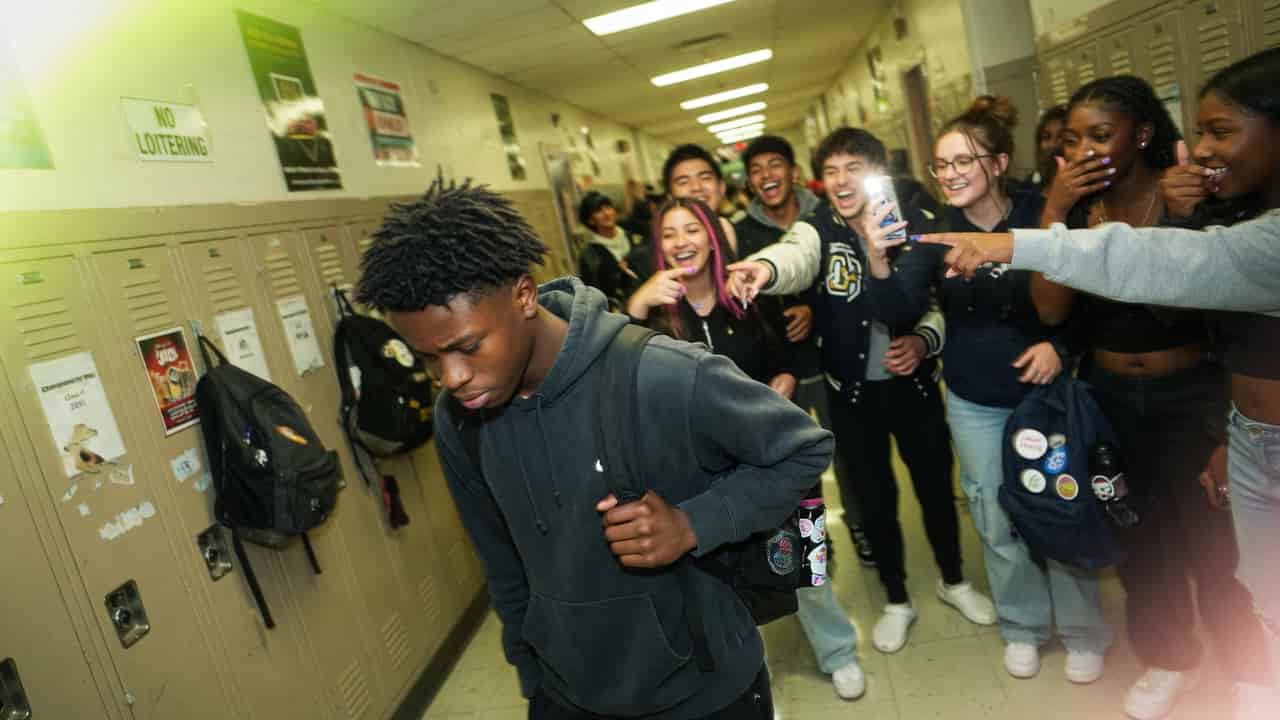
“There,” Caleb laughed, looking at the camera Silas was holding. “Now it’s as broken as your daddy’s reputation. Say hi to the internet, scholarship.”
The laughter was high and sharp. Elias stayed in the mud for a heartbeat, his hands sinking into the muck. He stared at the red taillight of his bike, now shattered on the pavement. To the kids at Oakhaven Prep, it was just a bike. To Elias, the destruction triggered a tectonic shift in his soul.
He didn’t growl. He didn’t shout. He rose.
Chapter 2: The Anatomy of a Ghost
To understand why Elias Thorne moved the way he did, you had to understand the man who raised him after the world fell apart. His grandfather, Silas Thorne, was a man built of old oak and even older secrets. Silas was a legendary veteran of a unit the government didn’t acknowledge, a man who believed that the greatest weapon a person possessed was the silence they carried before a strike.
“Elias,” Silas would say during their dawn training sessions in the woods, the air thick with the scent of pine and damp earth. “Violence is a debt. You don’t spend it unless you’re prepared to go bankrupt. But if you have to pay it, you pay it in full, and you pay it fast.”
Elias had spent his youth learning the “surgical science” of the body. He didn’t learn how to brawl; he learned how to dismantle. He knew the precise amount of pressure required to shut down a nervous system, the exact angle to strike a joint to render it useless, and the psychological weight of a stare that held no fear.
But his father, David, had wanted a different life for him. David was a mechanic who believed in the beauty of machines, in things that could be fixed with patience and a steady hand. “Your hands were made for building, Elias,” David had told him, shortly before the accident that took his life. “Don’t let the world turn them into hammers.”
Elias had been a builder for three years. He had taken the scholarship to Oakhaven Prep, a school that looked like a castle but felt like a prison. He took the insults about his thrift-store clothes. He took the snickers about his silence. He let Caleb Sterling treat him like a non-entity because he was protecting the only thing he had left: his future.
But as he stood in the rainy parking lot, mud dripping from his hoodie, the “Student” vanished. The “Ghost” took the wheel.
The rain seemed to slow down. The shouting of the boys became a distant, muffled static. Elias’s internal HUD flickered on—identifying threats, measuring distances, calculating the most efficient way to end the conflict. Caleb was 6’2″, 210 pounds of varsity-fed muscle. Jace was a wrestler, low center of gravity. Silas was the cameraman, the weak link.
“You’re shaking, Thorne,” Caleb laughed, misinterpreting the tension in Elias’s body as fear. “What’s the matter? You gonna cry for the Principal? Or maybe you’ll go find a new bike in the trash where you belong?”
Caleb stepped forward, his hand coming up for a mocking slap. It was a lazy, arrogant move—the strike of a man who had never been hit back.
Elias didn’t wait for the contact.
He moved like water. He stepped into Caleb’s space, his left hand catching Caleb’s wrist, his right hand finding the crook of Caleb’s elbow. With a surgical application of torque, Elias pivoted his hips.
In the eyes of the students watching from the windows, it looked like a glitch in the reality of the lot. Caleb’s feet left the mud. He didn’t just fall; he was redirected. He hit the wet asphalt with a bone-jarring thud, his arm pinned behind his back in a clinical joint lock before he could even register the pain.
“I spent three years trying to forget how easy it is to break someone like you,” Elias whispered into Caleb’s ear. “Don’t make me remember the rest of the lesson.”
Chapter 3: The System’s Teeth
The silence that followed the takedown was absolute, save for the rhythmic patter of the rain on the hoods of expensive SUVs. Jace and Silas stood paralyzed, their phones still held out like useless digital talismans. They had spent their lives watching videos of “the help” getting bullied; they had no frame of reference for the “help” turning into a hunter.
“Let go of him!” Jace finally roared, his wrestler’s instinct kicking in. He charged, a low-profile double-leg takedown attempt.
Elias didn’t even look at him. He shifted his weight, a subtle “Shadow Shuffle” he’d practiced a thousand times on the dirt floor of his grandfather’s garage. He caught Jace’s momentum, guided his head toward the metal bumper of a parked Audi, and delivered a short-range palm strike to the back of Jace’s neck.
Jace went down like a sack of concrete, his consciousness flickering out before he hit the ground.
Elias released Caleb, who scrambled backward through the mud, his face a mottled purple of rage and primal fear. Caleb’s designer varsity jacket was ruined, caked in the same muck he’d shoved Elias into.
“You’re dead, Thorne!” Caleb wheezed, clutching his shoulder. “My dad is the Chairman of the Board! You’re going to prison! I’ll have your grandfather on the street by morning!”
Elias stood in the center of the lot. He didn’t look like a student anymore. He looked like a man who had just cleared a room in a war zone. He reached down and picked up a small, tarnished silver wrench that had fallen from his bike. It was the tool his father had given him for his tenth birthday.
“Your father owns the school, Caleb,” Elias said, his voice a low, terrifying vibration that seemed to rattle the windows of the cars. “But he doesn’t own the rain. And he doesn’t own the truth. This video? The one your friend Silas is holding? It shows the trip. It shows the slurs. It shows you smashing a dead man’s property.”
Elias looked at Silas, who was still holding the phone. Silas’s hand was shaking so hard the footage was a blur.
“Silas,” Elias said. “Upload it. Let the world see exactly who the Sterlings are when the lights go out.”
Elias didn’t wait for a response. He picked up the remains of his Schwinn, slung it over his shoulder, and walked out of the parking lot. He didn’t go to the administration. He didn’t go to the police. He walked four miles through the rain to his grandfather’s house, the metal of the bike cutting into his shoulder like a penance.
When he reached the porch, Silas was waiting. The old man didn’t ask what happened. He looked at the mud, the ruined bike, and the cold clarity in his grandson’s eyes.
“The debt is paid?” Silas asked.
“No, Grandfather,” Elias said. “The interest is just starting to accrue.”
Chapter 4: The Sterling Reckoning
The next morning, Oakhaven Prep was a fortress of whispers. The video hadn’t just gone viral in the school; it had hit the local news. The “Golden Boy” of Oakhaven was seen in high definition hurling racial slurs and destroying property.
Elias walked through the grand mahogany doors of the school, his head high. He wasn’t wearing a hoodie. He was wearing a crisp, ironed shirt and the small silver wrench on a cord around his neck.
He was met in the lobby by the Principal and two men in suits—lawyers for the Sterling family.
“Elias Thorne,” Principal Halloway said, his voice sounding like dry parchment. “My office. Now.”
The office was a cathedral of unearned power. Richard Sterling—Caleb’s father—sat at the head of the table, his face a mask of polished granite. He looked at Elias with the cold, clinical detachment of a man who thought he was a god.
“You’re a trespasser, Thorne,” Richard said. “You’re a glitch in the system. And glitches are deleted. You attacked my son. You used professional-grade violence on a student. I’ve already contacted the District Attorney.”
“Then you should contact a better one,” a voice boomed from the doorway.
Silas Thorne walked in. He wasn’t wearing a suit. He was wearing his old VFW jacket and carrying a heavy leather folder. Behind him stood Sarah Vance—a girl from the senior class who had seen the whole thing, her face set in a mask of grim determination.
“Richard,” Silas said, leaning over the table. “I spent twenty years in the shadows of this state. I know where you buried the building codes for the Sterling Heights project. I know about the bribes you paid to the zoning board in ’98. And I know that your son has a history of ‘incidents’ that you’ve been paying to keep out of the record.”
Richard Sterling’s facade finally cracked. He looked at Silas, then at the folder. He realized that the “quiet old man” from the woods was the same ghost that had haunted his father’s generation.
“You think you can blackmail me?” Richard whispered.
“I’m not blackmailing you, Richard,” Silas said. “I’m offering you a graceful exit. You drop the charges. You pay for the bike. And you step down from the board. If you don’t… well, Elias isn’t the only one who knows how to be a ghost.”
The silence in the office was so heavy it felt like a physical weight. Elias looked at his grandfather, then at the man who thought he owned the world. He realized then that the silence wasn’t a cage. It was a choice.
Chapter 5: The Price of the Peace
The board meeting that afternoon was the shortest in Oakhaven’s history. Richard Sterling resigned for “personal reasons.” The charges against Elias were dropped before lunch. The school offered to pay for a brand-new, top-of-the-line carbon fiber racing bike.
Elias refused it.
He sat in the metal shop after school, the smell of grease and hot steel a comfort he’d missed. He was working on the Schwinn. The wheel was still bent, the frame still scarred, but it was his.
“You’re a fool, Thorne,” a voice said from the shadows.
It was Caleb. He was wearing a sling on his arm, his “Golden Boy” mask replaced by a look of utter defeat. He wasn’t shouting anymore. He looked like a boy who had finally realized the ground could move beneath him.
“Why didn’t you take the new bike? My dad would have bought you ten of them just to make you go away.”
Elias didn’t look up from his welding. “A new bike doesn’t have a soul, Caleb. It doesn’t have the grease from my father’s hands on the gears. You thought you were breaking a toy. You didn’t realize you were breaking a bridge.”
“I… I didn’t know,” Caleb whispered. “I just thought… I thought I was supposed to be the one on top.”
“Being on top is easy when you’re standing on other people’s backs,” Elias said. “The hard part is standing on your own two feet.”
Elias turned off the welder. He looked at Caleb. He saw the bruises, the shame, and the sudden, terrifying realization of a life without a safety net.
“The school is holding a hearing for your expulsion tomorrow,” Elias said. “I told them I wouldn’t testify.”
Caleb’s eyes widened. “Why?”
“Because my father told me that the greatest strike you can ever deliver is the one that allows your enemy to become a man,” Elias said. “Don’t waste the chance, Caleb. The rain is eventually going to stop, and you’re going to have to decide who you are when you’re dry.”
Elias walked out of the shop, the silver wrench glinting around his neck. He felt the weight of the past lifting, replaced by the terrifying, beautiful light of the future.
Chapter 6: The New Blueprint
Six months later, the parking lot at Oakhaven Prep was dry. The sun was setting over the hills, painting the town in shades of gold and amber.
Elias Thorne stood by his Schwinn—fully restored, its chrome shining like a mirror. He wasn’t a ghost anymore. He was the Valedictorian. He had been awarded a full ride to MIT, a scholarship built on his own merits, not a Sterling’s guilt.
He looked at the crowd gathered for graduation. He saw Sarah Vance, who was going to study law. He saw his grandfather, Silas, standing tall in the front row.
And he saw Caleb.
Caleb wasn’t in the varsity wing. He was working with the ground crew, his varsity jacket replaced by a simple work shirt. He caught Elias’s eye and gave a short, respectful nod. He was building his own life, one brick at a time.
Elias walked to the podium. He didn’t have a speech written. He didn’t need one. He looked at the faces of the students—the rich, the poor, the loud, and the quiet.
“I spent a long time trying to be invisible,” Elias told the crowd, his voice resonating through the courtyard. “I thought that silence was the only way to protect the things I loved. I thought that my skin and my clothes made me a target.”
He reached into his pocket and touched the small silver wrench.
“But I realized that invisibility isn’t a shield; it’s a cage. Real strength isn’t found in the hands that strike, but in the heart that remembers what is worth defending. We are all ghosts until we decide to be seen. And today, I choose to be seen.”
The applause was like a tidal wave, a sound that washed away the decades of unearned power. Elias stepped down from the podium and walked straight to his grandfather. The two men didn’t say a word. They just stood in the golden light, two generations of Thorne men who had finally cleared the path.
As Elias rode his Schwinn out of the parking lot for the last time, the tires humming on the smooth asphalt, he looked back at the mud puddle where it had all started. It was gone, dried up by the sun.
He didn’t have nothing left to lose. He had everything to gain.
He rode toward the horizon, his father’s voice echoing in his mind, a heartfelt truth that he would carry into the city and beyond.
The greatest victory isn’t the battle won with the fist, but the peace built with the hands that refused to strike.