The linoleum floor of the Oak Ridge High cafeteria was cold, smelling of industrial lemon cleaner and the lingering scent of cheap pizza. It was the kind of cold that seeped into your bones when you were forced to press your cheek against it.
I didn’t even see the foot coming. I just felt the sudden, violent shift in gravity as my chair was kicked out from under me.
The sound of the plastic hitting the floor was like a gunshot in the crowded room. Then came the silence. That horrible, suffocating silence that happens right before the laughter starts.
“Who’s going to save you now, Leo?” Tyler Vance’s voice boomed. It was the voice of a kid who had never been told ‘no’ in his entire life. A kid whose father owned half the car dealerships in the state and whose mother sat on the school board.
I stayed down for a second too long. Not because I was hurt—though my hip throbbed—but because I was counting. One. Two. Three. My father always told me that the most dangerous man in the room is the one who keeps his temper in his pocket until he actually needs it.
“Look at him,” Sarah hissed, her phone already up, the flashlight recording my humiliation for a TikTok that would probably have ten thousand views by third period. “He’s literally just laying there. Say something, freak.”
Tyler stepped closer, his expensive sneakers inches from my face. “I asked you a question, loser. You’re always so quiet. So tough in your head. But here you are, crawling in the dirt like the nothing you are.”
He laughed, a jagged, ugly sound, and kicked my backpack across the floor. “Your dad’s gone. Your mom’s working three jobs. You’ve got nobody. So I’ll ask again: Who is going to save you now?”
I looked up then. I didn’t look at Tyler. I looked past him, through the large glass windows that faced the school’s main entrance.
In the distance, a low rumble started. It wasn’t thunder. It was deeper. It was the sound of a storm made of steel and brotherhood.
“You should have kept the chair under me, Tyler,” I whispered, finally finding my voice.
“What did you say?” Tyler leaned in, his face contorting in mock confusion.
“I said,” I stood up slowly, the silence in the cafeteria turning from mockery to genuine, confused tension, “that you’re about to realize that some people stay quiet not because they’re afraid, but because they’re protecting you from the people who love them.”
And then, the roar of fifty engines shattered the school windows.
Read the full story in the comments.
If you don’t see the new chapter, tap ‘All comments’.
FULL STORY
Chapter 2: The Ghost of the Highway
The roar wasn’t just a sound; it was a physical force. It vibrated through the floorboards, rattled the trays on the tables, and sent a visible tremor through Tyler’s chest. The students near the windows scrambled back as the first line of black Harleys crested the hill of the faculty parking lot.
To everyone else at Oak Ridge High, I was Leo Thorne: the scholarship kid who wore the same three flannels, the boy who spent his lunch hours in the library, the kid who never fought back. They saw the “nothing.” They didn’t see the history.
My father, Big Sam Thorne, hadn’t just been a mechanic. He had been the Sergeant-at-Arms for the Iron Guardians—a veteran-owned motorcycle club that functioned more like a displaced tribe than a gang. When he died two years ago in a highway accident that wasn’t his fault, the club didn’t just send flowers. They showed up in a line that stretched for three miles.
Since then, I had lived by the Code of the Road. Be invisible. Be humble. Do not use the Brotherhood’s name for your own vanity.
I had followed it religiously. Even when Tyler started targeting me. Even when he poured milk on my head in the locker room. Even when he told the whole school my mother was a “service worker” as if it were a slur. I kept the Code because I knew what would happen if I broke it.
“What is that?” Principal Miller stood at the cafeteria entrance, his face ashen. He was a man who preferred spreadsheets to confrontation, and the sight of fifty leather-clad bikers encroaching on his manicured lawn was clearly not in the budget.
“Looks like a parade, Sir,” I said, my voice steady.
Tyler was looking out the window now, his bravado leaking out of him like air from a punctured tire. “Those… those are bikers. Why are they coming here?”
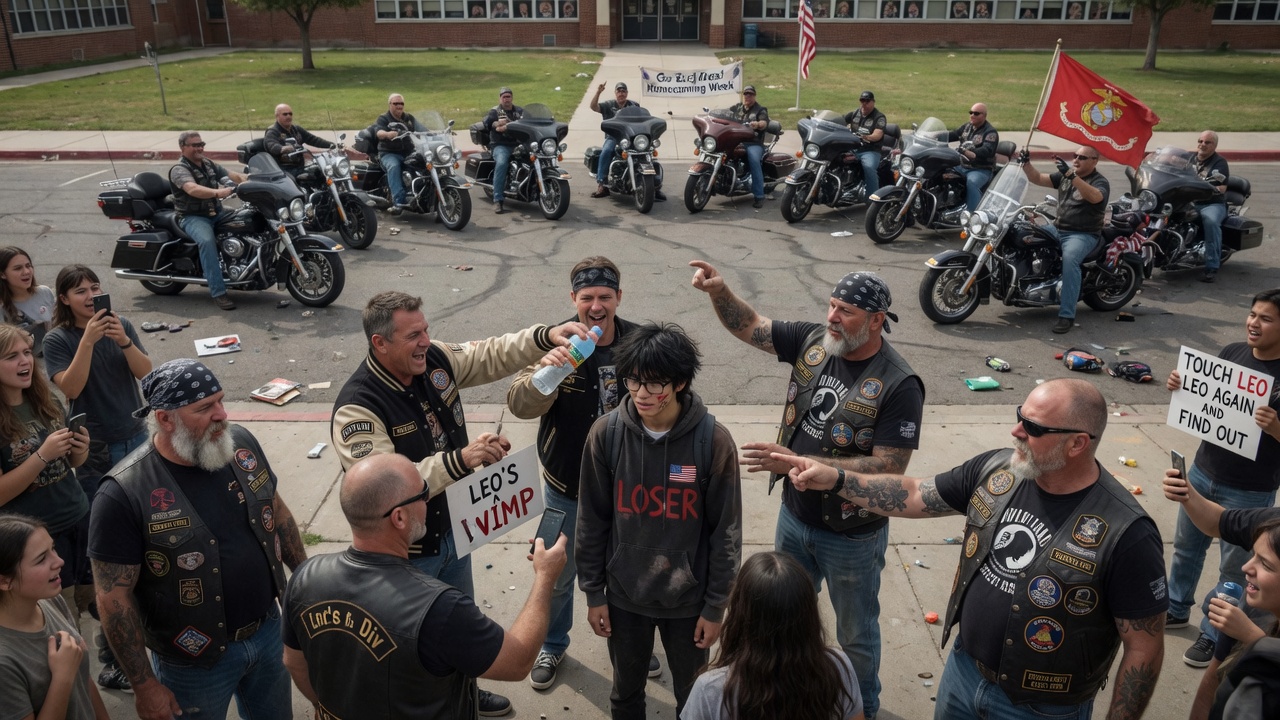
Jax, the National President of the Guardians, didn’t wait for an invitation. He rode his custom Softail right onto the sidewalk, the front tire stopping inches from the cafeteria’s double glass doors. He didn’t look like a criminal. He looked like an ancient king of the asphalt—grey beard braided, eyes hidden behind dark aviators, his “President” patch glowing in the afternoon sun.
Behind him were the others. Hammer, a man built like a refrigerator; Doc, a former combat medic; and Preacher, who could quote the Bible and the owner’s manual of a ’65 Panhead with equal fervor.
They didn’t look at the school. They looked at the windows. Searching.
“Leo,” Principal Miller stammered, walking toward me. “Do you know these people?”
“They’re family, Mr. Miller,” I said. “And I think they heard I was having trouble finding a seat for lunch.”
Tyler turned back to me, his face a mask of desperation. “Hey, man, look. It was just a joke. The chair… it was just a joke, alright? We’re all friends here.”
I looked at Sarah, who was still holding her phone, though her hand was shaking so badly she could barely frame the shot. I looked at Marcus, Tyler’s muscle, who was suddenly very interested in the texture of his shoelaces.
“A joke is when everyone laughs, Tyler,” I said. “I wasn’t laughing. And I don’t think my uncles are going to find it funny either.”
Jax killed his engine. The sudden silence was more terrifying than the roar. He climbed off the bike, his boots heavy on the concrete, and began walking toward the door.
Chapter 3: The Weight of the Ring
The cafeteria doors didn’t just open; they seemed to surrender. Jax walked in, followed by four of the largest men I had ever known. They didn’t run. They didn’t shout. They moved with the terrifying, synchronized patience of a pack of wolves that had already cornered their prey.
Jax’s eyes scanned the room, bypassing the terrified faculty and the gaping students until they landed on me. He saw the dust on my shirt. He saw the red mark on my hip where I’d hit the floor.
His jaw tightened.
“Leo,” Jax said, his voice a low rumble that felt like it was coming from the earth itself. “You missed Sunday dinner.”
“I had a project, Jax,” I said, trying to keep my voice from cracking. “I didn’t want to bother anyone.”
Jax stepped into the center of the cafeteria, his presence shrinking the room. He turned his gaze toward Tyler. Tyler, who was six-foot-two and built for the football field, suddenly looked like a toddler in a costume.
“You the one?” Jax asked. Simple. Direct.
“I… I don’t know what you’re talking about, sir,” Tyler squeaked. “We were just… playing around.”
Jax reached out—a movement so fast it was a blur—and grabbed the collar of Tyler’s varsity jacket. He didn’t lift him, but he held him with a grip that suggested he could if he wanted to.
“My brother Sam died with a wrench in one hand and a prayer in the other,” Jax said, his face inches from Tyler’s. “He spent his life making sure this boy grew up to be a man of character. A man who stays quiet when fools bark. A man who works hard while others play. And you think because he doesn’t hit back, he’s alone?”
Hammer stepped forward, his arms crossed over a chest that looked like it was made of granite. “We’ve been watching the feeds, kid. We saw the TikToks. We saw the ‘jokes.’ We were just waiting for Leo to ask for help.”
“I didn’t ask,” I whispered.
Jax looked at me, a flicker of pride in his weathered eyes. “You didn’t have to, son. The Iron Guardians don’t wait for a formal invitation when one of our own is in the dirt.”
He let go of Tyler’s jacket. Tyler stumbled back, hitting the very table where I had been sitting.
“The school board is going to hear about this!” Principal Miller finally found his courage, though he stayed behind a row of trash cans. “This is trespassing! This is intimidation!”
Jax didn’t even turn around. “No, Miller. This is a wellness check. And what I’m seeing is a school that allows its students to be assaulted in broad daylight. If I call our lawyers—who happen to ride with us on Saturdays—I think the ‘trespassing’ charge will be the least of your worries.”
Jax turned back to Tyler. “Apologize.”
“I… I’m sorry,” Tyler muttered.
“Not to me,” Jax growled. “To the man you tried to break.”
Chapter 4: The Moral Compass
The entire cafeteria was a sea of wide eyes and silent breaths. This was the moment everyone expected me to take my revenge. To let Jax handle it. To watch Tyler get what he deserved.
But as I looked at Tyler—trembling, his eyes darting toward his friends who had all abandoned him—I didn’t feel the rush of victory I thought I would. I felt a strange, heavy weight in my chest.
My father used to say that revenge is a fire that burns the house down just to kill a termite.
“Jax,” I said, stepping between the giant man and the terrified boy. “Let him go.”
Jax looked at me, his brow furrowed. “Leo, this kid has been making your life a living hell for six months. He needs a lesson in humility.”
“He just got one,” I replied. “Look at him. He’s not a villain, Jax. He’s just a kid who thought he was bigger than the world because his dad has a big bank account. Pushing him further isn’t going to make him a better person. It’s just going to make him hate me more.”
The bikers looked at each other. Hammer seemed disappointed, but Doc nodded slowly.
I turned to Tyler. “You asked who was going to save me. The answer isn’t these guys, Tyler. They didn’t come here to save me. They came here to remind me who I am. And I’m not someone who needs to see you suffer to feel good about myself.”
I reached down and picked up the chair Tyler had kicked. I set it back at the table, perfectly straight.
“Sit down, Tyler,” I said.
Tyler blinked, confused. “What?”
“Sit. Eat your lunch. And the next time you think about kicking a chair out from under someone, remember the sound of those engines. Remember that everyone you meet has a story you don’t know. Some of us are just better at keeping the ending a secret.”
Tyler sat. He didn’t have a choice. His legs seemed to have turned to jelly.
Jax watched me for a long time. Then, he let out a short, sharp laugh and slapped me on the shoulder hard enough to rattle my teeth. “Spoken like a Thorne. Your old man would have been pissed you didn’t let us crack a few heads, but he would have been damn proud of the man you’ve become.”
“We leaving, Jax?” Hammer asked.
“Yeah,” Jax said, adjusted his glasses. “We’re leaving. Leo, you’re coming with us. I think you’ve had enough of this cafeteria food.”
“I have a math test next period,” I said.
Jax looked at Principal Miller. “Does he have a math test, Miller?”
Miller looked at the row of bikes outside, then at me, then back at Jax. “I think… I think Leo can take a personal day. For, uh, family reasons.”
Chapter 5: The Road Ahead
Leaving the school was like a scene from a movie. I walked out the front doors, my backpack slung over one shoulder, flanked by the Iron Guardians. The hallway was lined with students, but no one whispered. No one mocked. They watched with a kind of hushed reverence.
As we stepped out into the bright afternoon air, Jax handed me a helmet. It was my father’s helmet. Matte black, with the faded sticker of a silver phoenix on the back.
“Hop on, Leo,” Jax said, gesturing to the empty seat behind him.
As we pulled out of the parking lot, the roar of the fifty bikes drowning out the sound of the school bells, I looked back one last time.
I saw Tyler through the cafeteria window. He was sitting alone at that table, staring at the empty chair across from him. For the first time, he looked small. Not because he was being bullied, but because he was finally seeing the world for what it was: a place where power isn’t about who you can push down, but who you can stand up for.
We rode for hours. We hit the backroads where the oak trees formed a canopy over the asphalt, the smell of pine and gasoline filling my lungs. For the first time in two years, the weight of being “the poor kid” and “the quiet kid” was gone. I was just Leo.
We stopped at a roadside diner, the kind with neon signs and pie that tasted like home. The Guardians took over three large booths, laughing and retelling stories of my father—the time he fixed a bike with a piece of gum and a prayer, the time he rode through a blizzard to get Doc to a hospital.
“You know why we showed up today, Leo?” Doc asked, leaning across the table over a plate of fries.
“Because Tyler kicked my chair?” I guessed.
“No,” Doc said, his face becoming serious. “We showed up because you never complained. We’ve been watching you for months, kid. We saw you working that late shift at the garage. We saw you helping that old lady with her groceries. We saw you taking the hits from those punks and never once using our name to threaten them.”
“You earned that roar today, son,” Jax added, his voice thick with emotion. “You showed more strength in your silence than those kids will ever have in their shouting.”
Chapter 6: The Gift of Silence
By the time Jax dropped me off at my mom’s small apartment that evening, the sun was dipping below the horizon, painting the sky in bruises of purple and gold.
My mom was standing on the porch, her eyes wide as she saw the fleet of motorcycles idling in the street. She knew the sound. She knew the men.
“Jax?” she called out, her voice trembling. “Is everything okay? Is Leo…?”
“He’s better than okay, Maria,” Jax shouted over the engines. “He’s a Thorne through and through. He just needed a reminder that the road is never as lonely as it feels.”
Jax looked at me and nodded. Then, with a collective thunder that shook the windows of the entire block, the Iron Guardians turned their bikes and roared away into the night.
I walked up the stairs to my mom and hugged her. I didn’t tell her about the chair. I didn’t tell her about Tyler. Not yet.
The next Monday, I walked into Oak Ridge High.
The atmosphere had shifted. It wasn’t that people were afraid of me—though some definitely were—it was that the hierarchy had been shattered. The “untouchables” weren’t untouchable anymore.
Tyler was there, standing by his locker. When he saw me, he froze. He didn’t look away, but he didn’t smirk either. He just gave a small, jerky nod. A sign of recognition. A sign of respect.
I walked past him and went to the library.
Mrs. Gable, the librarian who had seen every one of my humiliations over the past year, looked up from her desk. She smiled—a real, knowing smile.
“Quiet morning, Leo?” she asked.
“The best kind, Mrs. Gable,” I said, setting my bag down.
I realized then that my father was right. Silence isn’t a sign of weakness. It’s a sign of a man who knows exactly what he’s capable of, and chooses not to use it. It’s a gift you give to people who don’t deserve to know your heart.
As I sat down to finish my history paper, I felt a shadow fall over my table. I looked up. It was Elena, a girl who usually sat in the back of the class, invisible just like I used to be.
“Is this seat taken?” she asked softly.
I looked at the chair—the same model as the one Tyler had kicked out from under me. I pulled it out for her.
“No,” I said. “It’s all yours.”
Because at the end of the day, the engines will fade and the roar will stop. But the way you treat someone when you finally have the power to destroy them—that is the only thing people will ever truly remember.
The greatest power you will ever possess is the strength to be kind when the world is begging you to be cruel.