The engine of my 1972 Ironhead Sportster didn’t purr; it growled like a beast with a sore throat. It was rusted, the seat was held together by duct tape, and it leaked just enough oil to leave a mark wherever I went. To the kids at Oak Creek Academy, it was an eyesore—a piece of “trash” that didn’t belong next to their Teslas and Range Rovers.
To me, it was a throne.
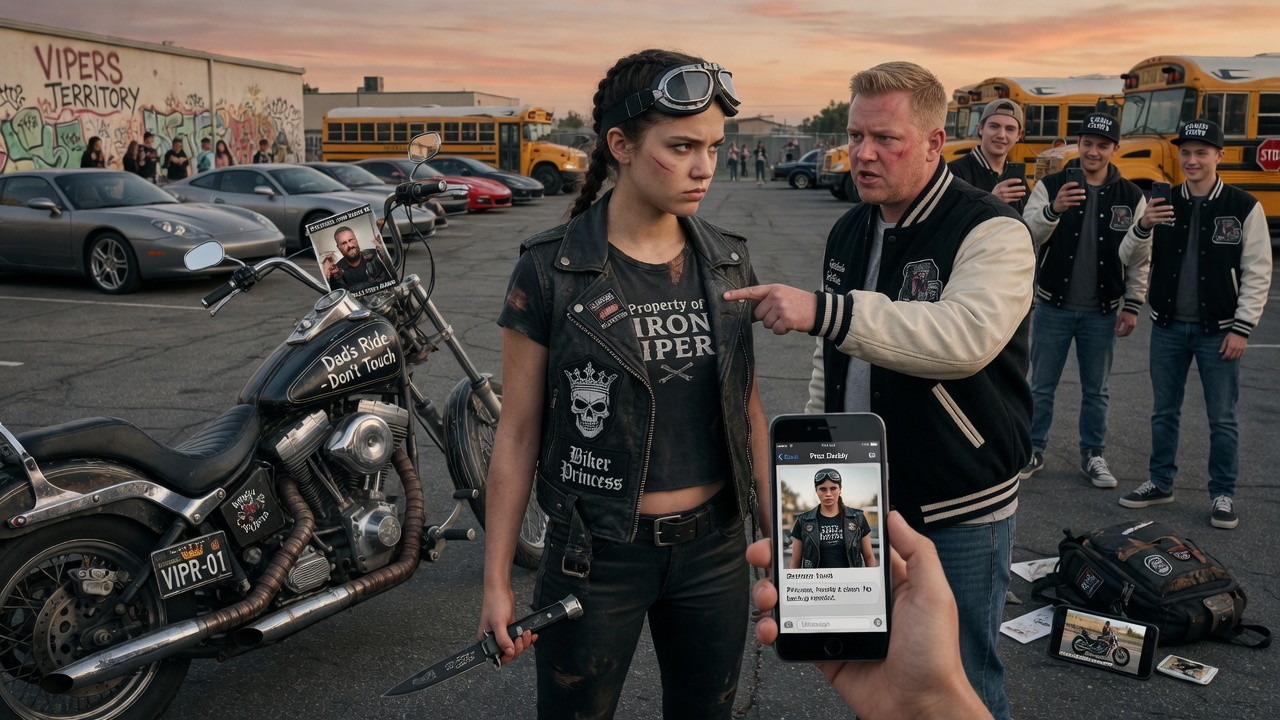
I was pulling into the senior lot when I saw them. Chad Montgomery and his “inner circle”—the kind of kids who thought a high GPA and a trust fund made them invincible. Chad was leaning against his $100,000 Porsche, a smirk plastered across his face that made my skin crawl.
“Hey, Grease Monkey!” Chad yelled, his voice echoing across the lot. “Did you find that thing in a scrapyard, or did you steal it from a museum?”
I didn’t answer. I just killed the engine, the silence following the roar feeling heavier than the noise. I started to unstrap my helmet, my movements slow and deliberate.
“I’m talking to you, Vance,” Chad said, stepping toward me. “This lot is for luxury vehicles. Not… whatever this tetanus-trap is. It’s an embarrassment to the school.”
“It gets me from A to B, Chad,” I said, my voice steady. “Which is more than I can say for your personality.”
A few kids in the background “oohed.” Chad’s face flushed a deep, ugly red. He didn’t like being challenged, especially not by the girl who smelled like gasoline and spent her lunch breaks in the library.
He walked over and did the one thing he should have never done. He kicked my kickstand.
The Sportster hit the asphalt with a sickening, metallic thud. Oil began to weep onto the pristine pavement.
“Oops,” Chad sneered. “Looks like it’s finally where it belongs. In the gutter.”
He reached down and grabbed the small leather tool bag strapped to the forks. He ripped it open, spilling my wrenches and a small, worn leather patch onto the ground. The patch featured a silver skull with wings—the emblem of the Reaper’s Ridge.
“Is this your old man’s little motorcycle club?” Chad laughed, dangling the patch between two fingers like it was garbage. “I heard about those guys. Just a bunch of low-life thugs playing dress-up. Your dad’s probably sitting in a cell right now, isn’t he?”
The air in the parking lot seemed to drop ten degrees.
I looked at the patch—the symbol my father had bled for, the symbol that represented a brotherhood built on loyalty and protection for those who couldn’t protect themselves. My father wasn’t a thug. He was a man who had spent his life keeping our neighborhood safe when the police were too afraid to show up.
I looked back at Chad. He had no idea. He thought he was poking a stray dog. He didn’t realize he had just stepped into the den of a wolf.
“Pick it up,” I said. My voice was a low vibration, almost a growl.
“What was that?” Chad mocked, leaning in.
“Pick. It. Up.”
“Or what? You’re gonna call your biker gang to come beat me up? Please. This is Oak Creek. We have security. We have laws.”
I stepped into his personal space, my boots clicking against the pavement. I didn’t call for help. I didn’t reach for my phone. I reached into the inner pocket of my jacket and pulled out a heavy, silver signet ring. It was the “Princess” ring—given to the daughters of the Ridge leadership when they came of age. It wasn’t just jewelry. It was a warrant.
I slid it onto my finger and watched Chad’s eyes drop to it.
“You’re right about one thing, Chad,” I whispered, so close I could smell his expensive cologne. “The laws here are different. But you just insulted the man who runs the only organization that makes sure those laws actually get enforced in this county. You didn’t just insult a biker. You insulted a King.”
Chad’s smirk didn’t just fade; it disintegrated. He looked at the ring, then at the patch, then back at my eyes—which I made sure were as cold as a winter night in the mountains.
“Now,” I said, my voice cutting through the silence like a blade. “Pick up my bike. Clean the oil off the ground. And give me my father’s patch. If you don’t… well, let’s just say you’re going to find out exactly how a Biker Princess handles garbage.”
Read the full story in the comments.
If you don’t see the new chapter, tap ‘All comments’.
FULL STORY
Chapter 2: The Ghost of the Ridge
I grew up in the smell of chain lube and stale beer, but not the kind you see in the movies. My father’s world was one of iron-clad rules. The Reaper’s Ridge wasn’t a gang to us; it was a tribe. We lived in a house that was technically a fortress, tucked away on the edge of the city where the streetlights didn’t always work, but the neighbors always felt safe.
My father, Jax “Iron” Vance, was a giant of a man with a beard that reached his chest and eyes that had seen things he never talked about. He had sent me to Oak Creek Academy for one reason: “Knowledge is the only weapon they can’t take from you, El,” he’d told me.
He wanted me to have the life he didn’t. He wanted me to be able to walk into a boardroom and own it the same way he owned a highway. But he also made sure I knew how to change my own oil and throw a punch that could crack a rib if necessary.
“People will judge you by what you have, Elena,” he’d said the day he gave me the Sportster. “But you judge them by what they do. Remember who you are. You’re a Vance. We don’t bow.”
Sitting in my first-period Calculus class after the parking lot confrontation, I could feel the stares. The news had traveled fast. The “Scholarship Girl” had stood up to Chad Montgomery. But more importantly, the “Scholarship Girl” had a ring that looked like it belonged in a gothic horror movie.
My only friend at Oak Creek, Maya, leaned over and whispered, “El, what the hell was that? Chad looks like he’s seen a ghost. He’s been in the principal’s office for twenty minutes.”
“He kicked my bike, Maya,” I said, my eyes fixed on the chalkboard. “He shouldn’t have done that.”
“It’s more than the bike, and you know it. That ring… what is it?”
I looked at the silver skull on my finger. “It’s a reminder. That some people are protected by money, and some people are protected by something much, much stronger.”
The central conflict of my life had always been this: the girl who wanted to be an engineer versus the girl who was the daughter of the most feared man in three states. I tried to keep them separate. I wore the uniform, I got the A’s, I kept my head down. But Chad had reached across that line. He had insulted the “Old Man.” And in the world of the Ridge, an insult to the President was an insult to the whole family.
By lunch, the atmosphere had shifted from curiosity to tension. I walked into the cafeteria and the noise level dropped by half. Chad was sitting at his usual table, surrounded by his lieutenants—Stacy, a girl whose mother ran the local country club, and Marcus, a varsity linebacker.
Chad wasn’t laughing anymore. He was staring at me, his jaw tight. He thought he had power because his dad owned the bank. He didn’t understand that my dad owned the people who walked into that bank every day.
I took my seat at a lonely corner table, but I didn’t stay alone for long.
Chapter 3: The Breaking Point
The escalation didn’t happen with words. It happened with a slow, creeping realization.
Stacy was the first one to break the silence. She walked over to my table, her designer heels clicking aggressively. She didn’t have the fear that Chad had; she had the arrogance of someone who had never been told “no.”
“Elena, right?” she said, tossing her blonde hair. “Chad’s a little shaken up. He thinks you’re part of some… cult? But I know better. You’re just a girl from the ‘Ridge’ trying to play tough. My dad’s the District Attorney. He could have your ‘King’ and his little club shut down by dinner time.”
I didn’t look up from my book. “Your dad handles white-collar crime and noise complaints, Stacy. My father handles things that don’t make it into the papers. There’s a difference.”
“You think you’re so special because you ride a loud bike and wear leather?” she hissed, leaning down. “You’re trash. And trash gets collected.”
She reached out to grab the signet ring off my finger. It was a mistake.
Before her hand could even touch my skin, I had her wrist locked. I didn’t hurt her—not yet—but the pressure was enough to make her gasp. The cafeteria went silent.
“Rule number one of the Ridge,” I whispered. “Never touch the colors. And never, ever touch the royalty.”
I let go, and she stumbled back, her face pale. “You’re insane!” she shrieked.
“No,” I said, finally looking her in the eye. “I’m just tired of being humble. You people think kindness is a weakness. You think my bike is old because I’m poor? It’s old because it’s survived more than your entire family tree. It’s got history. It’s got soul. Things you wouldn’t understand.”
That afternoon, I walked out to the parking lot to find my bike had been moved. It wasn’t on the ground this time. It was draped in a “Cleanup” tarp, and someone had spray-painted the word “GANG TRASH” across my leather seat.
Chad was standing nearby, his phone out, recording. “Just helping the janitors, Elena! Taking out the garbage!”
I felt a heat rise in my chest that had nothing to do with the sun. It was the “Iron” in my blood. I didn’t cry. I didn’t yell. I simply took out my phone and made one call.
Not to the gang. Not to my father. I called Officer Miller.
Officer Miller was a veteran cop who had grown up in the same neighborhood as my dad. He knew the truth—that the Ridge kept the drugs out of our schools and the predators off our streets. He knew that the line between “criminal” and “protector” was often just a matter of perspective.
“Miller,” I said when he picked up. “I need a favor. And I need a witness.”
Chapter 4: The Confrontation
The parking lot was full. Everyone wanted to see the fallout. Chad was leaning against his Porsche, looking triumphant. He thought he had won. He thought he had finally “put me in my place.”
Then, the sound started.
It wasn’t one bike. It was the low, rhythmic thrum of twenty.
The students turned toward the entrance of the school. A fleet of motorcycles, all black and chrome, led by a massive man on a custom chopper, pulled into the lot. They didn’t come in hot; they came in like a funeral procession—slow, dignified, and terrifying.
They didn’t wear masks. They wore their patches with pride. The Reaper’s Ridge.
They pulled into a perfect line, blocking the exit. My father, Jax, killed his engine and hopped off. He didn’t look like a thug. He looked like a king arriving at a border dispute.
He walked straight toward me, ignoring the gasps of the wealthy parents picking up their kids. He looked at my bike, then at the spray-painted seat. His eyes turned to flint.
“Elena,” he said, his voice like gravel. “Did you do this?”
“No, Dad,” I said. “I handled it. But they wouldn’t listen.”
Chad was backing away now, his bravado vanishing into the exhaust fumes. Officer Miller pulled up in his cruiser a second later, but he didn’t pull his gun. He stepped out, leaned against his door, and folded his arms.
“Everything okay here, Jax?” Miller asked.
“Just a little property damage, Miller,” my father said, his gaze fixed on Chad. “And a whole lot of disrespect.”
Chad’s father, Mr. Montgomery, came running out of the school building. He was a man in a three-piece suit, used to being the most important person in any room. “What is the meaning of this? Get these… these criminals off school property!”
My father didn’t flinch. He reached into his pocket and pulled out a stack of documents. “Actually, Mr. Montgomery, I’m here as a property owner. I recently purchased the vacant lot across from your bank. And I’m here because your son just committed a hate crime and felony vandalism against my daughter.”
He pointed to the “GANG TRASH” spray paint. “In this state, targeting someone based on their associations—even if you don’t like those associations—is a serious matter. And I have thirty witnesses with phone footage.”
The silence was absolute. Chad looked at his father. Mr. Montgomery looked at the bikers, then at Officer Miller, who just nodded.
“I didn’t call the Ridge to fight for me, Chad,” I said, stepping forward. “I called them to show you what a real family looks like. We don’t hide behind lawyers and bank accounts. We stand for each other.”
Chapter 5: The Truth Revealed
The climax wasn’t a brawl. It was a revelation of weakness.
As the bikers stood like statues, I walked over to Chad’s Porsche. I didn’t touch it. I just looked at it.
“You think this car makes you better than me?” I asked. “It’s a lease, Chad. I know because my dad’s company handles the insurance for your father’s firm. You’re living on borrowed time and borrowed money.”
The crowd murmured. The “Prince of Oak Creek” was a fraud.
“My bike?” I continued, pointing to the Sportster. “I built that engine with my own hands. I know every bolt, every seal. If it breaks, I fix it. If you break, Chad, you just cry to your daddy.”
I turned to Mr. Montgomery. “My father isn’t a criminal. He’s a man who makes sure people like you don’t forget where you came from. He keeps the peace so you can play at being powerful. But today? Today the peace is over.”
My father stepped up, looming over the Montgomerys. “I’m not going to press charges,” he said, his voice surprisingly soft. “Under one condition.”
Chad looked up, hope flickering in his eyes.
“You’re going to spend every Saturday for the next six months at the Ridge Community Center,” my father said. “You’re going to scrub floors, you’re going to serve food to the homeless, and you’re going to learn what it means to actually earn a living. And if you miss a day… well, Miller here will have that vandalism report ready to file.”
Mr. Montgomery looked at the bikers, then at the silent students, and finally at his trembling son. He knew he had no choice. The “Reaper’s Ridge” didn’t just have bikes; they had the hearts of the city.
“He’ll be there,” Mr. Montgomery whispered.
I walked over to my bike. My father reached out and ruffled my hair, a rare gesture of public affection. “You did good, El. You didn’t lose your cool.”
“I’m a Vance, Dad,” I said. “We don’t bow.”
Chapter 6: The Ride Home
The cooling down happened as quickly as the storm had gathered. The bikers roared to life, one by one, and filed out of the parking lot. The students watched in awe, the fear replaced by a strange kind of respect. They had seen something they couldn’t find in a textbook: true authority.
I spent the next hour cleaning the spray paint off my bike. Maya stayed with me, helping me scrub the leather.
“You really are a Biker Princess, aren’t you?” she asked, smiling.
“I’m just a girl who likes to ride,” I said. “The ‘Princess’ part is just for the people who forget how to be human.”
Chad didn’t show up to school the next day. Or the day after. When he finally returned, he was different. He didn’t wear the letterman jacket. He didn’t smirk. He sat in the back of the class and kept his head down. Rumor had it he was actually working at the center, and for the first time in his life, he was learning the names of the people he used to look past.
I kept riding my beat-up bike. I didn’t fix the rust, and I didn’t paint over the scars. They were part of the story.
A few weeks later, as I was leaving school, I saw a group of freshmen looking at my Sportster. One of them looked like he was about to make a joke.
Before he could speak, Stacy walked by. She stopped, looked at the bike, and then looked at the boy.
“Don’t,” she said simply. “That bike has more class than this entire school put together.”
I smiled, kicked the engine over, and felt the familiar vibration through my bones. I didn’t need a Porsche or a crown. I had the wind in my face, the road beneath my wheels, and the knowledge that I was my father’s daughter.
Power isn’t about what you own; it’s about what you’re willing to protect.
The final lesson was simple: Never judge a person by the machine they ride, because you never know the army that stands behind them.
True strength doesn’t roar for attention; it waits for the moment it’s needed most.