They thought they had me.
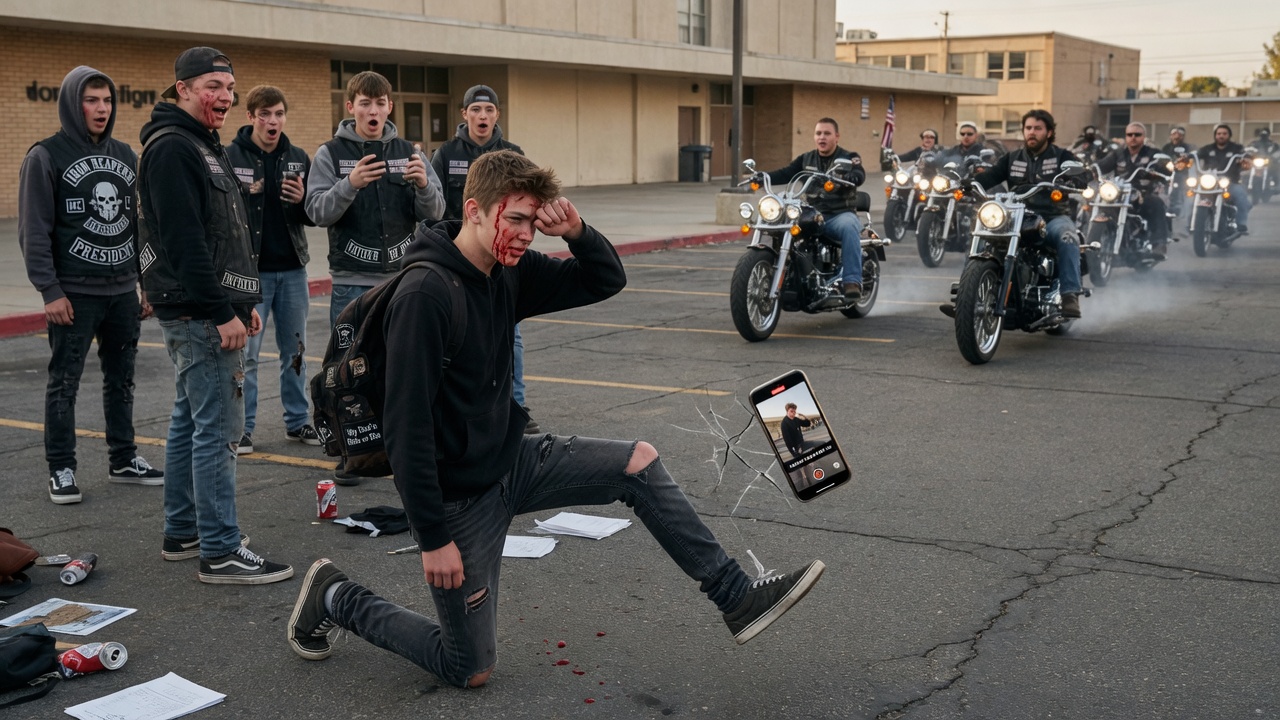
Jax and his crew had me pinned against the cold suburban asphalt of Oak Creek, the same street where they’d spent months making my life a living hell. The camera was inches from my face, catching every drop of blood that hit the ground.
“Say it, Leo,” Jax sneered, his expensive varsity jacket catching the evening sun. “Tell everyone your old man is a low-life thug. Tell them he belongs in a cage with the rest of his ‘gang’.”
They didn’t understand. They saw the leather jackets and the tattoos and they thought ‘criminal.’ They didn’t see the men who held my father’s hand when he woke up screaming from nightmares of a war they’d only read about in history books.
The insults kept coming, sharp and ugly, echoing off the neatly painted garages of our “perfect” neighborhood. They were recording my humiliation, ready to upload it before I could even get home to wash the dirt off my face.
But then, the air changed.
The mocking laughter died in their throats. The recording stopped. Jax’s hand started to tremble, the screen of his phone reflecting a sudden, blinding glint of chrome from the end of the block.
The rumble started as a vibration in my chest, then grew into a roar that shook the very foundations of the houses around us.
I stood up. I didn’t rush. I wiped the blood from my lip, looked Jax dead in the eye, and felt the weight of every silent prayer my father ever whispered.
Justice wasn’t coming on a white horse. It was coming on two wheels.
Read the full story in the comments.
If you don’t see the new chapter, tap ‘All comments’.
FULL STORY
Chapter 1: The Weight of the Patch
The asphalt of Oak Creek was always colder than it looked. To anyone else, this was the heart of the American Dream—rows of colonial-style houses, manicured lawns, and the scent of freshly cut grass. But to me, it was a battleground.
Jax Miller stood over me, his shadow long and imposing in the late afternoon sun. He was the son of the town’s biggest developer, a boy who had never known a day of hunger but had a bottomless appetite for cruelty. In his right hand, he held an iPhone 15 Pro, the lens pointed directly at my face.
“Look at him,” Jax laughed, his voice pitched for his followers. “The big tough biker’s kid. Where’s your dad now, Leo? Probably sleeping off a bender in some trailer park.”
His two friends, Caleb and Mark, stood behind him. Caleb was the muscle, a wide-necked linebacker who enjoyed the physical part of the bullying. Mark was the sycophant, the one who lived to provide the soundtrack of “ohhs” and “ahhs” for Jax’s videos.
“My dad’s at work, Jax,” I spat, my voice thick with the copper taste of blood. I’d taken a sucker punch to the mouth three minutes ago when I tried to walk past them.
“Work?” Mark chimed in. “You mean running drugs? Or is he just cleaning the floors at the clubhouse?”
They didn’t know anything. They saw the “Legacy Vets” patch on my father’s back and assumed it was an invitation to a life of crime. They didn’t know that every man in that club had a Purple Heart or a Bronze Star. They didn’t know that the “gang” they mocked was actually a brotherhood of survivors who spent their weekends raising money for the local children’s hospital.
“He’s more of a man than your father will ever be,” I said, pushing myself up to a kneeling position.
Jax’s face flushed. He didn’t like it when the “victim” talked back. He stepped closer, the toe of his expensive sneaker inches from my hand. “My dad owns half this town, Leo. Your dad is a ghost. A tattooed freak who hides behind a loud engine.”
He leaned down, the camera lens practically touching my nose. “Tell the world, Leo. Tell them your dad is a loser.”
I looked into the lens, then past it. At the end of the long, straight suburban road, something was moving. A flicker of light. A flash of polished silver.
The silence that followed was heavy. The birds stopped chirping. Even the wind seemed to hold its breath. Then, the vibration started. It was subtle at first—a low-frequency hum that rattled the windows of the nearby SUVs.
Jax noticed it too. His brow furrowed. He looked up, squinting against the sun.
The hum became a growl. The growl became a thunderous, rhythmic pulse. Six motorcycles, riding in a tight staggered formation, turned the corner into Oak Creek. The lead bike was a custom Harley-Davidson Fat Boy, its chrome so bright it looked like it was forged from lightning.
My father was in the lead. Behind him were Big Mike, Doc, and Preacher—men who had seen the worst of the world and decided to spend the rest of their lives being the best of it.
Jax’s smug expression didn’t just fade; it disintegrated. He lowered the phone, his fingers twitching.
I stood up. I didn’t feel the pain in my ribs or the sting on my lip anymore. I stood tall, my feet planted firmly on the ground my father’s friends were about to reclaim.
“The recording is over, Jax,” I said, my voice steady.
The bikes were fifty yards away, the sound of their engines echoing like a drumline. My father didn’t slow down until he was right there. The screech of tires and the smell of hot oil filled the air.
I didn’t wait for him to speak. I looked at the phone in Jax’s hand—the weapon he’d used to try and destroy my dignity.
In one fluid motion, I pivoted. My leg snapped out with the precision I’d practiced in the garage every night for three years. My foot connected with the side of the phone. There was a sharp crack as the device exploded out of Jax’s grip, sailing twenty feet through the air before shattering against a mailbox.
The silence that returned was different this time. It wasn’t the silence of fear. It was the silence of justice.
“My father’s ‘gang’ is here,” I whispered to the pale, shaking boy in front of me. “And I think you owe them an apology.”
Chapter 2: The Ghost of the Highway
My father, Elias, killed the engine of his Harley. The sudden quiet was almost more intimidating than the roar had been. He didn’t get off the bike immediately. He just sat there, his gloved hands resting on the handlebars, his eyes hidden behind dark aviators.
The other five men did the same. They formed a semi-circle of steel and leather around us. These weren’t the polished, suburban dads of Oak Creek. They were rugged, weathered men whose faces told stories of deserts and jungles.
Jax looked like he was about to faint. Caleb, the linebacker, had suddenly found something very interesting to look at on his own shoelaces.
“Leo,” my father said, his voice a low rumble. “You okay?”
“I’m fine, Dad,” I said, wiping the last of the blood away. “Just a little dirt.”
Elias swung his leg over the bike and stood up. He was a mountain of a man, his “Legacy Vets” vest fitting tight over his broad shoulders. He walked toward us, his boots clicking rhythmically on the pavement. He didn’t look at Jax with anger; he looked at him with a weary kind of pity.
“You the one with the camera?” Elias asked, looking at the shattered pieces of the phone on the grass.
Jax found his voice, though it was two octaves higher than usual. “He… he kicked my phone! That was a twelve-hundred-dollar phone!”
Elias stopped a few feet away. “And the boy he was recording? What’s he worth?”
Jax stammered, his eyes darting to the other bikers who were now dismounting. Big Mike, a man whose arms were the size of Jax’s torso, crossed his arms and leaned against his bike, watching the scene with a grim smile.
“We were just… joking,” Jax managed to say.
“Jokes usually have a punchline, son,” Elias said. “All I see is a kid on the ground and a bunch of cowards standing over him. Where I come from, we call that a target, not a joke.”
He turned to me, his expression softening for just a second. “Go get your stuff, Leo. We’re going home.”
As I walked toward my backpack, Jax made a mistake. Maybe it was the adrenaline or the desperation to save face in front of his friends. “You can’t do this! My dad is Thomas Miller! He’ll have you all arrested for trespassing! This is a private community!”
Elias stopped. He turned back slowly. The other men stepped forward, just a few inches, but the message was clear.
“We’re not trespassing, kid,” Big Mike growled. “We’re visiting a brother. And last I checked, the road is public.”
Elias looked at Jax. “Tell your father that Elias Thorne says hello. Tell him I remember the night we spent in that ditch outside Fallujah. Tell him I’m glad he’s doing so well in real estate. But tell him if his son ever touches mine again, we’re going to have a very different kind of conversation.”
Jax’s face went white. “You… you know my dad?”
“I saved his life,” Elias said simply. “But clearly, he forgot to teach you how to be a man.”
Chapter 3: The Patch and the Pain
The ride home was silent, save for the wind. I sat on the back of my dad’s bike, my hands gripped onto the sissy bar. We didn’t live in Oak Creek. We lived three miles away in a modest ranch-style house that smelled like motor oil and pine needles.
When we pulled into the driveway, the other guys waved and kept going, their engines fading into the distance. Only Big Mike stayed behind.
Inside, my dad pointed to the kitchen chair. “Sit. Let me look at that lip.”
He grabbed a first-aid kit and a cold beer. He pressed a wet cloth to my face, his touch surprisingly gentle for someone with hands that looked like they could crush stones.
“You didn’t have to kick the phone, Leo,” he said, though I could see a glint of pride in his eyes.
“He was going to post it, Dad. He wanted to make me a meme. He wanted to make us a joke.”
“People like that… they’re small,” Elias said, sitting down across from me. “They build themselves up by tearing others down because they don’t have a foundation of their own. You don’t need to sink to their level.”
“I didn’t,” I argued. “I just leveled the playing field.”
Big Mike leaned against the doorframe, cracking a knuckle. “Kid’s got spirit, Elias. Just like you.”
“That’s what I’m afraid of,” my dad muttered. He looked at me, his eyes searching mine. “Do you know why we call it a ‘gang’ in the streets, Leo? Because people are afraid of what they don’t understand. They see the bikes, the leather, the loud noise, and they think we’re the villains. It’s easier for them to categorize us as ‘bad guys’ than to admit that we’re just broken men trying to keep each other whole.”
“Jax called you a criminal,” I said quietly.
Elias sighed. “I’ve done things in the service of this country that I’m not proud of. Things that haunt me every time I close my eyes. But I’ve never taken anything that wasn’t mine, and I’ve never hurt someone who didn’t deserve it. You remember that. The patch isn’t about power. It’s about accountability.”
That night, I couldn’t sleep. I kept thinking about Jax’s face when my dad mentioned his father. The “Absolute Collapse” of his ego was a sight I’d never forget. But I knew it wasn’t over. People like Jax Miller didn’t learn lessons; they just looked for bigger sticks.
I opened my laptop and saw the first wave of the storm. Someone—one of the neighbors, probably—had filmed the encounter from their porch. The video was already going viral on the local town page.
The headline read: Biker Gang Terrorizes Suburban Teens.
The comments were a bloodbath.
Chapter 4: The Silent Witness
By Monday morning, I was the most famous person at Oak Creek High, and not in a good way. The video of the “confrontation” had been edited. It didn’t show Jax punching me or filming me on the ground. It started right when the bikes roared into the cul-de-sac and ended with me kicking the phone.
I walked down the hallway, and it was like I was a ghost. People stepped aside, whispering.
“There he is. The one with the biker thugs.”
“I heard they have guns.”
“Did you see him kick that phone? He’s a psycho.”
Jax was in the center of the cafeteria, surrounded by a larger crowd than usual. He had a bandage on his hand—purely for theatrical effect, I assumed—and a brand-new phone.
“He’s lucky I didn’t call the cops,” Jax was saying loudly as I walked by. “My dad says we should just let the school handle it. People like that… they don’t belong in our zip code.”
I kept my head down, heading for the library. I just wanted to disappear.
“Leo? Wait up.”
I turned. It was Sarah Van Zant. She was the girl Jax had been trying to impress for years—smart, quiet, and the daughter of the local police chief. We’d been in the same chemistry lab for two years, but we’d barely spoken more than ten words.
“You shouldn’t be talking to me, Sarah,” I said, glancing around. “I’m ‘dangerous,’ remember?”
She didn’t smile. She looked around to make sure Jax wasn’t watching, then stepped closer. “I saw what happened, Leo. All of it. I was in my car, waiting for my brother.”
I stopped. “Then you saw him hit me first?”
“I saw everything,” she whispered. “I saw him recording you. I saw how he was talking about your father. And I saw that kick. It was… actually pretty impressive.”
“Why didn’t you say anything?”
“Because my dad is the Chief, Leo. If I get involved in a ‘biker vs. developer’ feud, it becomes a political nightmare. But I have my own video. The real one. From my dashcam.”
My heart hammered against my ribs. “You have to post it, Sarah. They’re calling my dad a criminal. They’re trying to kick the club out of the VFW hall because of this.”
Sarah looked torn. “If I post this, Jax will come after me. And my dad… he won’t be happy I kept it from him.”
“Then don’t do it for me,” I said, leaning in. “Do it because it’s the truth. Isn’t that what your dad always says? That the truth is the only thing that matters?”
She bit her lip, her eyes darting to the cafeteria. “I’ll think about it. But Leo… be careful. Jax is planning something for the charity rally this Saturday. He wants to ‘expose’ the club.”
Chapter 5: The Absolute Collapse
The Legacy Vets Charity Rally was the biggest event of the year for the club. They closed down the park, set up a stage, and did a massive “Toy Run” for the children’s wing of the hospital.
I was helping Big Mike set up the grill when the black SUVs pulled up.
It wasn’t the police. It was the “Save Our Streets” committee—a group of wealthy homeowners led by Thomas Miller, Jax’s father. They were carrying signs and accompanied by a small camera crew from a local news station.
Jax was there too, looking smug. He was holding a stack of papers.
“Mr. Thorne!” Thomas Miller shouted, stepping toward my father. Thomas was a polished man in a silk polo shirt, the kind of man who thought he could buy his way out of any conflict.
My father wiped his hands on a rag and stepped forward. “Thomas. It’s been a long time.”
“Not long enough,” Miller said, his voice dripping with disdain. “We have a petition here. Over five hundred signatures from the residents of this county. We don’t want your ‘kind’ hosting events in our public parks. We’ve seen the videos. We know about the violence.”
“The ‘violence’ was your son bullying mine,” Elias said calmly.
“That’s your story,” Miller countered. “But the video shows a different reality. You’re a liability, Elias. You and your little club are a stain on this community. We’ve already spoken to the city council. Your permit is being revoked as of now.”
The crowd of bikers began to murmur. Big Mike stepped forward, but my father held up a hand.
“You really want to do this here, Thomas?” Elias asked. “In front of the kids we’re trying to help?”
“I’m protecting the kids,” Miller sneered.
“Then protect them from the truth,” a voice called out.
Everyone turned. Sarah Van Zant was walking through the crowd, her phone connected to a portable projector she’d grabbed from the school’s AV club. She didn’t look at Jax. She looked at his father.
“Mr. Miller, I think you should see the rest of the footage,” Sarah said, her voice trembling but clear.
She hit play.
The images projected onto the side of the club’s equipment trailer. It was crystal clear dashcam footage. It showed Jax throwing the first punch. It showed him standing over me, shouting slurs about veterans and “trailer trash.” It showed the sheer, unprovoked malice of the “suburban dream” attacking a kid who was just trying to go home.
The news crew immediately turned their cameras toward the projection.
Then, the audio kicked in. Jax’s voice rang out: “My dad owns the police, Leo. He’ll bury you and your loser father just like he buried those environmental reports last year.”
The silence that fell over the park was absolute. Thomas Miller’s face went from tan to a ghostly, sickly grey. He looked at his son, who was trying to shrink into the pavement.
“Is that true, Jax?” Thomas whispered, the news cameras now shoved in his face.
The “Absolute Collapse” wasn’t a physical one. It was the sound of a reputation shattering in real-time. The “Save Our Streets” committee began to back away, dropping their signs.
My father looked at Thomas Miller. He didn’t look triumphant. He looked sad.
“You were a good soldier once, Tom,” Elias said. “But you forgot that the most important battle is the one we fight at home, for the souls of our children.”
Chapter 6: Two Wheels and a New Road
The aftermath was swift. The news footage went national. It wasn’t just about the bullying anymore; it was about the corruption Jax had accidentally let slip. Thomas Miller was under investigation within the week, and Jax was expelled from Oak Creek High.
The Legacy Vets Charity Rally raised more money that Saturday than it had in the last five years combined. People from three towns over showed up just to shake my father’s hand.
I was sitting on the back of my dad’s Harley as we prepared to leave the park. The sun was dipping below the horizon, painting the sky in streaks of orange and purple.
Sarah walked up to the bike. She looked relieved, like a weight had been lifted off her shoulders.
“I guess I’m officially the most unpopular girl in the ‘elite’ circle now,” she joked.
“You’re pretty popular with us,” I said. “Thank you, Sarah. Truly.”
“It was the right thing to do,” she said, looking at my dad. “My father wanted me to tell you that he’s sorry. He… he forgot who the real heroes were for a minute.”
Elias nodded, a small, rare smile playing on his lips. “Tell him we’re even. And tell him he’s welcome at the clubhouse anytime. We have a bike he might like.”
He kicked the starter. The engine roared to life, a powerful, steady heartbeat that drowned out the world. I climbed on behind him, feeling the familiar vibration.
As we pulled out of the park, a line of motorcycles followed us, their chrome glinting in the twilight. We rode past the manicured lawns and the colonial houses of Oak Creek.
I looked back one last time. Jax’s house was dark, the “For Sale” sign already being hammered into the lawn.
I leaned forward, shouting over the wind. “Where to, Dad?”
“Wherever the road takes us, Leo!” he shouted back. “The world is a lot bigger than one suburban street.”
I realized then that my father was right. They called it a gang because they were afraid of the bond they could never understand. But as we hit the open highway, the wind rushing past us and the brothers riding at our side, I knew the truth.
Justice didn’t just come on two wheels—it stayed there, riding alongside you until the very end.
The final sentence of my viral post that night was simple, but it resonated with millions:
Sometimes, the people society calls “thugs” are the only ones brave enough to show us what a real family looks like.