Chapter 1
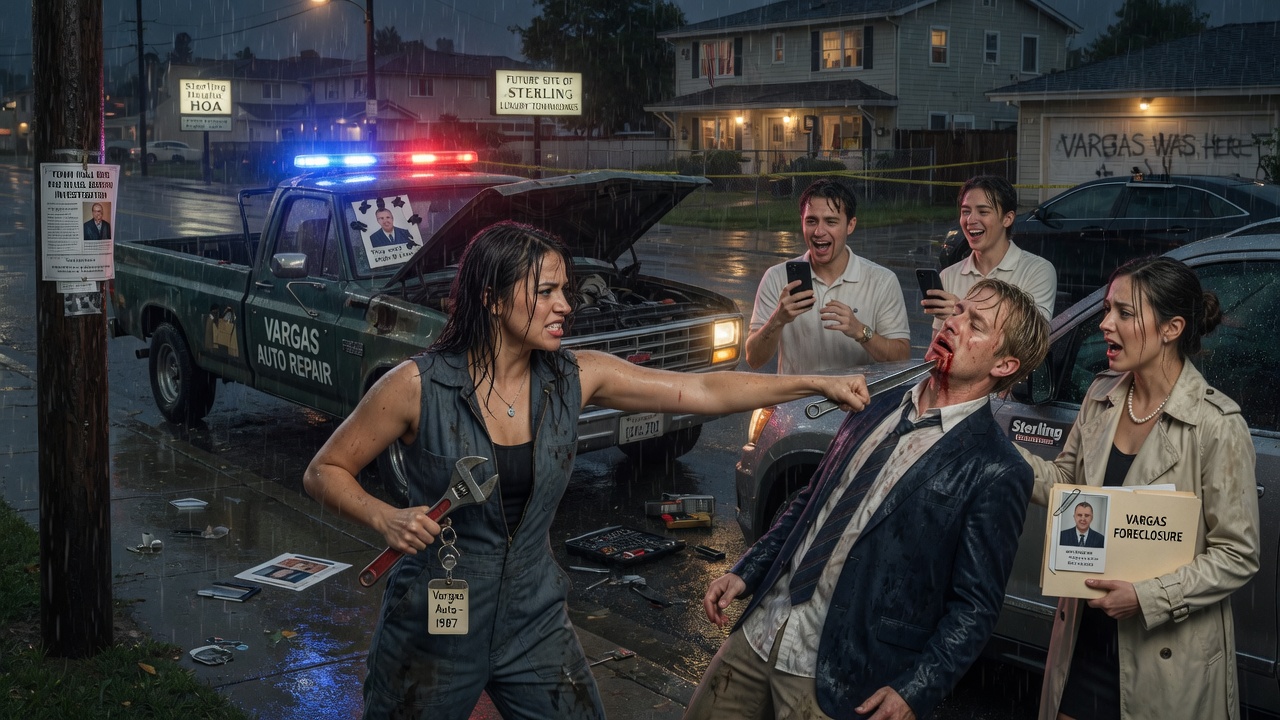
The rain in Oak Creek didn’t just fall; it punished. It turned the red clay of the suburban yards into a slick, treacherous soup and hammered against the corrugated metal roof of “Joe’s Automotive” like a thousand angry hammers. I stood in the center of the driveway, the water soaking through my canvas work jacket, chilling me to the bone. But the cold wasn’t the problem.
The problem was the three pristine SUVs idling at the edge of my property, their headlights cutting through the gray gloom like the eyes of predators.
Chad Sterling hopped out of the lead vehicle, his expensive leather boots splashing into the mud without a care. He looked out of place against the backdrop of rusted frames and oil-stained concrete—a prince visiting the ruins of a kingdom he intended to bulldoze. Behind him, his sister Tiffany followed, shielding her blowout hair with a designer umbrella that probably cost more than the engine I’d spent all morning rebuilding.
“Elena,” Chad called out, his voice dripping with that effortless Ivy League condescension. “You’re still here? I thought the bank sent the notice yesterday.”
I didn’t answer. I just kept my hands in my pockets, feeling the heavy, cold weight of my father’s 10mm wrench. It was the last thing he’d held before the heart attack took him right there on the shop floor.
“We’re making you a generous offer, honey,” Tiffany chimed in, her voice pitched in that fake-sympathetic tone that made my skin crawl. “This lot is an eyesore. The neighborhood is changing. People want organic cafes and yoga studios, not… whatever this is. Your dad was a dreamer, but he was a failure. He died in debt, and he left you with a graveyard.”
They moved closer, cornering me against the side of a rusted 1969 Chevy. Chad stepped into my personal space, the smell of expensive cologne clashing with the scent of diesel and rain.
“You’re nothing without your family, Elena,” he jeered, leaning in so close I could see the triumph in his eyes. “The legacy is dead. You’re just a girl playing dress-up in a dead man’s clothes.”
The laughter from his friends in the cars echoed through the street. They thought I was small. They thought I was broken. They saw a girl in a grease-stained shirt and assumed I was as empty as the bank account they’d helped drain.
I looked up at him, the rain streaming down my face, and I smiled. It wasn’t a friendly smile. It was the kind of smile my father used to wear right before he’d figure out a “totaled” engine.
“You think I’m alone?” I whispered.
Chad blinked, confused by the lack of tears. “I know you are.”
“You’re wrong,” I said, my voice growing steady, fueled by a sudden, roaring heat in my chest. “You see a girl in the rain. I see a girl standing on the shoulders of every man and woman who ever built this town. You’re about to find out just how much of my family lives inside me.”
Before he could react, I moved. It wasn’t a girl’s desperate swing; it was the fluid, explosive power of a thousand hours in the gym and a lifetime of hauling steel. That single kick—the one that sent Chad’s expensive phone flying into the mud and left him gasping for air—was the sound of a thousand engines roaring in defiance against their cruelty.
I am my father’s daughter. And the engine was finally turning over.
Read the full story in the comments.
If you don’t see the new chapter, tap ‘All comments’.
FULL STORY
Chapter 2
The shop wasn’t just a business; it was a sanctuary of steel and memories. After Chad and Tiffany retreated to their air-conditioned fortresses, I walked back into the garage, the silence hitting me harder than the rain ever could. Every tool on the wall had a story. The dented locker in the corner belonged to Bill, a man who had served in the same motor pool as my father in the late 80s.
Bill walked out from the back office now, wiping his hands on a rag that was more black than white. His face was a roadmap of scars and wrinkles, his eyes tired but sharp.
“You shouldn’t have kicked him, El,” Bill said softly, though the corner of his mouth twitched with a ghost of a smile. “The Sterlings own the police, the council, and half the mortgage on this building.”
“They called him a failure, Bill,” I snapped, throwing my wet jacket onto a stool. “They stood on his grave and talked about yoga studios.”
Bill sighed, sitting on the edge of a workbench. “Your father wasn’t a failure, but he was a martyr. He kept the books for the whole neighborhood. Half the people in this suburb are driving cars he fixed for free because they couldn’t afford the dealership prices. That’s why he died broke. He traded his wealth for the town’s mobility.”
I looked at the ledger on the desk—the “Old Wound” of our family. It was filled with IOUs and “pay me when you can” notes. My father, Joe, believed in a version of America that was dying. He believed that if you took care of the machine, the machine would take care of you. But he forgot that the people who own the machines don’t always have souls.
“We have three days,” I said, looking at the foreclosure notice. “If we don’t find fifty thousand dollars, they’ll level this place by Monday.”
“Fifty thousand?” Bill shook his head. “El, we don’t have fifty cents. We’re mechanics, not magicians.”
“My father left a secret,” I whispered, remembering the way he’d look at the floorboards of his old office. “He told me once that if things ever got ‘absolute zero,’ there was a fail-safe. I thought he was talking about a backup generator. But after what Chad said today… I think it’s something else.”
I spent the next six hours tearing up the floorboards. My hands were raw, my back ached, but the “thousand engines” inside me wouldn’t let me stop. Around midnight, I found it. It wasn’t a bag of cash. It was a heavy, waterproof Pelican case buried beneath the foundation. Inside was a flash drive and a stack of blueprints for the suburb’s original infrastructure—blueprints that hadn’t been seen since the 70s.
Attached was a note in my father’s shaky handwriting: For Elena. They’ll try to take the land, but they don’t know what’s buried under it. This isn’t just a garage. It’s the heart. Don’t let them stop the pulse.
Chapter 3
The next morning, the “Secret” began to unravel. I took the flash drive to Sarah, my only childhood friend who hadn’t fled for the city. She worked at the local diner, a place where the police and the council members met for breakfast. She was the eyes and ears of the “real” Oak Creek.
“Elena, you look like you haven’t slept in a week,” Sarah said, sliding a cup of black coffee across the counter. Her eyes were rimmed with red. She was struggling too—her mother’s medical bills were piling up, and the Sterlings were hiking the rent on her small apartment.
“I haven’t. I need you to look at this,” I said, sliding the drive toward her.
Sarah plugged it into the diner’s back-office computer. Her face went pale. “Elena… these aren’t just blueprints. These are environmental reports. The Sterlings’ new development—the one they’re building over the old marsh? It’s sitting on a massive chemical pocket left over from the old factory. Your dad knew.”
“He didn’t just know,” I realized, the truth hitting me like a physical blow. “He spent the last five years of his life paying off the old factory’s debts and filtering the runoff through the garage’s drainage system. He was literally cleaning the town’s poison in secret so they wouldn’t be condemned. And the Sterlings? They stopped the payments. They wanted the land to stay toxic so they could buy it for pennies, wait for the statute of limitations to expire, and then build on it anyway.”
“They’re going to kill the whole suburb,” Sarah whispered. “If they build there, that pocket will burst. It’ll poison the water table for everyone.”
The “Moral Choice” stood before me. I could use this to blackmail the Sterlings for the fifty thousand I needed. I could save my shop and walk away. Or, I could go public and risk them destroying me before the truth ever came out.
As I walked out of the diner, Officer Miller was waiting by my truck. He’d been my father’s friend, but now he was wearing the Sterling family’s “security” badge on his off-duty uniform.
“Elena,” he said, his voice heavy with regret. “Chad filed a report. Assault. I’m supposed to bring you in.”
“He shoved me first, Miller. You know that.”
“I know,” Miller said, looking at the ground. “But my daughter needs her braces, and my pension is tied to the Sterling development. Just… don’t make this hard.”
I looked at the man who had taught me how to change a tire when I was six. The betrayal felt like a serrated blade in my chest.
“My father died protecting your water, Miller,” I said, my voice cold. “And you’re helping them poison it.”
Chapter 4
The town was turning into a battlefield. By Thursday, Sarah had been fired from the diner. Someone had called the health inspector on a “tip.” I knew it was Chad’s way of isolating me.
I sat in the dark garage, the “thousand engines” now feeling like a heavy weight of responsibility. I wasn’t just fighting for a building anymore; I was fighting for the lives of the people who were currently trying to arrest me.
A knock came at the metal door. I expected Miller or a process server. Instead, I found a group of five men and women. They were the “debtors” from my father’s ledger. The construction workers, the teachers, the single moms.
“We heard what happened at the diner,” said a man named Marcus, a welder whose truck my dad had fixed three months ago. “And we heard about what’s under the marsh.”
“How?” I asked.
“Sarah,” he said simply. “She’s been talking to everyone. We might not have fifty thousand dollars, Elena. But we have tools. And we have voices.”
The “Victim and Perpetrator” roles were shifting. The Sterlings thought they were the masters of the board, but they had forgotten the pieces they’d discarded.
We spent the night preparing. If the “Climax” was coming, it wouldn’t be a quiet affair. I realized the secret Joe had kept wasn’t just the environmental report—it was the community itself. He’d built a network of loyalty that money couldn’t buy.
“Elena,” Bill said, coming up behind me as I prepped a portable projector. “You’re doing exactly what he would have done. You’re fixing the broken part of the machine.”
“It’s not enough to fix it, Bill,” I said, my eyes reflecting the harsh glow of the computer screen. “Sometimes, you have to replace the whole engine.”
But the night had one more twist. As the sun began to rise, I saw a familiar car pull up. It was Miller. He looked haggard, his uniform rumpled. He handed me a folder.
“I can’t go to the meeting with you,” he said, his voice cracking. “But this is the paper trail. The Sterlings knew about the chemicals. They’ve been bribing the inspectors for years. My name is on some of those papers, Elena. I’ll go to jail too.”
“Why are you giving this to me?”
Miller looked at the garage, then at me. “Because your father would have forgiven me. And I can’t live with the fact that I don’t deserve it.”
Chapter 5
Monday morning arrived with the roar of bulldozers. Chad and Tiffany stood at the front of the line, wearing hard hats that looked like costumes. A small crowd of reporters had gathered, lured by the promise of a “New Era for Oak Creek.”
I walked out of the garage, not with a wrench, but with a microphone and a projector screen.
“Move the equipment, Elena!” Chad shouted over the idling engines. “It’s over. You’re a squatter on Sterling land now.”
“You’re right about one thing, Chad,” I shouted back, my voice amplified by the shop’s old PA system. “I am nothing without my family. But you don’t understand what family means.”
I hit a switch. The side of the garage—the white-painted brick—became a massive screen. I didn’t show photos of my dad. I showed the environmental reports. I showed the maps of the chemical pocket. And then, I showed the video Miller had given me—a recording of Chad’s father discussing the “acceptable loss” of the neighborhood’s health.
The crowd went silent. The “Fast-paced” revelation hit like a thunderclap.
“It’s a lie!” Tiffany shrieked, but the crowd wasn’t looking at her anymore. They were looking at the water in their own plastic bottles. They were looking at their children.
Chad, panicked, signaled the bulldozer driver. “Knock it down! Now!”
The driver, a man named Henderson—another name from my father’s ledger—turned the engine off. He climbed down from the cab, pulled off his vest, and stood next to me.
One by one, the workers walked away from the machines. The suburb, usually so quiet and compliant, began to hum with a different kind of energy. The neighbors came out of their houses—not to watch, but to join the line.
The “Climax” wasn’t a fight; it was a wall of human defiance. Chad tried to push past me, his face purple with rage. “You ruined everything! You’re a gutter-rat mechanic!”
I didn’t need to kick him this time. I just looked him in the eye. “The gutter is where the truth flows, Chad. You should have stayed in your ivory tower.”
The police arrived, but they weren’t there for me. Miller walked up to Chad’s father, who had just arrived in a panicked sweat, and clicked the handcuffs into place. The “truth revealed” had finally broken the Sterlings’ hold.
Chapter 6
The “Cooling Down” was bittersweet. The garage stayed standing, but the “Enlightenment” came with a heavy price. The town was declared a superfund site for a few months while the cleanup—properly funded this time by the seized Sterling assets—took place.
Bill and I sat on the tailgate of the old Chevy a month later. The shop was busier than ever, but not because we were making money. We were the hub of the restoration project.
“He would have been proud, El,” Bill said, looking at the new sign I’d hung. Joe & Daughter Automotive.
“I think he would have been annoyed I used his good projector for a protest,” I joked, but the tears finally came. They weren’t tears of grief, but of release. I had faced the “loss” of my father and found that he hadn’t left me at all. He had simply integrated into the fabric of the world he’d helped build.
Sarah was the new manager of the diner—now worker-owned. Miller was serving a light sentence, but he wrote to me every week, thanking me for “cleaning the air.”
As the sun set over Oak Creek, the suburb didn’t look like a postcard anymore. It looked like a work-in-progress. It was gritty, it was tired, but it was honest.
I picked up my father’s 10mm wrench and felt the warmth of the metal in my hand. The “thousand engines” weren’t a metaphor anymore; they were the heartbeat of every person who had stood in the rain with me.
I looked out at the street where I had once been cornered and felt a profound sense of peace. The “final sentence” of my father’s life hadn’t been written in a ledger or a bank account. It was written in me.
The world might try to tell you that you are small, that you are alone, and that your legacy is nothing but dust and debt. But they forget that the strongest structures are built from the scraps the world throws away.
I am Elena. I am a mechanic. I am my father’s daughter. And I have finally found my way home.