I didn’t pull into the Midway Gas & Sip because I wanted to be a hero. I pulled in because my 1978 Shovelhead was running lean, and the humidity in Georgia was thick enough to choke a horse. I just wanted a cold Gatorade and ten minutes in the shade.
But to Caleb Vance and his “crew,” I wasn’t a traveler. I was a prop for their next TikTok.
“Check it out,” Caleb shouted, his voice echoing under the rusted tin roof. He and his friends jumped out of a Raptor that smelled like new leather and unearned confidence. They didn’t see the twenty years of Delta service. They didn’t see the engineering patents or the scars on my knuckles from three tours in the dark. All they saw was a Black man on an old bike, wearing a vest that had seen better days.
“You look thirsty, brother,” Caleb sneered, grabbing a red Jerry can from his truck bed. Before I could even kick the stand down, he began pouring the high-octane liquid over my boots.
I kept my voice level, the way my father taught me. “You’re making a mess, son. Stop the can.”
“Or what?” Caleb laughed, flicking a silver Zippo open. The flame danced in the heavy air, inches from my father’s vintage paint job. “You gonna call the cops? My dad owns the precinct. I’m the king of this county, and you’re just a ghost passing through.”
I waited. I waited with a bone-chilling patience that only comes from knowing exactly how a man breaks. I prayed he’d just walk away. I prayed he wouldn’t touch the bike.
But then Caleb kicked the stand. He sent my father’s legacy crashing into the concrete, the smell of gas and broken glass filling the air.
And that was the exact moment the “peaceful man” they were bullying vanished, and the man the government spent millions to train took over.
Chapter 1: The High-Octane Provocation
The heat in Midway, Georgia, wasn’t just weather; it was a physical weight. It pressed down on the rusted tin roof of the Gas & Sip, making the air hum with the smell of old grease and drying asphalt. Elias Thorne felt the sweat itching under his leather vest, a slow trickle moving down the spine of a man who had learned to tolerate discomfort in much worse places than a rural gas station.
He eased the 1978 Shovelhead into the shade of the furthest pump. The bike was a symphony of matte black and polished chrome, a machine that had been passed from his father’s hands to his own. It wasn’t a showpiece; it was a legacy. Elias wiped his brow with a grease-stained bandana, his eyes scanning the perimeter by reflex. Twenty years in Special Operations didn’t just leave you with bad knees and a pension; it left you with a brain that never learned how to turn off.
“Yo, Marcus! Get the camera rolling! We got a live one!”
The voice was high, sharp, and dripping with the kind of entitlement that usually led to a courtroom or a hospital bed. Elias didn’t look up. He knew the sound of a “Golden Boy” from a mile away.
Caleb Vance hopped out of the driver’s side of a white Ford Raptor, the suspension creaking under the weight of his ego. Caleb was twenty-two, wearing a jersey that cost more than most people’s monthly rent, and carrying a smirk that suggested he had never been told “no” in his entire life. He was followed by Tyler and Marcus—two boys who functioned more as an audience than as friends.
“Nice ride, pop,” Caleb said, swaggering over. He didn’t stand near Elias; he stood in his space. “A bit of a relic, isn’t it? Kind of like you.”
Elias unscrewed the gas cap, his movements slow and deliberate. “She runs better than most things built this year, son. Just need a splash of high-octane and I’ll be out of your hair.”
“Son?” Caleb’s smirk flickered. He looked at Marcus, who was already holding a smartphone steady, the red “record” light reflecting in his eyes. “I don’t think you heard me. I’m Caleb Vance. My dad is Vance Development. We own this station. We own that diner. And I don’t like the way your ‘relic’ is leaking oil on my concrete.”
“It doesn’t leak,” Elias said softly. He began to pump the fuel, the rhythmic thump-thump of the pump the only sound in the tense air.
“I think it does,” Caleb said. He reached into the back of his Raptor and pulled out a plastic Jerry can. He unscrewed the lid with a theatrical flourish. “Matter of fact, I think you’re a fire hazard. You look a little dry, brother. Let’s cool you down.”
Elias didn’t move as the first splash of gasoline hit his boots. The liquid was cool, soaking into the thick, protective leather he’d worn through two decades of service. The smell was immediate—sharp, pungent, and terrifyingly volatile.
“Stop the can, Caleb,” Elias said. His voice wasn’t a threat; it was a statement of fact. It was the same voice he’d used to coordinate extractions under heavy fire.
“Oh, he’s getting tough!” Caleb laughed, pouring more. The gas began to puddle around Elias’s feet, reflecting the afternoon sun in shimmering, rainbow-colored oil slicks. “What are you gonna do? I’m making ‘content’ here. This is gonna be a million views by dinner. ‘Biker Boy gets a bath.'”
Caleb tossed the empty can aside. He reached into his pocket and produced a silver Zippo. He flicked it open. The clink of the metal was like a gunshot in the silence. A small, orange flame danced in the heavy air, inches away from the fuel-soaked boots and the open gas tank of the motorcycle.
“You ever see how fast leather burns?” Caleb asked, his eyes wide with a sociopathic curiosity. “It’s organic material, right? Should go up like a Christmas tree.”
Elias looked at the flame. He looked at Marcus’s phone. He looked at the waitress, Sarah, who was watching from the diner window with her hand over her mouth. He saw the world in grids, in trajectories, in points of failure. He was calculating the flashpoint of the vapor, the distance to the fire extinguisher, and the exact three pounds of pressure needed to snap Caleb’s wrist before the lighter hit the ground.
“You’re playing with things you don’t understand,” Elias said.
“I understand power,” Caleb sneered. He stepped back and delivered a sharp, mocking kick to the motorcycle’s kickstand.
The 1978 Shovelhead—the bike Elias’s father had died trying to finish—toppled over. It hit the concrete with a sickening, metallic crunch. The mirror shattered. The gas from the open tank began to pour out, mixing with the puddles around Elias’s boots.
The laughter from the three boys was loud, hollow, and final.
And then, the world went quiet.
Elias Thorne didn’t roar. He didn’t curse. He simply stepped out of the puddle, his fuel-soaked boots making a wet, slapping sound on the asphalt. He looked at Caleb, and for the first time in his life, Caleb Vance saw a ghost. Not the kind that haunts houses, but the kind that haunts the nightmares of men who think they are untouchable.
“The prank is over,” Elias said.
FULL STORY
Chapter 2: The Tactical Shift
In the world of high-stakes operations, there is a concept called the “OODA Loop”—Observe, Orient, Decide, Act. Most people take seconds to process a threat. Elias Thorne had been trained to do it in milliseconds.
As Caleb laughed, his thumb hovering over the Zippo’s wheel, he thought he was the one in control. He thought the man in the leather vest was a victim. He didn’t realize he was standing three feet away from a human weapon designed by the most elite training programs in the United States military.
Elias saw the lighter. He saw the grip Caleb had on it—loose, arrogant, unprofessional. He saw the way Tyler and Marcus were positioned—weight on their heels, eyes fixed on their phone screens, totally unprepared for physical reality.
“Hey, pops, I said dance!” Caleb yelled, flicking the lighter again.
Elias moved.
It wasn’t a punch; it was a clinical extraction of a threat. In one fluid motion, Elias’s left hand caught Caleb’s wrist, twisting it inward with a precision that bypassed the muscle and went straight for the joint. The Zippo flew from Caleb’s fingers, arching through the air. Elias’s right hand caught the lighter mid-flight, snapping it shut before the flame could touch the gas-soaked concrete.
“What the—” Caleb started, but the air left his lungs as Elias’s palm struck his solar plexus. It wasn’t a killing blow, but it was a “system reboot.” Caleb collapsed into the puddle of gasoline, his designer jersey soaking up the fuel he had just poured.
“Drop the phone,” Elias barked, his voice cracking like a whip at Marcus.
Marcus froze, the smartphone trembling in his hand. He looked at Elias—really looked at him—and saw the “Mean Streak.” It was a look of cold, surgical indifference. It was the look of a man who had seen the worst of humanity and knew exactly how to dismantle it.
“I said drop it,” Elias repeated.
Marcus let the phone fall. It clattered onto the pavement, the screen cracking, but the record light still blinking.
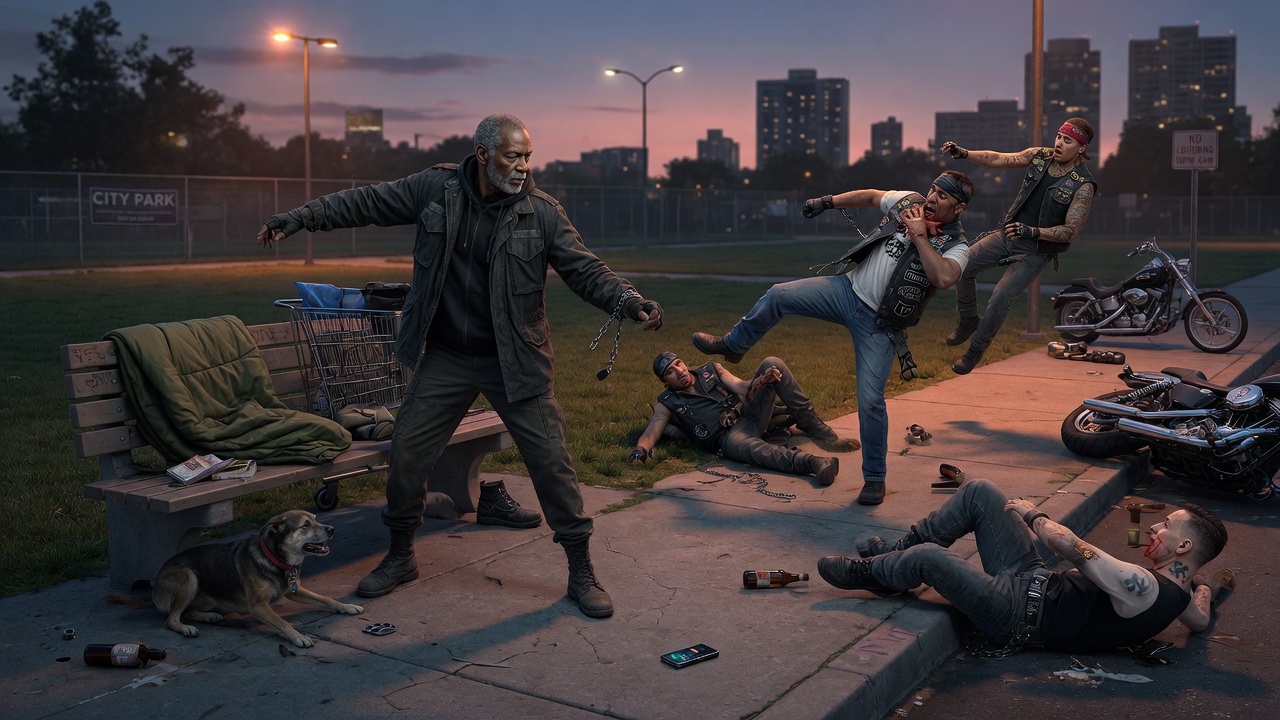
Tyler tried to step forward, his hands balled into fists, fueled by a desperate need to protect the “Golden Boy.” Elias didn’t even turn his full body. He delivered a snapping front kick to Tyler’s thigh—a common peroneal strike. Tyler’s leg went dead instantly, and he crumpled next to the Raptor, clutching his leg in silent agony.
The entire engagement had lasted exactly four seconds.
Elias stood in the center of the gas station, the smell of high-octane fuel filling his lungs. He looked down at Caleb, who was currently hyperventilating in the puddle of his own “prank.”
“You poured gasoline on a man,” Elias said, his voice a low, terrifying rumble. “In most jurisdictions, that’s attempted aggravated assault. With a lighter in your hand? That’s attempted murder.”
“I… I was just… it was a joke!” Caleb wheezed, his face turning a sickly shade of gray as the fumes began to sting his eyes. “My dad… he’ll kill you for this!”
“Your dad is the reason you think the world is a playground,” Elias said. He reached into the side bag of his fallen motorcycle—the bag that hadn’t been crushed in the fall—and pulled out a heavy, black leather folder.
Elias walked over to the Raptor and slammed the folder onto the hood. He flipped it open.
Inside wasn’t a driver’s license. It was a platinum-embossed credential for “Global Energy & Security Architecture,” a high-level federal consulting firm. Next to it was a gold-trimmed shield from the Department of Justice, identifying Elias as a Senior Tactical Auditor.
“My name is Elias Thorne,” he said, leaning down until he was inches from Caleb’s face. “I don’t just ride a bike, Caleb. I’m the man the federal government sends to audit the safety and security of the very fuel pipelines your father’s development company relies on. I was supposed to meet him tomorrow for a ‘friendly’ compliance review.”
Elias picked up the Jerry can Caleb had tossed aside and set it upright.
“I think the review just started,” Elias said. “And so far, your family is failing.”
FULL STORY
Chapter 3: The Weight of the Law
The silence that followed was broken only by the distant sound of a siren. Sarah, the waitress from the diner, had finally found the courage to pick up the phone. But she hadn’t called the local police; she had called the County Sheriff, a man she knew didn’t play favorites with the Vance family.
Sheriff Ben Halloway pulled into the station three minutes later. He was a man of sixty, with a face like a topographical map of Georgia and eyes that had seen every trick in the book. He stepped out of his cruiser, his boots crunching on the gravel, and took in the scene.
He saw the Raptor. He saw the three boys on the ground. He saw the spilled gas. And he saw Elias Thorne, standing tall over his fallen motorcycle, holding a DOJ shield.
“Special Agent Thorne,” Halloway said, tipping his hat. He didn’t look at the boys. He looked at Elias. “I heard you were coming to town. Didn’t think you’d be starting the party at the Gas & Sip.”
“The party was started for me, Sheriff,” Elias said, his voice regaining its calm, professional edge. “Mr. Vance here decided to facilitate a safety demonstration involving open flames and high-octane fuel.”
“Is that so?” Halloway walked over to Caleb, who was trying to scramble to his feet. The Sheriff put a heavy boot on Caleb’s shoulder, gently but firmly pinning him back down. “Caleb, I’ve told your daddy for years that your ‘content’ was gonna land you in a cage. Looks like today’s the day.”
“He attacked us!” Caleb screamed, his voice cracking with a mixture of rage and terror. “He’s a thug! Look what he did to Tyler’s leg! I want him arrested! Now!”
Halloway looked at the cracked phone on the ground. He picked it up. The video was still there. He hit play, watched for thirty seconds, and then looked at Caleb with a look of pure, unadulterated disgust.
“You poured gas on a federal officer, Caleb,” Halloway said. “And you held a lighter to him while your friends filmed it. In this county, we call that a felony. In the federal system, they call that a long-term residency in Leavenworth.”
The color drained from Caleb’s face. “Federal? No… no, my dad said—”
“Your dad isn’t here, son,” Halloway interrupted. He pulled out a pair of heavy steel handcuffs. The clink-clink-clink of the ratchets was the loudest sound in Midway.
As Halloway began to read Caleb his rights, a black Mercedes S-Class tore into the station, its tires screaming. A man in a $3,000 suit burst out of the door. This was Silas Vance—the man who owned the county, the man who built the shopping centers, and the man who had raised a monster.
“What is going on here?” Silas roared, his face a mask of practiced authority. “Ben, release my son this instant! I don’t care what he did, I’ll pay for the damage.”
Halloway didn’t flinch. He just pointed to Elias. “Silas, I’d like you to meet Special Agent Elias Thorne. He’s the man you’re supposed to have a meeting with tomorrow morning about your pipeline easements.”
Silas froze. He looked at Elias, then at the gas-soaked boots, then at his son in handcuffs. The realization hit him like a physical blow. The authority drained out of his posture, replaced by the desperate, frantic calculation of a businessman who had just watched his empire catch fire.
“Agent Thorne,” Silas stammered, his voice losing its edge. “I… I’m sure we can settle this. It was a prank. Boys being boys. My son has a… high spirit. I’ll make a donation to whatever fund you want. Just… let’s not make this a federal matter.”
Elias looked at the man. He saw the same entitlement in the father that he had seen in the son. He saw a man who thought everything had a price, including the honor of a veteran and the safety of a community.
“Your son didn’t just break a law, Silas,” Elias said, stepping forward. “He broke a man’s peace. He spit on a legacy. And he did it for ‘likes’.”
Elias knelt down by his fallen Shovelhead. He ran a hand over the dented tank. “This bike was the last thing my father touched before he died. He was a Master Sergeant in the First Cav. He taught me that respect isn’t something you buy; it’s something you earn through service and silence.”
Elias looked back at Silas. “Tomorrow’s meeting is canceled. My report will be on the Secretary’s desk by Monday. And as for your son? He’s not going to a donation fund. He’s going to a cell.”
FULL STORY
Chapter 4: The Old Wound
The sunset in Midway was a bruised purple and orange, casting long, haunting shadows across the pavement of the gas station. Elias sat on a plastic crate, a cup of coffee from Sarah in his hand, watching as the tow truck carefully winched his Shovelhead onto the bed.
“I’m so sorry, Elias,” Sarah said, sitting down next to him. She had been the one to bring the bucket of soapy water to wash the gas off his boots, though the smell still lingered—a sharp reminder of how close he had come to the fire.
“It’s just metal, Sarah,” Elias said, though his eyes told a different story.
“It’s not just metal,” she countered. “I remember your dad. Arthur Thorne. He used to come into the diner every Sunday. He’d talk about you. He was so proud when you went into the Rangers. He told me you were the kind of man who would ‘keep the world’s gears turning’ while everyone else was sleeping.”
Elias smiled, a rare, genuine expression that softened the hard lines of his face. “He was a good man. He didn’t have much, but he had his integrity. He bought me these boots the day I graduated from Jump School. He told me, ‘Elias, a man’s feet are what keep him connected to the earth. You keep them clean, and you keep them moving forward.'”
Elias looked at the boots. They were stained now, the gasoline having eaten into the finish.
“The Vances have been the ‘kings’ of this town for three generations,” Sarah said, her voice dropping. “They think the rules are just suggestions for people who don’t have their bank account. Caleb… he’s done things like this before. He bullied a kid last year until the family had to move. The Judge just threw the case out.”
“The Judge won’t be throwing this one out,” Elias said. “The DOJ doesn’t take kindly to its agents being targeted by local ‘royalty’.”
Elias thought back to his time in the Delta. He had seen warlords in third-world countries who operated exactly like Silas Vance. They built their power on fear, on the assumption that they could buy anyone and anything. They didn’t understand that there are some men who cannot be bought, men whose value is measured in oaths and honor rather than currency.
He thought about the “prank.” It was a symptom of a deeper rot. A generation of kids raised to believe that other people were just “content” for their digital lives. They didn’t see the human being; they saw the “view count.”
“Why did you wait?” Sarah asked. “I saw you. You could have stopped him the second he opened that Jerry can. You’re faster than a snake, Elias. Why did you let him pour it?”
Elias took a slow sip of the coffee. “Because in my world, you don’t engage until the threat is manifest. If I’d hit him before he poured the gas, I’d be the ‘aggressive biker’ attacking a local kid. I had to let him show the world exactly who he was. I had to wait for the OODA loop to close.”
“That’s a lot of patience,” she whispered.
“It’s not patience, Sarah. It’s the burden of power. When you know exactly how much damage you can do, you have a moral obligation to be the last person to throw a punch.”
Elias stood up as the tow truck driver signaled he was ready. He looked at the gas station—the scene of the “prank” that had just changed the course of the town’s history.
“He touched the bike, Sarah,” Elias said, his voice cold again. “That was the one thing I couldn’t ignore.”
FULL STORY
Chapter 5: The Climax of Truth
The Midway Town Hall was a red-brick building that looked like it belonged on a postcard, but inside, the atmosphere was more like a war room.
The news of Caleb Vance’s arrest had spread through the county like a brushfire. By the following evening, the diner was packed, and the Town Hall was overflowing with residents who had spent years under the thumb of Vance Development.
Silas Vance stood at the front of the room, his $3,000 suit looking wrinkled for the first time in his life. He was surrounded by a team of lawyers, but they looked like they were trying to hold back a flood with a handful of sand.
“This is an outrage!” Silas shouted, his voice cracking. “My son is a good boy! This ‘Agent Thorne’ provoked him! He’s an outsider coming in here to destroy our community’s progress!”
The crowd murmured, but it wasn’t the sound of support. It was the sound of a pot starting to boil over.
The back doors of the hall swung open.
Elias Thorne walked in. He wasn’t wearing his leather vest or his gas-stained boots. He was wearing a crisp, charcoal-gray suit that fit him with military precision. He carried a leather briefcase and a presence that made the entire room go silent.
He didn’t walk to the front. He stood in the aisle.
“Mr. Vance,” Elias said, his voice amplified by the acoustics of the hall. “I’m not here to talk about your son. I’m here to talk about your company.”
Elias opened his briefcase and pulled out a stack of documents. “While I was waiting for my motorcycle to be repaired today, I did a preliminary audit of the pipeline easements you filed with the Department of Energy last quarter. It seems there are some… inconsistencies.”
Silas’s face went from pale to ghostly. “Those are private records! You have no right—”
“As a Senior Tactical Auditor for the DOJ, I have every right,” Elias interrupted. “In fact, I found that you’ve been bypassing environmental safety protocols on three of the four lines running through this county. The same lines that run directly under the local elementary school.”
The room erupted. Mothers stood up, shouting. The Sheriff moved to the front to maintain order, but his eyes were on Silas.
“You’ve been cutting corners to maximize your profit, Silas,” Elias continued, his voice calm and relentless. “And you’ve been using your influence to make sure no one looked too closely. But you made a mistake. You raised a son who thought he was so untouchable that he could assault a federal officer on camera.”
Elias walked toward the front, the crowd parting for him like the Red Sea. He stopped three feet from Silas.
“Caleb thought he was ‘the king of the county,'” Elias said. “But he forgot that kings are only as strong as the people who serve them. And today, your people are done.”
Elias turned to Sheriff Halloway. “Sheriff, I’ve already contacted the EPA and the Federal Bureau of Investigation. They’ll be here in the morning to serve the warrants. As for Caleb… the U.S. Attorney has decided to pick up the case. He’ll be transferred to federal custody within the hour.”
Silas slumped into his chair. He looked at the faces of his neighbors—the people he had bullied, the people he had cheated. He didn’t see fear anymore. He saw justice.
Elias looked at the crowd. He saw Sarah in the front row, a look of pure relief on her face. He saw the truckers, the shopkeepers, the “ghosts” of the town who were finally being seen.
“Justice isn’t a prank, Silas,” Elias said. “And it isn’t a view count. It’s the engine that keeps this country running. And tonight, your engine just seized.”
FULL STORY
Chapter 6: The Cooling Down
The morning air was crisp and clean, the humidity of the previous week having been washed away by a midnight thunderstorm.
Elias stood in front of Jax’s Garage, the local shop where his Shovelhead had been spent the last two days. Jax, an older Black man with hands that looked like they were made of oak, rolled the bike out onto the gravel.
The tank had been repaired, the matte black paint flawlessly restored. The mirror was new, and the engine hummed with a precision that only a master mechanic could achieve.
“She’s ready, Elias,” Jax said, wiping his hands on a rag. “I took the liberty of tuning the carburetors. She was running a little lean.”
“Thanks, Jax. My dad would have appreciated the attention to detail.”
“Your dad was the one who taught me how to work on these old girls,” Jax said, a nostalgic glint in his eye. “He always said you were the best of us. I see he was right.”
Elias swung his leg over the seat. The leather felt familiar, the weight of the bike a comfort against his legs. He was wearing a new pair of boots—the same brand his father had bought him, but clean and ready for the miles ahead.
He looked at the Town Hall across the square. The FBI SUVs were already parked in front, agents in windbreakers carrying boxes of files out of Silas Vance’s office. Caleb was gone, already halfway to a federal holding facility in Atlanta.
The “Golden Boy” was gone. The “King” had been dethroned.
Sarah walked out of the diner, a thermos in her hand. She walked over to Elias and handed it to him.
“You’re leaving?” she asked.
“The road’s calling, Sarah. And my report is done.”
“Midway’s gonna be a different place because of you,” she said. “People are talking. They’re finally feeling like they can breathe again.”
“It wasn’t me, Sarah. It was the truth. It just needed a little push to get started.”
Elias kicked the bike into gear. He looked down at the “Veteran” patch on his vest. It was straight, proud, and clean.
He thought about the “OODA loop.” He thought about the fire that almost was. He realized that his life had always been about this—about being the man who stands in the gap, the man who ensures that the bullies don’t win and the legacy doesn’t die.
He didn’t feel like a hero. He felt like an architect. He had looked at a broken system, found the point of failure, and applied the necessary pressure to fix it.
“Take care of the town, Sarah,” Elias said.
“Take care of the road, Ghost,” she replied.
Elias twisted the throttle, the Shovelhead roaring to life with a sound that echoed off the brick buildings of the square. He pulled out of the garage, the wind catching his hair as he accelerated.
He passed the “Welcome to Midway” sign, but he didn’t look back. He looked forward, toward the horizon where the black asphalt met the blue sky.
He thought about his father. He thought about the boots on his feet and the steel between his legs. He knew that wherever he went, he was carrying a piece of Arthur Thorne with him.
The world is full of people who think they can set fire to your life for a moment of attention, never realizing that some men are forged in the very flames they try to start.
Respect isn’t a digital footprint; it’s the quiet vibration of an engine that refuses to quit, even when the road gets rough.