The world thinks it knows what a broken man looks like. They see the grey in my beard, the dust on my boots, and the way I share my last bite of beef jerky with a three-legged mutt named Bear, and they think I’m a victim. They see a man who lost his place in the sun and ended up on a splintered bench in O’Malley Park, and they think I’m an easy target.
They forget that some men aren’t hiding from the world because they’re afraid of it. They’re hiding because they’re afraid of what they’ll do to it if they’re ever pushed again.
It was a Tuesday, the kind of humid afternoon where the air feels like a wet wool blanket. I was sitting on Bench 4, watching the pigeons, when the rumble started. Four of them. Chrome, leather, and the kind of loud-mouthed arrogance that usually hides a very small soul. They didn’t just want to ride through the park; they wanted to own it.
“Look at this,” the leader said, killing his engine right in front of me. He was a mountain of a man, smelling of cheap beer and stale cigarettes. “Hey, Pops. You got a permit for this bench? Or do we need to start charging rent?”
I didn’t look up. I just kept scratching Bear behind the ears. “Just passing through, fellas. No trouble here.”
“I think there is trouble,” another one said, stepping off his bike. He looked at Bear. “And I hate rats. Especially ones that breathe.”
He didn’t wait for an answer. He pulled his heavy, steel-toed boot back and swung it toward Bear’s ribs.
For twelve years, I had kept the beast inside a cage. I had buried the operative, the ghost, the man they sent into the dark corners of the world to do the things no one else could. I had promised myself I was done.
But when I heard Bear’s yelp, the cage didn’t just open. It disintegrated.
I caught the boot two inches from my dog’s fur. The biker’s eyes widened. He tried to pull back, but I was an anchor. I looked him dead in the eye, and for the first time in a decade, the Ghost came out to play.
“You should have left the dog alone,” I whispered.
Chapter 2
The sound of the biker’s tibia snapping was a clean, sharp pop that cut through the afternoon hum of the park. It was a sound I hadn’t heard in years, but my body remembered it like a favorite song.
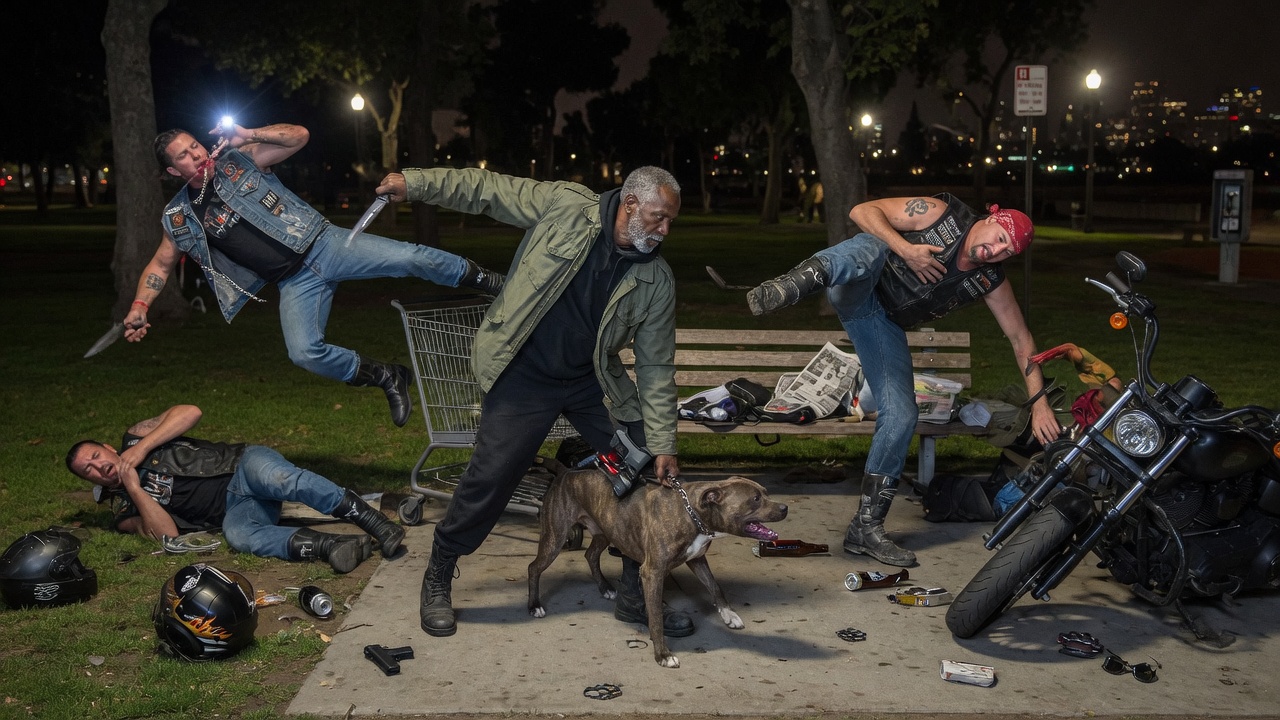
The leader, a man whose jacket said ‘Big Dog,’ didn’t even have time to scream before I stood up. I didn’t stand like an old man with a bad back. I rose with the fluid, predatory grace of a man who had spent his youth clearing rooms in Kandahar.
“Get him!” Big Dog roared, stumbling back.
The three remaining bikers lunged. The one on the left had a chain; the one on the right, a switchblade. It was a classic pincer movement, the kind they teach you to defeat in the first week of Black Ops transition training.
I stepped into the man with the chain, using his own momentum to drive my elbow into his temple. He went down hard, his eyes rolling back before he even hit the clover. I didn’t stop to watch him fall. I spun, catching the wrist of the knife-wielder. A simple torque of the joint, a quick palm-strike to the bicep, and the knife clattered to the pavement. I followed up with a knee to his sternum that ended the fight before his brain could register the pain.
It took exactly six point four seconds.
Big Dog was the only one left standing. He was reaching into his waistband, his fingers fumbling for a compact Glock. He was shaking. People like him are used to bullying those who can’t fight back. They aren’t used to seeing their entire world dismantled by a “bum” in a dusty jacket.
“Don’t,” I said. The word was a command, vibrating with the authority of a man who had commanded battalions.
He pulled the gun anyway.
I didn’t wait. I closed the distance in two strides. I didn’t punch him; I used a tactical disarmament technique that ended with his Glock in my left hand and my thumb pressing into the nerve cluster behind his ear. He fell to his knees, his face turning a mottled shade of purple.
“I spent twenty years serving a country that doesn’t remember my name,” I said, leaning close to his ear as he gasped for air. “I live on this bench because it’s the only place quiet enough to drown out the screams of the men I’ve had to break. And you thought it was a good idea to kick my dog?”
I tossed his gun into the park pond. It splashed once and vanished.
“Get your friends. Get your bikes. If I see you in this zip code again, I won’t be this gentle.”
I let him go. He collapsed, sobbing, as he crawled toward his unconscious comrades.
I turned back to Bench 4. Bear was sitting there, his tail giving a tentative wag. I reached into my pocket, my fingers brushing against the cold, notched edge of my old Mission Specialist coin. I looked at my hands. They weren’t shaking.
That was the problem. They should have been.
Chapter 3
The sirens arrived ten minutes later, but I wasn’t there. I had gathered my rucksack and Bear, moving through the shadows of the tree line with a silence that was second nature.
I ended up at ‘The Hole,’ a small, dingy diner on the edge of the industrial district. The waitress, a woman named Clara with tired eyes and a heart of gold, didn’t ask questions when she saw the dirt on my jacket or the way I kept my back to the wall.
“The usual, Elias?” she asked, setting a bowl of water down for Bear.
“Thanks, Clara.”
“You look like you’ve seen a ghost,” she remarked, wiping the counter.
“I think I woke one up,” I replied.
I wasn’t the only one at the diner. In the corner sat Marcus, a young man I’d been mentoring in secret. Marcus was a tech-whiz who had fallen through the cracks of the foster system. He didn’t know who I really was; he just knew I was the guy who taught him how to stay off the grid and how to spot a tail.
“Elias,” Marcus whispered, sliding into the booth across from me. He looked terrified. “You’re on the news. Or at least, the ‘Bench 4 Incident’ is. Someone caught the end of it on a dashcam.”
He flipped his laptop around. The video was grainy, but there I was—a blurred shadow dropping three men in seconds. The comments were a wildfire of speculation.
“They’re calling you the ‘Vigilante Vet,'” Marcus said. “But that’s not the bad part. The guy you tucked into the pond? Big Dog? His real name is Tommy Vance. His father is Silas Vance.”
I felt a cold stone drop in my stomach. Silas Vance wasn’t a biker. He was the head of a private security firm that handled “grey-area” contracts for the Department of Defense. He was a man with resources, a man with a grudge, and most importantly, a man who knew exactly what a tactical takedown looked like.
“He knows,” I muttered.
“Knows what?” Marcus asked.
“He knows I’m not just a homeless man. He knows I’m one of his former assets. And he knows I’m supposed to be dead.”
The bell above the diner door jingled. Two men in crisp charcoal suits walked in. They didn’t look like bikers. They looked like the men I used to work with.
I didn’t reach for a weapon. I just looked at Clara and felt a wave of guilt. I had brought the war to her doorstep.
“Marcus,” I said, my voice low and steady. “Get in the kitchen. Tell Clara to get on the floor. Now.”
Chapter 4
The two men didn’t pull guns. They didn’t need to. In our world, the presence of a ‘Cleaner’ team is a death sentence in itself.
“Major Elias Thorne,” the taller one said, stopping ten feet from my booth. “It’s been a long time. The Agency spent a lot of money on your funeral back in ’14.”
“It was a nice service,” I said, taking a slow sip of my coffee. “I liked the flowers.”
“Silas Vance wants his son’s pride back,” the man continued. “But more than that, he wants the encryption keys you took with you when you ‘died.’ He’s willing to forget the incident in the park if you hand over the drive.”
I looked at Bear, who was growling low in his throat. The encryption keys were the reason I was on the street. They contained the names of every double-agent Vance had planted in the domestic police force. If I gave them up, the corruption would be permanent. If I didn’t, Clara and Marcus wouldn’t live to see the sunrise.
“I don’t have the drive,” I lied. It was buried in a PVC pipe under a bridge three miles away.
“We thought you’d say that,” the man sighed. He tapped his earpiece. “Bring him in.”
The diner door opened again. This time, it was Big Dog—Tommy—looking terrified, his arm in a sling. But he wasn’t alone. He was holding Marcus by the scruff of his neck, a jagged piece of glass held to the boy’s throat.
“I want him to watch,” Tommy hissed, his voice trembling with a mix of pain and malice. “I want to see the ‘Samurai’ beg.”
The diner was silent, except for the hum of the refrigerator and the sound of my own heartbeat. This was the moral choice I had spent a decade running from. Do I protect the secret that saves the many, or do I save the boy who reminded me I still had a heart?
I stood up. I didn’t look at the suited men. I looked at Marcus. The boy was crying, his eyes wide and pleading.
“Elias, don’t!” Marcus choked out. “Don’t give them anything!”
I reached into my inner jacket pocket. Every man in the room tensed, their hands going to their holsters. I pulled out a small, battered silver locket. It was the only thing I had left of my daughter.
“Vance wants the keys?” I asked. “Fine. But he doesn’t get them from me. He gets them from the man I used to be.”
I looked at the lead suit. “Tell Silas to meet me at the old shipyard. Pier 9. One hour. Bring the boy. If I see a single drone in the air, the keys go into the furnace, and I start hunting your families. You know I can do it.”
The suit nodded. “Pier 9. One hour.”
Chapter 5
The shipyard was a skeleton of rusted iron and shattered glass, a graveyard for the city’s industrial past. It was the perfect place for a ghost to finish his business.
I arrived early. I didn’t bring a gun. I brought a gallon of gasoline and a flare.
Silas Vance arrived in a black SUV, flanked by six men. Tommy was there, looking smug, holding Marcus. Silas stepped out—a man in his sixties with silver hair and eyes that looked like they were made of flint.
“Elias,” Silas said, his voice echoing in the hollow warehouse. “You were my best student. It’s a shame you developed a conscience. It’s a very expensive hobby.”
“Let the boy go, Silas,” I said. I held up a small, black USB drive. “The keys are right here. Every name. Every payoff. Every murder.”
“Give it to me, and the boy walks,” Silas promised.
I walked forward, the drive held between two fingers. As I reached the midpoint, I stopped. I didn’t look at Silas. I looked at Tommy.
“You remember what I told you in the park, Tommy? About the person you trap?”
Tommy sneered. “Shut up, old man. You’re done.”
“No,” I said softly. “I’m just beginning.”
I dropped the drive. But I didn’t drop it into Silas’s hand. I dropped it into the puddle of gasoline I had poured earlier.
“What are you doing?” Silas screamed.
I struck the flare. The shipyard ignited in a wall of orange flame. In the confusion, I moved.
I didn’t go for Silas. I went for Marcus. I swept the boy’s legs, pulling him to the ground just as I delivered a spinning back-kick to Tommy’s chest. The force sent him flying into the rusted hull of a dry-docked ship.
The security team opened fire, but I had already pulled Marcus behind a concrete pillar. I wasn’t just fighting now; I was choreographing a masterpiece of chaos. I used the shadows, the fire, and the layout of the yard to pick them off one by one.
It wasn’t a battle. It was an extraction.
Ten minutes later, the warehouse was a funeral pyre. Silas Vance sat on the ground, his men neutralized, his legacy burning in the palm of my hand—because the drive I had dropped was a fake. The real one was already in the mail to the Attorney General’s office.
I stood over Silas. I didn’t kill him. Death was too easy for a man like him.
“You lost, Silas,” I said, the fire reflecting in my eyes. “Not because I’m better than you. But because you forgot that the people you step on are the ones who know exactly how to trip you.”
Chapter 6
The aftermath was a blur of blue lights and legal documents. The “Bench 4 Incident” became the “Vance Corruption Scandal.” The drive I had mailed contained enough evidence to dismantle Silas’s empire and put half the city’s corrupt officials behind bars.
I sat in a clean, white hospital room, watching Marcus sleep. He had a few bruises, but he was alive. Clara was there, too, holding a tray of food that actually looked edible.
“The police want to talk to you again,” Clara said, her voice soft. “They say you’re a hero, Elias.”
“I’m not a hero, Clara,” I said, looking out the window at the city skyline. “I’m just a man who finally stopped running.”
Bear was curled up at the foot of my bed, his tail thumping rhythmically against the floor. He didn’t care about encryption keys or private security firms. He just cared that I was there.
I knew I couldn’t stay in the park anymore. The Ghost was out, and once people see the light, they never let you go back to the shadows. But for the first time in twelve years, I didn’t feel like a ghost. I felt the weight of the silver locket in my pocket, and it didn’t feel like a burden. It felt like a promise.
I walked out of the hospital that evening. I didn’t have a rucksack, and I didn’t have a plan. But I had my dog, I had my name, and I had my soul.
As I passed a small park near the hospital, I saw an old man sitting on a bench, looking cold and tired. I stopped. I reached into my pocket and pulled out the last twenty dollars I had.
I handed it to him.
“Get some dinner,” I said. “And remember—the world might not see you, but that doesn’t mean you aren’t there.”
He looked at me, his eyes widening in recognition. “You’re him. The man from the news.”
I smiled, a real smile that reached my eyes.
“No,” I said, walking toward the sunset with Bear at my side. “I’m just a guy who’s finally going home.”
The world is full of invisible people, waiting for a reason to be seen. Sometimes, all it takes is a kick to the wrong dog to remind the world that even the shadows have teeth.