They Ripped My Only Memory And Left Me In The Freezing Rain Because I Was “Broke,” But They Forgot One Thing: You Can Mock A Man’s Wallet, But You Never Cross The Brotherhood He Spent A Lifetime Protecting.
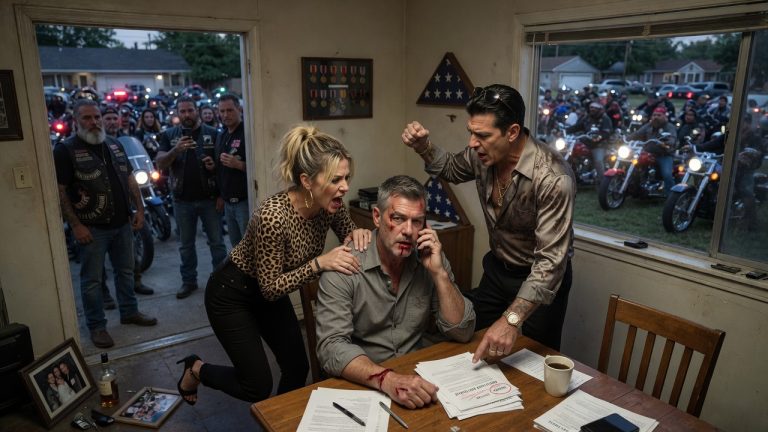
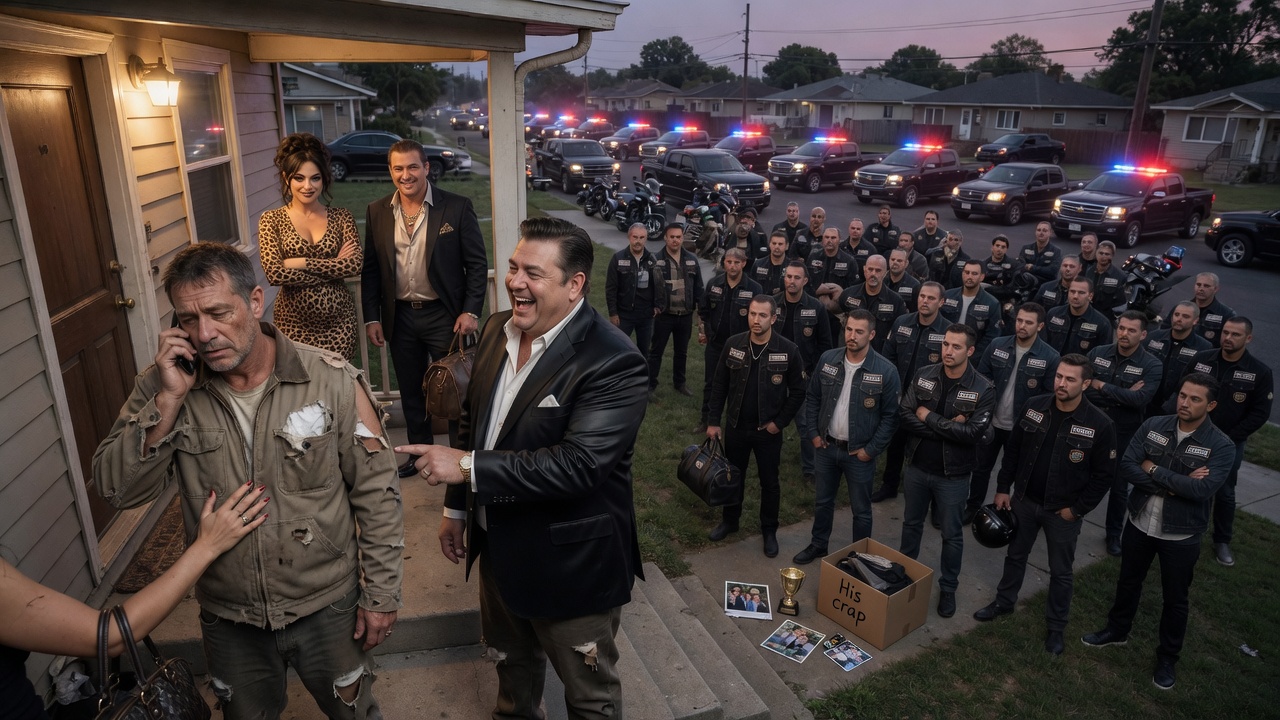
I stood silent as she ripped my favorite leather jacket—the only thing I had left of my father. Her lover, a man in a suit that cost more than my car, pointed a finger inches from my face, screaming that I was “trash” and a “burden.”
They locked me out in the freezing rain, mocking my poverty as they toasted champagne inside the house I helped pay for. They thought they were looking at a man with nothing. They didn’t realize that the “mechanic” they looked down on spent his weekends leading a brotherhood of five hundred men who would die for him.
One phone call was all it took. When the ground started shaking and the headlights filled the street, the look on their faces told me they finally understood: money can buy a house, but it can’t buy the kind of power that comes from loyalty.
Chapter 1
The sound of the leather tearing was louder than the thunder rolling over the suburbs of Ohio. It was a sickening, jagged noise—the sound of a memory being murdered.
“There,” Elena spat, tossing the jagged strip of brown hide into the mud at my feet. She stood on the porch of our colonial-style home, the yellow light from the foyer casting her in a glow that used to feel like warmth but now felt like a warning. “Now you don’t have to worry about looking like a hobo anymore, Jack. Since you’re going to be living like one.”
Behind her stood Chad. He was everything I wasn’t—or at least, everything Elena thought she wanted. He had the manicured stubble, the expensive watch, and the arrogant tilt of a man who had never had to bleed for a paycheck. He stepped forward, his polished Italian loafers clicking on the damp wood. He pointed a finger so close to my nose I could smell the expensive gin on his breath.
“You heard her, trash,” Chad sneered. “The locks are changed. The lease is in her name now. My lawyers made sure of that while you were busy ‘working overtime’ at that grease trap you call a garage.”
The rain started then—a cold, biting Midwestern downpour that soaked through my shirt in seconds. I didn’t move. I didn’t even blink. I just looked down at the jacket. It was a 1974 flight jacket, worn thin at the elbows, smelling of old tobacco and engine oil. My father had worn it when he came home from the service. It was the only thing I took when we buried him three years ago.
“That was his,” I said, my voice sounding like gravel under a tire.
“It was garbage,” Elena retorted. She looked at me with a mixture of pity and disgust that cut deeper than any blade. “Just like your dreams, Jack. I’m thirty-two. I’m tired of waiting for you to ‘make it.’ I’m tired of the smell of oil in the carpets. Chad can give me the life I deserve. You? You can’t even afford to take me to a decent steakhouse without checking your banking app first.”
Chad laughed, a sharp, barking sound. He reached out and shoved my shoulder, hard. “Go on. Get. Before I call the cops and tell them a vagrant is harassing my woman.”
They stepped inside and the heavy oak door thudded shut. The click of the deadbolt felt final, like a gavel hitting a desk. I stood there in the driveway of the house I’d spent every weekend renovating, my hands shaking—not from the cold, but from the sheer, vibrating pressure of the restraint I was practicing.
I looked at the house. I saw the silhouettes of the neighbors, the Millers and the Grahams, watching from behind their curtains. They’d seen the “poor mechanic” get kicked out by the “successful executive.” They were probably already texting the neighborhood group chat about the drama on Oak Street.
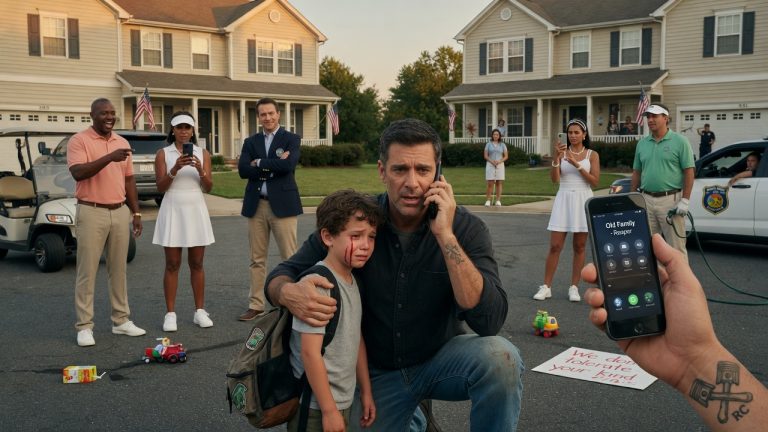
I reached into the pocket of my jeans and pulled out a phone. It wasn’t a smartphone. It was a ruggedized, military-grade flip phone, scuffed and battered. I flipped it open and hit a single programmed key.
It picked up on the first ring.
“Jack?” a deep, resonant voice answered. It was Miller—not the neighbor, but the man who had been my sergeant major twelve years ago, the man who now sat as the Treasurer of the Iron Circle.
“Code Blue,” I said, my eyes fixed on the window where Elena and Chad were clinking glasses. “Oak Street. Suburbia. Bring the family.”
“How many?” Miller asked, his tone shifting instantly from friendly to lethal.
“All of them,” I replied. “I want them to see what ‘trash’ looks like when it gathers.”
I closed the phone and sat down on the curb, right there in the rain. I picked up the piece of my father’s jacket from the mud and wiped it off on my jeans. I had lived a quiet life for three years because I thought I wanted peace. I thought I wanted the white picket fence and the quiet suburban Saturday nights.
I was wrong. Some men aren’t built for fences. They’re built for the road, and the brothers who ride it with them.
Read the full story in the comments.
If you don’t see the new chapter, tap ‘All comments’.
FULL STORY
Chapter 2
The silence of the suburb was deceptive. To anyone else, it was just a rainy Tuesday night in a sleepy corner of the county. To me, it was the countdown to a localized earthquake.
As I sat on the curb, the water pooling in my boots, I thought about how I’d ended up here. I’d met Elena at a roadside diner when my bike had broken down. She was a rising star in marketing, a woman who spoke about “brand identity” and “vertical integration.” I was just a guy with grease under his fingernails and a small specialized restoration shop.
For two years, it worked. She found my “blue-collar ruggedness” charming. She liked the way I could fix anything with a wrench and a bit of patience. But charm doesn’t pay for the lifestyle she started craving once she got promoted to Senior VP. Suddenly, my shop wasn’t a business; it was a “hobby.” My friends weren’t loyal companions; they were “intimidating distractions.”
She had spent the last six months trying to prune me like a hedge. “Don’t wear those boots to the gallery opening, Jack.” “Do you really need to take calls from Miller at dinner?” “Why don’t you look into a real estate license?”
Then came Chad.
Chad was a client of hers, a venture capitalist who specialized in “distressed assets.” I realized tonight that I was the distressed asset he’d been looking to liquidate.
Inside the house, the lights in the master bedroom flickered on. I could see their shadows. They were probably laughing about how easy it had been. They thought they’d stripped me of everything. My home, my dignity, my father’s jacket.
What they didn’t understand was that I had spent fifteen years building something they couldn’t conceive of. I wasn’t just a mechanic. I was the founder of the Iron Circle—a national network of veterans, first responders, and tradesmen who operated on a single, unbreakable code: The debt is always paid.
I had stepped back from the leadership to try and make it work with Elena. I had gone “civilian.” I had let the Iron Circle run itself under Miller’s watchful eye while I tried to learn how to be a “suburban husband.”
A pair of headlights turned the corner three blocks away. Then another. Then four more.
The rumble began as a low frequency, a hum that you felt in your teeth before you heard it in your ears. It was the sound of heavy-duty diesel engines and high-displacement V-twins. It was the sound of the brotherhood coming home.
I stood up, the water cascading off my shoulders. I felt the weight of the world shift. The quiet, humble Jack was gone. The man who had taken the shoves and the insults for the sake of a failing relationship had drowned in the rain.
The first truck, a matte black heavy-duty dually with the Iron Circle emblem—a stylized gear and a Spartan helmet—pulled up inches from Chad’s pristine silver Porsche. Miller hopped out of the driver’s side. He was sixty, built like a brick oven, with a white beard and eyes that had seen the worst of Fallujah.
He didn’t say a word. He just walked over to me, took off his own heavy canvas coat, and draped it over my shoulders.
“You look like hell, Boss,” Miller said, his voice a low growl.
“I feel like lightning, Miller,” I replied.
Behind him, the street was disappearing.
Chapter 3
It wasn’t just a few cars. It was a tactical envelopment.
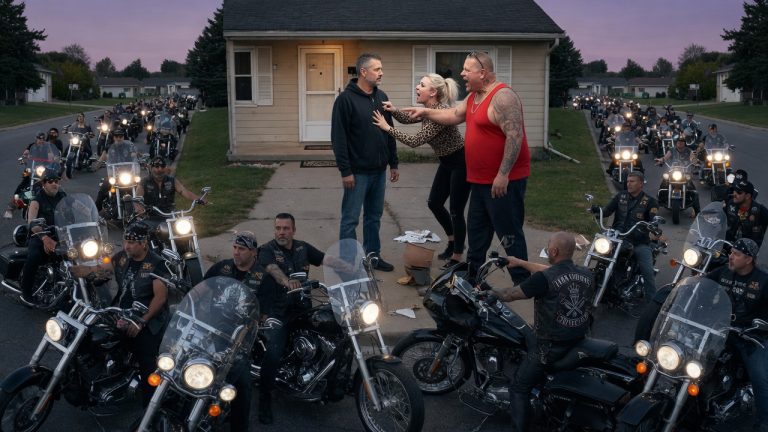
From the north end of Oak Street, a line of motorcycles three-abreast stretched back as far as the eye could see. Chrome glinted under the streetlights, and the roar of five hundred engines idling at once created a wall of sound that brought every single neighbor out onto their porches.
From the south, a dozen flatbed tow trucks and blacked-out SUVs rolled in, blocking every driveway and exit. Men began to climb out. These weren’t “thugs.” They were men in work uniforms, men in flight suits, men in local police uniforms who were off-duty, and men in simple jeans and flannels.
Five hundred brothers.
They didn’t shout. They didn’t break windows. They just moved with a synchronized, chilling precision, forming a massive semi-circle that faced the house, centering on me.
I saw the front curtain of the house twitch. Then it flew open. Elena’s face appeared, her mouth hanging open in a perfect ‘O’ of disbelief. Behind her, Chad’s smug expression had been replaced by a mask of sheer, unadulterated panic.
I walked toward the porch, the five hundred men behind me stepping forward in unison. The sound of a thousand boots hitting the wet pavement sounded like a clap of thunder.
I reached the front door and didn’t knock. I waited.
Five seconds. Ten.
The door creaked open just a few inches. Chad’s eye peered through the gap, flickering from me to the army of men standing in his front yard.
“W-what is this?” he stammered, his voice two octaves higher than it had been twenty minutes ago. “I’ll call the police. I mean it!”
“Look at the third row, Chad,” I said calmly. “The guy in the tan jacket? That’s the Captain of the local precinct. The guy next to him? He’s the County Sheriff. They’re here for the same reason everyone else is.”
“And what reason is that?” Elena yelled from behind him, though her voice was trembling. She tried to push the door shut, but Miller stepped up and placed one massive hand against the wood. The door didn’t move an inch.
“The reason,” I said, stepping into the dry air of the foyer, “is that you forgot who you were talking to. You called me trash. You called my father’s life trash. And then you tried to steal the one thing I actually built in this town.”
I looked at the house—the furniture I’d assembled, the walls I’d painted.
“Everything in this house that I paid for? Everything I built with these hands?” I gestured to the brothers outside. “It’s leaving. Now.”
Chapter 4
The next hour was a masterclass in “distressed asset liquidation.”
Under the silent, watchful eyes of the brotherhood, thirty men entered the house. They didn’t say a word to Elena or Chad. They simply began to dismantle the life I had built there.
They moved with the efficiency of a pit crew. The custom walnut table I’d built for the dining room? Carried out. The high-end appliances I’d installed? Disconnected and loaded onto a flatbed. Even the light fixtures I’d wired—they were gone in minutes, leaving the house in a dim, eerie shadows.
Elena was hysterical. She was screaming about “theft” and “property rights,” but every time she tried to approach one of the men, a brother would simply step in her way—a silent, immovable wall of muscle and denim.
Chad had retreated to the corner of the kitchen, clutching his phone, but he wasn’t calling anyone. He was watching the street. He was watching the five hundred men who were still standing there, motionless in the rain, their eyes fixed on the house.
He realized then that this wasn’t a robbery. It was an erasure.
I found them in the living room, standing amidst the crates and the dust. Elena was crying now, but they weren’t the tears of someone whose heart was broken. They were the tears of someone who had realized they’d made a catastrophic tactical error.
“Jack, please,” she sobbed, reaching for my arm. I stepped back, letting her hand fall through empty air. “We can talk about this. I was stressed. I didn’t mean those things about your father.”
“Yes, you did,” I said. “You meant every word. You thought I was a man who had nowhere else to go. You thought I was a man who could be humiliated because I didn’t have a title on a business card.”
I looked at Chad. He looked small. In his expensive suit, surrounded by the ghosts of the furniture that used to be there, he looked like a child playing dress-up.
“You told me to find a gutter that fit my budget, Chad,” I said. “The thing is, my budget includes five hundred brothers who would walk through fire for me. What does yours include? A lease you can’t afford and a woman who only loves you for the watch on your wrist?”
Chad didn’t answer. He couldn’t. His teeth were literally chattering.
Miller walked in, holding the torn piece of my leather jacket. He’d cleaned the mud off it. He handed it to me with a nod.
“The trucks are loaded, Jack,” Miller said. “The house is empty. What’s the final order?”
I looked at Elena. She looked at the empty spaces where our life used to be. She looked at Chad, who was currently trying to hide behind a kitchen island that was no longer there.
“The final order,” I said, “is that we leave them to it.”
Chapter 5
We walked out of the house for the last time.
The rain had slowed to a drizzle, but the air was still heavy with the scent of ozone and wet pavement. I stood on the porch and looked out at the sea of faces.
These were men I had served with. Men I had helped when their shops were failing. Men I had stood beside at their children’s weddings and their parents’ funerals. They hadn’t come here for violence. They had come here to remind me of who I was.
I felt a strange, hollow lightness in my chest. For three years, I had been trying to shrink myself to fit into Elena’s world. I had been trying to be “civilian Jack,” the quiet guy who didn’t make waves. I had almost convinced myself that the leather jacket was just an old coat.
I was wrong. The jacket was a symbol of a life lived with honor, a life where your word meant more than your bank balance.
I walked down the steps and stood in the center of the street. Miller stood to my left. A young kid named Silas, who I’d mentored at the garage, stood to my right.
“Listen up!” I shouted. The roar of the engines died down instantly. The silence that followed was more powerful than the noise.
“Tonight, I remembered something important,” I said, my voice carrying through the suburban air. “I remembered that you can lose a house. You can lose a job. You can even lose a woman who never really saw you. But as long as you have your brothers, you never truly lose your way.”
A low, rhythmic thumping began. Five hundred men began to hit their chests, a steady, heartbeat-like sound that echoed off the houses of the “perfect” neighborhood.
I looked back at the house. Elena and Chad were standing on the porch now, looking out at us. They looked like castaways on a desert island. They had the house, sure. They had the address. But they were completely and utterly alone.
“Miller,” I said, looking at the lead truck. “Where are we going?”
Miller grinned, his white teeth flashing in the dark. “There’s a warehouse in the city that needs a new foreman. And there’s a road that goes on forever. Your choice, Boss.”
I climbed into the passenger seat of the lead truck. I didn’t look back.
Chapter 6
We rolled out of the suburb in a single, massive column.
The neighbors watched from their porches, their faces a mix of awe and fear. They would talk about this night for years. The night the quiet mechanic on Oak Street revealed he was a king in a world they didn’t understand.
As we hit the highway, the lights of the city began to glow on the horizon. The vibration of the truck was a comfort, a reminder of the power and the movement of life.
I took the torn piece of my father’s jacket and held it against the sleeve. It was jagged and ugly, a scar on the leather. But I realized I wasn’t going to fix it. I was going to leave it exactly as it was. It would be a reminder.
Respect isn’t something you get from a lease or a leather-bound contract. It’s not something you get because you wear a suit or drive a silver Porsche. Respect is the currency of the soul, earned in the trenches and paid in loyalty.
Elena had thought she was taking my power by locking that door. She didn’t realize the door was the only thing keeping me small.
By the time we reached the city, the sun was beginning to peek over the edge of the world, turning the grey clouds into bruised shades of purple and gold. We pulled into the yard of the Iron Circle headquarters—a massive, sprawling complex of brick and steel.
The men began to unload my things. They didn’t ask where to put them. They just knew. They were rebuilding my life before the coffee was even brewed.
I stood at the edge of the yard, watching the sunrise. Miller walked up beside me, handing me a steaming paper cup.
“You okay, Jack?” he asked.
I took a sip of the bitter, hot coffee and looked at the scarred sleeve of my jacket. I thought about the cold rain and the way Chad had laughed. I thought about the look on Elena’s face when she realized that five hundred men were standing in her yard because of the man she had just called “trash.”
I felt a smile tug at the corner of my mouth. It was a real smile—the first one in a long time.
“I’m better than okay, Miller,” I said. “I’m home.”
I realized then that life has a funny way of stripping you down to your essentials just so you can see what’s really worth keeping. They thought they were throwing away a man with nothing, never realizing that a man with a brotherhood is a man who can never be broken.
You can rip the leather, but you can never tear the soul of the man who wore it.