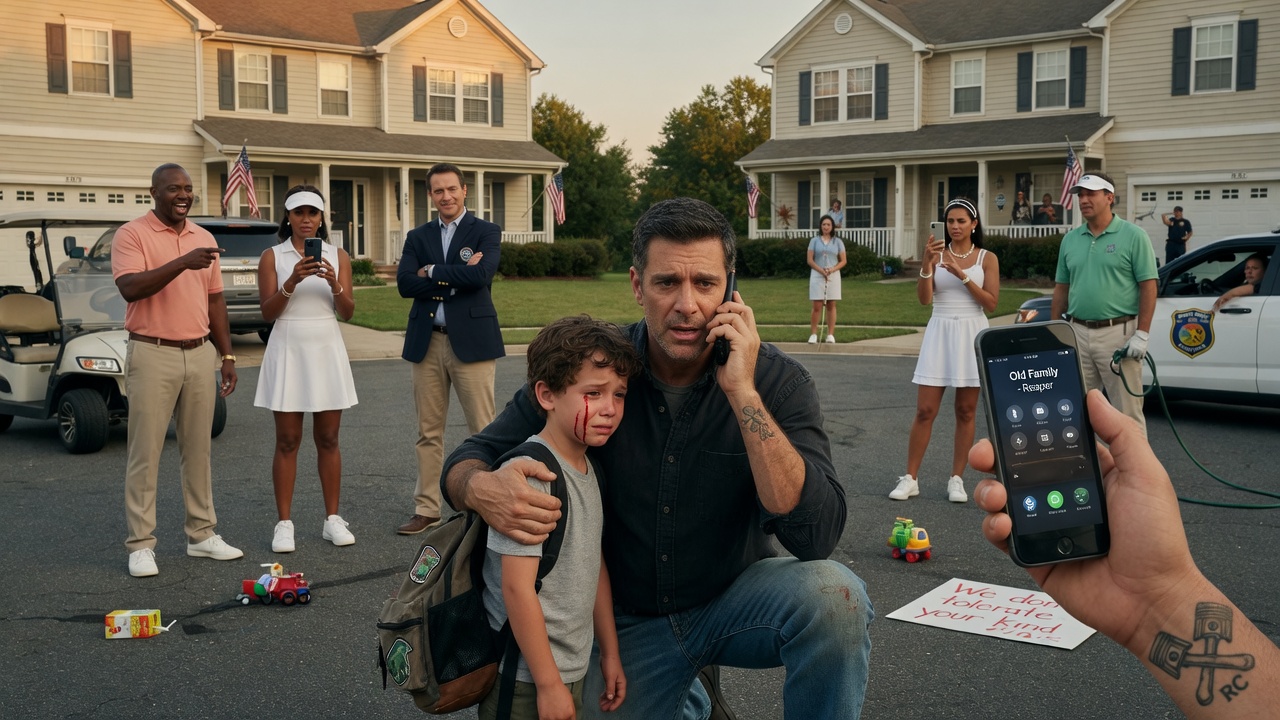
I knelt in the dirt, my knees sinking into the damp earth of the Oakhaven community park. It was the kind of dirt that shouldn’t exist in a town this expensive—manicured, fertilized, and exclusive. But there I was, right in the middle of it.
I wasn’t alone. My eight-year-old son, Leo, was tucked under my arm, his small body shaking with sobs that he was trying so hard to keep quiet. He’d always been a brave kid, but today was different. Today, the monsters weren’t under his bed; they were standing over us in $200 loafers.
“You heard me, Thorne,” Bryce Sterling spat, his voice carrying across the lawn where the “Summer Kickoff” fundraiser was in full swing. “This is a private event for residents. Not for the help. Not for guys who smell like motor oil and failure.”
Bryce was the HOA president, the kind of man who measured his worth by the height of his hedges and the size of his bonus. Behind him, a small group of his cronies chuckled. They were holding paper plates with wagyu sliders, watching the “show.”
Then came the trash.
It started with a crumpled napkin. Then a half-empty soda cup. It bounced off my shoulder and splashed sticky brown liquid onto Leo’s favorite superhero shirt. The boy let out a sharp, choked-up gasp.
“Look at them,” one of the women whispered, loud enough for us to hear. “It’s like a stray dog trying to protect a puppy. Why won’t he just leave?”
I didn’t leave because I had nowhere else to go. I had moved to Oakhaven for the schools, for the safety—the things a man promises his wife on her deathbed. I had spent three years being the “quiet guy” in the small house at the end of the cul-de-sac. I mowed my lawn, I kept my head down, and I never, ever talked about the life I left behind.
I had promised Sarah I was done with the noise. I was done with the brotherhood. I was done with the “Iron Saints.”
But as a banana peel landed on Leo’s head and Bryce’s laughter rang out like a death knell, I felt a familiar, cold sensation creeping up my spine. It was the feeling of a man who had nothing left to lose but his dignity.
“Pick it up, Elias,” Bryce sneered, stepping closer until his polished shoe was inches from my hand. “Pick up the trash and get out before I call the police for trespassing. You’re a nobody. You’re a ghost. And in this town, ghosts don’t get a seat at the table.”
I looked down at Leo. He looked up at me, his eyes wide and red-rimmed. “Dad?” he whispered. “Why are they being mean? We didn’t do anything.”
That was the moment. The snap. The click of a lock that had been holding back a flood for five long years.
I didn’t pick up the trash. I didn’t beg for mercy. I reached into my pocket and pulled out a small, scarred piece of black plastic—a heavy-duty encrypted radio I’d kept in a lead-lined box in my garage until this morning.
I pressed the button. My voice was a low, gravelly rasp that Oakhaven had never heard.
“Thunder One to all Saints. The shepherd is down. Code Black in Oakhaven. Bring the family home.”
The laughter died instantly. Not because they knew what I said, but because of the way I said it. I stood up, slowly, unfolding my six-foot-four frame until I was looking down at Bryce Sterling.
The dirt on my knees didn’t matter anymore. The trash at my feet was just fuel for the fire.
“You think I’m a ghost, Bryce?” I asked, my voice terrifyingly calm. “You’re half right. But you forgot one thing about ghosts.”
I leaned in, my breath hot against his pale, sweating face.
“They always bring the rest of the graveyard with them.”
Read the full story in the comments.
If you don’t see the new chapter, tap ‘All comments’.
FULL STORY
Chapter 2: The Ghost in the Cul-de-Sac
For three years, I had been the invisible man of Oakhaven. I worked as a freelance diesel mechanic, mostly for long-haul truckers who didn’t care about my zip code as long as their rigs kept humming. My hands were always stained with a hint of grease that no amount of Gojo could ever truly remove, a mark of my trade that acted like a repellant to the white-collar elite of the suburb.
Sarah had loved this town. She grew up in a place like this—white picket fences, the smell of fresh-cut grass, and the illusion that if you just followed the rules, nothing bad could ever happen to you. When the cancer took her, she made me swear I’d keep Leo here. “Give him a normal life, Elias,” she’d whispered. “No more leather. No more road. Just… peace.”
I tried. God, I tried.
I traded my Harley for a 2016 Ford F-150. I buried my “President” vest in a cedar chest under the floorboards. I became the guy who helped the neighbors jump-start their SUVs in the winter, only to have them ignore me in the grocery store an hour later.
Oakhaven was a place of hierarchies. There was the “Old Guard”—the families who had been here for forty years. There was the “New Money”—the tech guys and lawyers like Bryce. And then there was me. The outlier.
The “Absolute Collapse Engine” of my life started a week before the fundraiser. Leo had been bullied at the local elementary school. Nothing physical at first—just the cruel, sharp words that kids learn from their parents. “Your dad is a garbage man.” “Your house is small.”
I had gone to the school to talk to the principal, Mrs. Gable. She was a woman who lived for the school’s ranking and the PTA’s approval.
“Mr. Thorne,” she’d said, looking at me over her spectacles with a mixture of pity and annoyance. “Oakhaven is a high-pressure environment. Perhaps Leo just isn’t… a fit. Kids can be perceptive. They see that you don’t quite participate in the community the way the other fathers do.”
“Participate?” I’d asked. “I pay my taxes. I follow the laws. I’m raising my son.”
“It’s more than that,” she sighed. “It’s about culture. Bryce Sterling, our PTA chair, has expressed concerns about your… aesthetic. He thinks it brings down the property values of the neighborhood.”
I walked out of that office with my jaw clenched so tight it felt like it would shatter. I realized then that Oakhaven wasn’t a community. It was a gated cult where the only sin was being different.
The fundraiser at the park was supposed to be a peace offering. I thought if I brought Leo, if we volunteered to help clean up or set up chairs, they’d see we were just like them. I dressed him in his best clothes. I tried to smile.
But Bryce had been waiting. He’d been looking for a way to push me out for months, ever since I refused to let his landscaping crew cut across my backyard to save five minutes on their route. To a man like Bryce, a ‘no’ from a ‘nobody’ was an act of war.
As I stood in the park, the radio call still echoing in my mind, the world felt like it was moving in slow motion. The neighbors were still frozen, theirwagyu sliders forgotten.
“What was that?” Bryce stammered, trying to regain his bravado. “What did you just say into that… that toy?”
“That wasn’t a toy, Bryce,” I said. “That was a dinner bell.”
I turned my back on him and knelt back down to Leo. I used the hem of my jacket to wipe the soda from his face. “Hey, buddy,” I whispered. “Remember when I told you about my old friends? The ones who looked like giants but had hearts like lions?”
Leo nodded, his eyes wide. “The Saints?”
“The Saints,” I confirmed. “They’re coming to visit. And they’re not happy about the trash.”
Chapter 3: The Gathering Storm
The silence in Oakhaven didn’t last long. It was replaced by a sound that started as a hum—a vibration in the soles of everyone’s feet. It was the kind of sound you feel in your teeth before you hear it in your ears.
A few miles away, at a nondescript warehouse off the interstate, 500 engines had just roared to life.
Back in the park, the “Old Guard” and the “New Money” were starting to panic. Bryce was on his phone, likely calling the local police chief, a man he played golf with every Sunday.
“You’re done, Thorne!” Bryce shouted, his voice cracking. “I’m having you arrested! Assault! Threatening! Whatever it takes to get you and that brat out of my sight!”
Leo flinched at the word ‘brat.’ I felt that cold steel in my chest turn into a white-hot spark.
“Stay behind me, Leo,” I said.
Sarah’s sister, Sarah, had appeared from the edge of the crowd. Her name was also Sarah—well, Sara without the ‘h’—but I always associated her with the sister she’d lost. She was a nurse, the only person in town who actually treated us like human beings.
“Elias, what did you do?” she hissed, grabbing my arm. Her eyes were darting toward the street. “I know that look. I saw it on the news ten years ago. You promised her.”
“I promised her peace, Sara,” I said, not looking at her. “But you can’t have peace with people who don’t know what it is. They poked the bear. Now they get the claws.”
“This is a mistake,” she whispered, her voice trembling. “They’ll ruin you. They have the money, the lawyers, the connections—”
“They have paper,” I interrupted. “I have blood.”
Suddenly, the first of them appeared.
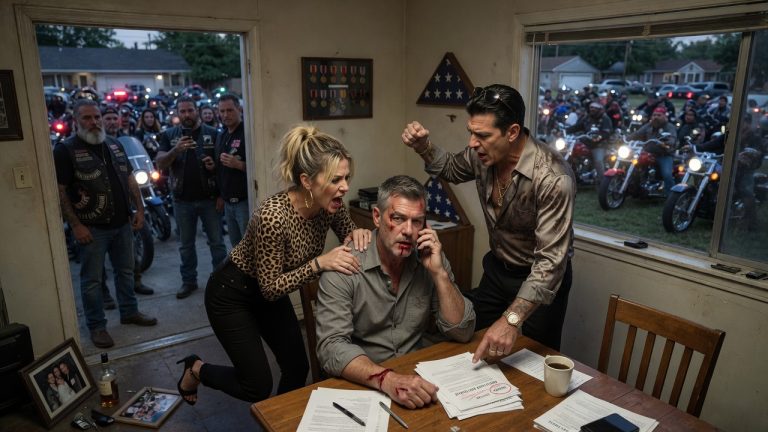
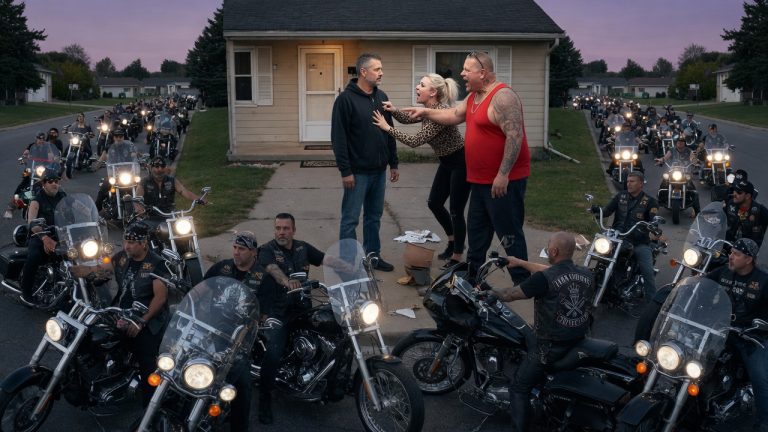
A lone scout on a blacked-out Indian Pursuit rounded the corner of Elm Street. He wasn’t speeding. He was cruising, slow and deliberate. He wore the colors: a black leather vest with the winged skull of the Iron Saints.
Then came two more. Then four. Then a dozen.
They began to circle the park. They didn’t say a word. They just rode in a slow, rhythmic orbit, the thunder of their pipes drowning out the sounds of the suburban afternoon. The neighbors were retreating now, backing away from the edges of the grass toward the safety of their SUVs and the clubhouse.
Bryce was shouting into his phone, but he looked like a cornered rat. “Where are the police?! I pay your salary, Miller! Get down here!”
The scout rider—a mountain of a man named ‘Big Mike’—pulled his bike up onto the grass, the heavy tires tearing into the perfect sod that Bryce loved so much. He kicked the kickstand down and dismounted, his boots heavy on the earth.
He walked straight toward me, ignoring the gasps and the phones being pointed at him. He stopped three feet away and slammed his fist against his chest in a silent salute.
“President,” Mike said, his voice like grinding stones. “The brothers are here. All 500 of them. The perimeter is set. Nobody leaves Oakhaven until you say so.”
I looked at Bryce, whose phone had finally fallen from his hand.
“Welcome to the neighborhood, Bryce,” I said. “I believe you had some trash you wanted someone to pick up?”
Chapter 4: The Price of Silence
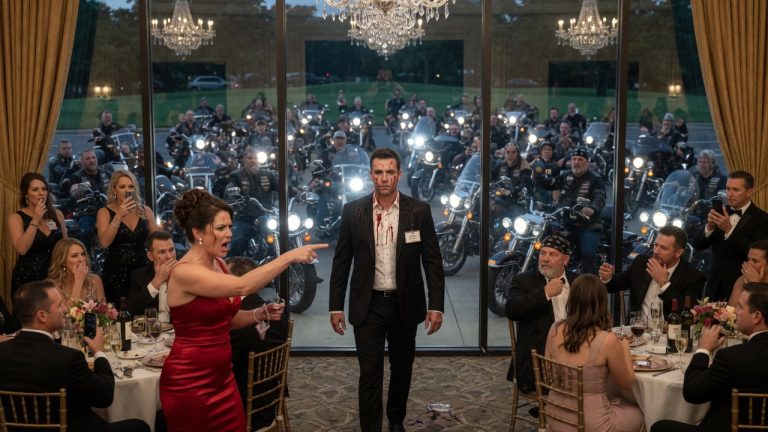
The atmosphere in the park had shifted from a garden party to a high-stakes standoff. The 500 bikes were now parked in a solid, impenetrable ring around the entire community center and the adjacent streets. It was a sea of black leather, denim, and chrome. These weren’t the “weekend warriors” you see on TV. These were the Saints—men who had served in wars, worked in mines, and lived by a code that Oakhaven couldn’t even fathom.
Mrs. Gable, the principal, was trembling near a table of gourmet cheeses. “This is… this is kidnapping! This is a riot!”
“No, Mrs. Gable,” I said, walking toward her. “This is a parent-teacher conference. You told me my son didn’t ‘fit the culture.’ I thought I’d bring some of my culture here so we could find a middle ground.”
I looked over at Bryce. He was trying to hide behind a decorative fountain.
“Mike,” I called out.
Big Mike stepped forward. “Yeah, Boss?”
“Mr. Sterling here is very concerned about property values. He thinks motor oil and ‘the help’ ruin the view. Why don’t you show him what ‘ruined’ really looks like?”
Mike didn’t draw a weapon. He didn’t have to. He just whistled.
Two other Saints, ‘Stitch’ and ‘Grave,’ walked over to Bryce’s pristine Mercedes-Benz parked in the VIP spot. They didn’t smash it. Instead, they pulled out a set of industrial-grade scales and a thick legal folder.
“What is this?” Bryce squeaked.
“This,” I said, taking the folder from Stitch, “is the documentation of the three million dollars you’ve been skimming from the Oakhaven Development Fund over the last five years. It’s amazing what a ‘ghost’ can find when he has brothers in the IRS and the state auditor’s office.”
The crowd went silent. The neighbors, who had been sneering at me minutes ago, now turned their eyes toward Bryce.
“Is that true, Bryce?” a man in a golf shirt asked. “Is that where the pool money went?”
“He’s lying!” Bryce screamed. “He’s a criminal! Look at him!”
I stepped into Bryce’s personal space. I didn’t push him. I didn’t have to. The sheer weight of the 500 men standing behind me did the work.
“I am a man who lost his wife and just wanted to raise his son in peace,” I whispered. “But you couldn’t let that happen. You had to make him cry. You had to throw trash at a child.”
I leaned in closer.
“The Saints don’t care about your money, Bryce. We care about family. And you just declared war on mine.”
I turned back to the crowd. “Listen up! Oakhaven is under new management for the next hour. Every single one of you who laughed while this man threw trash at my son… you’re going to help Leo clean up this park. Every napkin. Every cup. Every scrap of your ‘exclusive’ lifestyle.”
“And if we don’t?” a younger, arrogant-looking guy asked, stepping forward.
Big Mike stepped in front of him, his massive shadow swallowing the man whole. Mike didn’t say a word. He just cracked his knuckles.
The young man looked at the 500 bikers, then looked at the ground. He reached down and picked up a crumpled flyer.
“Good start,” I said.
Chapter 5: The Reckoning
The next hour was the most surreal sight Oakhaven had ever seen. Doctors, lawyers, and socialites were on their hands and knees, picking up trash in their Sunday best. The 500 Saints stood like statues, their presence a silent, looming reminder of the world outside the Oakhaven gates.
Leo sat on a park bench, eating an ice cream that Big Mike had somehow procured from a nearby shop. For the first time in months, he wasn’t looking at the ground. He was watching the people who had mocked him, seeing them for what they really were: small, scared, and desperate to save their own skin.
Sara stood by my side. “You’ve destroyed this town’s ego, Elias. They’ll never be the same.”
“Good,” I said. “Ego is what made them think they could hurt a child.”
But the climax wasn’t the cleaning. It was the truth.
The local police finally arrived—six cruisers, their lights flashing. Chief Miller stepped out, looking like he wanted to be anywhere else on earth. He saw the 500 bikers and he saw me. He also saw the folder in my hand.
“Elias,” Miller said, his voice weary. “What the hell is this?”
“This is a citizen’s arrest, Miller,” I said, tossing him the folder. “Bryce Sterling has been robbing this town blind. The evidence is all there—bank accounts, wire transfers, the works. I’m sure the DA will be very interested in why your signature is on three of those ‘maintenance’ contracts.”
Miller’s face went white. He looked at the folder, then at the silent, watching bikers. He knew he couldn’t win this. Not today. Not against the Iron Saints.
“Bryce Sterling,” Miller said, turning to the man still cowering by the fountain. “You’re coming with me.”
As the handcuffs clicked shut on Bryce’s wrists, the crowd of neighbors watched in stunned silence. The man they had followed, the man they had modeled their arrogance after, was being hauled away in the back of a cruiser.
I walked over to the police car as they were shoving Bryce inside.
“Wait,” I said.
Bryce looked up, his eyes filled with a desperate, pathetic hope. “Please… Elias, tell them… tell them I’ll pay you. Whatever you want.”
I reached into the trash bag I had been carrying. I pulled out the sticky, soda-soaked superhero shirt that Leo had been wearing.
I dropped it onto Bryce’s lap.
“Keep it,” I said. “It’s a reminder that some people are worth more than their bank accounts. And some people, no matter how much they have, will always be trash.”
I signaled to Big Mike. One short, sharp whistle.
The roar of 500 engines ignited simultaneously. It was a sound like thunder, a sound that shook the very foundations of the million-dollar homes.
Chapter 6: The Long Road Home
The bikes filed out of Oakhaven as quietly as they had arrived, leaving behind a suburb that felt suddenly very small and very quiet.
I stayed behind for a moment, standing in the center of the park with Leo and Sara. The sun was beginning to set, casting long, golden shadows across the grass. The park was spotless. Not a single piece of trash remained.
Mrs. Gable walked up to us. She looked different—less like a principal and more like a woman who had just seen a ghost.
“Mr. Thorne,” she started, her voice trembling. “I… I want to apologize. For everything. For the things I said in my office. For not standing up.”
I looked at her. I saw the fear, but I also saw a flicker of genuine regret.
“Don’t apologize to me, Mrs. Gable,” I said, putting my hand on Leo’s shoulder. “Apologize to the next kid who doesn’t ‘fit the culture.’ Because next time, I might not be here to stop the Saints from staying.”
She nodded quickly and hurried away.
Sara looked at me, her eyes soft. “What now, Elias? You can’t stay here. Not after this.”
“I know,” I said. “Oakhaven was Sarah’s dream. But Leo needs a place where he can grow up around people who know what loyalty looks like. Not just what a credit score looks like.”
I looked down at my son. “You ready to go, Leo? We’re going to go live near Uncle Mike and the guys. You can learn how to fix engines. Real ones.”
Leo’s face lit up. “Can I have my own vest, Dad? A small one?”
I smiled—a real, genuine smile that reached my eyes for the first time in five years. “Maybe a small one. But only if you promise to never use it to make someone feel small.”
“I promise,” he said, hugging my waist.
We walked to my truck. I didn’t look back at the big houses or the manicured lawns. I didn’t look back at the town that had tried to break me.
As I pulled out of the driveway of the little house at the end of the cul-de-sac, I felt a weight lifting off my chest. I had kept my promise to Sarah. I had given Leo a normal life as long as I could. But now, I was giving him something better. I was giving him a family that didn’t care about the dirt on his knees, only the strength in his heart.
I tapped the radio one last time.
“Thunder One to all Saints. We’re coming home. Clear the road.”
The response came back instantly, 500 voices in a chorus of static and brotherhood.
“Welcome back, Boss. The road is yours.”
I looked in the rearview mirror and saw Oakhaven fading into the distance. It was a beautiful place, on the outside. But I knew the truth now.
In a world full of people trying to be perfect, I’d rather be the man in the dirt who knows exactly who has his back.