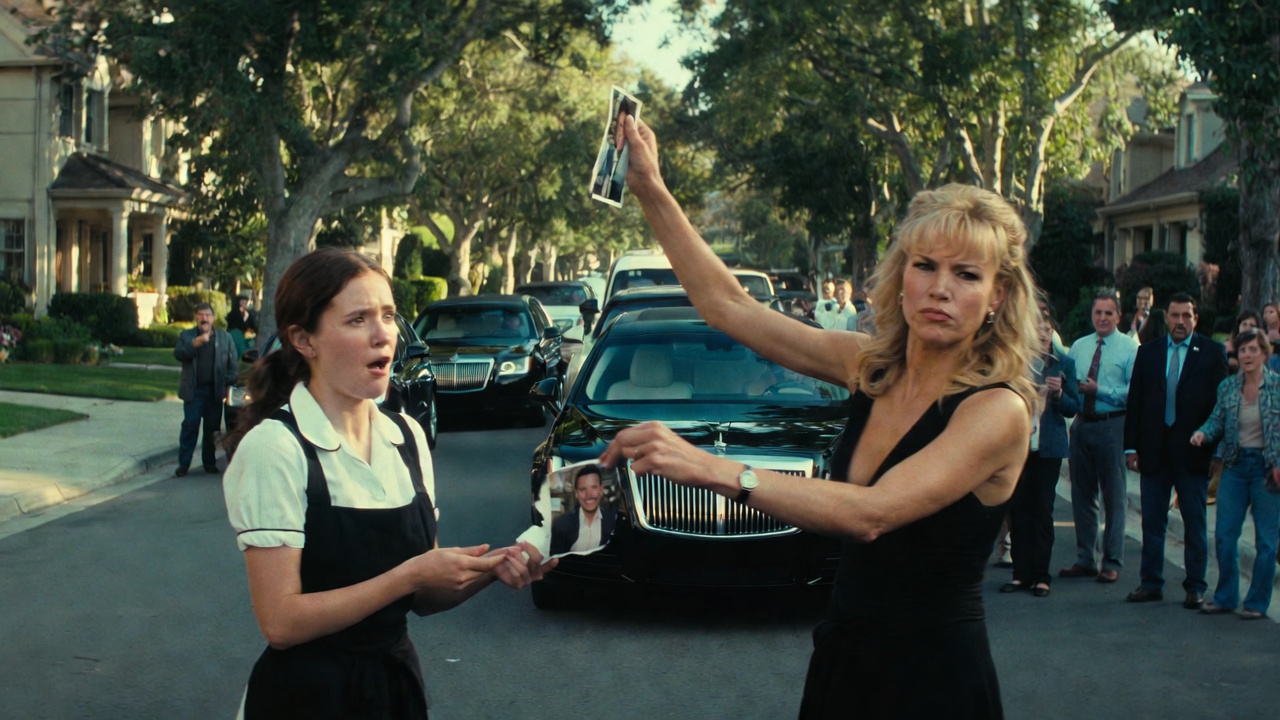
The sound of the photo tearing was louder than the midday traffic in Greenwich. It was a sickening, jagged noise—the sound of my only connection to a life I couldn’t remember being obliterated by a woman who thought her bank account gave her the right to play God.
“You’re a charity case, Sarah,” Vanessa hissed, her designer perfume cloying in the humid air. She flicked the white scraps of paper onto my shoes. “You’re a stain on this establishment. You don’t deserve to eat here, let alone work here.”
I stared at the pavement. My hands were shaking so hard I had to tuck them into the pockets of my stained apron. That photo—the blurry Polaroid of a man with kind eyes and a crooked smile—had been under my pillow in every foster home I’d ever been cycled through. It was my north star. And now, it was confetti.
I looked up at her, my vision blurred by tears I refused to let fall. “You didn’t have to do that,” I whispered.
“I’m doing you a favor,” Vanessa laughed, turning to the crowd of onlookers who were already filming the spectacle on their iPhones. “I’m reminding you of your place. Now, pick up your trash and get out of my sight before I have the police trespass you.”
She didn’t see the black Suburban pull up to the curb. She didn’t see the man who stepped out—the man whose face was plastered on every business magazine in the country.
But I saw him. And for the first time in twenty years, I recognized the eyes.
Read the full story in the comments.
If you don’t see the new chapter, tap ‘All comments’.
FULL STORY
Chapter 1: The Weight of a Polaroid
The humidity in Greenwich, Connecticut, always felt like a heavy wool blanket, but today it felt like it was suffocating me. I had been on my feet for nine hours at The Gilded Leaf, an upscale bistro where the appetizers cost more than my weekly rent. My back ached, my feet were throbbing in cheap non-slip shoes, and I had exactly twelve dollars in my bank account.
But I had the photo.
In the quiet moments between the lunch rush and the afternoon tea service, I’d step into the alleyway, pull that worn, plastic-protected Polaroid from my pocket, and just breathe. It showed a man in his late twenties holding a toddler—me. He was laughing, his dark hair windblown, a small silver crest visible on his cufflink. It was the only thing I owned that hadn’t been issued by the state.
“Back to work, charity case!”
The voice belonged to Vanessa Sterling. She wasn’t just a regular; she was the self-appointed queen of the suburb’s social scene. Her husband sat on the board of half the charities in the state, and she never let anyone forget it. She was currently hosting a “strategy brunch” for a gala she was planning, and I had been her target all morning.
“I was just taking my state-mandated break, Mrs. Sterling,” I said, trying to keep my voice even.
“Your ‘break’ is an eyesore,” she snapped, stepping toward me. She was dressed in head-to-toe cream linen that probably cost five thousand dollars. She looked at the photo in my hand with a look of pure disgust. “What is that? Some pathetic memento of the man who dumped you at a fire station?”
My heart stopped. “It’s my father. And he didn’t dump me.”
“Please,” she scoffed, lunging forward with a speed that caught me off guard. Her manicured nails snatched the photo from my grip. “It’s a crutch. You use your ‘sob story’ to get better tips, don’t you? It’s manipulative.”
“Give it back,” I said, my voice rising. “Please, Vanessa. Just give it back.”
She looked at the photo, then back at me. A cruel, calculated smile spread across her face. “You need to learn that in this world, people like you don’t get to hold onto fantasies. You get what you earn. And you’ve earned nothing.”
Then, she did it. With a slow, deliberate motion, she hooked her thumbs into the center of the photo and pulled. The thick cardstock resisted for a second before giving way with a sharp crrr-ack.
I felt the air leave my lungs. She did it again, and again, until the image of the man who loved me was nothing but jagged white teeth of paper. She tossed them into the air like mocking snow.
“There,” she said, dusting her hands off. “Now you can focus on refilling the mimosas. You’re a charity case, Sarah. Act like one.”
I didn’t move. I couldn’t. I just watched the wind catch a piece of the man’s face and blow it toward the gutter. I felt a hole opening up in my chest, a vacuum that threatened to swallow the whole street.
I didn’t notice the silence that had fallen over the bistro. I didn’t notice the long, black motorcade that had silently pulled up to the curb, blocking the lane of traffic.
All I saw was the trash at my feet.
Chapter 2: The Ghost of Greenwich
Twenty years. That’s how long I had been a ghost.
I grew up in the system, moving from the drafty attics of well-meaning old ladies to the crowded basements of people who only wanted the monthly stipend. I never had a last name that felt like it fit. I was just “Sarah,” the girl with the photo.
Social workers told me my father had probably met with foul play, or that he had simply vanished into the shadows of the city. There were no records of our family. It was as if I had dropped from the sky on that rainy night in Manhattan when a policeman found me shivering in a subway station, clutching that Polaroid.
As I stood outside the bistro, the humiliation Vanessa had heaped on me should have been the thing that hurt the most. But it wasn’t. It was the loss of the evidence. Without that photo, was I even real?
“Look at her,” Vanessa said, turning to her friends at the table. “She’s going to cry. Honestly, the drama of the lower class is so exhausting. Someone call the manager. I want her fired for creating a scene.”
A man stepped out of the lead vehicle of the motorcade. He didn’t look like the police. He didn’t look like a customer. He moved with a terrifying, quiet gravity that made the air feel heavy. He was followed by three men in dark suits with earpieces.
Vanessa’s eyes went wide. Her posture shifted instantly from a predator to a fawning sycophant.
“Oh my god,” she whispered, her voice trembling with excitement. “That’s Elias Thorne. He’s the keynote speaker for the gala. He’s worth fifty billion dollars.”
She smoothed her hair and stepped toward the sidewalk, stepping right over the shredded remains of my life.
“Mr. Thorne!” she called out, her voice dripping with artificial sweetness. “What an unexpected honor! I’m Vanessa Sterling, the chair of the—”
Elias Thorne didn’t even look at her. He didn’t stop. He walked past her as if she were made of glass.
His eyes were locked on the ground. Specifically, on the pieces of paper resting on my cheap black shoes.
He stopped two feet away from me. The world seemed to stop with him. The birds stopped chirping. The distant hum of the highway faded. There was only the sound of his breathing—ragged and heavy.
He slowly lowered himself. This man, whose hands controlled the global economy, knelt on the dirty concrete of a suburban sidewalk. He reached out with a trembling hand and picked up the largest piece of the photo. It was the piece showing the silver crest on the cufflink.
He looked at the fragment, then he looked up at me.
His eyes were exactly like mine. Not just the color—a deep, stormy grey—but the sadness behind them. A twenty-year-old sadness that had finally found its match.
“Sarah?” he whispered. The name sounded like a prayer he’d been practicing for a lifetime.
Chapter 3: The Twenty-Year Search
Elias Thorne was not supposed to be a father. He was supposed to be a titan.
Twenty years ago, he had been a rising star in the tech world, a man who had everything—except safety. The story, the one the public never knew, was that a business rival had orchestrated a kidnapping to break him. They hadn’t taken his money; they had taken his two-year-old daughter while he was in a meeting that lasted ten minutes too long.
He had spent two decades and a significant portion of his fortune tearing the world apart to find me. He had hired former Mossad agents, bought satellite time, and chased a thousand false leads. He had never stopped looking.
“Mr. Thorne?” Vanessa’s voice broke the silence, sounding shrill and desperate. “I’m sorry, there’s some mistake. This girl… she’s just a waitress. She’s a troublemaker. She was just harassing me—”
Elias stood up slowly. He didn’t look at me yet; he looked at Vanessa. The warmth that had been in his eyes when he looked at the photo vanished, replaced by a cold, industrial frost.
“You ripped this,” Elias said. It wasn’t a question.
Vanessa blinked, her smile faltering. “It was just a piece of trash, sir. She was using it to—”
“This ‘piece of trash,'” Elias interrupted, his voice dropping to a dangerous, vibrating bass, “is a photo I took of my daughter on her second birthday. It is the only thing she had left of me for twenty years.”
The color drained from Vanessa’s face so fast I thought she might faint. She looked at me, then at Elias, then back at the shredded paper on the ground. The realization hit her like a physical blow.
“Daughter?” she stammered. “But… she’s… she’s Sarah.”
“She is Sarah Thorne,” Elias said, turning back to me. He ignored the gasps from the patio. He ignored the phones recording every second. He reached out, his hand hovering near my cheek, afraid to touch me as if I might vanish. “And you will never have to worry about people like this ever again.”
I looked at him, my heart hammering against my ribs. “You’re the man in the photo.”
“I’m the man who hasn’t slept in twenty years,” he said, a single tear escaping and rolling down his cheek. “I’m so sorry it took me so long, Sarah. I’m so, so sorry.”
I didn’t care about the money. I didn’t care about the SUVs or the security guards. I reached out and grabbed the lapels of his expensive suit, pulling him toward me, and buried my face in his chest. He smelled like cedarwood and home.
Chapter 4: The Fall of Vanessa Sterling
The aftermath was a blur of motion and sound.
Elias’s security team moved with surgical precision. One of them, a man named Miller who I later learned was a former lead detective, stood between us and the crowd.
“Mr. Thorne,” Miller said quietly. “We should get her into the car. The press will be here in minutes.”
Elias nodded, but he didn’t let go of my hand. He looked over at the manager of The Gilded Leaf, who had come scurrying out, looking terrified.
“Who is the owner of this establishment?” Elias asked.
“I… I am, sir,” the manager stuttered. “Marcus Higgins. I had no idea—”
“Effective immediately, my firm is purchasing the lease on this building,” Elias said. “And as of this moment, Vanessa Sterling and any member of her family are permanently barred from these premises. If I see her name on a guest list anywhere in this state, I will withdraw every cent of Thorne Industries’ charitable funding from that organization.”
Vanessa let out a strangled cry. “You can’t do that! My husband… our reputation…”
“Your reputation,” Elias said, looking her in the eye, “is currently being shredded on social media by every person on this patio. You called my daughter a charity case. I think it’s time you learned what it’s like to rely on the charity of others. Because by tomorrow morning, your husband’s firm will be facing a series of audits they won’t survive.”
Vanessa collapsed into one of the bistro chairs, her designer world crumbling around her. She looked at the scraps of the photo on the ground—the pieces she had so carelessly destroyed. They were her death warrant.
Elias guided me toward the SUV. He held the door open for me, a gesture of respect I hadn’t felt in years. As I sat down on the cool leather seat, I looked out the window one last time.
I saw my coworker, Chloe, holding her phone up, a triumphant smile on her face. She had caught everything. The bully had finally met someone she couldn’t break.
“Are you okay?” Elias asked as the door closed, sealing us in a world of quiet luxury.
I looked at my hands. They were still shaking, but for the first time, it wasn’t from hunger or fear. It was from the overwhelming weight of being found.
“I’m okay,” I said. “But my photo… it’s gone.”
Elias reached into his jacket pocket and pulled out a small, leather-bound wallet. He opened it to show a pristine, digital copy of the same photo, enlarged and sharpened.
“I have the original negative,” he said softly. “I have thousands of photos of you, Sarah. And we’re going to take thousands more.”
Chapter 5: The Cost of Cruelty
By the time we reached the Thorne estate, the video of the “Greenwich Takedown” had ten million views.
The headline was everywhere: Billionaire Finds Long-Lost Daughter While She’s Being Bullied by Socialite.
The public’s reaction was swift and merciless. Vanessa Sterling’s name became synonymous with “entitled cruelty.” By that evening, her husband had been asked to resign from three boards. By the next morning, their country club membership had been “reviewed and terminated.”
But inside the walls of the Thorne mansion, the world was quiet.
Elias didn’t push me. He didn’t ask me to change into silk dresses or meet with lawyers. He sat with me in a library that smelled of old paper and history, and he told me stories. He told me about my mother, who had passed away from a broken heart only a few years after I was taken. He told me about the nursery he had kept exactly the same for twenty years, just in case.
“I used to sit in there,” he admitted, staring into the fireplace. “I’d look at that photo and wonder if you were cold. If you were hungry. If you were being treated with the kindness you deserved.”
I looked down at my lap. “I wasn’t always. But it made me strong.”
“You shouldn’t have had to be strong,” he said fiercely. “You should have been cherished.”
A week later, a package arrived at the estate. It was from the Sterling’s lawyers. It was a formal apology, written in shaky handwriting by Vanessa herself. It was a plea for mercy, a desperate attempt to save what was left of her life.
I read it once and handed it back to Elias.
“What do you want to do?” he asked. “I can make them disappear, Sarah. Financially, socially… they can be erased.”
I thought about the feeling of that photo ripping in her hands. I thought about the years of being called a “charity case” and a “nobody.” Then I looked at the man sitting across from me—my father.
“Let them keep their house,” I said quietly. “Let them keep enough to live on. I don’t want to be the reason someone else loses everything. That’s the difference between her and me.”
Elias looked at me with a pride so intense it was almost painful to witness. “You have your mother’s heart. But you have my resolve.”
He picked up the phone. “Miller? Cancel the audits on the Sterling firm. But keep the ban at the bistro. I want her to remember that day every time she wants a cup of coffee.”
Chapter 6: A New Narrative
The morning of my twenty-third birthday was the first time I woke up without a sense of dread.
There was no shift to rush to. No manager to appease. No bank balance to check with bated breath. Instead, there was the smell of bacon and the sound of my father humming in the kitchen.
We went back to the bistro that afternoon. Not as a “charity case” and a “titan,” but as a father and daughter.
The bistro had been renamed The Sarah. It was no longer a place for the elite to look down on the poor; it had been converted into a foundation-run restaurant where the staff were paid a living wage and a portion of every meal went to finding missing children.
We sat at the same table where Vanessa had sat. The sun was shining, and the air was clear.
Elias reached into his pocket and pulled out a small frame. Inside was a restored version of the Polaroid. Every tear had been digitally mended, every crease smoothed out. It looked like it had been taken yesterday.
“I realized something,” I said, tracing the glass of the frame.
“What’s that?” Elias asked.
“Vanessa was right about one thing,” I said, looking up at him. “I was a charity case. But not the way she thought. I survived on the charity of strangers, the kindness of librarians, and the hope of a man I didn’t even know was looking for me.”
Elias took my hand. “And now?”
“And now,” I said, a smile finally reaching my eyes, “I’m just Sarah. And that’s more than enough.”
As we walked out of the restaurant, a young girl—no older than five—ran up to me and handed me a flower she had picked from the sidewalk. I knelt down, just like my father had, and thanked her.
I realized then that the photo wasn’t my identity. It was just the map that led me home. The real story was just beginning.
The final lesson I learned wasn’t about the power of money or the sting of a bully’s tongue. It was that no matter how many pieces your life is shredded into, there is always a way to put it back together—as long as you never stop holding onto the light.
Because the people who try to tear you down are usually the ones most afraid of how high you can fly.