Chapter 1
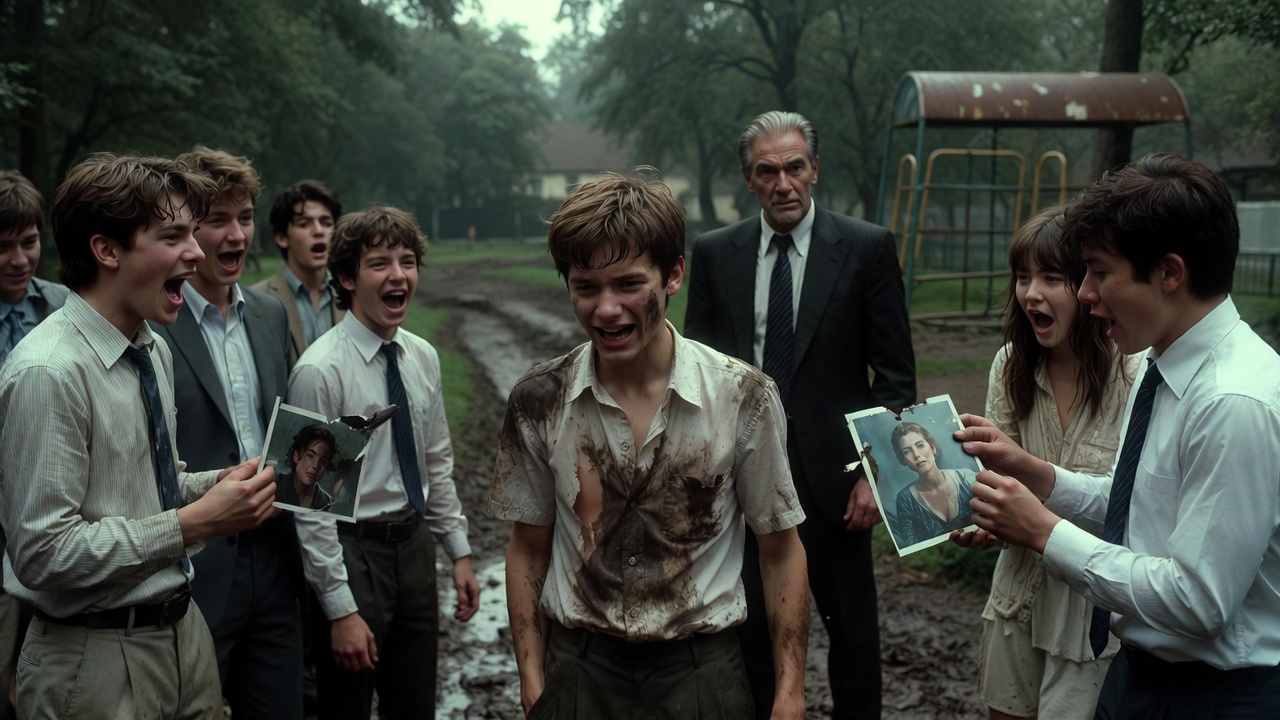
The mud in Oakwood Heights didn’t smell like nature; it smelled like expensive fertilizer and the cold, damp scent of a November rain that wouldn’t let up. I felt it seeping into the knees of my thrift-store jeans as Jackson Miller’s designer sneaker pressed firmly into the center of my back.
“Look at him,” Jackson sneered, his voice carrying that effortless confidence only five generations of old money can buy. “The scholarship kid is literally eating dirt. Is that where you get your lunch, Leo? Or do you just miss the gutter you crawled out of?”
His friends, a circle of varsity jackets and polished smiles, erupted in that hollow, rehearsed laughter that sounds like glass breaking. I didn’t care about the insults. I didn’t even care about the bruise forming on my ribs where Jackson had kicked me two minutes ago. My eyes were locked on my backpack, lying three feet away, its zipper burst open.
Lying in the center of a puddle was a small, plastic-sleeved photograph.
It was the only thing I had left of her. My mother, Elena. In the photo, she was twenty-two, laughing at a joke I’d never hear, her hair windswept and her eyes bright with a future that had been stolen from her by a hit-and-run driver five years ago.
“Please,” I whispered, my voice cracking. “The photo. Just give me the photo.”
Jackson followed my gaze, his eyes lighting up with a cruel, predatory spark. He reached down, snatching the plastic sleeve from the mud with two fingers, holding it up like it was a piece of contaminated evidence.
“This?” he asked, tilting his head. “Who is she? Your babysitter? Or is this the woman who forgot to tell the state who your daddy was?”
“Give it back, Jackson,” I said, my voice shaking with a rage that felt like it might swallow me whole. I tried to stand, but Jackson’s friend, Caleb, shoved me back down.
“I don’t think so,” Jackson said, his thumb hovering over the edge of the photo. “I think Oakwood needs a little less trash. And that includes your memories.”
He began to peel the plastic back. I felt my heart stop. If the mud touched that paper, she’d be gone. The last physical proof that I had ever been loved would dissolve into gray sludge.
“Hey!”
The voice didn’t come from a student. It was deep, resonant, and carried a weight that seemed to physically shift the air around us.
A black Cadillac Escalade had pulled up to the curb of the park. A man was stepping out. He wore a charcoal-gray suit that probably cost more than my mother had made in a year. His hair was peppered with silver at the temples, and his face was a mask of cold, surgical precision.
Jackson’s hand froze. His face went from arrogant to ashen in a heartbeat. “Mr. Thorne?”
The man didn’t look at Jackson. He didn’t look at the other boys who were suddenly scurrying to put distance between themselves and me. He walked straight toward us, his steps measured and heavy.
He stopped inches from Jackson. He didn’t yell. He didn’t threaten. He simply held out his hand, palm up.
“The photograph,” the man said. It wasn’t a request. It was an ultimatum.
Jackson handed it over, his fingers trembling. “Sir, we were just—we were joking. He’s just a kid from the—”
“Quiet,” the man snapped.
He looked down at the photo in his hand. For a second, the mask of ice broke. His shoulders dropped an inch, and his breath hitched in a way that made my own chest ache. He touched the plastic where my mother’s face was, his thumb tracing the curve of her smile.
“Where did you get this?” he asked, his voice barely a whisper, directed at me.
I wiped the mud from my eyes, looking up at him. “It’s my mother. It’s all I have left.”
The man closed his eyes for a long moment. When he opened them, they were wet, reflecting the gray sky. He looked at me—really looked at me—and I saw something in his face I’d never seen before. Recognition.
He looked back at Jackson and his crew. The boys were already backing away, sensing a storm they couldn’t survive.
“Get out of my sight,” the man said, his voice low and dangerous. “If any of you ever speak to him, look at him, or even think his name again, I will ensure your families are living in the dirt you just pushed him into. Do you understand?”
They didn’t wait for a second warning. They ran.
The man knelt in the mud, heedless of his expensive suit. He reached out a hand, helping me sit up, but he didn’t let go of the photo.
“What was her name?” he asked.
“Elena,” I choked out. “Elena Vance.”
He let out a jagged, broken laugh, his hand shaking as he pulled me toward him. “She told me she was leaving to protect you. She told me I was too dangerous to be a father.”
He pulled me into a hug that smelled of cedar and expensive leather, a hug that felt like a fortress.
“That’s my wife,” he whispered into my hair. “And you… you are the son I’ve spent fifteen years trying to find.”
The world stopped turning. The boy who had nothing just realized he was the heir to the man who owned everything.
Read the full story in the comments.
If you don’t see the new chapter, tap ‘All comments’.
FULL STORY
Chapter 2
The inside of the Escalade was silent, a vacuum of leather and tinted glass that shielded us from the prying eyes of Oakwood Heights. I sat on the edge of the heated seat, acutely aware of the mud I was transferring to the pristine interior.
Elias Thorne—the man whose name graced the hospital wings and the downtown skyscrapers—sat across from me, the small photograph held between his fingers like it was the most fragile diamond in the world.
“I thought she was dead,” he said, his voice flat, drained of the authority he’d used on the bullies. “Her family… they told me there was an accident shortly after she left. They said she was gone, and the baby hadn’t survived. I spent a decade burning their bridges, thinking I was avenging her.”
“She was alive,” I said, my voice sounding small in the vastness of the car. “We lived in Syracuse for a while. Then here. She worked three jobs. She never talked about you. She just said my dad was… a man who had to go away.”
Elias looked out the window. “I wasn’t a good man, Leo. Not then. I was young, greedy, and I had too many enemies. Elena saw the darkness in the life I was building, and she didn’t want it touching you. She was right to leave. But she was wrong to think I’d ever stop loving her.”
We pulled into a driveway that felt like it belonged in a movie. Iron gates swung open automatically, revealing a sprawling manor of stone and glass. This wasn’t a home; it was a statement.
“You’re staying here,” Elias said, turning to me. “No more scholarship dorms. No more thrift-store jeans. From this second, you are a Thorne. And the world is going to learn exactly what that means.”
I looked at my reflection in the dark window—a muddy, bruised kid with hollow eyes. “Why now? Why did you come to the park today?”
“I didn’t know you were there,” he admitted, a flash of guilt crossing his face. “I was in town for a board meeting. I saw a group of boys cornering someone in the park. I’ve always hated bullies. I didn’t realize I was stopping a crime against my own blood until I saw her face in your hand.”
He reached out, placing a hand on my shoulder. His grip was firm, grounding. “I’ve missed fifteen years, Leo. I can’t get those back. But I can give you the next fifty. I can make sure no one ever puts you in the dirt again.”
As we stepped out of the car, a woman in a crisp uniform stood at the door. “Sarah,” Elias said, not missing a beat. “This is my son, Leo. Clear the East Wing. Get a doctor here to look at his ribs. And call the headmaster at Oakwood Academy. Tell him we need to have a very long, very unpleasant conversation about his student body.”
I looked back at the gates. Somewhere out there, Jackson Miller was probably trying to figure out how to explain to his father why Elias Thorne was looking for his head on a platter. For the first time in five years, the constant, gnawing cold in my chest began to thaw.
I wasn’t a ghost anymore. I had a name. And I had a father who looked like he was ready to burn the world down just to keep me warm.
Chapter 3
Monday morning at Oakwood Academy usually felt like a slow walk to the gallows. I was the “poverty project,” the kid whose existence served as a reminder of how lucky everyone else was. But today, the atmosphere was different. It was electric with a tension that made my skin crawl.
I didn’t walk through the front doors. I was driven to the curb in a silver Maybach, the engine a low, predatory hum.
When I stepped out, I wasn’t wearing my oversized hoodie. I wore a tailored navy blazer and a white shirt that felt like silk against my skin. My hair was cut, the mud washed away, but the bruise on my cheek was still there—a purple badge of courage that Elias had insisted I not cover up.
“Let them see it,” he’d said this morning over a breakfast I couldn’t finish. “Let them see exactly what they did.”
The hallway went dead silent as I walked in. It was a physical wall of silence that rippled as I passed. People who had looked through me for three years were now staring with wide, panicked eyes.
“Is that… is that Leo?” I heard a girl whisper.
“I heard his dad is Thorne,” another replied, her voice trembling. “Like, the Thorne. My dad says his company just pulled all their investments from Miller’s firm this morning.”
I kept my head up, walking straight toward the principal’s office. I didn’t have to knock. The door was already open.
Inside, Principal Higgins looked like he was having a heart attack. He was sweating through his tweed jacket, standing behind his desk while Elias Thorne sat in one of the guest chairs, looking as relaxed as a lion in tall grass.
And in the corner sat Jackson Miller and his father, Richard. Richard Miller was a man who usually blustered with importance, but today he looked like he’d aged a decade. Jackson was staring at his shoes, his face a ghostly shade of white.
“Ah, Leo,” Elias said, standing up. He draped an arm around my shoulder, a gesture of public ownership that sent a visible shiver through Jackson. “Glad you could join us. We were just discussing the school’s ‘Zero Tolerance’ policy on bullying.”
“Mr. Thorne, please,” Richard Miller started, his voice cracking. “Jackson is a kid. He didn’t know—”
“He knew Leo was a human being,” Elias cut him off, his voice like a razor. “He knew Leo was defenseless. That was enough for him. It was also enough for me.”
Elias turned to Principal Higgins. “My son tells me that this has been going on for two years. He tells me he reported it three times. And yet, the only record I find in your files is a disciplinary note for Leo ‘disturbing the peace’ during an altercation Jackson started.”
Higgins stammered, “There was… there was conflicting testimony, sir. The Miller family has been very generous donors—”
“Donors,” Elias repeated with a cold smile. “Richard, how is that merger going? The one with the European steel firm? The one my company provides the logistics for?”
Richard Miller’s jaw dropped. “Elias, you wouldn’t.”
“I already did,” Elias said. “The contract was terminated at 6:00 AM. Your firm is over-leveraged, Richard. Without that merger, you’re looking at bankruptcy by the end of the quarter.”
He then looked at Jackson. “And as for you. You like mud, don’t you? You like making people feel small?”
Jackson looked up, tears finally spilling over. “I’m sorry. I’m so sorry, Leo.”
“Don’t apologize to me,” I said, my voice steady for the first time in my life. “Apologize to the photo of my mother you tried to ruin. The one woman who worked herself to death so I could be here, while you spent your life pretending you earned something you just inherited.”
Elias looked at me with a pride so fierce it was almost painful. He turned back to Higgins. “Expulsion. For all five of them. By the end of the day, or I’ll buy the land this school sits on and turn it into a parking lot for my employees.”
He didn’t wait for an answer. He led me out of the office, through the gauntlet of staring students. As we reached the exit, I saw Coach Miller—the man who had watched Jackson kick me in the locker room and walked away. He was standing by the trophy case, looking terrified.
Elias stopped, looked the Coach up and down, and simply said, “You’re fired.”
We walked out into the sunlight.
“Too much?” Elias asked as we got back into the car.
“No,” I said, looking at the bruise in the rearview mirror. “It was just right.”
Chapter 4
The honeymoon phase of my new life lasted exactly four days. On the fifth day, the past came knocking, and it wasn’t wearing a suit.
I was in the library of the Thorne estate, trying to make sense of a world where I didn’t have to worry about the cost of a textbook, when I heard a commotion in the foyer. A woman’s voice was rising, sharp and hysterical.
“You can’t keep him from us! He’s our blood!”
I recognized that voice. It was Aunt Martha—my mother’s sister. The woman who had slammed the door in my mother’s face when she showed up pregnant and broke. The woman who hadn’t even come to my mother’s funeral because it was “too depressing.”
I walked to the balcony overlooking the foyer. Below, Martha and her husband, Ted, were being held back by Elias’s security team. They looked frantic, their eyes darting around the opulence of the house with a transparent greed that made me sick.
Elias was standing at the foot of the stairs, his hands in his pockets. “I believe I made myself clear on the phone, Mrs. Gable. You surrendered any claim to this boy the moment you let his mother sleep in a bus station.”
“We were struggling!” Martha wailed, her eyes catching mine on the balcony. “Leo! Leo, honey! It’s your Auntie Martha! We’ve been looking everywhere for you! We wanted to take you in after the accident, but the state… the state was so difficult!”
“The state didn’t have to do anything,” I said, my voice echoing in the marble hall. “I sent you letters. For three years, I sent you letters from the foster home. You never answered.”
Martha’s face twisted into a mask of fake sorrow. “We never got them! Oh, Leo, we’ve missed you so much. Come home with us. This man… he’s a stranger. He’s dangerous.”
Elias didn’t look at them. He looked up at me. “It’s your choice, Leo. I have no legal right to keep you if you want to go with your biological kin. I am, as she said, a stranger.”
I looked at Elias. I saw the man who had knelt in the mud for a photo of a woman he hadn’t seen in fifteen years. Then I looked at Martha, who was already eyeing the gold-leaf molding on the ceiling.
“You’re not my kin,” I told Martha. “You’re just people who share my DNA. This ‘stranger’ is the only person who saw me when I was invisible.”
I turned to Elias. “Get them out of here. Please.”
Elias nodded once to his security. As Martha and Ted were led out, screaming about lawyers and “rightful custody,” Elias walked up the stairs to meet me.
“They’ll keep coming,” he warned. “Now that they know who you are, the leeches will come out of the woodwork. Everyone who ever ignored you will suddenly have a story about how much they cared.”
“I know,” I said. “But I think I’m getting better at spotting the difference between a predator and a father.”
Elias leaned against the railing. “There’s something you should know, Leo. About why your mother really left. It wasn’t just the ‘danger.’ It was her family. Martha and her father… they took a payoff from my enemies to tell Elena I was planning to take the baby and disappear. They poisoned her against me for a few thousand dollars.”
I felt a cold shiver. “They sold us out?”
“Yes,” Elias said, his eyes hardening. “I didn’t find out until yesterday, when my investigators finished digging into the Gable family history. They didn’t just abandon you. They orchestrated your disappearance.”
I looked at the closed front door. The anger I’d felt at the bullies was nothing compared to the white-hot rage blooming in my chest now. My mother had died thinking she was alone because of a lie told by her own sister.
“Elias?” I asked.
“Yes, son?”
“Don’t just kick them out,” I said. “Make them pay back every cent they took from your enemies. With interest.”
Elias smiled—a slow, terrifying expression. “I already have the paperwork drawn up.”
Chapter 5
The climax of my transformation didn’t happen in a courtroom or a boardroom. It happened in a small, quiet cemetery on the outskirts of town.
Elias had arranged for my mother to be moved. She had been buried in a “charity plot” with a headstone that didn’t even have her full name. Now, she lay under an oak tree in a private garden, her name carved in white marble: Elena Vance Thorne.
We stood there together, the billionaire and the boy, as the sun began to set.
“I’m moving the company headquarters here,” Elias said quietly. “I’ve spent my life running away from things. I’m tired of running.”
“You don’t have to do that for me,” I said.
“I’m doing it for us,” he corrected. “But there’s one more thing we need to do.”
He led me back to the car, but we didn’t go home. We drove to the center of the Oakwood Heights business district. We stopped in front of a crumbling storefront—a small grocery store that had been the center of my mother’s world when she was struggling. It was owned by the Millers’ holding company.
A crowd had gathered. Reporters, city council members, and curiously, Jackson Miller and his father, Richard. They were standing on the sidewalk, looking humiliated. Richard was holding a shovel.
“What’s going on?” I asked.
“The Millers owe the city a lot of back taxes,” Elias explained as we stepped out. “And I happened to buy the debt. I’ve decided to forgive it, on one condition.”
He looked at Richard Miller. “Start digging.”
“Digging what?” Richard stammered.
“This building is coming down,” Elias said. “And in its place, we are breaking ground on the Elena Thorne Community Center. A place for kids who don’t have fathers to come for us. A place for mothers who are struggling to find work. And since your family has benefited so much from the labor of the ‘invisible’ people in this town, I thought you should provide the manual labor for the foundation.”
The cameras flashed. Jackson Miller, the boy who had pushed me into the mud, had to pick up a shovel alongside his father. They had to dig the first trench for a building named after the woman they had mocked.
I watched them for a while, feeling a strange sense of peace. It wasn’t about the revenge anymore. It was about the balance.
As the sun dipped below the horizon, I looked at Elias. “Can we go now?”
“Where to?”
“Home,” I said. “I have a lot of catching up to do on my homework.”
Elias laughed, a sound that finally reached his eyes. “Spoken like a true Thorne.”
Chapter 6
Six months later, the mud of Oakwood Heights had turned into the lush green of spring.
I was sitting on the back porch of the manor, a laptop open in front of me. I wasn’t the “poverty project” anymore, but I wasn’t the “rich brat” either. I was just Leo. A kid who knew exactly what he was worth because he’d seen the bottom of the world and the top of it.
The community center was nearly finished. Jackson Miller had moved to another state, his family’s fortune a memory. Aunt Martha had disappeared after the lawsuits stripped her of her house.
Elias walked out onto the porch, carrying two mugs of cocoa. He sat down in the chair next to me, looking at the sunset.
“I found something,” he said, handing me a small, velvet box.
I opened it. Inside was a gold locket. I clicked it open. On one side was the photo from the mud—restored, cleaned, and perfect. On the other side was a new photo. It was a picture of me and Elias from the day of the ground-breaking ceremony. We were both smiling, looking at the camera with the same stubborn set of the jaw.
“She would have loved this,” I whispered.
“She would have loved you,” Elias said. “She did love you. More than her own life.”
I looked out over the sprawling estate. For years, I had walked these streets feeling like I was made of glass—like at any moment, someone would step on me and I’d shatter into nothing. I had spent every night praying for a miracle, for a sign that my mother hadn’t died for nothing.
The miracle hadn’t come in a flash of light. It had come in the form of a man in a charcoal suit who refused to let a piece of paper stay in the mud.
“I used to think being strong meant being alone,” I said, looking at my father. “I thought if I didn’t need anyone, no one could hurt me.”
Elias nodded. “I thought the same thing for fifteen years. I was wrong.”
He stood up, ruffling my hair—a gesture that still felt new, still felt like a gift. “Come on. Dinner’s ready. And your tutor says if you don’t finish that essay on the Great Gatsby, he’s going to tell me you’re slacking.”
“I’m not slacking,” I laughed, closing the laptop. “I’m just living the dream.”
As we walked back into the house, I took one last look at the locket.
Life had thrown me into the dirt, but my father had taught me that the mud is just where you plant the seeds for something stronger to grow. I wasn’t just a survivor anymore. I was a son. And for the first time in my life, I knew exactly where I belonged.
No matter how deep the mud gets, remember that your worth isn’t defined by the people who push you down, but by the love that pulls you back up.