CHAPTER 1
The humidity in Oak Creek always felt like a heavy blanket, but today, it felt like a noose. I was just trying to get through my shift at the club, keeping my head down and my mop moving. That’s the thing about true power—it doesn’t need to scream. It’s the silence that should scare you.
Jax Miller didn’t understand silence. He was the kind of guy who thought the volume of his voice was directly proportional to the size of his bank account. To him, I was just “Floor Boy.” A nobody. A target for whenever his father’s expectations got too high or his latest business deal went south.
“I asked for a towel three minutes ago, trash,” Jax barked, his voice echoing off the marble walls of the locker room. I didn’t look up. I just reached for the stack of Egyptian cotton and handed it to him. I felt his eyes on the back of my neck—hot, hateful, and entitled.
I’d been in Oak Creek for two years, living in a studio apartment that cost less than one of Jax’s tires. My father had sent me here with a single instruction: “Live as they live. Learn what it means to be small, so you are fit to be great.” I’d taken it to heart. I’d learned the sting of being ignored and the ache of being stepped on.
But today, Jax wanted more than just a towel. He followed me out to the parking lot after my shift. The sun was dipping low, casting long, dramatic shadows across the rows of Porsches and Range Rovers.
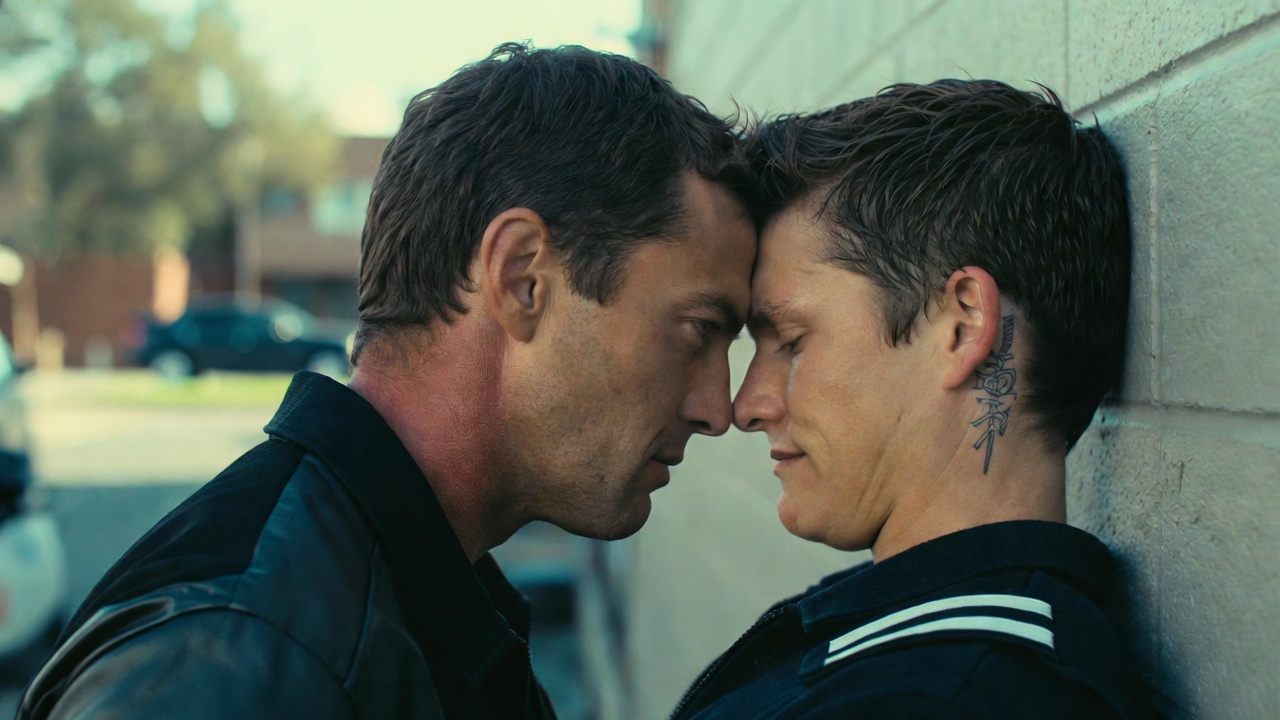
“I’m talking to you!” Jax screamed, his hand slamming into my shoulder. He spun me around and shoved me back against the brick wall of the annex. The air left my lungs in a sharp puff.
“You think you’re better than us with your quiet act?” he hissed, pinning me there. His face was inches from mine, smelling of expensive bourbon and unearned confidence. “You’re nothing. You’re a ghost. I could erase you from this town tonight and nobody would even find your shoes.”
He was enjoying it. He loved the way the people in the parking lot were looking away, pretending they didn’t see the rich kid assaulting the janitor. He felt invincible.
Then, he grabbed my hair, yanking my head to the side to whisper some final insult into my ear.
That’s when he saw it.
Behind my right ear, nestled just against the hairline, was a small, intricate tattoo. It wasn’t art; it was a signature. A silver-and-black crest of a soaring hawk clutching a broken crown. The mark of the Moretti family.
The air in the parking lot seemed to freeze. Jax’s grip didn’t just loosen; it turned into a palsy. His breath hitched, a wet, rattling sound in his throat. He knew that mark. Every man in the top one percent knew it. It was the mark of the family that owned the banks, the land, and the very air Jax was currently gasping.
“No,” Jax whispered, his face turning a sickly shade of grey. “No, that’s… that’s impossible.”
I looked at him then. Really looked at him. For the first time in two years, I let the “Floor Boy” mask slip, and I let the Moretti heir look back.
“You were saying something about erasing me, Jax?” I asked quietly.
Behind him, the roar of heavy engines broke the silence. Three black Suburbans tore into the lot, ignoring the lanes, and screeched to a halt in a perfect tactical formation.
Jax’s world was about to end, and he was the one who had invited the destruction.
Read the full story in the comments.
If you don’t see the new chapter, tap ‘All comments’.
FULL STORY
CHAPTER 2
The sound of the Suburban doors opening was like the cocking of a massive, collective hammer. Six men stepped out, their movements synchronized with the terrifying precision of a Swiss watch. They weren’t police, and they weren’t typical mall security. These were ghosts in charcoal suits, men who existed in the shadows of international treaties and private boardrooms.
Marcus, the lead operative, stepped forward. He was a man made of granite and scars, his eyes scanning the parking lot with a predator’s calm. When his gaze landed on Jax’s hand, which was still hovering near my neck, his expression didn’t change, but the air around him seemed to drop ten degrees.
“Step away from the young master,” Marcus said. It wasn’t a request. It was a physical force.
Jax scrambled back so fast he tripped over his own designer loafers, sprawling onto the asphalt. He looked up at me, then at the circle of armed men, then back at the tattoo behind my ear. The realization was hitting him like a series of high-speed collisions.
“I… I didn’t know,” Jax stammered, his voice cracking into a high-pitched whine. “Leo, I swear, I thought you were just… I didn’t know!”
“That’s the problem, isn’t it?” I said, stepping away from the wall. I felt the familiar weight of my heritage settling back onto my shoulders. It was a heavy suit of armor I had enjoyed taking off, but Jax had forced me to put it back on. “You only treat people with respect when you think they have the power to destroy you. That’s not character, Jax. That’s cowardice.”
Marcus stood at my side, his presence a silent wall of obsidian. “Sir, your father is concerned. He felt the ‘Living Experiment’ had reached a point of diminishing returns. Especially given the… physical contact.”
Marcus glanced at the bruise already forming on my shoulder. His hand moved toward the comms unit on his wrist. “Initiate Protocol Delta-Nine on the Miller holdings. All of them.”
Jax let out a sound that was half-sob, half-gasp. “Protocol what? What are you doing? My father—”
“Your father,” Marcus interrupted, looking down at Jax as if he were an insect under a microscope, “is currently receiving a series of phone calls. His lines of credit are being frozen. His permits for the Sterling Heights project have been revoked. By tomorrow morning, the Miller name will be a footnote in a bankruptcy filing.”
“You can’t do that!” Jax shrieked, though his eyes told me he knew they could.
I looked at the people watching from the edges of the lot. Sarah, a waitress from the club who had always been kind to me, was standing by her beat-up sedan, her mouth hanging open. She had seen me take Jax’s insults for months. She had even tried to share her lunch with me when she thought I was starving.
“Marcus,” I said, pointing to Sarah. “See that she gets the management position at the new estate. And make sure her car is replaced with something that actually starts in the winter.”
Sarah’s eyes went wide, but I didn’t wait for her thanks. I turned back to Jax, who was now weeping openly on the ground.
“The thing about being ‘trash’, Jax,” I said, leaning down so only he could hear me, “is that eventually, someone comes along to take it out. Today, that’s me.”
I climbed into the back of the lead SUV. The leather smelled of home and cold, hard reality. As we pulled away, I didn’t look back at the club or the life I’d tried to build in the shadows. I looked forward, toward the city, where my father was waiting. The experiment was over, and the reckoning had begun.
CHAPTER 3
The Moretti estate was a fortress of glass and limestone perched on the cliffs overlooking the Potomac. It was a place of silence, where the only sounds were the hum of the climate control and the soft footsteps of servants who moved like smoke.
My father, Arthur Moretti, was standing by the floor-to-ceiling windows in the library when I walked in. He didn’t turn around. He didn’t need to. He knew my stride, my breath, the very rhythm of my heart.
“You stayed longer than I expected, Leo,” he said, his voice a deep baritone that commanded the room. “Two years in the mud. Tell me, what did you find there?”
“I found that people are cruel when they think no one is watching,” I replied, standing in the center of the room. The transition from the locker room to this palace was jarring. My hands still felt like they should be holding a mop, not a crystal glass of mineral water.
“And what else?”
“I found that kindness is a luxury most people can’t afford, yet they give it anyway. And that those who have everything are often the most impoverished.”
Arthur turned then. He looked older, the lines around his eyes etched deeper by the weight of an empire that spanned three continents. He looked at the bruise on my shoulder, his jaw tightening.
“Jax Miller was a mistake,” my father said. “A small man with a small mind. I allowed him to persist because I wanted to see if you would break. If you would use the name to save yourself.”
“I didn’t,” I said. “He saw the mark. I didn’t tell him.”
“But you felt the urge, didn’t you? To scream who you were while he slammed you against that wall?”
I hesitated. “Yes. For a second. But then I realized that if I had to tell him, I’d already lost. The crest is a burden, Father. Not a shield.”
Arthur walked over and placed a hand on my shoulder, directly over the bruise. It hurt, but I didn’t flinch.
“It is both,” he said. “And now, you must use it as a sword. The Miller family was just the tip of the spear. There are others within our own circles who saw your absence as a sign of weakness. They thought I was hiding a broken heir. They thought the Moretti line was thinning.”
He handed me a leather-bound folder. Inside were photos, bank statements, and transcripts.
“While you were cleaning floors, your cousin Julian was cleaning out our offshore accounts in the Caymans. He’s been funnelling money to the Millers to fund their expansion—and his own coup.”
I looked at the photos of Julian. We had grown up together, played in these very halls. He had always been the faster one, the louder one. I realized then that my “experiment” hadn’t just been for my education. It had been a trap set by my father to see who would move against us while the heir was “vulnerable.”
“What do you want me to do?” I asked.
“You’ve learned what it’s like to be at the bottom, Leo. Now, I want you to show Julian what it’s like to fall from the top. He’s hosting a gala tonight at the National Gallery. He thinks he’s celebrating his final move. I want you to attend. Not as the boy he remembers, and certainly not as the boy from Oak Creek.”
“I want the ‘Floor Boy’ to go to the ball,” I said, a cold smile tugging at the corners of my mouth.
“No,” Arthur said, his eyes flashing. “I want the Hawk to go to the feast.”
CHAPTER 4
The National Gallery was a sea of black ties, silk gowns, and the suffocating scent of lilies and old money. I stood at the top of the grand staircase, adjusted the cuffs of my bespoke tuxedo, and felt the weight of the Moretti signet ring on my finger.
I wasn’t the same person who had scrubbed the showers at the club forty-eight hours ago. But in a way, I was. The humility I’d learned was now a weapon. I knew how to read a room because I’d spent two years being invisible in them. I knew who was lying by the way they avoided the eyes of the staff. I knew who was desperate by how tightly they gripped their champagne flutes.
“Leo?”
A voice drifted up from the crowd. I looked down to see Julian. He looked radiant, surrounded by a circle of sycophants. He began to climb the stairs, his smile wide and predatory.
“My god, look at you! We all thought you’d joined a cult or were living in a cave in Tibet. Father said you were on a ‘sabbatical’. You look… well-rested.”
He reached the top and pulled me into a superficial hug, whispering into my ear, “You should have stayed away, Leo. The board is mine. The banks are mine. You’re a relic.”
I pulled back and smiled at him. It was the same smile I’d given Jax Miller right before the Suburbans arrived.
“I wasn’t in Tibet, Julian. I was in Oak Creek. Working at the athletic club. You remember the Millers, don’t you? Your business partners?”
Julian’s smile faltered for a fraction of a second. “I don’t know what you’re talking about.”
“I think you do. I think you liked the idea of a partner who was loud and distracting while you did the real work in the dark. But the thing about working in the dark, Julian, is that you forget people are still watching from the corners.”
I signaled to Marcus, who was standing near the entrance. He nodded and tapped a command into his tablet.
Suddenly, the large digital displays throughout the gallery—the ones meant to show Julian’s “Vision for the Future”—flickered and changed. They didn’t show architectural renderings. They showed wire transfer logs. They showed encrypted messages between Julian and Jax Miller discussing the systematic dismantling of Moretti assets.
The room went silent. The music died. Hundreds of the most powerful people in the country turned to look at the screens.
“This is a fabrication!” Julian shouted, his face flushing a deep, panicked red. “Leo, what have you done?”
“I didn’t do anything, Julian. You wrote the emails. You signed the transfers. I just… cleaned up the mess.”
I stepped closer to him, my voice dropping to a whisper. “You thought I was weak because I walked away from the power. But I only walked away so I could see what the world looked like without the Moretti shadow. And what I saw was you, picking at the bones of our family like a vulture.”
Security guards—our guards, the ones who had remained loyal to my father—moved in. They didn’t grab him. They didn’t have to. The social death was already complete. Everyone in that room was already moving away from Julian, a physical tide of rejection.
“By the way,” I added as Julian began to tremble, “I ran into Jax Miller the other day. He sends his regards. Or he would, if he hadn’t lost his house, his cars, and his father’s respect in a single afternoon.”
Julian looked around the room, searching for a single friendly face. He found none. He had spent his life building a kingdom of fear, and now that he was the one who was afraid, he was utterly alone.
CHAPTER 5
The aftermath was a whirlwind of legal filings and corporate restructuring. Within a week, Julian was under house arrest, and the Miller family had vanished from the social register entirely.
But I didn’t feel the triumph I expected.
I was sitting in a small park in Oak Creek, far from the estate and the gallery. I was wearing a plain hoodie and jeans, trying to find the man I had been for the last two years.
“I thought I might find you here.”
I looked up. It was Sarah. She was wearing a new coat, and she looked different—rested, less haunted by the grind of living paycheck to paycheck.
“How’s the new job?” I asked, gesturing for her to sit.
“It’s… it’s life-changing, Leo. Or whatever your name actually is,” she said, giving me a small, shy smile. “I still can’t believe it. The car, the position… why me? I was just a waitress who gave you half a tuna sandwich once.”
“That’s exactly why,” I said. “You were the only one who saw me when I was nobody. Everyone else waited until I was a Moretti to be ‘kind’. You did it when it gained you nothing.”
Sarah looked at the playground across the street, where kids were playing without a care in the world. “Is it hard? Being who you are?”
“It’s lonely,” I admitted. “In that world, everyone is playing a game. Even my father. Especially my father. I spent two years trying to escape the game, only to find out I was just being trained for a bigger one.”
“So, what happens now? You go back to the castle and rule the world?”
I looked at my hands. They were clean now. No calluses, no dirt under the nails. But I missed the honesty of the work. I missed the way a floor looked when it was finally, truly clean.
“I think I’m going to change the game,” I said. “My father wants me to be a hawk. But hawks only see what they can kill. I want to see what I can build.”
I stood up and handed her a small envelope.
“What’s this?” she asked.
“A scholarship fund for the kids in this neighborhood. Real money, Sarah. Not just a PR stunt. I want you to run it. I need someone who knows what it’s like to struggle to make sure the help actually reaches the people who need it.”
Sarah looked at the envelope, then at me. Her eyes filled with tears. “You’re not like them, are you?”
“I’m trying not to be,” I said.
As I walked back toward the waiting black SUV, I felt the mark behind my ear. It didn’t feel like a crown anymore. It felt like a promise. A promise to remember the “Floor Boy” even when I was sitting in the corner office.
CHAPTER 6
A year later, the Moretti Group looked very different. We were still powerful, still wealthy, but the “Moretti Shadow” had begun to lift. We had divested from companies that exploited their workers and invested heavily in community-led development.
My father had grumbled at first, calling me “soft.” But when the profits actually rose because of the stability and loyalty we were building, he finally went quiet. He had retired to the estate, leaving the day-to-day operations to me.
I was standing in the lobby of our new headquarters—a building designed to be open, airy, and welcoming. I wasn’t in a tuxedo. I was in a simple suit, walking through the halls without a security detail.
I saw a young man scrubbing the glass of the front doors. He looked tired, his shoulders slumped in that way I knew all too well. He was invisible to the executives rushing past him with their leather briefcases and self-importance.
I stopped.
“You missed a spot,” I said, pointing to a small smudge near the handle.
The young man looked up, startled. “Oh, sorry, sir. I’ll get it right away.” He started to scrub frantically, his eyes filled with that familiar fear of being scolded by someone important.
“Take your time,” I said, putting a hand on his shoulder. “It’s a big door. And you’re doing a good job.”
He paused, looking at me with genuine surprise. “Thanks, sir. Most people don’t even see the door, let alone me.”
“I see you,” I said. “And I know how hard it is to make something shine when everyone else is trying to dull it.”
I reached into my pocket and handed him my business card. “When you’re finished with the glass, go to the tenth floor. Ask for Sarah. Tell her Leo sent you. We’re looking for people who know the value of a job well done.”
The boy looked at the card, then at me, his face lighting up with a hope I hadn’t seen in a long time.
As I walked away, I felt a sense of peace that no amount of money could buy. I had spent years hiding my name, thinking that power was something you inherited. But I was wrong.
True power isn’t about pinning someone to a wall or destroying their future. It’s about being the person who helps them stand up when the rest of the world is waiting for them to fall.
I looked at my reflection in the polished marble of the elevator. I wasn’t a hawk, and I wasn’t a floor boy. I was a Moretti. And for the first time in generations, that name finally meant something good.
Power is a privilege, but humility is a choice.