I watched the man who claimed to love my mother raise his hand. I watched the sting of the slap ripple across her skin—the skin of the woman who raised me in a trailer, who worked three jobs so I could have boots that fit, who never complained once.
Derek Vance thought his bank account made him a king. He thought his expensive suit was a suit of armor. He looked at my grease-stained hands and my leather vest and saw a “thug” he could look down on.
He was wrong. He didn’t just hit a waitress. He hit the Mother of the 999.
By the time the sun sets over this quiet little suburb, Derek will learn that some debts aren’t paid in dollars. They’re paid in chrome, thunder, and the kind of fear that money can’t buy off.
The engines are starting. The brothers are coming. And God help anyone who stands in our way.
FULL STORY BELOW
Chapter 1: The Sound of the Break
The air in “Mama’s Kitchen” always smelled like home—burnt coffee, maple syrup, and the faint, citrusy scent of the floor wax my mother, Mary, insisted on using every single morning before the first shift. It was a 1950s-style relic tucked away in the heart of a quiet Ohio suburb, a place where people came to complain about their taxes and eat eggs over-easy.
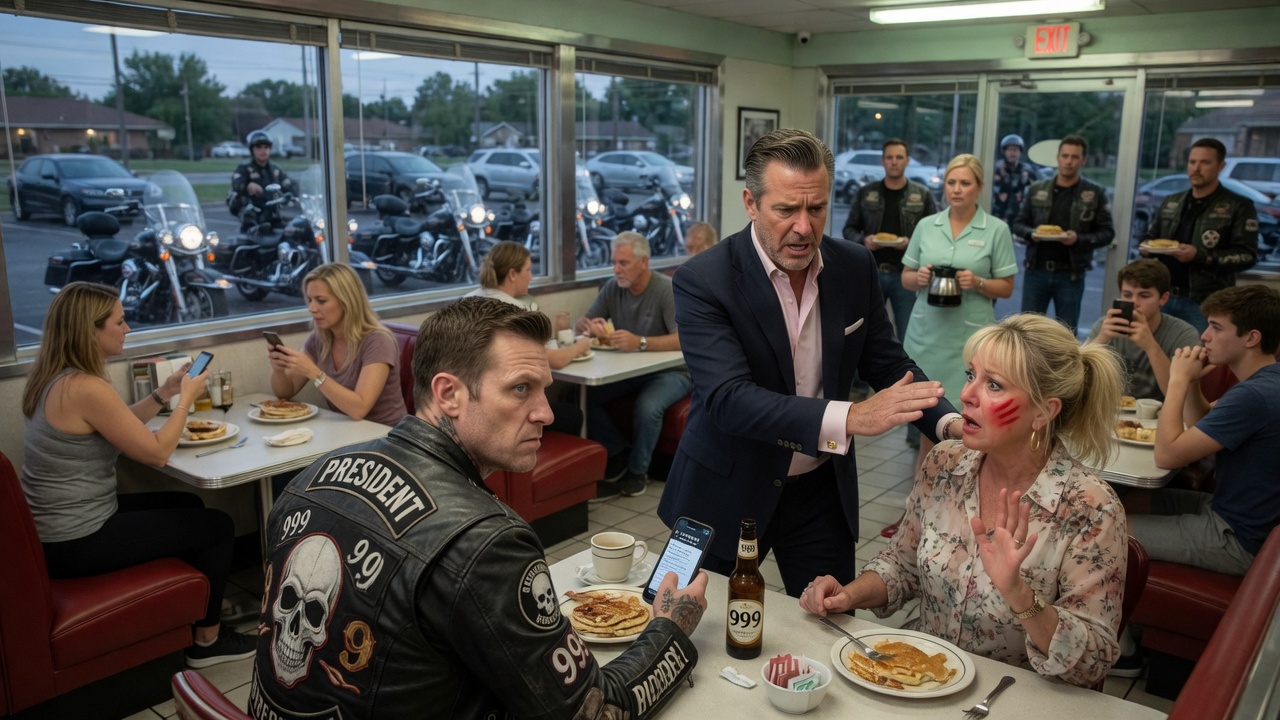
I was sitting in the back booth, the one with the cracked vinyl that the owner let me keep for free. I was nursing a black coffee, my mind a thousand miles away, thinking about the shipments coming into the clubhouse and the tension brewing with the rival crew three counties over. My leather vest—the “cut,” as we call it—felt heavy on my shoulders. The “999” patch on the back was a symbol of the family I’d built after the Army spit me out.
Then I saw him.
Derek Vance walked in like he owned the air we were breathing. He was the kind of man who wore a three-thousand-dollar suit to a diner just to make sure the people inside knew they were beneath him. He’d been seeing my mother for three months. She thought he was a “gentleman.” I thought he was a snake in a silk tie.
“Mary!” he barked, not waiting for her to finish with a customer.
My mother turned, a tired but genuine smile on her face. “Derek? I didn’t expect you until—”
“We’re leaving,” he snapped, grabbing her wrist. “Now. I have the fundraiser at the club, and you’re still in this… polyester rag.”
“Derek, I have twenty minutes left on my shift,” she said softly, trying to pull her arm back. “The girls need help with the lunch rush.”
“I don’t care about the lunch rush or these people,” Derek sneered, his voice rising. The diner went silent. The clinking of silverware stopped. “I told you to be ready. You’re making me look like an idiot.”
“You’re hurting me,” she whispered.
That should have been the end of it. He should have let go. He should have seen me standing up from the booth. But arrogance is a blinding thing.
Derek’s face contorted. “Don’t you ever talk back to me in public.”
The slap wasn’t just a sound. It was an explosion. It cracked through the quiet diner like a gunshot. My mother’s head snapped to the side, her glasses flying off and skidding across the checkered floor. She stumbled back, hitting the counter, her hand instantly flying to her cheek.
The world turned gray. The peripheral vision I’d trained in the deserts of the Middle East narrowed into a single, sharp point of focus.
I didn’t run. I didn’t scream. I walked. Every step was heavy, deliberate. The sound of my heavy engineer boots on the linoleum was the only thing moving in the room.
Derek was still standing there, his chest heaving, looking surprised at his own violence but not yet afraid. He looked at Mary like she was a broken toy.
“Jax,” my mother gasped, seeing me. “Jax, please, it’s okay.”
It wasn’t okay. It would never be okay again.
I stopped three feet from him. I’m six-foot-four, two hundred and thirty pounds of muscle and scar tissue. Derek was a well-fed office bird. When he finally looked up and met my eyes, he saw the “999” on my chest. He saw the cold, dead vacuum of a man who had seen things he could never unsee.
“You have five seconds to apologize,” I said. My voice was a low, vibrating growl.
Derek tried to find his bravado. He straightened his tie, though his hands were shaking. “Stay out of this, Jax. This is between me and your mother. You don’t understand the world I live in.”
“I don’t care about your world, Derek,” I said, stepping into his personal space. I could smell his expensive cologne—something woodsy and fake. “I care about mine. And in my world, we don’t hit women. Especially not mine.”
He laughed, a shrill, panicked sound. “What are you going to do? Call your little motorcycle club? This is a civilized neighborhood, boy. I have lawyers. I have the police chief on speed dial.”
I leaned in, my mouth inches from his ear. “I’m not going to hit you, Derek. Not here. Not yet. I want you to go home. I want you to sit in that big, glass house of yours and wait. I want you to listen for the sound of the wind.”
“You’re crazy,” he spat, but he was already backing toward the door.
I watched him scramble out to his Mercedes. I watched him peel out of the parking lot like the coward he was.
I turned to my mother. She was shaking, holding a cold rag to her face. The diner owner, a veteran named Sal, was already on the phone, likely calling the cops, but I caught his eye and shook my head. This wasn’t for the cops.
“Mom,” I said, taking her hand.
“Don’t do anything foolish, Jax,” she pleaded. “He’s powerful. He has money.”
I kissed her forehead. “Money is just paper, Mom. But family? Family is iron.”
I walked out to my bike—a custom blacked-out Harley that sounded like a thunderstorm. I pulled my phone from my pocket and hit the speed dial for Cutter, my VP.
“Gather the brothers,” I said. “All of them. Full colors. We’re going for a ride to the Heights.”
“Who’s the target, Ghost?” Cutter asked, his voice eager.
“A man who forgot how to be a man,” I replied. “Bring the heavy chains. We aren’t just sending a message. We’re closing the account.”
As I kicked the starter, the engine roared to life, a guttural scream that echoed off the suburban storefronts. The hunt had begun.
Read the full story in the comments.
If you don’t see the new chapter, tap ‘All comments’.
FULL STORY
Chapter 2: The Weight of the Cut
The clubhouse of the 999 was an old iron foundry on the edge of the industrial district, a place where the air always tasted like rust and spent oil. By the time I pulled through the gates, the yard was already humming. This wasn’t just a club; it was an organism. When the President’s blood felt a chill, the whole body reacted.
Cutter was waiting by the main bay doors. He was a man made of sharp angles and old scars, a former medic who had saved my life in a ditch outside Fallujah. He didn’t ask what happened. He just looked at my face and handed me a glass of neat bourbon.
“The brothers are inside,” Cutter said. “Word’s already out. Sal’s girl called Bear. She told him about the diner.”
I downed the bourbon in one go. The burn helped center me. “How many can we get on the road in an hour?”
“Forty here now. Another thirty coming in from the North Chapter. If you want the full legion, give me two hours.”
“One hour,” I said. “I want Derek Vance to feel the floor shaking before the sun goes down.”
I walked into the main hall. The 999 wasn’t like the clubs you see in the movies. We weren’t a gang of mindless thugs. We were mechanics, electricians, veterans, and fathers. We were the men the world forgot until something broke.
Bear, our Sergeant-at-Arms—a man who lived up to his name in both size and temperament—stepped forward. “Ghost, tell us it’s a lie. Tell us some suit didn’t lay a hand on Mary.”
I stood on the small riser at the head of the room. The silence that fell was absolute. “He hit her. In the diner. In front of God and everyone. He thought his zip code protected him. He thought we were just a bunch of ‘grease monkeys’ he could look down on.”
A low, dangerous murmur rippled through the room. It sounded like a hornets’ nest being stirred.
“We aren’t going there to kill him,” I said, my voice carrying into every corner. “Killing is too easy. It’s too fast. We are going there to take away the only thing he loves: his status. His peace. His sense of being untouchable. We are going to show him that the 999 doesn’t just ride. We rule the night.”
“What’s the play?” Preacher asked. He was our road captain, a man who could navigate a bike through a hurricane.
“We surround the Heights,” I said. “Every entrance. Every exit. I want a wall of chrome around his gated community. Then, I’m going to his front door. And I’m taking his keys.”
For the next forty-five minutes, the clubhouse was a hive of clinical efficiency. Vests were snapped tight. Chains were checked. Engines were tuned. There was no joking today. No laughter. This was a funeral procession for a man’s ego.
I went to my private locker in the back. I pulled out a small, wooden box. Inside was a set of brass knuckles my grandfather had carried in the Pacific. I didn’t plan on using them, but the weight of them in my pocket felt like a promise.
I looked at a photo taped to the inside of the locker. It was me, ten years old, and my mom at the county fair. She was laughing, holding a giant stick of blue cotton candy. She looked so young. So safe.
I had failed to keep her safe today. I wouldn’t fail again.
“Ghost,” Cutter said, appearing in the doorway. “We’re ready.”
I walked out to the yard. Seventy motorcycles were idling. The vibration was so intense I could feel it in my teeth. The exhaust smoke rose like a dark cloud against the setting sun.
I mounted my Harley. I didn’t need to give a speech. I just raised my left hand, then dropped it into a fist.
Seventy engines screamed at once. We pulled out of the gate, two by two, a river of black leather and steel flowing toward the suburbs. People on the sidewalks stopped and stared. Some pulled out phones. Others looked away in fear.
They had no idea that we were the ones doing the world a favor. We were the reckoning.
As we hit the highway, the wind whipped against my face. The rage was still there, but it had cooled into something sharper. Derek Vance thought he lived in a world of rules and regulations. He was about to find out that when you strike the heart of a family, the only rule that matters is “An eye for an eye.”
And I intended to take much more than an eye.
Chapter 3: The Gated Cage
The “Heights” was the kind of neighborhood where the grass was measured with a ruler and the homeowners’ association sent you a fine if your curtains were the wrong shade of beige. It was a fortress of boredom and wealth, guarded by a single, bored security guard in a kiosk.
He saw us coming from a mile away. You don’t miss seventy bikes riding in a tight “staggered” formation.
The guard scrambled to close the gate, his hands fumbling with the buttons. He looked like he wanted to crawl under his desk. I pulled my bike right up to the glass of the kiosk. I didn’t say a word. I just looked at him.
Behind me, the roar of the bikes filled the quiet street, echoing off the million-dollar mansions. It was the sound of a nightmare arriving in paradise.
“I… I can’t let you in,” the guard stammered over the intercom. “This is private property.”
Cutter hopped off his bike and walked to the gate arm. He didn’t break it. He just leaned his three-hundred-pound frame against it until the gears groaned and the arm snapped upward.
“It’s a public emergency,” Cutter said with a terrifying grin. “Common sense just died, and we’re here for the wake.”
I rode through. The club followed. We didn’t speed. We didn’t do burnouts on the lawns. We rode at a slow, funereal pace, circling the cul-de-sac where Derek Vance lived.
Number 42. It was a monstrosity of glass and white stone, glowing with expensive interior lighting. Derek’s Mercedes was parked in the driveway, looking like a discarded toy.
I signaled for the club to “circle the wagons.” Within seconds, the house was surrounded. Seventy men stood by their bikes, arms crossed, their headlights all pointed directly at Derek’s front windows. The house was bathed in a harsh, industrial glare.
I dismounted and walked toward the front door. Bear and Cutter were at my sides.
“You think he’s called the cops yet?” Bear asked.
“Let him,” I said. “The Sheriff owes us for that toy drive last Christmas, and half the deputies have cousins in the club. By the time they get here, the party will be over.”
I didn’t knock. I kicked the door.
It didn’t fly open—it was a heavy, reinforced piece of oak—but it shook the house. I waited five seconds. Then I kicked it again.
The door opened a crack. Derek’s face appeared, pale as a ghost. He was holding a small handgun, his hand shaking so badly the barrel was dancing.
“Get off my property!” he shrieked. “I’m armed! I’ll shoot!”
“You couldn’t hit a barn from the inside, Derek,” I said, my voice calm. “And even if you do, there are sixty-nine men behind me who will dismantle this house brick by brick until they find you. Put the toy away.”
“I… I’ll call the police!”
“I’m sure they’re on their way,” I said, stepping forward. “But they’re going to be very slow tonight. There’s a lot of ‘traffic’ on the main road.”
I pushed the door open. Derek fell back, tripping over a designer rug. The gun clattered across the hardwood. I stepped on it, crushing the plastic grip under my boot.
I looked around the foyer. There was a photo on the wall—Derek at a gala, smiling with some local politician. He looked so confident. So safe.
“Why did you do it, Derek?” I asked, looking down at him. “Why did you hit her?”
“She was being difficult!” he cried, scrambling backward on his hands and knees. “She doesn’t understand my life! I have pressure you wouldn’t believe!”
I reached down, grabbed him by the lapels of his expensive shirt, and hauled him to his feet. He was surprisingly light.
“Pressure?” I whispered. “You want to talk about pressure? My mother spent twenty years worrying about whether we’d have electricity. She spent ten years praying I’d come home from a war zone in one piece. That’s pressure. You? You’re just a bully who found a target he thought was weak.”
I dragged him toward the front door.
“What are you doing? Where are we going?”
“Outside,” I said. “It’s time for you to meet the rest of the family.”
Chapter 4: The Court of Chrome
When we stepped onto the porch, Derek let out a small, pathetic whimpering sound. The sight of seventy bikers silhouetted against the blinding glare of their own headlights was enough to break a stronger man than him.
The club was silent. No one shouted. No one moved. They were like statues of judgment.
I dragged Derek to the center of the driveway and threw him down onto the asphalt. He landed hard, his suit trousers tearing at the knee.
“Look at them, Derek,” I commanded. “Every one of these men has a mother. Every one of them knows what it means to protect what’s theirs.”
Cutter stepped forward, holding a thick, manila envelope. “We did a little digging while we were waiting for the ‘legion’ to assemble, Ghost.”
I took the envelope. “Derek here is a financial advisor. He handles ‘high-net-worth’ individuals. But it turns out, Derek likes to gamble. And he likes to use his clients’ money to cover his losses.”
Derek’s eyes went wide. The panic in them was now replaced by pure, unadulterated terror. “You… you can’t know that. That’s confidential.”
“Nothing is confidential when you’re a 999,” I said. “We have friends in low places, Derek. And those low places have access to your high-place servers.”
I tossed the envelope onto his chest. “In there is enough evidence of embezzlement to put you away for twenty years. Sal’s girl—the one you ignored at the diner—she’s a whiz with forensic accounting. She’s been looking for a reason to nail you for months.”
Derek looked at the envelope like it was a coiled viper. “What do you want? Money? I can get you money.”
“I don’t want your money,” I said. “I want you to feel the weight of what you did.”
I looked at Bear. “Bear, do we have the ‘Gift’?”
Bear walked to his bike and pulled out a heavy, industrial-sized hair clipper. He plugged it into a portable power pack and flipped the switch. The high-pitched whine sliced through the night air.
“No,” Derek gasped, clutching his perfectly coiffed hair. “No, please!”
“You like looking down on people, Derek,” I said. “You like your ‘image.’ Let’s see how that image holds up in a prison yard.”
I held Derek down while Bear went to work. We didn’t hurt him. We just took his vanity. In three minutes, his expensive haircut was gone, replaced by a jagged, uneven mess.
“Now,” I said, leaning down so our noses were touching. “Here’s how this goes. You’re going to sign over the title of your Mercedes to the diner. Sal needs a new delivery vehicle. Then, you’re going to write a check—a very large one—to the local women’s shelter. And then, you’re going to leave this town. Tonight.”
“And if I don’t?”
“Then this envelope goes to the Feds,” I said. “And the ‘999’ will make sure that every inmate in the state knows exactly why you’re there. They don’t like men who hit women in prison, Derek. Even the ones who stole millions.”
Derek was sobbing now. A grown man, broken on his own driveway.
“The check,” I prompted. “Now.”
He scrambled inside, escorted by Cutter and Bear. Five minutes later, they emerged with a signed title and a check that had enough zeros to keep the shelter running for a decade.
“Get in your house,” I told him. “Pack a bag. If I see your face in this county after sunrise, the envelope gets mailed. And I’ll come back for the house.”
He didn’t argue. He ran inside and locked the door.
I turned to the brothers. “Load up! We’re done here.”
As we rode out of the Heights, the neighbors were watching from their windows. They saw the 999 leaving. They saw the silence return. But they also saw that for one night, the rules had changed. The bullies didn’t win.
Chapter 5: The Morning After
The sun was just beginning to peek over the horizon when I pulled back into the diner’s parking lot. The “Open” sign was already glowing.
I walked inside. Sal was behind the counter, wiping down the same spot he’d been wiping for thirty years. My mother was sitting at the back booth, a cup of tea in front of her. The swelling on her cheek had gone down, but the bruise was turning a deep, angry purple.
I sat down across from her. I placed the car title and a copy of the shelter receipt on the table.
“He’s gone, Mom,” I said softly.
She looked at the papers, then at me. Her eyes were full of a complicated mix of sadness and relief. “Jax… you didn’t have to do all this.”
“Yes, I did,” I said. “People like him… they think the world is a ladder. They think they can kick the people on the rungs below them and never have to look down. I just reminded him that the ladder is held up by people like us.”
Sal walked over and set a fresh plate of bacon and eggs in front of me. “Cops came by last night,” he said, his voice gruff. “Said they got a call about a ‘riot’ in the Heights. I told them I didn’t see anything but a bunch of law-abiding citizens out for a late-night ride.”
I nodded to Sal. “Thanks, brother.”
“Vance called me an hour ago,” Sal added, a smirk playing on his lips. “Sounded like he was in a hurry. Said he was resigning from the board. Said he was moving to Florida for his ‘health.'”
My mother reached across the table and took my hand. Her skin was rough from years of work, but her grip was strong. “I just want things to be quiet again, Jax.”
“They will be,” I promised. “The club is going to keep an eye on the place. You won’t ever have to worry about someone like that again.”
Just then, the door to the diner swung open. It was Cutter, Bear, and ten other members of the 999. They weren’t in “war mode” anymore. They were just men looking for breakfast.
They filed in, filling the stools at the counter. One by one, as they passed our booth, they stopped.
“Morning, Mary,” Bear said, tipping his cap.
“Looking good, Miss Mary,” Preacher added.
“If you need anything, you call us,” another said.
My mother’s face transformed. The shadow of the slap seemed to lift, replaced by the warmth of being surrounded by seventy “sons” she never knew she had. She stood up, smoothing her apron.
“Alright, you hooligans,” she said, her old spark returning. “Who wants coffee? And if I see one boot on my clean rungs, there’ll be hell to pay!”
The diner erupted in laughter. It was a beautiful, normal sound.
I sat back and watched her work. She was moving with a new lightness, a sense of belonging that Derek Vance could never have given her. He had tried to break her spirit to make himself feel big. Instead, he had only succeeded in showing her how much she was loved.
I felt the weight of the brass knuckles in my pocket one last time before I decided to drop them into the trash can by the door on my way out. I didn’t need them anymore. The message had been sent, and the debt was paid.
Chapter 6: The Road Ahead
A week later, the town was back to its usual, sleepy self. Derek Vance’s house was on the market, and his Mercedes—now sporting a “Mama’s Kitchen” magnet on the door—was parked out front of the diner, filled with boxes of supplies.
The 999 held a BBQ at the clubhouse that Saturday. We invited the whole neighborhood. We had a bounce house for the kids and a band playing classic rock. Even the Sheriff showed up, though he made sure to keep his patrol car’s lights off.
I was standing by the grill, flipping burgers, when my mother walked up. She was wearing a new dress—something blue that matched her eyes.
“You look nice, Mom,” I said.
“I feel nice, Jax,” she said. She looked around at the bikers, the families, and the laughter. “I used to think that your ‘club’ was just a way for you to stay in the past. To keep fighting a war that was already over.”
“And now?”
She looked at Bear, who was currently letting a five-year-old girl “drive” his stationary motorcycle. She looked at Cutter, who was patiently explaining engine mechanics to a group of teenagers.
“Now I see that it’s not about the war,” she said. “It’s about the peace you build afterward. It’s about making sure that the people who can’t fight for themselves always have someone who will.”
I hugged her, the scent of her perfume mixing with the smell of charcoal and leather.
“We’re the 999, Mom,” I whispered. “We’re the last line of defense.”
That night, after the party had died down and the brothers were sitting around the fire pit, I took a moment to look up at the stars. The world is a loud, messy, and often cruel place. There are always going to be men like Derek Vance—men who think that power is something you wield over others.
But as long as there are people willing to stand up, to ride through the night, and to say “Not on my watch,” the darkness doesn’t stand a chance.
I felt a hand on my shoulder. It was Cutter.
“What’s on your mind, Prez?”
I looked at the “999” patch on his vest, glowing in the firelight.
“Just thinking about the road,” I said. “It’s a long one.”
“Yeah,” Cutter said, kicking a log into the flames. “But at least we’re riding it together.”
I smiled, listening to the distant hum of an engine somewhere out on the highway. My mother was safe. My brothers were loyal. And the 999 was stronger than ever.
Sometimes, a slap isn’t an ending. Sometimes, it’s just the spark that lights the way home.
The engines are quiet for now, but we’re always ready to ride. Because in this life, you don’t just protect the woman who gave you life—you protect the dignity of everyone who deserves it.