I stood in the driveway of the house I paid for, listening to my own blood call our mother a “clutter problem.”
Brad didn’t see me. He was too busy shoving a woman who spent thirty years cleaning his messes into a dark corner so he could “stage the house” for a garden party.
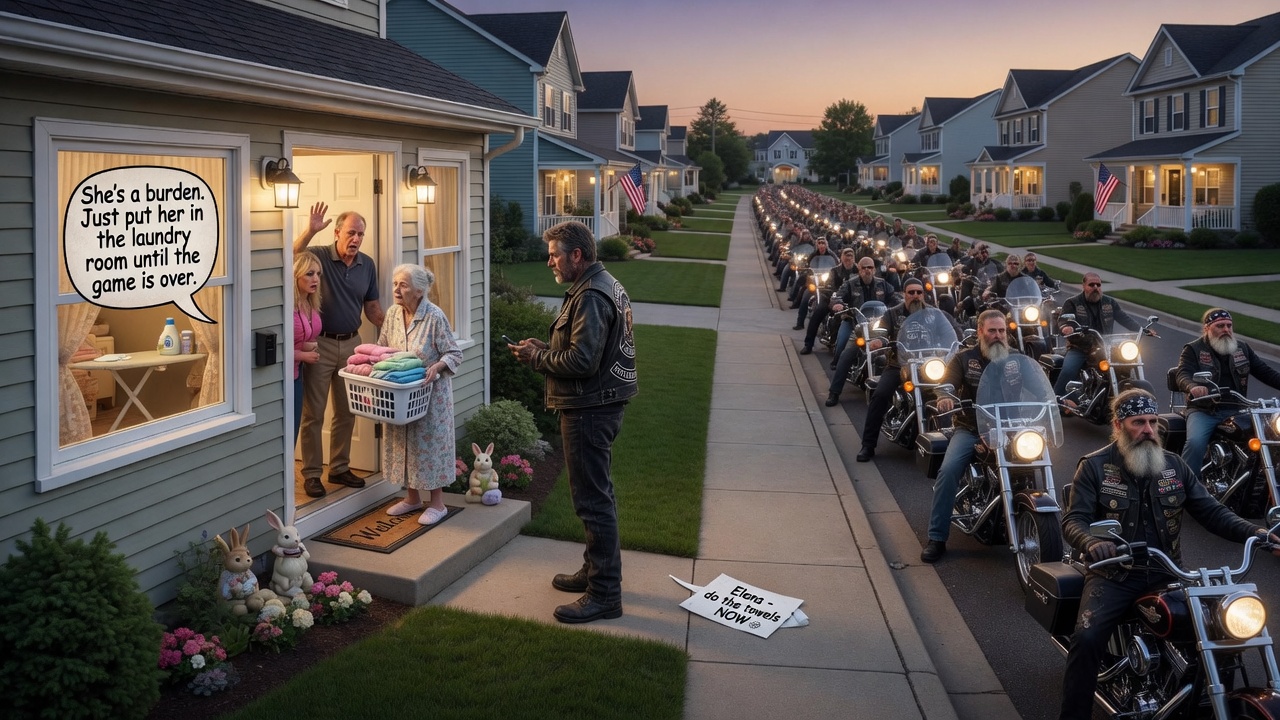
“She’s a burden, Jax,” he told me, not even looking up from his phone. “She’s dragging down the property value. We need her gone.”
They forgot one thing. I didn’t spend the last ten years just riding—I spent them building a family that actually understands the word ‘loyalty.’
I didn’t yell. I didn’t raise a hand. I just made one phone call.
When the ground started to shake and the chrome started to scream, I saw the exact moment the color left my brother’s face. He thought he was the king of this cul-de-sac. He was about to find out that the “burden” he wanted to throw away was the only thing keeping the wolves from his door.
The streets of this quiet little suburb are about to get very, very crowded.
CHAPTER 1: The Ghost in the Hallway
The air in Oak Crest always smelled like freshly mowed grass and expensive hypocrisy. I pulled my Harley-Davidson Fat Boy onto the curb, the engine’s low growl feeling like a sacrilege against the oppressive silence of the neighborhood. This was the zip code of “perfect” families, where the lawns were manicured but the skeletons in the closets were starving.
I hadn’t been home in six months. The “Steel Sentinels” had been on a cross-country run, and my phone had been a brick of missed calls and unread texts. But I didn’t need a notification to tell me something was wrong. I could feel it in my gut, a heavy, sinking intuition that usually meant trouble on the road.
As I kicked the stand down, I looked at the house. Two-story colonial, white siding, black shutters. I’d bought it for Ma five years ago after Dad passed, putting the deed in her name but keeping the mortgage on my tab. It was supposed to be her sanctuary.
Then my brother Brad lost his “senior VP” gig in the city and moved back in “temporarily” with his wife, Tiffany. That was a year ago.
I walked up the stone path, my boots heavy. Before I could even reach the porch, I heard it. A sharp, ugly sound—the sound of someone being dismissed.
“I told you, Elena! The caterers need this space clear. Just stay in the laundry room until the guests leave. It’s not that hard to understand.”
That was Tiffany. Her voice had the refined edge of a woman who spent more on her hair than most people spent on their rent.
I didn’t knock. I pushed the door open.
The foyer was filled with crates of expensive wine and floral arrangements that looked like they cost a month’s wages. In the center of the kitchen, my brother Brad was holding our mother by the upper arm. He wasn’t hitting her, but he was steering her—the way you steer a dog that won’t stop barking.
Ma looked smaller. Her gray hair, usually pinned in a neat bun, was coming loose. She was clutching a faded dish towel like a shield.
“Jax?” she whispered, her eyes widening.
Brad spun around, his face flushing a deep, guilty red. “Jax! You’re… you’re early. We weren’t expecting you until the weekend.”
“Clearly,” I said. My voice was a low rumble, the kind that usually makes people back away in bars. I didn’t move. I just watched his hand on her arm. “Take your hand off her, Brad.”
“Look, Jax, you don’t understand the logistics of this evening,” Tiffany chimed in, stepping out from behind a massive vase of lilies. She was wearing a silk dress that cost more than my bike’s engine. “We have the HOA board coming over. Very influential people. Your mother… she’s been getting confused. She’s a burden on the flow of the party. We’re just trying to keep things organized.”
“A burden?” I repeated. The word tasted like ash in my mouth.
“It’s a medical term, Jax,” Brad snapped, trying to regain his bravado. “Caregiver burnout is real. We’re doing all the work here while you’re out playing ‘Easy Rider.’ She’s dragging us down. We’re planning to move her to the Willow Creek facility next month. It’s for the best.”
I looked at Ma. She wasn’t looking at me. She was looking at the floor, her shoulders hunched as if she were trying to disappear into the linoleum.
“Ma,” I said softly. “Is that what you want?”
She didn’t answer. She just tightened her grip on that dish towel.
“She doesn’t know what she wants,” Tiffany sighed. “Now, please, Jax. Go wash up or something. You smell like gasoline and road. And try to use the back entrance.”
I looked around the house I paid for. I looked at the brother I’d bailed out of debt three times. I looked at the mother who had worked two jobs to make sure we had shoes.
“The laundry room?” I asked, pointing to the dark corner where they’d been shoving her.
“It’s quiet in there,” Brad said. “Less stimulating.”
I nodded slowly. I didn’t explode. I didn’t flip the table. I just reached into my vest and pulled out my heavy-duty encrypted radio.
“Brad, Tiffany,” I said, my voice deathly calm. “I want you to enjoy the next twenty minutes. Truly. Because after that, the ‘flow’ of this neighborhood is going to change forever.”
I turned and walked back out the door, Ma’s silent, weeping face burned into my retinas.
Read the full story in the comments.
If you don’t see the new chapter, tap ‘All comments’.
FULL STORY
CHAPTER 2: The Architecture of Greed
The sun was beginning to dip below the horizon, casting long, jagged shadows across the suburban lawns of Oak Crest. To the neighbors, I was a stain on their perfect canvas—a man in worn denim and leather, standing next to a machine that looked like it belonged in a post-apocalyptic wasteland.
I sat on the low stone wall at the edge of the property, my radio in one hand and a cigarette I didn’t light in the other.
Inside that house, my mother was being treated like a piece of furniture that didn’t fit the aesthetic. I thought back to the summer of ’98. Dad had been gone a year, and the bank was breathing down our necks. Ma had worked double shifts at the diner, her feet swollen and bleeding, just so Brad could have the right suit for his prom. She’d skipped meals so I could have a new tire for my first beat-up bike.
She wasn’t a “burden” then. She was the gravity that kept our world from flying apart.
Brad had always been the “golden child.” He was the one with the degree, the one who worked in glass towers. I was the one who went to trade school, the one who liked the smell of oil and the freedom of the open road. When Brad’s firm collapsed under the weight of his own ego and a few “accounting errors,” I was the one who told him to bring his family home. I thought he’d help take care of Ma.
I was wrong. He didn’t come home to help her; he came home to colonize her life.
Tiffany was the architect of the new regime. She had replaced Ma’s lace doilies with minimalist marble. She’d thrown out the old family photos because they “cluttered the visual field.” They had relegated the woman who owned the house to the smallest guest room, and now, apparently, to the laundry room.
I looked at my watch. Eighteen minutes left.
“Sarge, you there?” I spoke into the radio.
“Always, Boss,” the voice crackled back. It was deep, gravelly, and carried the weight of a thousand miles. “We’re two miles out. All chapters accounted for. The brothers from the Tri-State area joined the line. We’re sitting at a cool eleven hundred bikes.”
“Approach in ‘Ghost Mode’ until you hit the main gate,” I instructed. “Then I want the thunder. No speeding, no revving—just the idle. I want them to feel the ground shake before they see you.”
“Copy that. How’s the Lady of the House?”
“She’s crying in a laundry room, Sarge.”
There was a long silence on the other end. When Sarge spoke again, the playfulness was gone. “The street is ours, Jax. See you in five.”
I stood up and tucked the radio away. Inside, I could see the first of the guests arriving. Men in tailored blazers and women in cocktail dresses. Brad was at the door, flashing that toothy, fake smile that had made him a mediocre salesman. He looked like he’d forgotten I was even there.
He had no idea that the “burden” he was trying to hide was about to become the reason his world collapsed.
CHAPTER 3: The Gathering Storm
The first sign wasn’t a sound. It was a vibration.
In Oak Crest, the only vibrations usually came from the high-end lawnmowers or the occasional passing delivery truck. But this was different. It was a low-frequency hum that seemed to vibrate the very marrow of my bones.
Inside the house, I saw a guest pause, a glass of Chardonnay halfway to her lips. She looked at the floorboards. Brad frowned, glancing toward the window.
Then came the sound.
It started as a distant rolling thunder, the kind that warns of a storm that’s going to tear the roof off. But the sky was clear. The sound grew deeper, more rhythmic. It was the sound of one thousand V-twin engines breathing in unison.
I walked back into the house. The guests were murmuring now. Brad was standing by the window, his brow furrowed.
“What is that? Is there construction on the main road?” he asked, trying to sound annoyed rather than worried.
“That’s not construction, Brad,” I said, walking into the center of the room. I looked at the gathered guests—the “influential people” Tiffany was so desperate to impress. “That’s a funeral procession.”
Tiffany scoffed, adjusting her pearl necklace. “A funeral? For who?”
“For your reputation,” I said.
I walked over to the laundry room door and opened it. Ma was sitting on a plastic crate, her head in her hands. I reached out and took her hand. “Come on, Ma. It’s time for you to see your garden.”
“Jax, I don’t want to cause trouble,” she whispered, her voice trembling.
“You aren’t the trouble, Ma. You’re the guest of honor.”
As I led her into the living room, the roar reached a crescendo. The street outside was no longer visible. It had been replaced by a wall of black leather, polished chrome, and the steady, intimidating throb of the Steel Sentinels.
They didn’t stop. They didn’t park haphazardly. They lined the street in perfect, military-grade formation, three rows deep, stretching as far as the eye could see in both directions.
Brad’s jaw dropped. He looked at the window, then at me, then at the sea of bikers. “Jax… what have you done? You’re going to get us evicted! The HOA—”
“I own the house, Brad,” I reminded him, my voice cutting through the murmurs of the terrified guests. “And these men? They don’t care about your HOA.”
One massive biker, Sarge, dismounted. He was six-foot-four, covered in tattoos, and wearing a vest that displayed his rank as Road Captain. He didn’t look at Brad. He didn’t look at the guests. He walked straight to the front door, which was held open by a stunned guest, and stepped inside.
The room went dead silent. Sarge removed his helmet, revealing a scarred but kind face. He walked over to Ma and bowed his head slightly.
“Miss Elena,” he said, his voice a gentle rumble. “The brotherhood heard you were being moved. We just wanted to come by and let you know that if you’re moving, we’re all moving with you. But Jax tells us you’d rather stay home.”
Ma looked at Sarge, then at the thousand men standing guard outside her window. For the first time in a year, her back straightened.
CHAPTER 4: The Betrayal Unmasked
The “influential guests” were scrambling for the exit, but they found the front porch blocked. Not by violence, but by a wall of silent, staring men. The Steel Sentinels didn’t say a word. They just stood there, arms crossed, their presence an undeniable judgment.
Tiffany was hysterical. “This is kidnapping! This is… this is an invasion! Brad, do something!”
Brad tried. He really did. He stepped toward Sarge, his voice cracking. “Listen here, you… you people. You need to leave. This is private property. I am a member of the—”
Sarge didn’t even blink. He just looked at me. “Boss? Should I explain the situation to him?”
“No,” I said. I turned to my brother. “Brad, you told me Ma was a burden. You told me she was dragging down the value of your life. You wanted to put her in a home because she didn’t fit your ‘flow.'”
I pulled a stack of papers from my inner pocket—the mortgage statements and the deed. I tossed them onto the marble kitchen island.
“I’ve been paying the taxes. I’ve been paying the mortgage. I’ve been sending you five thousand dollars a month to ‘manage’ the house and take care of her. I checked the accounts today, Brad. You haven’t paid the utilities in three months. Where’s the money?”
The guests who hadn’t managed to flee yet turned to look at Brad. The “Senior VP” was shrinking.
“I… the market is down, Jax. I was going to pay it back. I just needed a win. Tiffany needed—”
“Tiffany needed silk dresses and wine for people who don’t even like her,” I finished for him. “While Ma was sitting in a laundry room so she wouldn’t ‘clutter’ your party.”
The silence that followed was heavy. The only sound was the distant, rhythmic idling of a thousand engines. It sounded like the heartbeat of a giant.
“You want to talk about burdens, Brad?” I stepped closer, until I was inches from his face. He smelled like expensive cologne and cheap fear. “A burden is a man who steals from his mother. A burden is a woman who treats a saint like a servant. You’re not the ‘man of the house.’ You’re a squatter.”
I looked at the guests. “The party’s over. Leave. Now.”
They didn’t need to be told twice. The bikers parted just enough to let them through—a gauntlet of silent, leather-clad judgment. Within minutes, the house was empty of everyone except the family and the brotherhood.
“What now?” Brad whispered, his voice trembling. “Are you going to have them hurt us?”
I looked at Ma. She was sitting on the sofa now, Sarge standing beside her like a gargoyle. She looked at Brad, and for the first time, I saw pity in her eyes instead of fear.
“No, Brad,” I said. “I’m not going to hurt you. I’m going to give you exactly what you wanted. A house without any clutter.”
CHAPTER 5: The Arrival of Truth
The next three hours were a whirlwind of activity. I didn’t need to hire movers. I had a thousand brothers.
“Sarge, the master suite belongs to Ma again. Move all the ‘modern’ junk to the curb,” I ordered.
It was a cinematic display of efficiency. Bikers who looked like they could wrestle bears were carefully carrying Tiffany’s minimalist furniture out to the sidewalk. They moved with a quiet, respectful precision.
Brad and Tiffany stood in the corner of the kitchen, watching their world being dismantled. Every time Tiffany tried to screech about her belongings, a biker would simply stare at her until she went quiet.
“Jax, you can’t do this! We have nowhere to go!” Tiffany cried.
“You have that SUV in the driveway,” I said, pointing to the expensive vehicle. “And I’m sure some of those ‘influential friends’ of yours have a spare couch. Since you’re so successful, it shouldn’t be a problem.”
I walked over to Ma. She was watching the bikers bring back her old photos from the garage—the dusty frames of Dad, the pictures of us as kids, the lace doilies she’d crocheted herself. One of the bikers, a giant of a man named Tiny, was carefully dusting off a picture of our family at the Grand Canyon.
“Is this okay, Ma?” I asked.
She reached out and touched the frame. “It smells like home again, Jax.”
Outside, the neighborhood was in an uproar. Police cars had arrived, their lights flashing blue and red against the sea of motorcycles. But there was no crime being committed. No one was fighting. No one was shouting. It was just a group of men helping a woman move her furniture.
The sergeant of the local precinct walked up the driveway. He looked at the thousand bikers, then at me. He was an older guy, probably close to retirement. He looked at Brad, who was trying to explain that I was “invading” the house.
The sergeant looked at the deed on the counter. He looked at Ma, who was finally smiling. Then he looked at Brad.
“Looks to me like a family dispute over property,” the officer said. “And since Mr. Jax here has the deed and the mortgage in his name… I’d say he has the right to decide who stays for dinner.”
He looked at the bikers. “Just keep the noise down when you leave, boys.”
Brad realized then that there was no rescue coming. No status, no money, and no lie could protect him from the truth of what he had done. He had traded his mother’s dignity for a social standing that vanished the moment a thousand men in leather showed up to challenge it.
“I’m sorry, Ma,” Brad mumbled, but he didn’t look at her. He was looking at his shoes.
“I know you are, Brad,” she said softly. “You’re sorry you got caught. That’s the saddest part of all.”
CHAPTER 6: The Weight of Silence
By midnight, the house was restored. The “clutter” was back—the house felt warm, lived-in, and full of history. Brad and Tiffany’s belongings were piled neatly on the curb, a monument to a life built on sand.
They had left an hour ago, driving off in their SUV to find a hotel they could no longer afford.
The bikers were preparing to roll out. The engines were starting to roar again, but this time, it felt like a celebration rather than a threat.
I stood on the porch with Sarge.
“We’re heading to the clubhouse, Jax,” Sarge said, putting his helmet on. “You staying here tonight?”
“Yeah,” I said. “I’ve got some catching up to do.”
I walked back inside. Ma was in the kitchen, making a pot of coffee. She looked ten years younger. The house was quiet, but it was a good quiet. The kind of silence that comes after a long, hard-won battle.
“Jax?” she called out.
“Yeah, Ma?”
“Thank you for bringing your friends.” She smiled, a real, genuine smile that reached her eyes. “I never knew I had so many sons.”
I sat down at the table—the old wooden one with the scratch from when Brad and I played with trucks. I realized then that the world sees “burdens” everywhere. They see them in the elderly, the broken, and the quiet. They think that because someone doesn’t scream, they don’t have power.
But power isn’t about how loud you can yell. It’s about who shows up when you can’t speak for yourself.
I looked out the window as the last of the Steel Sentinels pulled away, their taillights fading into the distance like a string of red embers. They had taught this neighborhood a lesson they wouldn’t soon forget: the most dangerous thing in the world is a quiet woman with a thousand brothers.
I took a sip of the coffee. It was strong, hot, and tasted like home.
“You’re never going to be a burden again, Ma,” I whispered. “I promise.”
And as the house settled into its familiar, comfortable skin, I knew that for the first time in a long time, the weight of the world wasn’t on her shoulders anymore.
It was on mine. And I was more than strong enough to carry it.
The true weight of a person isn’t measured by what they can do for you, but by the hole they would leave behind if they were gone.