The smell of burning leather and gasoline is something you never forget once you’ve smelled it in a war zone. But I never expected that scent to be drifting through my own driveway in Virginia on a Tuesday afternoon.
I sat on my walker, my legs shaking from the tremors that have haunted me since the blast in Kandahar. I watched as Sarah, the woman I had dreamed of every night for three deployments, doused my combat boots in fuel.
The boots that had walked through blood and sand for my country.
“You’re a burden, Elias! Not a hero!” she screamed, her face contorted into something I didn’t recognize. “I’m sick of the nightmares! I’m sick of the VA! I’m sick of being a nurse to a ghost!”
She flicked the lighter.
The flames jumped up, orange and hungry, devouring the leather and the letters I’d kept in those boots—letters from my mother, who didn’t live to see me come home.
Mark stood behind her, his arms crossed over his expensive polo shirt. He was the man she’d been seeing while I was in the recovery center. He laughed, a high, mocking sound that felt like a knife in my ribs.
“Look at him,” Mark sneered. “The great Sergeant Vance, crying over some old shoes. Move on, buddy. You’re obsolete.”
I tried to stand. I wanted to fight. But my body betrayed me. I slumped to the pavement, the heat of the fire searing my skin. The neighbors were watching from their porches, their faces hidden behind curtains and screen doors. Nobody moved. Nobody helped.
I felt the absolute collapse of my soul. I was a man who had survived an ambush, only to be executed by indifference in my own yard.
But then, the ground began to shake.
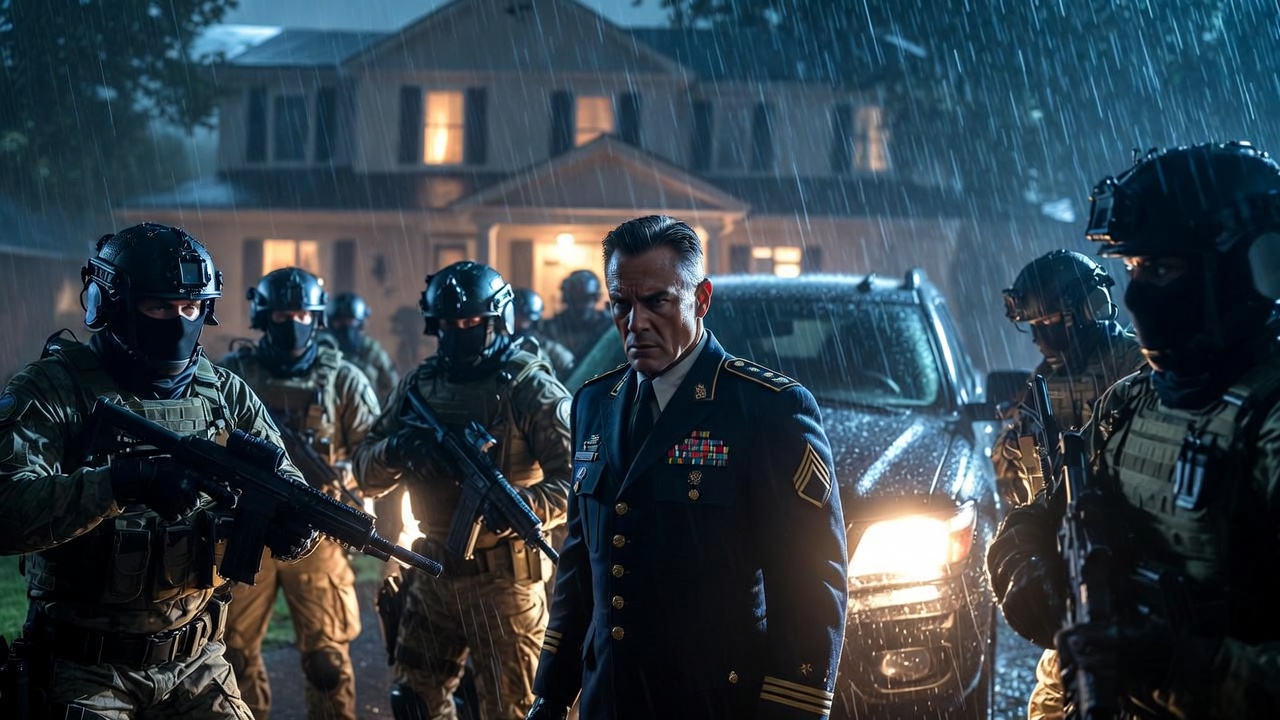
It wasn’t the tremors. It was the roar of heavy-duty diesel engines. Three black trucks pulled onto the curb, blocking the driveway like a tactical wall.
The mocking stopped the moment a massive hand gripped Sarah’s wrist, stopping her from throwing my Silver Star into the fire.
I looked up. Miller. My old Sergeant. A man who looked like he’d been carved out of the very mountains we’d fought in.
He leaned into Sarah’s face, his voice a deep, gravelly whisper that froze the air in her lungs.
“You just started a war you can’t win,” he said.
Chapter 1: The Ash of My Life
The suburban dream is supposed to be quiet. It’s supposed to be about lawnmowers, lemonade, and the soft hum of sprinklers. But for me, it had become a theater of psychological warfare.
I am Elias Vance. I spent twelve years in the Army, earning more medals than I have functioning nerves in my legs. When I came home, I thought I was bringing the war with me in my head, but I didn’t realize the real battle was waiting for me in the kitchen.
Sarah had been the “perfect” military wife—on social media. She posted about her ‘warrior husband’ and the ‘sacrifice of the spouse.’ But behind closed doors, she hated the man I had become. She hated the silence. She hated the way I woke up screaming at 3:00 AM, searching for a rifle that wasn’t there.
“It’s just trash, Elias!” she yelled, kicking the burning boots. “Like you! You’re just taking up space in a house I paid for with my sanity!”
I watched the smoke rise. That smoke carried the scent of my youth. Those boots had seen the dust of Marjah. They had carried me through the worst days of my life. And now, they were being used as entertainment for her lover.
Mark Higgins was a “financial advisor.” He was everything I wasn’t. He was smooth, unscarred, and had a smile that looked like it belonged on a billboard. He’d moved into my house two weeks after I returned from the long-term recovery wing. They didn’t even try to hide it.
“Go ahead, Sarah,” Mark urged, tossing a handful of my old unit patches into the flames. “Clean the slate. He’s never going to be the man in those photos again. He’s just a medical bill with a pulse.”
I felt a tear slip down my face, hot and shameful. I was a Sergeant. I was a leader. But here, on the hot asphalt of my own driveway, I was nothing. I reached out, trying to grab a patch—the 101st Airborne “Screaming Eagle”—but Mark stepped on my hand.
He didn’t press hard. He didn’t have to. The humiliation was heavy enough.
“Stay down, hero,” Mark whispered, leaning over me. “The grown-ups are talking.”
I looked at Sarah. I expected a flicker of regret. A moment of “What have I done?” But her eyes were cold. She looked at me with the same disgust someone might look at a stain on the carpet.
That was when the roar started.
It was a sound I knew in my marrow. The sound of heavy-duty engines, synchronized and powerful. Three black RAM 3500s pulled up, their tires screeching as they jumped the curb to block the exit.
Miller stepped out of the lead truck. He was wearing a faded “Veteran” cap and a look that would have stopped a tank. Behind him came Coop, our old medic, and Ghost, the man who could hit a target from a mile away and never blink.
Miller didn’t run. He walked. He had that heavy, deliberate gait of a man who knew exactly how the next five minutes were going to play out.
He reached Sarah just as she was about to throw my graduation photo from Ranger School into the fire. His hand clamped around her wrist like a steel trap.
The silence that followed was absolute. Even the fire seemed to hiss in fear.
“You’ve had your fun,” Miller said, his voice a low, vibrating growl. “Now, you’re going to step away from the Sergeant. And you’re going to do it before I decide to treat this like a hostile engagement.”
Sarah gasped, her face turning a sickly shade of white. Mark stepped forward, trying to maintain his “alpha” persona. “Hey, who do you think you—”
Miller didn’t even look at him. He just shifted his weight, and Mark stopped talking. Ghost was already behind Mark, standing so close that Mark could probably feel the coldness radiating off the man.
“Elias,” Miller said, finally looking down at me. His eyes softened for a fraction of a second. “Sorry we’re late. The perimeter was further out than we thought.”
“Miller…” I choked out.
“Don’t talk yet, El,” Coop said, kneeling beside me with a professional grace. He started checking my vitals, ignoring the fire and the screaming woman. “We’ve got the situation under control. The Army’s here.”
FULL STORY
Chapter 2: The Perimeter is Set
The neighborhood had never seen anything like it. Within ten minutes, the driveway was no longer a suburban waste; it was a secured zone. Miller had mobilized the “Wolfpack,” a group of us who had served together and stayed in touch through the dark years.
Sarah was hysterical, screaming about “private property” and “assault.” Mark was trying to call the police, but Ghost had a way of standing that made Mark’s hands shake so hard he kept dropping his phone.
“This is my house!” Sarah shrieked. “Get these animals out of my yard!”
Miller turned to her. He was holding the Silver Star he’d kicked out of the embers. He wiped the soot off with his thumb. “Actually, Sarah, we checked the deed this morning. This house was bought with a VA loan under Elias’s name. The trust is in his name. You’re a guest. And your guest?” He looked at Mark. “He’s an intruder.”
“I have rights!” Mark barked, though his voice was an octave higher than it had been five minutes ago.
“You have the right to leave,” Ghost whispered, appearing at Mark’s shoulder. “In approximately sixty seconds, Miller is going to stop being ‘polite.’ I’d suggest you be gone by forty-five.”
Mark didn’t wait. He looked at Sarah, looked at the wall of veterans, and realized that his expensive polo shirt offered zero protection against men who had survived IEDs. He bolted for his car, leaving Sarah standing alone by the dying fire.
“Mark! Mark, come back!” she screamed, but he was already peeling out, his tires leaving black marks on the street.
I was sitting on a folding chair now, wrapped in a blanket Coop had brought from the truck. My tremors had subsided, replaced by a strange, cold clarity.
“You okay, El?” Miller asked, kneeling in front of me.
“I thought I lost everything, Miller,” I said, looking at the charred remains of my gear.
“You lost some leather and some paper,” Miller said firmly. “But look around you. Did you lose us?”
I looked at the men standing in my driveway. Men I hadn’t seen in years. Men who had their own scars, their own nightmares. They were standing there like a human shield between me and the woman who had tried to break me.
“No,” I whispered. “I didn’t lose you.”
“Then you didn’t lose anything that matters,” Miller said. He turned to the crowd of neighbors who were still watching. “The show is over! Go back to your lives! There’s nothing to see here but a brother coming home!”
The neighbors dispersed, but Sarah didn’t move. She was looking at me with a mix of fury and genuine shock. She had spent months convincing me I was alone. She’d convinced me that the “Army family” was a myth and that nobody cared about a broken soldier.
“You think this changes anything?” she spat. “They’ll leave, Elias. They always leave. And then you’ll be back here, in the dark, with your shaking hands and your ghosts. And I won’t be here to help you.”
“You weren’t helping me, Sarah,” I said, my voice finally steady. “You were feeding the ghosts.”
Miller stepped toward her. “The bags are packed, Sarah. We took the liberty of moving your things to the porch while you were busy with your little bonfire. You have ten minutes to clear out before we change the locks. Coop has the legal injunction ready.”
“You can’t do this!”
“Watch us,” Ghost said, pulling a set of new deadbolts from a bag.
As Sarah began to realize that the power had shifted, the weight of her betrayal seemed to settle on her shoulders. She looked at the house, then at the wall of men, and finally at me. For the first time, she saw me not as a burden, but as a man who still had an army behind him.
FULL STORY
Chapter 3: The Reconstruction of a Man
The first night in the house without Sarah was the quietest I had ever known. But it wasn’t the “empty” quiet I was used to. Miller and the guys didn’t just leave after Sarah drove away. They stayed.
Coop took over the kitchen, making a meal that didn’t come out of a microwave. Ghost was in the garage, systematically fixing the door that Sarah had let fall into disrepair. Miller sat with me on the back porch, a silent sentinel in the dark.
“I didn’t think I deserved this,” I said, looking at the stars. “I thought… maybe she was right. Maybe I am just a ghost.”
Miller leaned back, his chair creaking. “We all feel like that sometimes, El. The civilian world? It isn’t built for us. It’s built for the Marks of the world. People who think sacrifice is waiting ten minutes for a latte. But that doesn’t mean you’re a ghost. It just means you’re in the wrong frequency.”
“How did you guys know?” I asked. “I hadn’t called. I hadn’t messaged.”
“You didn’t have to,” Miller said. “Ghost seen your post on the unit’s private page—the one where you mentioned the ‘cleanup’ Sarah was doing. He noticed the tone. Then he did a little digital recon. Found out about Mark. Found out about the VA appointments you were missing because she wouldn’t drive you.”
I felt a surge of shame. “I was embarrassed, Miller. A Sergeant First Class… being bullied by his wife.”
“The most dangerous ambushes always happen in the places you think you’re safe,” Miller said. “There’s no shame in being hit. There’s only shame in staying down when your brothers are holding out a hand.”
Over the next week, the house transformed. It wasn’t just about cleaning up the ash in the driveway. It was about reclaiming the space. They helped me set up a proper home office. They installed grab bars in the shower that didn’t look like hospital equipment. They treated the house like a base—functional, secure, and ours.
But the real work was inside me.
Coop, being the medic, didn’t just check my heart rate. He checked my head. “You’ve been off your meds because she told you they made you ‘dull,’ didn’t she?”
I nodded. “She said she missed the ‘old me.’ The one who was fun.”
“The old you didn’t have a building fall on him, Elias,” Coop said gently. “The new you needs a different kind of fuel. We’re going to the VA tomorrow. Together. Not as a patient and a driver, but as a unit.”
For the first time in a year, I slept through the night. No screaming. No searching for the rifle. Because I knew, in the rooms around me, there were men who were keeping watch.
However, the war wasn’t over.
On Thursday, a lawyer arrived. Not Sarah’s lawyer, but a man named Henderson, a veteran himself. He had a folder thick with documents.
“We’ve got the financial records, Elias,” Henderson said. “It turns out Sarah wasn’t just seeing Mark. They were siphoning off your disability back-pay into a joint account in the Cayman Islands. They were planning to leave you with a foreclosed house and an empty bank account by Christmas.”
The betrayal went deeper than I thought. It wasn’t just emotional; it was a cold, calculated execution of my future.
“What do we do?” I asked.
“We do what we were trained to do,” Miller said from the doorway. “We counter-attack.”
FULL STORY
Chapter 4: The Counter-Attack
The legal battle was fast and brutal. Sarah and Mark had underestimated the “Wolfpack.” They thought they were dealing with a broken veteran, not a legal team backed by the resources of a national veteran’s advocacy group that Miller had reached out to.
The “Cayman account” was frozen within forty-eight hours. The Ring camera footage from the neighbor’s house—the one that recorded Sarah burning my gear and Mark assaulting me—was handed over to the police.
Mark Higgins was arrested at his office on charges of assault and financial fraud. Sarah was served with an eviction notice and a restraining order.
But the climax came when we had to go to the courthouse for the final hearing.
I was terrified. My hands were shaking so hard I had to sit on them. The courtroom felt like an interrogation room.
Sarah was there, sitting with a cheap lawyer. She looked different. The “suburban princess” mask had slipped. She looked desperate.
When it was my turn to speak, I couldn’t find my voice. I looked at the judge, then at Sarah. She gave me a look of pure venom, a look that whispered, You’re nothing without me.
I felt the familiar spiral of panic. The air felt thin. The walls were closing in.
Then, I heard a sound.
The back doors of the courtroom opened. One by one, men in suits and veterans’ jackets walked in. Miller. Coop. Ghost. And twenty others. They didn’t say a word. They just sat in the gallery, filling the seats until there was no room left.
A wall of brotherhood.
I looked back at the judge. My hands stopped shaking.
“Your Honor,” I said, my voice clear for the first time in years. “My name is Sergeant First Class Elias Vance. For twelve years, I served my country. And for the last year, I’ve been a prisoner in my own home. My wife didn’t just burn my boots; she tried to burn my dignity. She tried to convince me that my service made me a burden.”
I looked directly at Sarah.
“But I realized something this week. I’m not a burden. I’m a soldier who got wounded. And a soldier’s story doesn’t end when the fire goes out. It ends when he decides he’s done fighting. And I am nowhere near done.”
The judge looked at the gallery of veterans, then at the evidence of the fraud. The decision was swift. The house was returned to my sole ownership. The stolen funds were ordered to be returned. And Sarah was given a suspended sentence with mandatory community service—at a veterans’ shelter.
As we walked out of the courthouse, the sun was shining. It was the same kind of day as the one when she’d burned my boots, but the air smelled different. It smelled like rain and fresh beginnings.
Sarah was standing on the steps, her lawyer whispering frantically to her. She saw us—the whole unit—walking toward her.
“You think you won?” she hissed as I passed. “You’re still broken, Elias. You’re still a cripple.”
Miller stepped in front of her. He didn’t say a word. He just handed her a small, charred piece of leather—the tongue of one of my boots that had survived the fire.
“Keep it,” Miller said. “As a reminder. You tried to burn a man, but you only ended up making the metal stronger.”
She watched us walk away, a solid block of men, moving in formation toward the parking lot. She was alone on those steps, her “consultant” in jail and her life in ruins.
She had tried to start a war she couldn’t win. And she had lost everything in the process.
FULL STORY
Chapter 5: The New Perimeter
A month later, the driveway was clean. The scorch marks had been power-washed away, and the flower beds were full of new life.
But it wasn’t just my house anymore.
Miller and I had started a project. We called it “The Rally Point.” We turned the extra bedrooms and the basement into a temporary transition space for guys coming out of the VA who didn’t have a place to go.
It wasn’t a charity. It was a unit.
Coop was the medical liaison. Ghost handled the security and job placement. I was the coordinator.
I was standing in the kitchen, making coffee for a young Corporal who had arrived the night before. He was sitting at the table, his hands shaking just like mine used to.
“It gets better, kid,” I said, sliding the mug over to him.
“How do you know?” he asked, his voice barely a whisper.
I pointed to the mantle. Sitting there, cleaned and polished, was my Silver Star. And next to it, a new pair of combat boots.
“Because I was where you are,” I said. “I was on the pavement, watching my life go up in smoke. I thought the fire was the end. But it was just the forge.”
Miller walked in, carrying a box of supplies. “We’ve got two more guys coming in from North Carolina tonight, El. You got room?”
“We’ll make room,” I said.
I looked out the window. A group of the guys were in the driveway, playing a game of touch football. Neighbors were no longer watching from behind curtains. Mrs. Gable from next door was walking over with a tray of cookies, laughing at something Ghost had said.
The “Wolfpack” hadn’t just saved my house; they had saved the neighborhood. They had brought a sense of purpose and community to a street that had forgotten how to look out for one another.
That evening, as the sun began to set, Miller and I sat on the porch.
“You doing okay, Sergeant?” Miller asked.
“I’m doing good, Miller,” I said. “The tremors… they’re almost gone. I haven’t had a nightmare in three weeks.”
“That’s because you’re busy taking care of other people’s nightmares,” Miller said. “Best therapy in the world.”
I looked at the driveway. In the twilight, I could almost see the ghost of the fire. But it didn’t hurt anymore. It was just a mark on the map. A place where we had turned the tide.
“She called yesterday,” I said quietly.
Miller stiffened. “Sarah?”
“Yeah. She’s working at the shelter in the city. She wanted to apologize. Said she didn’t realize how far she’d gone.”
“What did you say?”
“I didn’t say anything,” I said. “I just listened. Then I told her I hoped she found whatever it was she was looking for in Mark. And then I hung up.”
“Good man,” Miller said. “Closure is a hell of a drug.”
We sat in silence for a while, listening to the sounds of the men in the house. The laughter, the clinking of dishes, the low hum of conversation.
“You know,” Miller said, “when I saw her burning those boots, I was going to hit her. My hand was already in a fist.”
“What stopped you?”
“I saw your eyes, Elias. You weren’t looking at the fire. You were looking at the trucks. You were waiting for us. And I realized that if I hit her, I’d be no better than the trash she was with. But if I just stood there and showed her who you really were… that was a much bigger victory.”
I smiled. “Thanks for not hitting her, Miller. I think the ‘war’ we won was much better this way.”
FULL STORY
Chapter 6: The Unbroken Circle
A year later, the Rally Point had grown into a full-fledged non-profit. We had bought the house next door, too. It was the premier veteran-support community in the state.
I was no longer the man on the walker. I was walking with a cane now, my gait steady and purposeful. I was a guest speaker at the VA, telling my story to rows of men and women who were struggling to find their way home.
But my favorite place was still my own driveway.
Every year, on the anniversary of the “Incineration,” we held a BBQ. We didn’t burn boots. We burned old grudges. We invited the whole neighborhood.
I was standing by the grill—a massive, professional-grade unit the guys had bought me—when a car I didn’t recognize pulled up.
A woman stepped out. She was young, maybe twenty-five. She looked nervous.
“Is this the Rally Point?” she asked.
“It is,” I said, wiping my hands on my apron. “I’m Elias. How can I help you?”
“My husband… he’s coming home tomorrow. From a deployment in Syria. He’s… he’s different, Elias. He’s angry. He’s scared. I don’t know how to talk to him. I don’t want to be the woman who gives up.”
I looked at her, and I saw a version of Sarah that could have been. A woman who was scared, who was at the end of her rope, but who was still reaching out.
“Come sit down,” I said, gesturing to the porch. “I’ll tell you a story. It starts with a fire and a pair of boots. But it ends with a family.”
Miller walked over, sensing the moment. He sat down on the other side of her.
“It’s going to be hard,” Miller told her, his voice still like gravel but infused with a strange gentleness. “But you’re not doing it alone. You’ve got the whole unit behind you now.”
As the evening wore on, the driveway filled with people. The Wolfpack was there in force. The neighbors were there. The air was filled with the smell of woodsmoke and hope.
I looked around at the life I had built from the ashes. I looked at Miller, Coop, and Ghost—the men who had refused to let me become a ghost.
I realized then that the fire hadn’t destroyed my life. It had cleared the ground. It had burned away the illusions and the lies, leaving only the truth. And the truth was that as long as there is one brother standing, no soldier is ever truly defeated.
I reached into my pocket and felt the small, charred piece of leather I still carried. It was a reminder of where I’d been. But as I looked at the young woman talking to Miller, I knew where I was going.
I was going to keep the perimeter. I was going to guard the door. And I was going to make sure that no one else ever had to watch their honor turn to ash.
The final sunset of the year painted the sky in shades of purple and gold. I stood at the head of the table, raised my glass, and looked at the family I had found in the fire.
“To the Rally Point,” I said. “And to the brothers who never let the flame go out.”
The roar of “Hooah!” that followed was the most beautiful sound I’d ever heard.
I was no longer a burden. I was a lighthouse. And the war was finally, truly, over.
A soldier’s greatest strength isn’t his weapon—it’s the brother standing to his left.