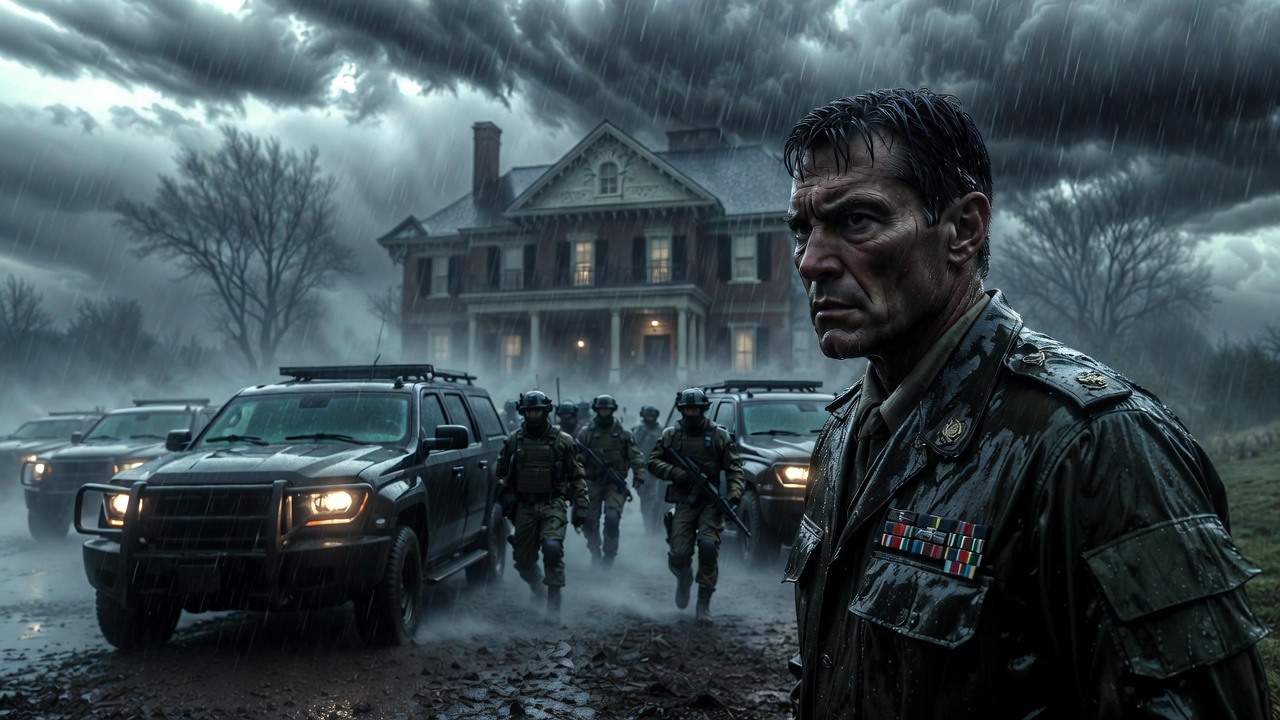
I walked toward the backyard, the gravel crunching under my boots. The house was glowing, every light on, a “Welcome Home” banner draped mockingly over the fence. But the party wasn’t for me.
I rounded the corner and stopped dead.
There he was. Mark. The guy Sarah told me was “just a coworker who helped with the lawn.” He was standing on our picnic table, holding a beer high. But it wasn’t his clothes he was wearing. He was stuffed into my Army Dress Blues. My jacket. The one I bled in. The one that held the medals I earned while he was probably scrolling through dating apps in his air-conditioned office.
He had my Garrison cap on backward. He’d pinned my Silver Star to his chest upside down.
“And then,” Mark shouted, slurring his words while the crowd of “friends” roared, “the ‘Hero’ says we have to secure the perimeter! I’m a hero, Sarah! Give your hero a kiss!”
Sarah didn’t just laugh. She leaned in, adjusted the collar of my uniform on his neck, and kissed him deeply. “You look way better in it than he ever did,” she whispered, loud enough for the front row to hear.
My heart didn’t break. It turned into a cold, heavy stone. I felt the weight of the shadow behind me before I saw them. My phone had been buzzing in my pocket for twenty minutes—a group chat of the men I’d served with, the local VFW chapter I’d joined months ago. They weren’t just my friends; they were my brothers. And they had seen the “Live” story Sarah had been posting on Instagram.
The low, guttural growl of twenty Harley Davidsons began to vibrate the ground. The party-goers stopped. The music died. Sarah looked toward the side gate, her smile faltering.
I finally stepped into the light. “Party’s over, Sarah,” I said, my voice as flat as a grave.
Mark froze on the table. He looked down at me, then at the leather-clad giants beginning to file into the yard behind me. These weren’t suburban dads. These were men who lived by a code he couldn’t even spell.
The silence that followed the roar of the engines was heavier than the noise itself. My brothers from the “Iron Remnants” MC didn’t say a word at first. They just formed a semi-circle around the picnic table, twenty men in black leather vests, their faces etched with the kind of grim resolve you only see in people who have stared death in the eyes.
Big Mike, the president of the chapter and a man who had lost half an ear in Fallujah, stepped up beside me. He didn’t look at the crowd. He looked at Mark, who was currently trembling so hard the beer in his hand was sloshing over the sleeve of my dress blue jacket.
“That’s a fine jacket, son,” Mike said, his voice a low, terrifying rumble. “Do you know what it takes to earn those stripes?”
Mark tried to find his bravado. He looked at Sarah for support, but Sarah was busy looking at me. Her face had gone through three shades of pale in ten seconds. “Elias,” she stammered, stepping toward me. “It’s… it’s just a joke. We were just having a little fun. You weren’t supposed to be home until Friday.”
“Clearly,” I said. I looked around the yard. These were people I’d hosted. People I’d grilled for. Neighbors I’d helped during the winter. They were all looking at their shoes now. They knew. They’d watched this affair blossom while I was finishing my final tour. They’d watched a man mock a sacrifice they weren’t brave enough to make.
“Take it off,” I said, looking up at Mark.
Mark swallowed hard. “Hey, man, look, I’ll pay for the dry cleaning. It’s just a costume—”
In a flash, Big Mike had a handful of Mark’s collar. He didn’t pull him down; he just held him there, looming over him. “A costume? This man buried three friends in a suit just like that. This isn’t a costume. This is a shroud for the men who didn’t come back.”
“Elias, tell them to stop!” Sarah screamed, grabbing my arm. “You’re embarrassing me in front of our friends! It’s my house too!”
I looked down at her hand on my arm. The wedding ring I’d spent six months of combat pay on was still on her finger. It felt like a lie. I gently reached down, unhooked her fingers, and dropped my arm. “It’s not your house anymore, Sarah. I checked the deed while I was at the gate. My VA loan, my name. You have until tomorrow morning to find a place that likes ‘jokes’ as much as you do.”
The crowd began to disperse. People were literally climbing over the side fence to get away from the radiating heat of the situation.
“The jacket,” I repeated.
Mark began to fumble with the buttons, his fingers shaking so badly he couldn’t undo them. One of the younger vets, a kid named Jax, stepped up and literally ripped the jacket open, buttons popping and flying into the grass like tiny brass bullets.
“You don’t deserve to touch the brass,” Jax spat.
They stripped the jacket off him right there on the table. Mark was left standing in a stained undershirt and his jeans, looking small and pathetic. But it wasn’t over. As the jacket came off, my Silver Star fell into the dirt.
Sarah reached for it, maybe out of some twisted sense of “helping,” but I stepped on it first. I felt the sharp metal under my boot.
“You want to know why I got that medal, Sarah?” I asked, looking her in the eye. “I got it for carrying a man three miles through a valley while being shot at. I thought I was coming home to someone worth that struggle. I was wrong.”
I picked up the medal. It was bent. Just like my life.
The next four hours were a blur of cold efficiency. The “friends” were gone. The music was replaced by the sound of Sarah’s frantic packing. The bikers stayed. They didn’t have to, but they sat on my porch, drinking water and talking in low tones, a silent wall of protection between me and the wreckage of my marriage.
I sat at the kitchen table, the Dress Blue jacket draped over the chair next to me. I was cleaning the dirt off the Silver Star with a dishcloth. My hands weren’t shaking, which surprised me. I felt a strange, hollowed-out clarity.
Sarah walked into the kitchen, dragging a suitcase. Her eyes were red, but she wasn’t crying out of sadness. It was anger. The “how dare you treat me this way” anger of someone who had never been held accountable.
“You really called your little biker gang to intimidate me?” she hissed, throwing a pile of shoes into a box. “That’s low, Elias. Even for a ‘hero.'”
“I didn’t call them,” I said, not looking up. “They saw your Instagram. They care more about my honor than the woman who promised to protect it.”
“Honor?” She laughed, a harsh, jagged sound. “You were gone, Elias! For years! You think a few Skype calls and a paycheck make a marriage? Mark was here. Mark listened. Mark didn’t have ‘episodes’ in the middle of the night where he’d wake up screaming and sweating.”
That hit me. The PTSD. The nights I’d spent on the bathroom floor because the sound of a car backfiring sounded like an IED. I thought she was sleeping through those. I thought I was protecting her from it.
“I tried to get help,” I whispered.
“Well, it wasn’t enough!” she shouted. “I wanted a life, not a project! And yeah, we laughed at the uniform. Because that’s all you are now. You’re not Elias anymore. You’re just ‘The Soldier.’ You’re boring, and you’re broken.”
I looked up then. “If I’m so broken, why are you still wearing the ring?”
She looked at her hand, then back at me. She twisted the diamond off her finger and flung it at me. It bounced off my chest and rolled under the stove. “Keep it. Buy yourself some more medals.”
She stormed out, the front door slamming so hard the windows rattled. I heard her car peel out of the driveway, followed by the mocking silence of an empty house.
Big Mike walked in a moment later. He didn’t say anything. He just put a heavy hand on my shoulder and squeezed.
“She’s wrong, you know,” Mike said.
“Is she?” I asked. “I feel pretty broken, Mike.”
“We’re all broken, brother. That’s how the light gets in. But you’re not boring. And you’re definitely not alone.”
He pointed to the backyard. Through the window, I saw the guys. They weren’t just sitting there. Jax was picking up the trash from the party. Another guy was fixing the fence gate Sarah had clipped with her car.
“We’re staying the night,” Mike said. “In the morning, we’re gonna help you clear out the rest of her junk. And then, we’re going for a ride.”
Morning came with the smell of scorched earth and cheap coffee. Sarah had left half her life behind—clothes she didn’t want, the “live, laugh, love” signs that felt like a mockery now, and a wedding album with the glass shattered.
By 9:00 AM, the guys had a bonfire going in the backyard fire pit. Not out of malice, but out of necessity. We weren’t burning her clothes; we were burning the remnants of a life that was built on a lie. The “Welcome Home” banner went in first.
I was in the garage, sorting through boxes, when a silver Lexus pulled into the driveway. It was Mark.
He didn’t get out of the car at first. He sat there, looking at the five large men standing on my lawn. But curiosity, or maybe stupidity, got the better of him. He cracked the window.
“I just want my watch!” he yelled. “I left it on the nightstand!”
I walked down the driveway, my boots heavy on the pavement. I had the watch in my hand. It was a flashy, expensive thing—something a man wears when he wants people to think he’s important.
I stopped at his window. He flinched, pulling back into the leather seat.
“You really came back here?” I asked.
“Look, man, Sarah’s with me now. We’re moving into an apartment in the city. Just give me the watch and we’re even.”
I looked at the watch, then at him. “You wore my uniform to feel like a man, Mark. But a man doesn’t hide in a car. A man doesn’t build a relationship on the back of another man’s absence.”
I dropped the watch into the dirt next to his tire. “There’s your watch. And since you love the Army so much, I have a gift for you.”
I handed him a manila envelope.
“What’s this?” he asked, suspicious.
“Information for the local recruiter. They’re looking for ‘heroes.’ Since you look so good in the blues, I figured you’d want to earn a pair of your own. Though, I don’t think you’d last through the first haircut.”
Mark looked at the envelope, then at me. He didn’t have a comeback. He threw the car into reverse, ran over his own watch with a sickening crunch, and sped away.
I stood there, watching the dust settle. I felt a hand on my shoulder. It was Jax.
“He’s not worth the breath, Elias,” the kid said. “Come on. The bikes are warmed up.”
We spent the day riding through the hills. The wind in my face did something the therapy never could. It blew away the scent of Sarah’s perfume. It blew away the sound of her laughter mocking my service. For the first time in years, I wasn’t a soldier, and I wasn’t a husband. I was just a man, moving forward.
But when we got back to the house that evening, there was a package on my doorstep. No return address. Just my name written in a neat, familiar hand.
It wasn’t from Sarah.
I took the package inside and sat at the kitchen table. My hands, usually steady, had a slight tremor as I pulled the tape away. Inside was a small wooden box and a letter.
Dear Elias,
I saw the news on social media. People in this town talk, and they’ve been talking about what happened at your house. I’m so sorry. Nobody deserves to have their sacrifice turned into a punchline.
My father was in the 101st with your grandfather. He always said that a uniform is just fabric, but the man inside it is steel. Don’t let a woman who doesn’t know the value of steel break you.
I found this in my father’s things. I think it belongs with your collection.
— Clara (from the hardware store)
I opened the wooden box. Inside was an old, weathered brass compass from the Korean War era. On the back, it was engraved: For when you lose your way.
Clara. I remembered her. She worked at the local hardware store where I’d gone a dozen times to buy supplies for the “home improvement” projects Sarah always demanded. Clara was quiet, with eyes that seemed to see right through my “I’m fine” mask. She’d always given me a veteran’s discount without me asking. She’d always asked how I was really doing.
I looked at the compass, then at the empty house. It wasn’t empty, I realized. The ghosts of Sarah’s betrayal were being replaced by the quiet support of people I’d barely noticed.
The next few weeks were a transformation. I repainted the rooms. I sold the furniture we’d picked out together. I started attending the VFW meetings not just for the camaraderie, but to lead. I started a program for younger vets returning home, helping them navigate the world that felt too fast and too loud.
I was becoming a different kind of hero. Not the one on the battlefield, but the one who survives the peace.
But the final test came on a rainy Tuesday. I was at the hardware store, looking for a new deadbolt—a final bit of security for my new life.
“Find what you’re looking for, Elias?”
I turned. Clara was standing there, her hair pulled back, a smudge of charcoal on her cheek. She wasn’t laughing. She was just looking at me with a steady, honest warmth.
“I think so,” I said. “And thank you for the compass. It helped me find north.”
“Good,” she said, leaning against the counter. “Because the south was getting pretty toxic.”
We talked for an hour. Not about the war. Not about Sarah. Just about the town, the rain, and the future. But the peace was shattered when the front door of the store flew open.
It was Sarah. She looked haggard. Her expensive highlights were growing out, and the “city life” clearly wasn’t agreeing with her.
“Elias!” she cried, ignoring Clara. “The bank called. They’re freezing the joint account. You can’t do that! I have bills! Mark’s job didn’t pan out and—”
She stopped when she saw Clara. She looked at me, then at the way I was standing next to her.
“Oh,” Sarah said, her voice dripping with the old poison. “Already replaced me with the help? Fast work, ‘Hero.'”
I didn’t feel the surge of anger I expected. I didn’t feel the need to defend myself or Clara. I just felt… pity.
“Sarah,” I said, my voice calm and steady. “I didn’t freeze the account to hurt you. I froze it because it’s my money. The money I earned while you were ‘having fun.’ You wanted a life without a project? Well, this is it. You’re on your own.”
“You owe me!” she screamed, her face contorting. “I waited for you! I dealt with your nightmares!”
“No,” I said, stepping toward her. “You didn’t deal with them. You mocked them. You let another man put on the symbols of my sacrifice while you cheered. You didn’t wait for me, Sarah. You just waited for the paycheck to arrive.”
I pulled a small envelope from my pocket. It was the final divorce papers. I’d been carrying them, waiting for the right moment.
“Sign these. Now. Or we can go to court and I can have Big Mike and nineteen other witnesses testify about the ‘joke’ you played with federal property and my military honors. I don’t think a judge will find it as funny as you did.”
Sarah looked at the papers, then at the crowded store. People were watching. The “friends” who had cheered for Mark were nowhere to be found. She was alone.
She snatched the pen from the counter, scribbled her name with a shaking hand, and threw the folder at my chest. “Fine! Enjoy your boring, broken life in this dead-end town!”
She turned and ran out into the rain. I watched her go, and for the first time in years, the weight on my chest—the one I thought was caused by the war—was gone. It had been her all along.
I turned back to Clara. She was watching me, her expression unreadable.
“You okay?” she asked softly.
“I’m better than okay,” I said. I looked at the deadbolt in my hand. “I don’t think I need this anymore. I’m not trying to keep the world out. I’m just moving into a new house.”
“It’s a good house, Elias,” she said, smiling.
I walked out of the store into the rain. It didn’t feel cold. It felt like a cleansing. I walked to my truck, where my brothers were waiting. They didn’t ask what happened. They saw the folder in my hand.
We rode back to my place, the engines roaring in a symphony of brotherhood. I walked into my home—my real home—and hung my Dress Blue jacket in the hallway. It was clean now. The buttons were replaced. The Silver Star was polished and straight.
I looked at the uniform. It was just fabric, like Clara said. But it represented a man who had survived the worst the world could throw at him, only to find that the greatest victory wasn’t on a map, but in the mirror.
I sat down at my table, opened the compass Clara gave me, and smiled.
The war was over, and finally, I was home.